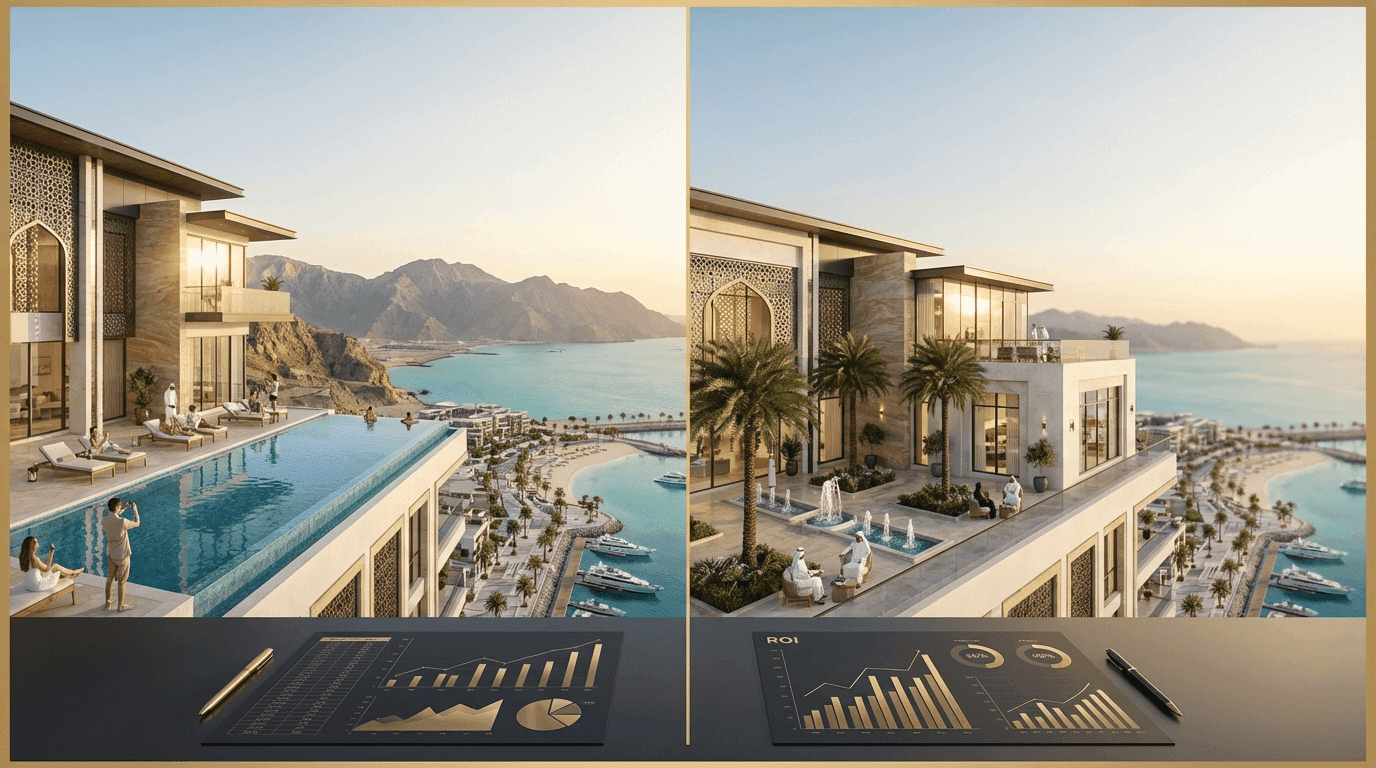
Holiday Rental vs Annual Lease in RAK: Complete Profitability Analysis for Property Investors
Discover which RAK rental strategy maximises returns. Expert analysis comparing holiday rentals versus annual leases with real profitability data, costs, and ROI calculations.
Table Of Contents
- Understanding RAK's Rental Market Landscape
- Holiday Rentals in RAK: Revenue Potential and Realities
- Annual Leasing in RAK: Stability and Predictability
- Profitability Comparison: The Numbers That Matter
- Regulatory Considerations and Licensing
- Which Strategy Suits Your Investment Goals?
- Maximising Returns: Hybrid Approaches and Strategic Timing
- Final Verdict: Making the Right Choice for Your RAK Investment
Ras Al Khaimah has emerged as one of the UAE's most compelling property investment destinations, offering exceptional value propositions that attract both international buyers and strategic investors. As the emirate continues its transformation into a premium tourism and residential hub, property owners face a critical decision: should they pursue the potentially lucrative holiday rental market or opt for the stability of annual leasing?
This question isn't merely academic—it directly impacts your bottom line, management responsibilities, and long-term investment strategy. Whilst holiday rentals promise attractive nightly rates and capitalise on RAK's growing tourism sector, annual leases offer predictable income streams and significantly reduced operational demands. The right choice depends on numerous factors, from property location and type to your risk tolerance and involvement preferences.
In this comprehensive analysis, we'll dissect both strategies with concrete financial examples, examine real-world occupancy patterns, calculate true profitability after all costs, and provide the strategic insights you need to maximise returns on your RAK property investment. Whether you're considering exclusive RAK off-plan projects or evaluating existing properties, understanding these rental dynamics is essential for optimising your investment performance.
Understanding RAK's Rental Market Landscape
Ras Al Khaimah's property market occupies a unique position within the UAE real estate ecosystem. The emirate has strategically positioned itself as an affordable yet premium alternative to Dubai and Abu Dhabi, attracting a diverse demographic of residents and tourists who appreciate natural beauty, cultural authenticity, and exceptional value.
The rental market reflects this positioning. RAK appeals to long-term tenants seeking quality accommodation at competitive rates—particularly young professionals, families, and employees of the emirate's expanding industrial and hospitality sectors. Simultaneously, the tourism sector has experienced remarkable growth, with visitor numbers increasing substantially as RAK develops its offerings around mountain adventures, beach resorts, and cultural experiences.
This dual appeal creates genuine opportunities for both rental strategies, but success requires understanding the distinct characteristics of each market segment. Holiday rental guests typically seek proximity to tourist attractions—beachfront locations, mountain resorts, or developments with exceptional amenities. Annual tenants prioritise practical considerations: proximity to employment hubs, school accessibility, and community facilities.
Property type significantly influences which strategy proves more profitable. Luxury waterfront apartments and villa communities with resort-style amenities naturally command premium holiday rental rates, whilst family-oriented developments in established residential areas often perform better as annual leases. Understanding these market dynamics before committing to a rental strategy represents the foundation of profitable property investment.
Holiday Rentals in RAK: Revenue Potential and Realities
Holiday rentals in Ras Al Khaimah offer the allure of substantial nightly rates that, when calculated across a full year, appear to dwarf annual rental income. However, the reality requires examining actual occupancy rates, seasonal variations, and the comprehensive cost structure that accompanies short-term letting.
Peak Season Performance
RAK's peak tourism season typically extends from October through April, when pleasant weather conditions attract both international tourists and domestic visitors escaping the summer heat. During these months, well-positioned holiday rentals can achieve remarkable occupancy rates of 70-85%, with nightly rates that substantially exceed the daily equivalent of annual rent.
A waterfront one-bedroom apartment in a premium development might command AED 400-600 per night during peak season, whilst two-bedroom properties with superior amenities can reach AED 700-1,000 nightly. Luxury villas with private pools and beach access regularly achieve AED 1,500-3,000 per night during this period. These figures represent the aspirational ceiling that attracts investors to the holiday rental model.
However, peak season performance alone doesn't determine annual profitability. The critical question becomes: can you maintain sufficient occupancy during shoulder and low seasons to offset the higher operational costs and vacancy periods inherent in holiday letting?
Occupancy Rates Throughout the Year
The reality of RAK holiday rentals involves significant seasonal fluctuation. Whilst peak season delivers strong performance, the summer months (May through September) present considerable challenges. Occupancy rates typically decline to 30-45% during this period, with nightly rates dropping 40-60% to attract the limited tourist traffic.
Annual average occupancy rates for well-managed RAK holiday rentals typically range between 55-65%, though premium properties in exceptional locations with professional management can achieve 65-75%. These figures incorporate peak season success, shoulder season variability, and summer challenges.
Several factors influence occupancy performance:
- Location proximity to attractions: Properties near Jebel Jais, premium beach clubs, or resort areas consistently outperform those in residential zones
- Property quality and amenities: Modern furnishings, hotel-standard facilities, and unique features command higher rates and occupancy
- Marketing effectiveness: Properties listed across multiple platforms with professional photography and dynamic pricing achieve superior results
- Guest reviews and ratings: Exceptional hospitality and property condition create momentum through positive feedback
- Competitive pricing strategy: Algorithmic pricing tools that respond to demand fluctuations optimise revenue
Understanding these occupancy realities is essential for accurate profitability projections. Optimistic assumptions about year-round high occupancy frequently lead to disappointing actual returns.
Operating Costs and Management Requirements
Holiday rentals involve substantially higher operational costs than annual leases, significantly impacting net profitability. Investors must account for numerous ongoing expenses:
Licensing and regulatory compliance: RAK requires holiday rental operators to obtain proper licensing from tourism authorities, with associated fees and compliance requirements. Registration costs and annual renewals typically range from AED 2,000-5,000 depending on property type and classification.
Professional management fees: Unless you're prepared for intensive personal involvement, professional management becomes essential. Management companies typically charge 20-30% of gross rental income, handling bookings, guest communications, check-ins, and operational coordination.
Cleaning and turnover costs: Each guest departure requires thorough cleaning and preparation for the next arrival. Depending on property size, cleaning costs range from AED 150-400 per turnover. With average stays of 3-5 nights, these expenses accumulate rapidly.
Linen and consumables: Hotel-quality linens, towels, toiletries, and kitchen essentials require regular replacement and replenishment, typically costing AED 3,000-8,000 annually depending on property size and guest volume.
Utilities: Unlike annual leases where tenants typically cover utilities, holiday rental operators bear these costs. With air conditioning essential year-round and intensive usage during guest stays, monthly utility bills can reach AED 800-1,500 for apartments and AED 1,500-3,000 for villas.
Maintenance and wear: Significantly higher than annual leases due to frequent guest turnover, furniture and fixture replacement, and the need to maintain pristine condition. Annual maintenance costs typically represent 8-12% of gross revenue.
Platform commissions: Listing platforms like Airbnb and Booking.com charge 3-5% host fees, whilst guest-paid fees partially offset this expense.
Insurance: Comprehensive short-term rental insurance covering guest liability and property damage costs AED 2,000-5,000 annually, substantially exceeding standard landlord insurance.
These operational realities mean that gross revenue figures dramatically overstate actual profitability. Investors must calculate net returns after accounting for all expenses to make informed comparisons with annual leasing.
Annual Leasing in RAK: Stability and Predictability
Annual leasing represents the traditional landlord approach, offering fundamentally different characteristics from holiday rentals. Whilst potentially delivering lower gross revenue, the combination of predictability, reduced management burden, and lower operational costs creates an attractive proposition for many investors.
Rental Yields for Long-Term Tenancies
RAK's annual rental market offers competitive yields by UAE standards, particularly for properties in established residential communities and areas with strong tenant demand. Current market conditions deliver the following approximate annual rental ranges:
One-bedroom apartments: AED 25,000-40,000 annually depending on location, development quality, and amenities. Properties in premium waterfront developments command the higher end of this range, whilst apartments in standard residential buildings occupy the lower tier.
Two-bedroom apartments: AED 35,000-65,000 annually, with significant variation based on development prestige, views, and facilities. Family-oriented developments with schools nearby and community amenities achieve consistent demand.
Three-bedroom apartments: AED 50,000-85,000 annually, appealing primarily to families seeking spacious accommodation at more affordable rates than Dubai or Abu Dhabi equivalents.
Townhouses and villas: AED 60,000-150,000+ annually depending on size, location, and exclusivity. Premium villa communities with beach access, golf course proximity, or mountain views command premium rates.
These rental rates translate to gross yields typically ranging from 6-8% for well-positioned properties, comparing favourably with Dubai's 4-6% average yields. However, the critical advantage lies not merely in the yield percentage but in the certainty and simplicity of receiving this income.
Operational Simplicity and Reduced Overheads
Annual leasing dramatically reduces the operational complexity and ongoing costs associated with property ownership. Once a suitable tenant is secured—typically through a property management agency for a one-time fee of 5% of annual rent—the landlord's involvement becomes minimal.
Tenants assume responsibility for utilities, reducing the landlord's ongoing expenses to:
- Service charges: Building maintenance fees paid to developers or homeowner associations, typically AED 8-15 per square foot annually
- Basic maintenance: Addressing structural issues or major appliance failures, averaging 2-3% of annual rent for well-maintained properties
- Management fees (optional): Some landlords engage property managers for ongoing tenant relations and maintenance coordination, typically 5-8% of annual rent
- Insurance: Basic landlord insurance covering building structure and liability, costing AED 800-1,500 annually
The absence of frequent turnovers, constant guest communications, and intensive cleaning requirements represents a substantial advantage for investors seeking passive income. Annual leasing truly delivers a "set and forget" investment approach after the initial tenant placement.
Tenant Quality and Property Maintenance
Well-screened annual tenants typically treat properties with greater care than short-term holiday guests, resulting in reduced wear and longer intervals between refurbishment requirements. A quality tenant occupying a property for 2-3 years creates stability that benefits both cash flow predictability and property condition.
RAK's tenant market includes substantial numbers of stable, long-term residents—professionals employed by established companies, families committed to the emirate's lifestyle, and retirees attracted by the quality of life. This demographic profile supports consistent demand for quality rental properties and reduces vacancy risk compared to more transient markets.
However, annual leasing isn't without challenges. Tenant defaults, although relatively rare in RAK, can create cash flow disruptions and legal complications. The RERA-regulated eviction process, whilst fair, can be time-consuming if disputes arise. Additionally, once a lease is signed, rental rates remain fixed for the tenancy period regardless of market improvements, potentially limiting income growth in rapidly appreciating markets.
Profitability Comparison: The Numbers That Matter
Theoretical advantages mean little without concrete financial analysis. Let's examine realistic profitability scenarios for both strategies across different property types, using current RAK market conditions and comprehensive cost accounting.
One-Bedroom Apartment Analysis
Consider a modern one-bedroom apartment in a waterfront development, purchased at AED 500,000 (a realistic price point for quality properties in RAK's premium developments).
Holiday Rental Scenario:
- Peak season nightly rate (Oct-Apr): AED 450
- Low season nightly rate (May-Sep): AED 250
- Annual average occupancy: 60%
- Gross annual revenue: (AED 450 × 180 days × 0.75 occupancy) + (AED 250 × 185 days × 0.45 occupancy) = AED 81,563
- Management fees (25%): -AED 20,391
- Cleaning (73 turnovers × AED 200): -AED 14,600
- Utilities: -AED 10,800
- Linen and consumables: -AED 4,000
- Maintenance (10% gross): -AED 8,156
- Platform fees (4% gross): -AED 3,263
- Licensing and insurance: -AED 3,500
- Net annual income: AED 16,853
- Net yield: 3.37%
Annual Lease Scenario:
- Annual rent: AED 32,000
- Service charges: -AED 4,000
- Management fee (5%): -AED 1,600
- Basic maintenance (2%): -AED 640
- Insurance: -AED 1,000
- Net annual income: AED 24,760
- Net yield: 4.95%
Verdict: For standard one-bedroom apartments, annual leasing delivers superior net returns with dramatically reduced effort and risk.
Two-Bedroom Apartment Analysis
Consider a premium two-bedroom apartment with superior amenities and sea views, purchased at AED 900,000.
Holiday Rental Scenario:
- Peak season nightly rate: AED 750
- Low season nightly rate: AED 400
- Annual average occupancy: 65% (better performance due to premium positioning)
- Gross annual revenue: (AED 750 × 180 days × 0.80 occupancy) + (AED 400 × 185 days × 0.50 occupancy) = AED 145,000
- Management fees (25%): -AED 36,250
- Cleaning (79 turnovers × AED 250): -AED 19,750
- Utilities: -AED 13,200
- Linen and consumables: -AED 6,000
- Maintenance (10% gross): -AED 14,500
- Platform fees (4% gross): -AED 5,800
- Licensing and insurance: -AED 4,000
- Net annual income: AED 45,500
- Net yield: 5.06%
Annual Lease Scenario:
- Annual rent: AED 55,000
- Service charges: -AED 7,200
- Management fee (5%): -AED 2,750
- Basic maintenance (2%): -AED 1,100
- Insurance: -AED 1,200
- Net annual income: AED 42,750
- Net yield: 4.75%
Verdict: Premium two-bedroom properties with strong tourist appeal can deliver marginally better returns through holiday rentals, but only with excellent occupancy management and positioning. The additional income (approximately AED 2,750 annually) may not justify the substantially increased management burden for many investors.
Luxury Villa Comparison
Consider a luxury four-bedroom villa with private pool in an exclusive community, purchased at AED 2,500,000.
Holiday Rental Scenario:
- Peak season nightly rate: AED 2,000
- Low season nightly rate: AED 1,000
- Annual average occupancy: 55% (luxury market more selective)
- Gross annual revenue: (AED 2,000 × 180 days × 0.70 occupancy) + (AED 1,000 × 185 days × 0.40 occupancy) = AED 326,000
- Management fees (25%): -AED 81,500
- Cleaning (60 turnovers × AED 400): -AED 24,000
- Utilities: -AED 28,000
- Linen and consumables: -AED 12,000
- Pool and garden maintenance: -AED 18,000
- Property maintenance (12% gross): -AED 39,120
- Platform fees (4% gross): -AED 13,040
- Licensing and insurance: -AED 6,000
- Net annual income: AED 104,340
- Net yield: 4.17%
Annual Lease Scenario:
- Annual rent: AED 130,000
- Service charges: -AED 18,000
- Pool and garden maintenance: -AED 15,000
- Management fee (7%): -AED 9,100
- Basic maintenance (3%): -AED 3,900
- Insurance: -AED 2,000
- Net annual income: AED 82,000
- Net yield: 3.28%
Verdict: Luxury villas represent the category where holiday rentals demonstrate clearest financial advantage, delivering approximately AED 22,000 additional annual income. However, this requires accepting significantly higher operational complexity and the risk of occupancy shortfalls during economic downturns or seasonal variations.
Regulatory Considerations and Licensing
RAK's regulatory framework for holiday rentals continues to evolve as the emirate develops its tourism infrastructure. Property owners considering short-term letting must navigate specific licensing requirements administered by Ras Al Khaimah Tourism Development Authority (RAKTDA).
Holiday home operators must obtain a holiday home trading licence, which requires:
- Property ownership documentation or landlord permission for leased properties
- Compliance with safety and furnishing standards
- Civil defence approval confirming fire safety compliance
- Payment of applicable licensing fees
Failure to obtain proper licensing exposes operators to financial penalties and legal consequences. Additionally, homeowner associations in some developments explicitly prohibit short-term rentals through community bylaws, making annual leasing the only viable option regardless of profitability considerations.
Annual leasing involves simpler regulatory compliance—standard tenancy contracts registered through RERA (Real Estate Regulatory Agency) systems, with well-established procedures familiar to property management professionals throughout the UAE.
Investors should verify specific regulatory requirements and community restrictions before committing to either rental strategy, as these legal frameworks can fundamentally determine which approach is permissible for particular properties.
Which Strategy Suits Your Investment Goals?
The profitability analysis reveals that neither strategy universally outperforms the other—the optimal choice depends on your specific circumstances, property characteristics, and investment objectives.
Holiday rentals make sense when:
- You own premium properties in tourist-centric locations with genuine holiday appeal
- You're prepared for active management or can afford professional services
- You value flexibility to use the property personally during low seasons
- You possess marketing skills or engage specialists who can optimise occupancy
- You can weather seasonal income fluctuations and occasional vacancy periods
- Your property type (luxury villa, beachfront apartment) commands substantial holiday premiums
Annual leasing makes sense when:
- You prioritise passive income and minimal ongoing involvement
- Your property is located in residential areas without specific tourist appeal
- You value income predictability and simplified financial planning
- You prefer lower operational costs and reduced management complexity
- You lack the time or inclination for intensive property management
- You want to avoid regulatory complexity and licensing requirements
Many successful investors in RAK's property market have discovered that portfolio diversification—holding some properties for holiday rentals and others for annual leasing—provides an optimal balance of income stability and upside potential.
Maximising Returns: Hybrid Approaches and Strategic Timing
Sophisticated investors increasingly employ hybrid strategies that capture benefits from both approaches whilst mitigating their respective disadvantages. Several tactical variations deserve consideration:
Seasonal hybrid approach: Operate as a holiday rental during peak tourism season (October-April) when nightly rates justify the operational costs, then secure a six-month annual tenant for the summer period. This strategy requires careful contract structuring but can optimise revenue whilst reducing summer vacancy risk.
Corporate accommodation: Target medium-term corporate tenants (1-3 months) who pay premium rates for furnished accommodation without requiring the intensive turnover of traditional holiday rentals. This niche often delivers the highest returns with moderate management requirements.
Strategic transitions: Begin with annual leasing to establish stable cash flow, then transition to holiday rentals once you've developed market knowledge, management capabilities, and financial reserves to weather the transition period.
The key insight is that rental strategy need not remain fixed permanently. As your circumstances evolve, market conditions shift, or property characteristics change, adapting your approach can optimise long-term returns.
Final Verdict: Making the Right Choice for Your RAK Investment
The profitability analysis demonstrates that for most property types in Ras Al Khaimah, annual leasing delivers superior risk-adjusted returns when accounting for all costs, management requirements, and occupancy realities. The apparent revenue advantages of holiday rentals often evaporate when comprehensive expense accounting reveals the true net position.
However, specific property types—particularly luxury villas and premium waterfront apartments in tourist-focused developments—can generate meaningful additional income through holiday rentals for investors willing to accept higher complexity and hands-on involvement.
The critical mistake is making decisions based on gross revenue projections without rigorous analysis of actual occupancy rates, comprehensive cost structures, and honest assessment of management capabilities. Many investors have discovered that holiday rental reality disappoints initial projections, whilst annual leasing consistently delivers its promised stability.
For investors seeking to capitalise on RAK's exceptional growth potential, the rental strategy decision represents just one component of a comprehensive investment approach. Property selection—location, development quality, and future appreciation potential—ultimately matters more than rental strategy optimisation.
Whether you're evaluating exclusive off-plan opportunities or existing properties, understanding these profitability dynamics enables informed decisions that align rental strategy with your broader investment objectives, risk tolerance, and involvement preferences. The right choice isn't the strategy that generates the highest theoretical returns—it's the approach that delivers optimal results within your specific circumstances whilst supporting your long-term wealth creation goals in RAK's dynamic property market.
Choosing between holiday rentals and annual leasing in Ras Al Khaimah ultimately depends on a nuanced assessment of your property's characteristics, your management capacity, and your investment philosophy. Whilst holiday rentals offer the allure of premium nightly rates and personal usage flexibility, the reality of operational costs, occupancy fluctuations, and management intensity often diminishes their financial advantage.
Annual leasing delivers consistent, predictable returns with minimal ongoing involvement—an approach that aligns perfectly with investors seeking truly passive income from their RAK property holdings. For most investors and property types, this stability and simplicity justify accepting potentially modest reductions in gross revenue.
However, owners of premium properties in exceptional locations with genuine tourist appeal can realise meaningful additional income through professionally managed holiday rentals, provided they approach the strategy with realistic expectations and comprehensive cost accounting.
The most successful investors recognise that rental strategy represents a tactical decision within a broader investment framework. Property selection, market timing, and long-term capital appreciation potential matter far more than optimising rental income alone. By focusing on high-quality properties in RAK's most promising developments, you create the foundation for exceptional returns regardless of which rental approach you ultimately pursue.
Ready to Explore RAK's Premium Investment Opportunities?
Whether you're drawn to the stability of annual leasing or the potential of holiday rentals, success begins with selecting the right property in the right location. Azimira Real Estate specialises in identifying exceptional RAK investment opportunities that deliver strong performance across both rental strategies.
Our exclusive access to pre-launch and off-market properties, combined with deep market insights and tailored investment guidance, ensures you secure premium assets positioned for outstanding capital growth and rental returns.
Contact our investment specialists today to discover how we can help you build a profitable RAK property portfolio aligned with your investment goals and rental strategy preferences.
Related articles
What Counts as Good Real Estate Investments in 2026
Learn what makes good real estate investments in 2026, from net yield and demand signals to legal checks, exit plans and UAE opportunities.

Investors Needed for Real Estate? Start With This Plan
Investors needed for real estate? Use this practical plan to define strategy, numbers, due diligence and partners before raising capital.
Investment Marketing Tactics Developers Use at Launch
Understand investment marketing tactics developers use at launch, from scarcity to incentives, and learn how to assess UAE off-plan deals.