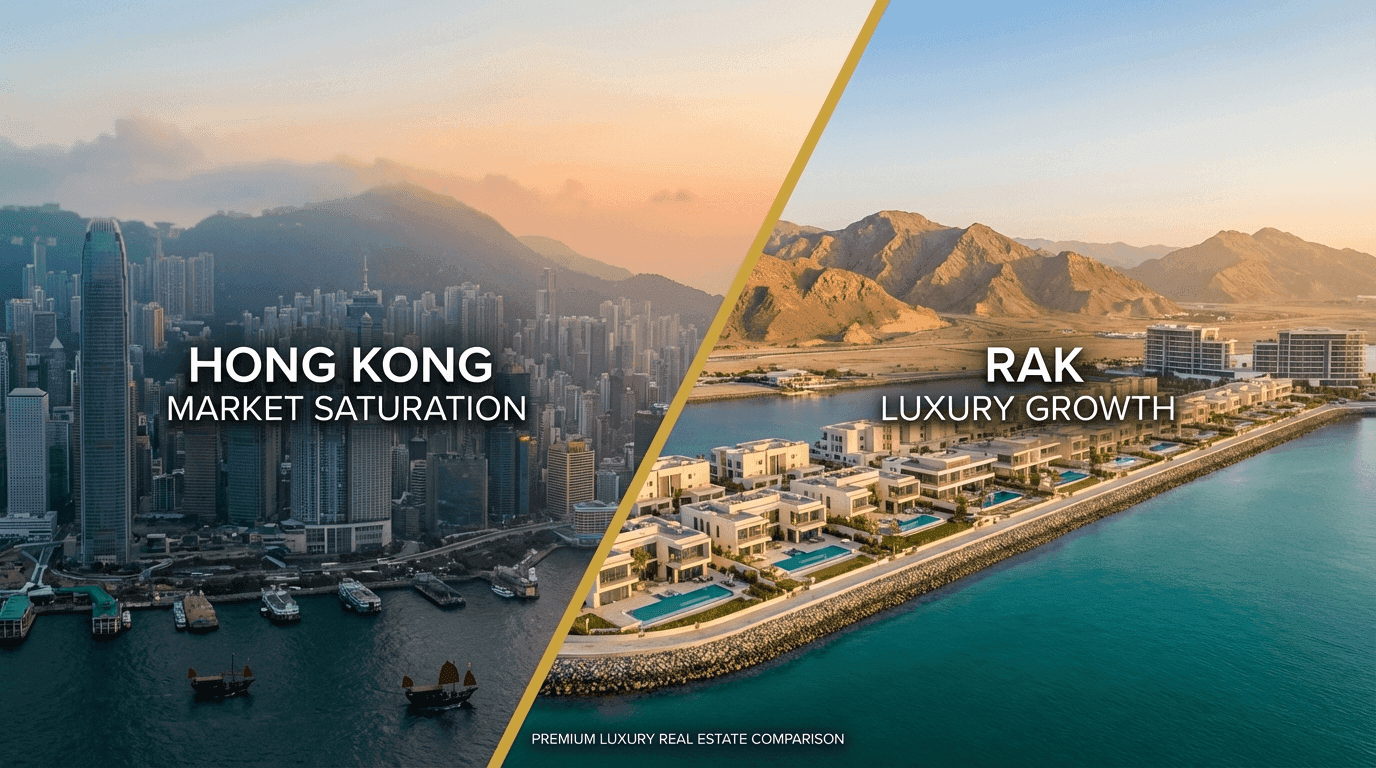
Hong Kong vs RAK Property: Complete Rental Yield Comparison for Investors
Discover how RAK property rental yields compare to Hong Kong's saturated market. Expert analysis of returns, regulations, and growth potential for discerning investors.
Table Of Contents
- Understanding Rental Yields in Global Property Markets
- Hong Kong Property Market Overview
- Ras Al Khaimah Property Market Overview
- Direct Rental Yield Comparison: Hong Kong vs RAK
- Beyond the Numbers: Total Return Analysis
- Market Stability and Risk Assessment
- Which Market Suits Your Investment Strategy?
- Maximising Returns in RAK Property Investment
The global property investment landscape has shifted dramatically over recent years, with traditional strongholds facing mounting challenges whilst emerging markets present compelling new opportunities. For investors accustomed to Hong Kong's reputation as Asia's financial powerhouse, the property market has long represented stability—albeit at a premium price point. Yet as 2026 unfolds, discerning investors are increasingly questioning whether Hong Kong's diminishing rental yields justify the substantial capital requirements and regulatory complexities.
Meanwhile, Ras Al Khaimah has emerged as one of the UAE's most promising property investment destinations, offering a fundamentally different value proposition. With rental yields that significantly outperform established markets, investor-friendly regulations, and infrastructure development accelerating at pace, RAK presents an opportunity that warrants serious consideration for those seeking exceptional returns rather than merely prestigious addresses.
This comprehensive comparison examines the rental yield dynamics of both markets, analysing not only the headline percentages but the regulatory frameworks, capital appreciation potential, hidden costs, and practical realities that ultimately determine investment success. Whether you're diversifying an existing portfolio or seeking your first international property investment, understanding these two contrasting markets will prove essential to making an informed decision.
Hong Kong vs RAK Property
The Rental Yield Showdown for Savvy Investors
Hong Kong
Ras Al Khaimah
Annual Income on $1M Investment
Why RAK Outperforms
Superior Returns
3-4x higher net rental yields with strong capital appreciation potential of 5-8% annually
Lower Entry Barriers
Enter from $150k-$300k vs $900k+ in Hong Kong, enabling portfolio diversification
Investor-Friendly Laws
100% freehold ownership, no income tax, minimal transaction costs of just 4-6%
Total Return Potential
Ready to Explore RAK Opportunities?
Discover exclusive off-plan properties and pre-launch developments with privileged investor access
Schedule Your ConsultationUnderstanding Rental Yields in Global Property Markets
Rental yield represents the annual rental income as a percentage of the property's purchase price or current market value. Whilst the calculation appears straightforward—annual rent divided by property value, multiplied by 100—the true picture requires examining gross yields alongside net yields, which account for maintenance costs, property management fees, insurance, and vacancy periods.
For international investors, rental yield serves as a crucial metric for comparing opportunities across different markets and currencies. However, experienced investors recognise that yield alone tells an incomplete story. A 3% yield in a mature, stable market with strong capital appreciation may ultimately deliver superior total returns compared to an 8% yield in a market with stagnant property values or concerning economic fundamentals.
The divergence between Hong Kong and RAK rental yields reflects not merely different numbers, but fundamentally different market stages, regulatory environments, and growth trajectories. Hong Kong represents a mature, densely populated market where supply constraints have driven prices to levels that compress yields despite premium rental rates. RAK, conversely, exemplifies an emerging market where strategic government investment, infrastructure development, and competitive pricing create conditions for both strong yields and capital growth—a combination increasingly rare in global property markets.
Hong Kong Property Market Overview
Hong Kong's property market has long epitomised the challenges facing investors in land-scarce, highly developed financial centres. With a population exceeding 7.5 million compressed into approximately 1,100 square kilometres—much of which remains undevelopable mountainous terrain—the city consistently ranks amongst the world's least affordable property markets.
The market's trajectory over recent years has been shaped by multiple headwinds: economic uncertainties, demographic shifts, emigration trends, and regulatory interventions designed to cool speculative activity. Whilst Hong Kong property once represented a virtually guaranteed appreciation vehicle, the landscape has become considerably more nuanced.
Current Rental Yield Landscape in Hong Kong
Hong Kong's rental yields have compressed significantly over the past decade as property prices escalated faster than rental rates. As of early 2026, gross rental yields for residential properties typically range between 2% and 3% across most districts, with premium locations in Central, Mid-Levels, and The Peak often delivering yields below 2%.
Mass market residential properties in districts such as Sha Tin, Tuen Mun, and Yuen Long may achieve slightly higher yields of 3% to 3.5%, yet these locations lack the prestige and liquidity of core Hong Kong Island properties. The city's infamous "nano flats"—units measuring less than 200 square feet—can occasionally deliver yields approaching 4%, though these appeal to a limited tenant demographic and present liquidity challenges upon eventual sale.
Net yields paint an even more sobering picture. After accounting for rates, management fees, maintenance costs, and the inevitable vacancy periods in an increasingly competitive rental market, net yields frequently fall into the 1.5% to 2.5% range. For international investors, currency considerations and the costs of remote property management further erode returns.
Regulatory Environment and Ownership Restrictions
Hong Kong's government has implemented progressively stringent measures to cool property speculation and improve affordability for local residents. The Special Stamp Duty (SSD) imposes substantial penalties on properties sold within three years of purchase, with rates ranging from 10% to 20% depending on the holding period. This effectively locks investors into medium-term commitments regardless of market conditions.
The Buyer's Stamp Duty (BSD) levies an additional 15% tax on non-permanent residents purchasing residential property, creating a significant upfront cost that must be recouped through rental income or capital appreciation. For a HKD 10 million property—a modest sum in Hong Kong's market—this represents an immediate HKD 1.5 million cost beyond the purchase price.
Ad Valorem Stamp Duty (AVD) applies at progressive rates up to 4.25% for properties exceeding HKD 21.74 million, whilst the doubled ad valorem stamp duty rate of 15% applies to most residential transactions unless the purchaser is a permanent resident buying their only residential property.
These regulatory costs, combined with legal fees, agency commissions, and other transaction expenses, mean investors typically face total acquisition costs of 20% to 25% beyond the property price itself—a substantial hurdle that directly impacts overall investment returns.
Ras Al Khaimah Property Market Overview
Ras Al Khaimah represents a fundamentally different investment proposition. As the UAE's northernmost emirate, RAK has historically operated somewhat in the shadow of Dubai and Abu Dhabi. However, strategic government initiatives, substantial infrastructure investment, and a deliberate focus on creating investor-friendly conditions have transformed RAK into one of the region's most compelling property markets.
The emirate offers diverse geography spanning pristine beaches, rugged mountain landscapes, and developing urban centres. This natural variety, combined with lower living costs than Dubai whilst maintaining proximity to the emirate (approximately 45 minutes' drive), has attracted both residents seeking quality of life and investors recognising exceptional value.
RAK's Emerging Investment Opportunity
RAK's property market operates at a fundamentally different price point than Hong Kong whilst delivering substantially higher rental yields. Quality apartments in desirable developments typically achieve gross rental yields between 7% and 10%, with certain off-plan and newly completed properties occasionally exceeding these levels.
The market benefits from multiple demand drivers: expatriate professionals working in Dubai but residing in RAK for affordability; tourism sector growth supporting short-term rental demand; and increasing recognition amongst UAE residents that RAK offers exceptional value. The emirate's population has grown steadily, supported by economic diversification beyond traditional industries into tourism, manufacturing, and business services.
Particularly noteworthy for investors are exclusive RAK off-plan projects that combine competitive entry pricing with strong rental demand upon completion. These developments often incorporate resort-style amenities—infinity pools, gym facilities, landscaped grounds—that command premium rents whilst remaining accessible to middle-income tenants, a demographic segment with substantial depth in the UAE market.
Regulatory Advantages for Foreign Investors
The regulatory environment in RAK stands in stark contrast to Hong Kong's restrictive framework. Foreign investors enjoy 100% freehold ownership in designated areas without the punitive stamp duties that characterise Hong Kong transactions. The UAE imposes no personal income tax, meaning rental income remains entirely with the investor rather than being diminished by taxation.
Transaction costs in RAK typically total just 4% to 6% of the property value, encompassing registration fees (approximately 2.75% in RAK), agency commissions, and conveyancing costs. This represents a fraction of Hong Kong's total acquisition costs, allowing investors to deploy capital more efficiently.
The UAE's Golden Visa programme offers significant additional value for property investors. Those purchasing property valued at AED 2 million or above become eligible for a 10-year residence visa, providing long-term security and the flexibility to reside in the UAE whilst managing investments directly. This programme, verified through official UAE government sources, has proven particularly attractive to international investors seeking both financial returns and lifestyle options.
For those exploring the broader opportunity, investing in RAK property provides access to a market characterised by transparency, efficient legal processes, and investor protections that meet international standards.
Direct Rental Yield Comparison: Hong Kong vs RAK
When examining rental yields in isolation, the contrast between these markets becomes immediately apparent. However, understanding the context behind these numbers proves essential for meaningful comparison.
Yield Percentages and Income Potential
A typical quality apartment in Hong Kong might generate a 2.5% gross rental yield, meaning a HKD 8 million property (approximately USD 1.03 million) would produce annual rental income of HKD 200,000 (approximately USD 25,600). After accounting for management fees, maintenance, insurance, and vacancy periods, net yield might settle around 1.8%, delivering approximately HKD 144,000 (USD 18,400) annually.
The same USD 1.03 million invested in RAK property could acquire a substantially larger portfolio—potentially two or three quality apartments depending on specific selections. A single premium property at this price point might achieve an 8% gross yield, generating approximately USD 82,400 in annual rental income. After deducting service charges, management fees, and maintenance (typically lower in newer developments), net yield might reach 6.5% to 7%, delivering USD 67,000 to 72,000 annually.
This represents nearly four times the net rental income for equivalent capital deployed—a difference that compounds significantly over investment horizons spanning five, ten, or fifteen years. For investors dependent on property income rather than merely capital appreciation, this differential proves transformative.
Entry Costs and Capital Requirements
Hong Kong's property market presents formidable barriers to entry. The minimum viable investment for a property in a desirable location with reasonable liquidity typically exceeds HKD 6 million (USD 770,000), with regulatory costs adding another HKD 1.2 to 1.5 million. An investor therefore requires approximately USD 900,000 to 1 million in deployable capital merely to establish a position.
RAK's market accessibility differs dramatically. Quality apartments in established developments can be acquired from USD 150,000 to 300,000, with transaction costs of just USD 6,000 to 18,000. This allows investors to either enter the market with substantially less capital or to diversify across multiple properties and developments, thereby reducing concentration risk.
Off-plan opportunities present even more compelling entry points, with developers offering flexible payment plans that spread costs across construction periods. Some developments require just 10% to 20% upfront, with the balance paid in instalments aligned with construction milestones. This structure allows investors to control valuable assets whilst preserving capital for additional opportunities.
Beyond the Numbers: Total Return Analysis
Whilst rental yield comparisons reveal substantial differences, sophisticated investors recognise that total return—combining rental income and capital appreciation—ultimately determines investment success.
Capital Appreciation Forecasts
Hong Kong property has historically delivered strong capital appreciation, though recent years have challenged this assumption. The market peaked in 2019 before declining through subsequent years, with 2023 and 2024 showing continued softness. Forecasts for 2026 and beyond remain mixed, with demographic headwinds, emigration trends, and economic restructuring creating uncertainty. Realistic appreciation expectations for the medium term likely range from flat to 3% annually, though specific properties in prime locations may outperform.
RAK's market trajectory appears considerably more promising based on fundamental drivers. Government infrastructure investment continues apace, with the expansion of Al Marjan Island, development of new tourism facilities, and enhancement of transportation links all supporting property values. The emirate's property market remains substantially below peak pricing seen in Dubai, suggesting considerable headroom for appreciation as awareness grows.
Market analysts project RAK property appreciation of 5% to 8% annually over the medium term, with certain developments and locations potentially exceeding these figures. The combination of yield and growth creates total return potential of 12% to 18%—a profile that compares favourably with most global property markets.
Hidden Costs and Tax Implications
Hong Kong's absence of rental income tax represents one advantage for the market, as investors retain gross rental income without tax deductions. However, property rates (a form of local taxation), management fees in premium developments (often 2% to 3% of property value annually), and maintenance reserve requirements all diminish net returns.
RAK similarly imposes no income tax, whilst ongoing costs typically prove more modest. Service charges in quality developments range from AED 8 to 15 per square foot annually (approximately USD 2.20 to 4.10), whilst newer buildings require minimal maintenance expenditure during initial years. The Dubai Electricity and Water Authority (DEWA) charges remain reasonable, and many landlords successfully pass utility costs to tenants through contractual arrangements.
Currency considerations warrant attention for international investors. Hong Kong dollar stability (pegged to USD since 1983) provides certainty for dollar-based investors. The UAE dirham maintains a similar peg to the USD, offering equivalent currency stability for those operating in dollar terms. Investors based in other currencies must consider foreign exchange implications in both markets.
Market Stability and Risk Assessment
No investment analysis proves complete without examining risk factors and market stability considerations.
Hong Kong's geopolitical position has introduced uncertainties that were previously less prominent. The relationship between Hong Kong and mainland China, international perceptions, and demographic shifts all create variables that investors must weigh. The market's maturity provides stability in some respects, yet also limits upside potential and creates sensitivity to broader economic shifts.
RAK benefits from the UAE's political stability, business-friendly governance, and strategic geographic position. The country's diversification away from oil dependency, substantial sovereign wealth, and track record of pragmatic policy-making provide reassurance. Property laws protecting investor rights, transparent registration systems, and efficient dispute resolution mechanisms all contribute to a secure investment environment.
Market liquidity represents another consideration. Hong Kong's established market offers relatively quick exits when required, though transaction costs and stamp duties can be punitive for shorter holding periods. RAK's market, whilst growing rapidly, requires slightly longer timelines for property sales, though quality properties in desirable developments typically find buyers within reasonable periods.
Which Market Suits Your Investment Strategy?
The choice between Hong Kong and RAK property ultimately depends on individual investment objectives, capital availability, risk tolerance, and return expectations.
Hong Kong may suit investors who prioritise absolute stability over returns, possess substantial capital requiring deployment, and maintain particular affinity for the market through business connections or personal familiarity. Those content with modest yields in exchange for perceived security, and those whose investment horizon extends beyond medium-term considerations despite uncertain appreciation prospects, may find Hong Kong appropriate.
RAK presents compelling advantages for investors seeking strong rental income, capital appreciation potential, accessible entry points, and transparent, investor-friendly regulatory frameworks. The market particularly suits those building property portfolios rather than acquiring single trophy assets, investors who value efficiency of capital deployment, and those who recognise that emerging markets often deliver superior returns to those who invest during growth phases rather than after opportunities have been fully priced.
For international investors without particular geographic constraints, the combination of yield, appreciation potential, low taxation, and regulatory accessibility makes RAK's value proposition exceptionally strong in the current market environment.
Maximising Returns in RAK Property Investment
Investors committed to RAK property can enhance returns through several strategic approaches. Focusing on off-plan acquisitions from reputable developers provides access to below-market pricing, flexible payment terms, and the potential for appreciation during construction. Developments offering strong amenities, strategic locations near employment centres or tourist attractions, and quality construction standards tend to outperform.
Diversification across multiple units rather than concentrating capital in a single property reduces vacancy risk whilst capturing opportunities across different price points and tenant demographics. Properties appealing to both long-term residential tenants and short-term holiday rentals provide flexibility to optimise income based on market conditions.
Engaging specialists with deep RAK market knowledge proves invaluable for identifying opportunities before they reach broader market awareness. Access to pre-launch and off-market properties not available to general investors can provide significant advantages in pricing and unit selection.
For investors serious about maximising RAK property returns whilst navigating the market efficiently, partnering with experts who understand both the opportunities and potential pitfalls ensures capital deployment delivers optimal results.
The rental yield comparison between Hong Kong and RAK reveals two markets operating in fundamentally different paradigms. Hong Kong offers the familiarity of an established financial centre with corresponding premium pricing and compressed yields, whilst RAK provides the compelling combination of strong income returns, appreciation potential, and investor-friendly conditions that characterise emerging opportunities before they become mainstream.
For investors prioritising returns over prestige, capital efficiency over market maturity, and growth potential over static stability, RAK's advantages prove substantial and measurable. The market delivers rental yields three to four times higher than Hong Kong, requires dramatically lower entry capital, imposes minimal transaction costs and no taxation, and offers appreciation prospects that Hong Kong struggles to match given its maturity and current headwinds.
The question facing discerning investors isn't whether RAK can compete with Hong Kong—the data demonstrates clear superiority on virtually every financial metric. Rather, the question becomes whether investors recognise the opportunity whilst RAK remains in its growth phase, or whether they will later lament having overlooked exceptional value in pursuit of familiar names.
Property investment success ultimately belongs to those who identify compelling opportunities based on fundamentals rather than reputation, who deploy capital efficiently rather than merely following established patterns, and who act whilst value remains accessible rather than after markets have fully priced in their potential.
Begin Your RAK Property Investment Journey
Discover exclusive off-plan opportunities and pre-launch properties in Ras Al Khaimah's most promising developments. Azimira Real Estate provides discerning investors with privileged access to high-yield opportunities and tailored investment strategies based on deep market expertise.
Schedule a consultation with our RAK property specialists to explore how strategic property investment in the UAE's emerging market can transform your portfolio returns.
Related articles
What Counts as Good Real Estate Investments in 2026
Learn what makes good real estate investments in 2026, from net yield and demand signals to legal checks, exit plans and UAE opportunities.

Investors Needed for Real Estate? Start With This Plan
Investors needed for real estate? Use this practical plan to define strategy, numbers, due diligence and partners before raising capital.

Investment Marketing Tactics Developers Use at Launch
Understand investment marketing tactics developers use at launch, from scarcity to incentives, and learn how to assess UAE off-plan deals.