
How to Read the Dubai Property Index Before You Invest
Learn how to read the Dubai property index, spot misleading signals, and compare price vs rent trends so you can invest with confidence in 2026.
Most investors don’t lose money in Dubai because they chose the “wrong” property, they lose it because they misread the market signal they were relying on.
A Dubai property index can be a powerful tool, but only if you understand what it measures (and what it does not). In this guide, you’ll learn how to interpret Dubai’s price and rent indices, spot misleading conclusions, and translate index trends into a practical investment decision.
What “Dubai property index” actually means (and why that matters)
When people say “property index Dubai”, they can mean several different datasets:
- Price indices: track changes in transaction prices over time (often for residential).
- Rent indices: track rental levels and are sometimes used for rent increase guidance.
- Transaction dashboards: show volumes, values, and sometimes median prices by area.
- Private sector indices: compiled by consultancies and portals, useful for triangulation.
Before you interpret any chart, identify:
- Publisher (government vs private)
- Coverage (residential only, or mixed)
- Methodology (repeat-sales, hedonic, median price, asking vs achieved)
- Update frequency (monthly, quarterly)
For official data and market indicators, start with the Dubai Land Department (DLD) and RERA, which publish market information and tools via their portals and apps.
Step 1: Confirm the index type: price index vs rental index
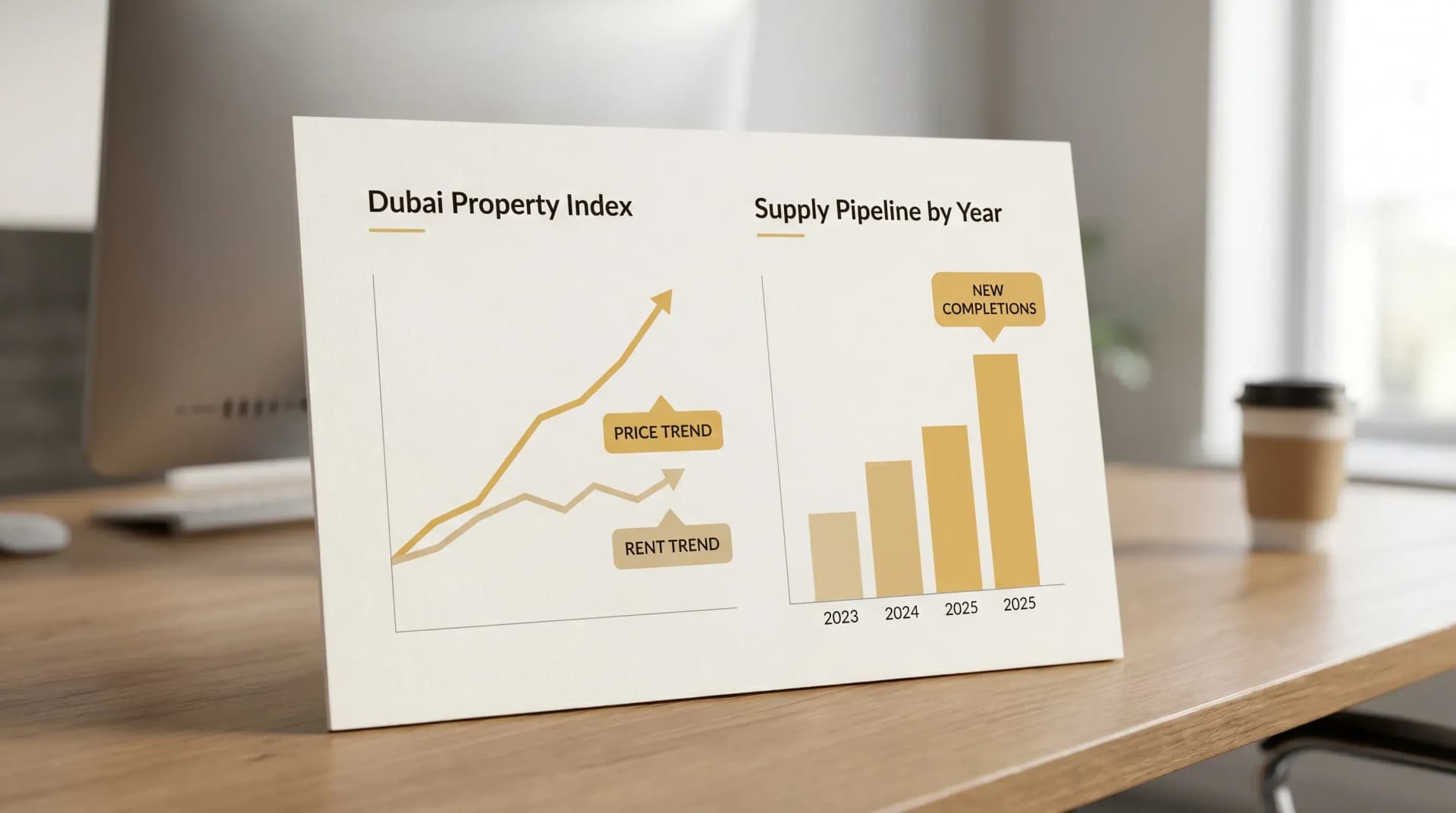
Price growth and rental growth do not always move together. Dubai can see periods where:
- Prices rise faster than rents (yields compress).
- Rents rise faster than prices (yields expand).
- Both rise, but in different neighbourhoods.
A common mistake is to assume that a rising price index automatically means “good buying”. If the rental side is not keeping pace, your net yield may fall even as capital values rise.
Quick interpretation rule
- Price index up + rent index flat: capital growth story, be stricter on entry price and exit liquidity.
- Price index flat + rent index up: income story, focus on tenant demand and renewal risk.
- Both up strongly: momentum market, but pay extra attention to supply pipeline and affordability.
Step 2: Check the time window (short-term noise vs cycle shift)
Property markets can change direction quickly, but indices can also overreact to one-off quarters.
Use at least three lenses:
- 3-month / quarter: momentum and turning points (noisy).
- 12-month: trend you can underwrite in an investment memo.
- 3 to 5 years: cycle context (helps avoid buying late-cycle purely off headlines).
If you are investing off-plan, time window matters even more. Your real exposure is not “today’s index print”, it is handover timing and the resale or rental market at completion.
Step 3: Understand what’s driving the change (mix effect vs true appreciation)
A big index move can happen because:
- The same types of homes got more expensive (true appreciation).
- More high-end units transacted this period (mix effect).
This is why transaction mix and segmentation are essential. If luxury waterfront sales suddenly dominate, the overall index can climb even if mid-market communities are flat.
What to look for alongside the index
- Number of transactions (volume)
- Total value (turnover)
- Breakdown by property type (apartments vs villas)
- Breakdown by geography (area-level performance)
- Off-plan vs ready shares
Official dashboards and reputable market reports often provide these supporting indicators.
Step 4: Segment the index to match your strategy (don’t invest in “Dubai”, invest in a micro-market)
Dubai behaves like multiple markets.
A strategy fit checklist:
- Yield-focused buy-to-let: you care about rent trend, tenant depth, vacancy risk, service charges, and unit efficiency.
- Capital growth: you care about future supply, infrastructure catalysts, brand premium, and resale liquidity.
- End-user / owner-occupier: you care about affordability, school and commute dynamics, and quality-of-life drivers.
- Off-plan value capture: you care about launch pricing, payment plan structure, developer delivery history, and completion cycle risk.
So, when you read the Dubai property index, ask: Is this index tracking the segment I’m actually buying?
To make this practical, use the table below.
| Your investment goal | Index signals that matter most | Supporting data to verify | Typical mistake |
|---|---|---|---|
| Maximise rental income | Rent trend, renewal pressure, tenant demand | New lease vs renewal patterns, vacancy proxies, comparable achieved rents | Using asking rents from portals as “market rent” |
| Maximise capital growth | Price trend, transaction value, premium segment strength | Pipeline and delivery schedule, absorption, resale liquidity | Buying because the citywide index is up |
| Off-plan ROI | Price trend by area and segment, off-plan vs ready dynamics | Developer track record, escrow protections, handover comparables | Underwriting today’s rent for a unit delivering in 2 to 4 years |
| Balanced return | Relationship between price and rent indices (yield compression/expansion) | Net yield model including service charges and fees | Ignoring all-in ownership costs |
Step 5: Translate index moves into yield and affordability (the numbers that actually decide performance)
Indices are percentage moves. Your investment outcome is cash flow and exit value.
A simple way to connect the dots is to track two ratios over time:
- Gross yield trend (annual rent divided by purchase price)
- Affordability trend (price growth vs income growth, plus mortgage rate environment)
If the price index rises much faster than rents, yields compress. That is not automatically bad, but it changes what “a good deal” looks like.
A practical example (illustrative only)
If a unit price rises 15% year-on-year but achievable rent rises 5%, your yield drops unless you bought at a discount or can add value.
This is why sophisticated investors treat the Dubai property index as a screening signal, then underwrite the asset with a proper ROI model.
Step 6: Use the rental index correctly (especially if you are buying a tenanted unit)
Dubai’s rental index tools are often discussed in the context of rent increases, but investors should use them for two broader purposes:
- Reality check: does the current rent sit above or below the area’s typical range?
- Renewal risk: if the rent is materially above market, expect pressure at renewal.
If you are buying a property with an existing tenant, a strong rent index headline can hide a weak situation, for example a tenant already paying top-of-range rent with limited upside.
Step 7: Cross-check the index with supply pipeline (the most ignored risk)
Indices tell you what happened. Supply tells you what could happen next.
Even in a strong market, concentrated deliveries in a single micro-market can soften rents and resale pricing.
Before you invest, ask:
- How many competing units are due to deliver near my handover window?
- Are they similar in size, finish, and positioning?
- Will new stock be owner-occupied, long-let, or short-let oriented?
This is particularly important in off-plan investing where your exit depends on the market at completion.
Step 8: Validate demand using non-index signals (the “real world” checks)
A well-read investor triangulates the Dubai property index with evidence that tenants and buyers are actually active.
Useful non-index checks include:
- Transaction velocity in the building or community (how often comparable units sell)
- Discounting behaviour (do listings require frequent reductions)
- Time-to-let for similar units and quality of tenant enquiries
- Tourism and corporate activity signals for short-stay or mid-term strategies
For industrial and logistics-linked assets, demand can be influenced by how fast businesses are moving goods, storing inventory, and scaling fulfilment. Even operational trends, such as resellers sourcing inventory through bulk pallets for sale, can be a clue that downstream storage and warehouse demand is active in certain markets.
A quick “before you buy” checklist for reading the Dubai property index
Use this as your final filter before you make an offer or reserve an off-plan unit.
| Question | What a strong answer looks like |
|---|---|
| Is the index measuring my segment? | Area and property type match your target asset |
| Are index gains supported by volume? | Prices up with healthy transaction activity |
| Are rents keeping pace with prices? | Yield is stable or compression is justified by quality and scarcity |
| Is supply manageable through my hold period? | No major delivery concentration for close substitutes |
| Do my assumptions rely on asking prices/rents? | Underwriting uses achieved comps and conservative vacancy |
Where Azimira fits if you want a data-led UAE strategy
Dubai indices are useful, but the best investors compare opportunity sets across the UAE. In many portfolios, Dubai provides liquidity and global demand depth, while high-growth emerging markets can offer better entry pricing and upside, depending on timing and asset selection.
Azimira specialises in premium off-plan opportunities in the UAE, with a focus on high-growth markets like Ras Al Khaimah. If you want help interpreting market data, stress-testing returns, and accessing curated projects (including pre-launch opportunities where available), you can explore Azimira’s approach at azimira.com.
Frequently Asked Questions
What is the Dubai property index used for? It’s used to track how property prices or rents are changing over time. Investors use it to gauge market direction, then validate decisions with area-level comps, yields, and supply checks.
Is the property index in Dubai the same as the rental index? No. Price indices track transaction prices, rental indices track rental levels and are often referenced for rent increase guidance. They can move differently.
Can I rely on a citywide Dubai property index to pick an area? Citywide indices are a starting point, but Dubai is a multi-market city. Always validate with community-level performance, transaction volumes, and upcoming supply.
What’s the biggest mistake investors make when reading the Dubai property index? Confusing market momentum with investment quality. A rising index does not guarantee good entry pricing, strong yields, or a low-risk handover window for off-plan deals.
Ready to invest with a clearer signal than headlines?
If you’re using the Dubai property index to time an investment, the next step is turning that signal into a specific, underwritten deal: the right micro-market, the right unit, the right payment structure, and a realistic exit plan.
Azimira can help you compare UAE opportunities, model risk-adjusted returns, and access curated off-plan projects aligned with your goals. Start with a conversation at Azimira.
Related articles
What Counts as Good Real Estate Investments in 2026
Learn what makes good real estate investments in 2026, from net yield and demand signals to legal checks, exit plans and UAE opportunities.

Investors Needed for Real Estate? Start With This Plan
Investors needed for real estate? Use this practical plan to define strategy, numbers, due diligence and partners before raising capital.

Investment Marketing Tactics Developers Use at Launch
Understand investment marketing tactics developers use at launch, from scarcity to incentives, and learn how to assess UAE off-plan deals.