
Investors Needed for Real Estate? Start With This Plan
Investors needed for real estate? Use this practical plan to define strategy, numbers, due diligence and partners before raising capital.
Searching for 'investors needed for real estate' can mean two very different things. You may have a property opportunity and need capital partners, or you may be an investor trying to decide where your capital fits best. In both cases, the wrong first move is the same: rushing into conversations before the plan is clear.
Serious investors rarely fund a vague idea. They fund a defined thesis, credible numbers, clear risk controls and a realistic route to exit. That is especially true in UAE real estate, where off-plan payment plans, freehold rules, currency transfers, developer track records and residency goals can all affect the final return.
Use this plan before you approach investors, join a partnership or commit your own capital.
Why 'investors needed for real estate' is not a strategy
The phrase identifies a funding gap, not an investment case. The real question is not simply who has money. It is which type of capital is right for the deal, what that capital is being paid for and how everyone involved will be protected.
A well-prepared real estate plan answers five questions before anyone sees a property brochure:
- Why this market, and why now?
- Why this specific asset or project?
- How is capital protected if the base case changes?
- How are returns generated, through income, capital growth or both?
- How can investors exit, and under what conditions?
Without these answers, even a promising property can look speculative. With them, you can have a more professional conversation with partners, advisers, lenders and buyers.
Step 1: Define the investor role before discussing returns
Not all real estate investors want the same thing. Some want passive income. Some want capital growth. Some want residency-linked planning. Others want a joint venture where responsibilities, decision rights and profits are shared.
Before you pitch or participate in a deal, define the investor role clearly. If you are raising capital, this prevents you from approaching the wrong people. If you are investing, it helps you avoid deals that do not match your time horizon or risk tolerance.
| Investor role | Best suited to | What they usually care about | Main risk to clarify |
|---|---|---|---|
| Equity partner | Co-buying a property or portfolio | Ownership share, upside, voting rights | Disputes over decisions and exits |
| Private lender | Shorter-term secured funding | Interest, repayment schedule, security | Default, valuation and enforceability |
| Passive investor | Exposure without day-to-day involvement | Reporting, governance, risk controls | Lack of transparency or control |
| Family office or HNW investor | Larger strategic allocations | Capital preservation, tax context, succession | Concentration and liquidity |
| Owner-occupier investor | Lifestyle plus long-term value | Use, location quality, resale appeal | Overpaying for emotional reasons |
If money is being pooled, promoted or managed on behalf of others, get specialist legal and regulatory advice before making any offer. Depending on the structure and jurisdiction, fundraising can trigger securities, fund, licensing or financial promotion rules.
Step 2: Build a market thesis investors can test
A market thesis is more than saying a location is growing. It should explain the specific forces that could support demand, pricing and exit liquidity over your intended holding period.
For UAE property, this means looking beyond headline appreciation. Smart investors assess the emirate, the micro-location, the development stage, the developer, the product type and the likely renter or end buyer. In Ras Al Khaimah, for example, the investment case often centres on tourism growth, infrastructure, resort-led development, premium waterfront supply and value relative to more mature UAE markets. That does not make every project attractive. It simply gives investors a framework for deciding which projects deserve deeper analysis.
A practical thesis has four layers:
- Market thesis: The economic, demographic, tourism or infrastructure drivers supporting demand.
- Project thesis: Why this development is better positioned than comparable projects.
- Unit thesis: Why a particular layout, view, floor level or orientation has pricing power.
- Timing thesis: Why the entry point makes sense now, not just eventually.
For a broader UAE planning framework, see Azimira's guide to building an investment plan in the UAE.
Step 3: Model the numbers in three scenarios
Investors do not need perfect forecasts. They need a model that is honest about assumptions. A credible real estate plan should include a base case, a conservative case and an upside case.
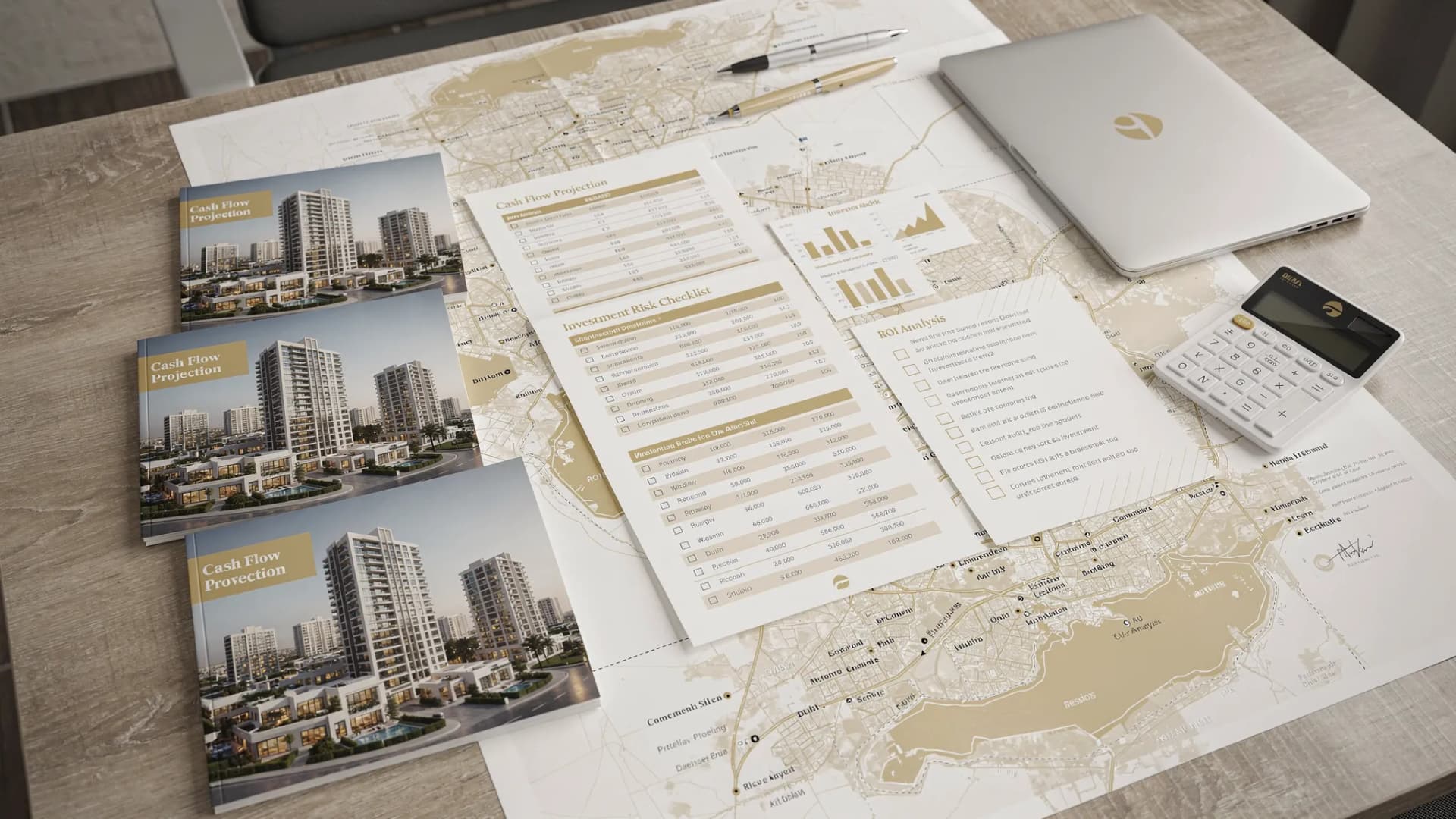
Start with the full cost stack, not just the purchase price. Include reservation fees, registration and transfer costs, agency fees where applicable, service charges, furnishing, insurance, property management, mortgage costs, currency conversion and a cash reserve. For off-plan property, also map staged payments against expected cash availability.
| Metric | Simple formula | Why it matters |
|---|---|---|
| Gross rental yield | Annual rent divided by purchase price | Quick income comparison before costs |
| Net rental yield | Net annual income divided by total investment | Shows real income after operating costs |
| Cash-on-cash return | Annual cash return divided by cash invested | Useful when using debt or staged payments |
| Break-even occupancy | Required occupied days or months to cover costs | Critical for short-stay and holiday rentals |
| IRR | Annualised return across all cash flows | Captures timing, income and exit value |
| Net exit proceeds | Sale price minus selling costs, debt and fees | Shows what investors actually receive |
A common mistake is presenting only the upside case. That weakens trust. A stronger approach is to show what happens if rents are lower than expected, handover is delayed, service charges rise or currency moves against the investor.
If you need a simple starting point, Azimira's 2-minute ROI calculation explains the basic formulas property buyers should understand before moving into deeper modelling.
Step 4: Choose the capital structure before approaching anyone
The capital structure determines who gets paid, when they get paid and what happens if more money is needed. In real estate, a weak capital structure can turn a good asset into a difficult investment.
For UAE off-plan property, capital planning is especially important because payments may be spread across reservation, contract signing, construction milestones and handover. Payment plans vary by developer and project, so investors should assess affordability under the actual schedule rather than relying on generic assumptions.
| Structure | Potential advantage | Key issue to manage |
|---|---|---|
| All-cash purchase | Simpler execution and no financing risk | Higher capital concentration |
| Mortgage plus equity | Can improve capital efficiency | Interest rate, valuation and approval risk |
| Developer payment plan | Spreads cash outlay over time | Handover payment and liquidity planning |
| Joint equity partnership | Larger deal capacity and shared risk | Governance, cash calls and exit terms |
| Portfolio approach | Diversifies across assets or timelines | More reporting and management discipline |
Every plan should include reserve rules. Decide in advance how much cash will be held for service charges, maintenance, vacancies, furnishing, legal costs, currency volatility and unexpected delays. If partners are involved, agree how future cash calls are approved and what happens if one party cannot contribute.
Step 5: Turn due diligence into investor confidence
Due diligence is not a box-ticking exercise. It is how you convert a property from an attractive story into an investment-ready opportunity.
For UAE property, investors should verify ownership eligibility, freehold status, developer credentials, escrow or project registration arrangements, contract terms, payment milestones, service charges, comparable pricing and exit liquidity. The UAE Government portal on property ownership is a useful starting point for understanding the country-level context, while emirate-specific requirements should be checked through the relevant authority and professional advisers.
If residency is part of the strategy, confirm current eligibility rules before purchasing. The official UAE Golden Visa guidance should be reviewed alongside specialist advice, particularly where mortgages, off-plan property or family sponsorship are involved.
A strong due-diligence pack usually covers:
- Developer track record and delivery history.
- Project registration, escrow and legal documentation.
- Sale and Purchase Agreement review by qualified professionals.
- Comparable prices and rents in the immediate micro-market.
- Service charge expectations and operating cost assumptions.
- Exit options, including resale, rental, refinancing or long-term hold.
- Risk register with mitigation actions.
For off-plan buyers, Azimira's guide to 8 checks before committing to UAE off-plan property provides a useful due-diligence framework.
Step 6: Prepare an investor pack, not just a pitch
If investors are needed for real estate, the quality of your preparation matters as much as the asset itself. A glossy presentation can attract attention, but a practical investor pack builds confidence.
The pack should be concise enough to read quickly and detailed enough to support serious diligence. It should not hide the risks. Sophisticated investors expect uncertainty. They simply want to know that it has been identified, quantified and managed.
Include the following core documents:
- One-page investment summary with the objective, asset type, location, capital required and target hold period.
- Market thesis explaining the demand drivers and timing.
- Financial model with conservative, base and upside scenarios.
- Capital structure showing equity, debt, staged payments and reserves.
- Due-diligence checklist with verified documents and outstanding items.
- Governance note covering decisions, reporting, approvals and dispute handling.
- Exit plan with realistic routes and estimated costs.
If you are the investor rather than the sponsor, ask for these materials before making a decision. If they cannot be provided, the opportunity may not be ready for capital.
Step 7: Agree governance before money moves
Most real estate disputes do not start with bad intentions. They start with vague assumptions. One partner thought the property would be flipped. Another expected long-term rental income. One expected to approve every decision. Another assumed the operating partner could act independently.
Governance should be written down before funds are transferred. At minimum, agree who can sign documents, approve expenses, select tenants, change rental strategy, refinance, sell, accept an offer, appoint managers and access reporting.
For partnerships, document:
- Ownership percentages and contribution timing.
- Decision thresholds for ordinary and major decisions.
- Bank account controls and record-keeping responsibilities.
- Reporting frequency and performance metrics.
- Rules for additional capital contributions.
- Buyout rights, exit timing and valuation method.
- Dispute resolution process.
This is particularly important for cross-border investors who may be managing UAE property from another country. For a deeper partnership framework, read Azimira's guide to real estate investment partnership terms.
How this plan applies to UAE off-plan property
Off-plan property can be attractive because it may offer early access, staged payments and exposure to capital growth before handover. It can also carry delivery, liquidity and specification risks. A proper plan helps investors separate genuine opportunity from marketing momentum.
In a high-growth market such as Ras Al Khaimah, the strongest off-plan opportunities are rarely judged by price alone. Investors should assess the developer, payment plan, micro-location, likely tenant profile, handover timing, operating costs and the depth of future resale demand.
A simple off-plan plan might look like this:
| Planning area | Example decision |
|---|---|
| Objective | Capital growth over a 4 to 6 year holding period |
| Market focus | Premium RAK waterfront or master-planned community |
| Asset filter | Strong developer, practical layout, defensible view or amenity access |
| Capital rule | Staged payments matched to cash flow, plus reserve buffer |
| Risk control | Legal review, developer checks, service charge assumptions and exit test |
| Exit route | Resale after key construction milestones, rental at handover or longer hold |
| Reporting | Quarterly review of payments, market comparables and project progress |
This is not a recommendation for any specific project. It is a structure for making better decisions. The point is to know what must be true for the investment to work before you are influenced by launch-day scarcity, incentives or pressure to reserve quickly.
Common mistakes when seeking real estate investors
The fastest way to lose investor confidence is to appear unprepared. Avoid these common mistakes:
- Starting with the property, not the strategy: A good unit still needs to fit the investor's objective, timeline and risk profile.
- Promising guaranteed returns: Real estate returns depend on market conditions, costs, occupancy, financing and exit liquidity.
- Ignoring total costs: Service charges, management, insurance, furnishing, currency and selling costs can materially change net returns.
- Using one forecast: A single optimistic projection does not show resilience.
- Skipping legal review: Contracts, ownership structures and investor agreements should be reviewed professionally.
- Treating access as due diligence: Pre-launch or off-market access is useful only when the opportunity has been properly vetted.
A professional property partner should help you slow down where diligence is needed and move quickly only when the fundamentals are clear. Azimira explains this process in what to expect from a property partner in the UAE.
Frequently Asked Questions
What does investors needed for real estate usually mean? It usually means a property sponsor, buyer or entrepreneur is looking for capital to acquire, develop or hold real estate. It can also refer to investors seeking access to property opportunities. In either case, the starting point should be a clear investment plan, not a vague request for funding.
How do I attract investors for a real estate deal? Start with a defined thesis, realistic financial model, due-diligence pack, capital structure, governance plan and exit strategy. Investors are more likely to engage when they can understand the opportunity, test the assumptions and see how risks are controlled.
Is a real estate investment partner the same as a lender? No. A partner usually shares ownership, upside, risk and decision-making. A lender normally provides capital in exchange for interest and repayment under agreed terms. The legal, tax and risk implications can be very different, so the structure should be documented properly.
What should investors check before putting money into UAE property? Investors should verify ownership eligibility, developer track record, project registration, escrow arrangements where applicable, contract terms, payment plan, total costs, rental assumptions, exit options and home-country tax implications. Professional legal, tax and financial advice is recommended.
Can foreign investors buy property in Ras Al Khaimah? Foreign buyers can generally purchase in designated freehold areas, subject to project, location and regulatory requirements. Investors should confirm the status of the specific property and complete proper registration and due diligence before committing funds.
Start with the plan, then choose the property
If investors are needed for real estate, the opportunity must be organised before capital is invited in. A strong plan clarifies the market thesis, numbers, risks, structure and exit before emotions or sales pressure take over.
Azimira helps investors and buyers access curated off-plan opportunities in the UAE, with a focus on high-growth markets such as Ras Al Khaimah. Our team supports clients with market insight, tailored investment strategies, project comparisons and dedicated guidance from initial planning through acquisition.
Explore Azimira's real estate investment opportunities or speak with the team to build a property plan that fits your capital, goals and risk tolerance.
Related articles
What Counts as Good Real Estate Investments in 2026
Learn what makes good real estate investments in 2026, from net yield and demand signals to legal checks, exit plans and UAE opportunities.

Investment Marketing Tactics Developers Use at Launch
Understand investment marketing tactics developers use at launch, from scarcity to incentives, and learn how to assess UAE off-plan deals.

What Makes a Premium Investment Worth the Price
Learn what makes a premium investment worth paying for, from scarcity and income resilience to due diligence and exit value in UAE property.