
Off Plan Property Investment: A Timeline From Booking to Handover
Off plan property investment timeline from booking to handover: SPA, registration, milestone payments, snagging, and post-handover setup to plan confidently.
Off-plan investing is attractive because you can lock in a unit early (sometimes even pre-launch), spread payments across construction, and potentially capture capital growth before completion. The trade-off is that you are buying a future asset, so timelines, paperwork, and milestone payments matter just as much as location and price.
This guide breaks down an off plan property investment timeline from booking to handover, with practical “what happens next” detail, realistic time ranges, and the key checks that protect you at each stage.
What “booking to handover” actually covers in off-plan
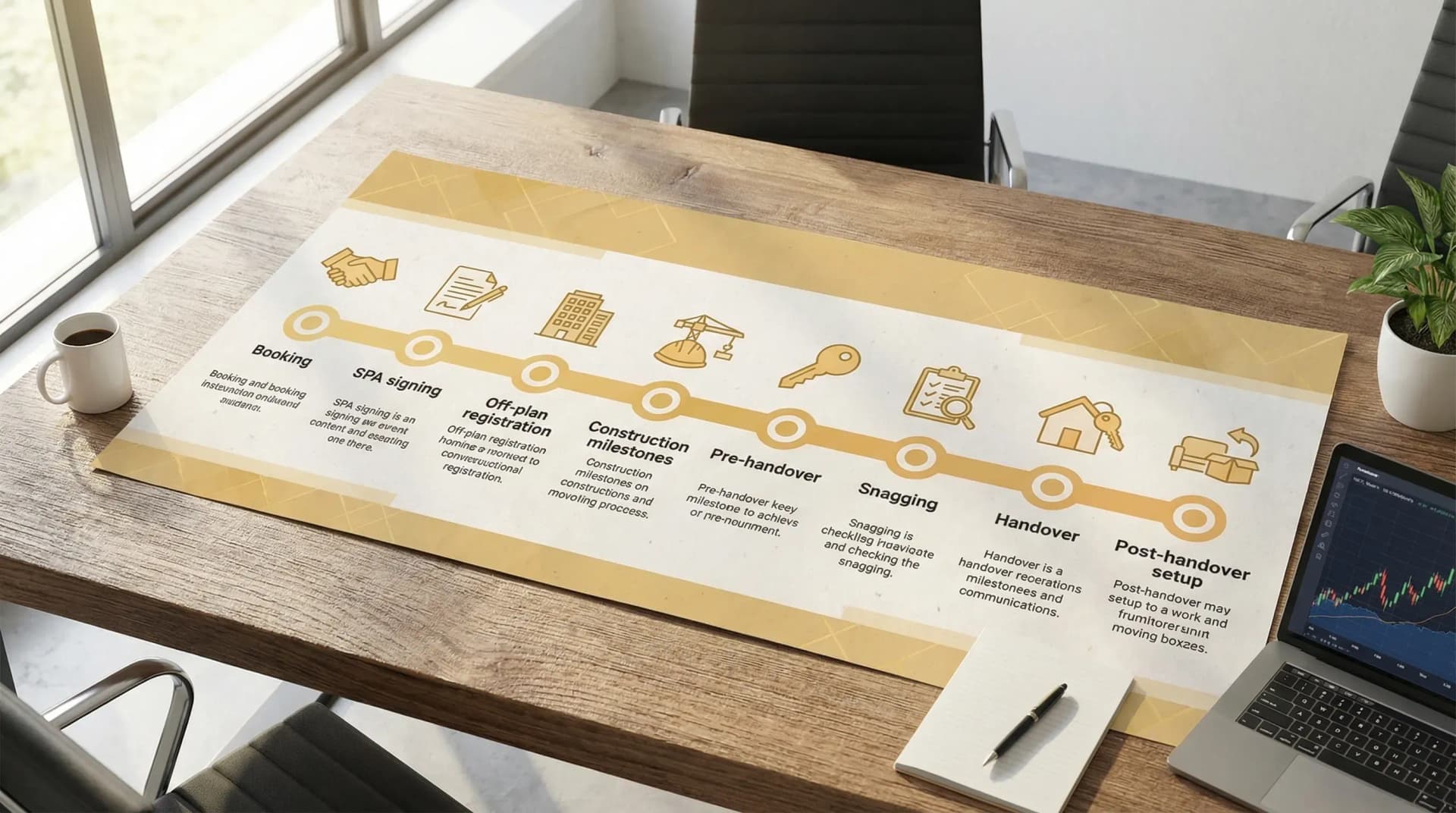
In most UAE markets, the off-plan journey has a predictable spine:
- Booking / reservation: you select a unit and pay a booking amount to reserve it.
- SPA signing: you sign the Sale and Purchase Agreement, which governs price, specs, delivery date targets, and remedies.
- Off-plan registration: your contract is recorded in the emirate’s off-plan system (for example, Dubai uses Oqood, other emirates have their own registration pathways).
- Construction milestone period: progress-linked payments are made into the project’s regulated framework (commonly via escrow arrangements and milestone certifications, depending on emirate rules).
- Completion and handover: final inspections (snagging), final settlement, keys, and post-handover documentation.
Because processes vary by emirate and developer, think in terms of phases and deliverables, not just dates.
Off-plan property investment timeline at a glance
The table below shows typical sequencing and planning ranges. Timings vary by developer, financing, and how quickly documents are provided.
| Phase | Typical planning range | What you do | What you receive / confirm |
|---|---|---|---|
| Booking and unit hold | Same day to 7 days | Reserve the unit, pay booking amount, confirm price and incentives | Reservation form, payment receipt, unit details (floor plan, view, parking) |
| SPA review and signing | 1 to 6 weeks | Review SPA, clarify specs and timelines, sign and pay first instalment | Signed SPA, payment schedule, project disclosures |
| Off-plan registration | 2 to 10 weeks | Submit KYC, register contract, confirm escrow payment instructions | Off-plan registration confirmation, buyer reference number (system varies) |
| Construction and milestone payments | 18 to 48 months (project dependent) | Pay per milestones, monitor progress, manage currency risk, plan leasing strategy | Progress updates, milestone notices, receipts, variation notices (if any) |
| Pre-handover close-out | 30 to 90 days before handover | Prepare final funds, book inspection, arrange utilities and insurance | Handover notice, final statement of account, inspection appointment |
| Snagging and handover | 1 to 30 days | Inspect, log defects, confirm rectification, collect keys | Handover documents, keys/access, snag list closure plan |
| Post-handover set-up | First 30 to 90 days | Title documentation, furnishing, management onboarding, tenanting or holiday letting permits | Title deed (or local equivalent when issued), contracts, operational readiness |
Phase 0 (before you book): the prep that makes everything faster
Most delays that investors experience are not construction-related. They happen earlier, when funds, documents, or decision-making are not ready.
Get your “deal-ready” pack in place
Before you put down a booking amount, prepare:
- Passport copy and proof of address (bank or utility statement)
- Source of funds evidence (especially for international transfers)
- A clear purchase objective (capital growth, long-let yield, short-stay strategy, future move-in)
- A decision on ownership name(s) and spelling (inconsistencies can slow registrations)
If financing is part of your plan, mortgage pre-approval can be a major timeline advantage, particularly if the lender requires additional time for non-resident verification.
Phase 1: Booking (reservation) to unit confirmation
Booking is where speed and precision matter. You are committing money before the full SPA is signed, so your goal is to reserve the right unit while reducing avoidable risks.
What typically happens
- You choose the unit (stack, orientation, floor, proximity to lifts, parking, view corridors).
- You sign a reservation form and pay a booking amount.
- The developer issues a receipt and blocks the unit from resale.
What to verify at booking (investor-focused)
At a minimum, confirm the following in writing:
- Exactly what is reserved: unit number, net area, balcony size (if stated), parking allocation, storage.
- Price and incentive conditions: discounts, fee waivers, furniture packs, DLD/land department fee support (if offered), and the conditions attached.
- Payment destination: official account details and references. Never rely on informal instructions.
- Cancellation and refund rules: reservation forms can be strict, understand the consequences if you do not proceed to SPA.
If you are buying in Ras Al Khaimah and want region-specific safety checks, Azimira’s wider due-diligence content library is a useful companion, but this article stays focused on the timeline mechanics.
Phase 2: SPA review and signing (your main control point)
The Sale and Purchase Agreement is the single most important document in the whole off-plan journey. It governs what you bought, how you pay, what happens if timelines slip, and what you can do if your plans change.
What happens during the SPA window
- The developer issues the SPA and supporting annexures (specifications, plans, payment schedule).
- You review, request clarifications, then sign.
- You pay the next instalment as defined in the schedule.
SPA clauses that directly affect your timeline
These are the items that commonly create surprises later:
- Long-stop date and handover conditions: the handover may depend on permits, final inspections, and completion certificates, not just construction finishing.
- Variation rights: how much the developer can change layout, materials, or amenities.
- Milestone definitions: what “completion” means for each payment trigger.
- Assignment / resale rules: whether you can sell before handover, and any fees or percentage-paid requirements.
- Defects liability period: how defects are reported and rectified after handover.
For a deeper legal overview (beyond the timeline), see Azimira’s explainer on the legal framework of off-plan investing in the UAE.
Phase 3: Off-plan registration and compliance (where admin delays often appear)
After SPA signing, the next milestone is the official recording of your off-plan contract with the relevant emirate authority or system.
In Dubai, this is commonly known as Oqood. Other emirates, including Ras Al Khaimah, have their own registration processes and requirements.
Why this step matters
- It creates an official record linking you to the unit.
- It supports orderly progress-payment administration.
- It is often required for later steps such as title issuance and, in some cases, residency-related applications.
What can slow registration
- Missing or mismatched name spellings across passport, SPA, and payment receipts
- Delayed KYC or compliance checks (especially for cross-border buyers)
- Unclear payment references, or payments made from a third-party account without supporting documentation
If you want the practical mechanics of progress registration and staged payments, Azimira also has a dedicated guide to Oqood registration and progress payments.
Phase 4: Construction milestones and staged payments (the long middle)
This is where your off-plan investment behaves more like a project you manage than a simple asset you own.
What you should do during construction
Think in “quarterly governance” rather than passive waiting:
- Track milestone notices: understand what triggered a payment request.
- Save every receipt and reference: you will need a clean audit trail later.
- Monitor progress evidence: official developer updates, site photos, third-party progress checks (if used).
- Plan your exit or leasing strategy early: decisions made late (for example, furnishing vs unfurnished, short-stay licensing) can delay income.
A simple way to map milestones to your cashflow
Developers use different milestone structures, but many follow a recognisable build sequence. Use the table below as a planning template, not as a promise of how any specific project will bill.
| Build stage (conceptual) | What it usually means | Why it matters to you |
|---|---|---|
| Groundworks and foundations | Site prep, piling, base structure | Early payments are often time-sensitive, arrange transfers in advance |
| Superstructure | Main frame rises (floors, core) | This is where delay risk becomes more measurable |
| Façade and glazing | External envelope progresses | Helps validate delivery trajectory and finishing quality direction |
| MEP first fix | Mechanical, electrical, plumbing rough-in | Quality here affects long-term maintenance and snagging workload |
| Interior finishing | Floors, joinery, kitchens, bathrooms | Specification alignment matters, compare against annexures |
| Testing and commissioning | Systems testing, final checks | Often the “invisible” stage that still consumes time |
| Completion and permitting | Final approvals, completion certificates | Handover can only occur after approvals, not just after construction |
Currency and payment planning for international investors
If you invest from abroad, staged payments create currency exposure across multiple years. Some investors reduce uncertainty by planning transfers ahead, or using hedging tools through licensed providers.
Azimira has a dedicated risk-management perspective on this topic, including FX hedging strategies for off-plan staged payments.
Managing the two big timeline risks: delays and specification drift
Even in well-run projects, two issues dominate investor outcomes.
Construction delays
Delays can come from supply chains, contractor changes, permitting schedules, or broader market dynamics. Your practical mitigation is not panic, it is structuring your investment plan so delays are survivable.
- Keep a liquidity buffer aligned to your next 1 to 2 milestone payments.
- Avoid relying on a single “handover month” for a major life plan.
- If your strategy depends on income at completion, consider how a 3 to 12 month delay affects cashflow.
Azimira’s risk matrix on construction delays vs ROI is useful if you want a decision framework.
Specification drift
What you saw in renders and brochures is not always what you receive. The SPA annexures and agreed specification are your anchor.
During construction, keep a file that includes:
- The signed SPA and annexures
- The latest floor plan and finish schedule you agreed to
- Any developer circulars announcing changes
This makes snagging and defect discussions simpler because you can reference the contract, not opinions.
Phase 5: Pre-handover close-out (where you win or lose weeks)
Most “handover delays” experienced by buyers are administrative: final statements, scheduling inspections, or waiting on documentation.
What pre-handover usually includes
- A handover notice or expected completion communication
- Final statement of account (what has been paid, what remains)
- Instructions for booking inspection and completing final payments
Your pre-handover checklist (timeline-first)
- Confirm how final payments must be made and to which verified account
- Align any financing drawdowns to the developer’s deadlines
- Schedule snagging early, prime time slots get booked
- Line up building insurance timing and the utility activation process (requirements vary)
For handover readiness in Ras Al Khaimah specifically, Azimira’s practical handover guidance is consolidated in The 3 Steps to a Seamless Handover.
Phase 6: Snagging and handover (turning a “new build” into a rentable asset)
Handover is not just collecting keys. For investors, it is the moment your asset changes category: from a contract to a physical unit that must meet standards.
What happens on snagging day
- You (or a professional snagging inspector) walk the unit room by room.
- Defects, unfinished items, and specification mismatches are recorded.
- A snag list is submitted to the developer for rectification.
Common snagging areas in premium off-plan units
- Doors and cabinetry alignment, soft-close function
- Tile lippage, grout quality, silicone sealing in wet areas
- AC performance and thermostat controls
- Water pressure, drainage, hot water timing
- Window seals and balcony drainage (especially important in coastal environments)
If you want a full luxury-level checklist, reference Azimira’s dedicated guide: The Ultimate Snagging and Handover Checklist for Luxury UAE Properties.

Phase 7: Post-handover (first 30 to 90 days) and getting to income
A surprising number of investors reach handover and then lose momentum, which delays rental income.
What to prioritise immediately after handover
- Documentation: keep a digital folder with handover papers, warranties, appliance manuals, and payment history.
- Insurance: arrange cover appropriate to how you will use the property (owner-occupier, long-let landlord, short-stay).
- Operational set-up: utilities activation, access cards, parking registration, community rules.
- Letting strategy execution: furnishing, photography, pricing, and manager onboarding.
If you are planning short-stay income, licensing and compliance can take time. Azimira’s process guide on getting a holiday home permit in RAK is relevant for investors targeting that route.
Timeline tactics experienced investors use
The fastest off-plan buyers are not the ones who rush, they are the ones who remove friction.
Treat your purchase as a timeline with decision gates
At a high level, your “gates” are:
- Book only after you have a clean funding plan and a document pack ready.
- Sign SPA only after you understand milestone triggers and exit constraints.
- Approach handover only after you have a clear plan for snagging and leasing.
Build a payment calendar, then add buffers
As soon as your SPA is signed, create a calendar of:
-
Payment due windows
-
Expected milestone periods nThen add buffer time for:
-
International transfer processing
-
Compliance checks and bank queries
-
Holidays and local working-week differences
Decide early if you might sell before handover
Some investors plan to exit via assignment, depending on market conditions and developer rules. If that is even a possibility, you should understand those SPA restrictions at signing, not later.
Azimira covers this exit route in detail in assignment sales before handover.
Where Azimira fits (and how to use this timeline)
Azimira specialises in connecting buyers and investors with curated off-plan opportunities in the UAE, with a strong focus on high-growth markets such as Ras Al Khaimah. If you use the timeline above as your operating framework, the next step is choosing projects and payment structures that match your horizon, risk tolerance, and intended exit.
To explore curated opportunities and get guidance aligned to your strategy, start here: Azimira Real Estate investments.
Related articles
What Counts as Good Real Estate Investments in 2026
Learn what makes good real estate investments in 2026, from net yield and demand signals to legal checks, exit plans and UAE opportunities.

Investors Needed for Real Estate? Start With This Plan
Investors needed for real estate? Use this practical plan to define strategy, numbers, due diligence and partners before raising capital.

Investment Marketing Tactics Developers Use at Launch
Understand investment marketing tactics developers use at launch, from scarcity to incentives, and learn how to assess UAE off-plan deals.