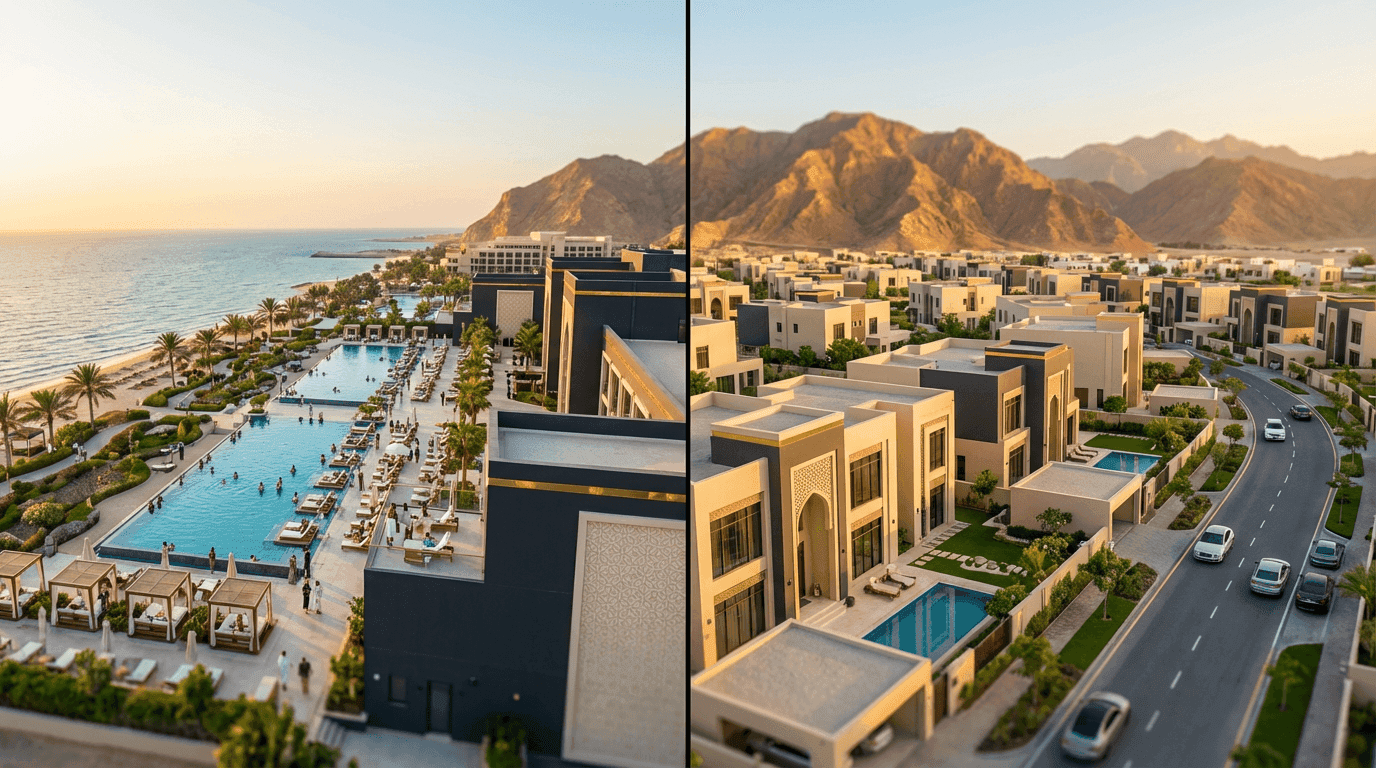
RAK Rental Demand Forecast: Tourism vs Resident Market Analysis
Comprehensive analysis of Ras Al Khaimah's rental market forecast comparing tourism-driven short-term demand against residential long-term opportunities for investors.
Table Of Contents
- Understanding RAK's Dual Rental Market Landscape
- Tourism Market: Short-Term Rental Demand Drivers
- Resident Market: Long-Term Rental Fundamentals
- Comparative Analysis: Which Market Offers Better Returns?
- Investment Strategies for RAK's Rental Markets
- Regulatory Considerations for 2026
- Location-Specific Demand Forecasts
- Risk Factors and Market Challenges
Ras Al Khaimah stands at a pivotal juncture in its real estate evolution, with 2026 poised to be a watershed year for rental market dynamics. As the emirate accelerates its transformation into a premium tourism destination whilst simultaneously attracting residential populations seeking affordable UAE living, investors face a compelling yet complex question: should they target the tourism-driven short-term rental market or the growing resident long-term rental sector?
The distinction between these two markets extends far beyond simple rental duration. Each segment operates with different demand drivers, regulatory frameworks, yield profiles, and risk characteristics. Tourism rentals ride the waves of seasonal visitor patterns and mega-project completions, whilst residential demand follows employment trends, demographic shifts, and the ongoing repricing of Dubai's property market. Understanding these divergent dynamics proves essential for investors seeking to optimise their RAK portfolios ahead of 2026.
This comprehensive analysis dissects both rental markets, examining infrastructure catalysts, demographic trends, regulatory environments, and location-specific opportunities. Whether you're evaluating beachfront apartments for holiday lets or family villas for long-term residents, the insights that follow will equip you with the strategic intelligence needed to navigate RAK's evolving rental landscape with confidence.
RAK Rental Market Forecast: 2026 Investment Outlook
Tourism vs Residential: Which Market Offers Better Returns?
Two Distinct Rental Markets: Side-by-Side Comparison
Tourism Market
Residential Market
RAK Affordability Advantage: Annual Rental Comparison
💰 Families save AED 60,000-80,000 annually by choosing RAK over Dubai
Prime Investment Locations
🏖️ Al Marjan Island
Beachfront proximity to Wynn Resort. Peak season: AED 450-1,800 nightly. Best for luxury tourism rentals.
🏘️ Mina Al Arab
Mixed-use with beaches and amenities. Ideal for hybrid strategies serving both tourism and residential.
🏡 Al Hamra Village
Mature community with golf, marina, schools. Strong family demand, stable long-term tenancies.
🛣️ Southern RAK
Dubai border proximity. Targets Dubai workers seeking affordable family housing with commute access.
Strategic Investment Approaches
Premium Tourism Positioning
Luxury beachfront properties targeting high-end visitors. Higher capital requirement, superior yields, quality guests.
Value Residential Strategy
Affordable family homes in connected communities. Prioritizes stability, occupancy, and long-term retention.
Hybrid Flexibility Approach
Properties permitting both rental types. Switch between tourism and residential based on market conditions.
Major Market Catalysts Through 2026
Wynn Resort Development
AED 15B integrated resort opening early 2027. Pre-launch activities and contractor demand throughout 2026.
Airport Expansion
New terminal facilities and enhanced connectivity. New routes delivering thousands of additional annual visitors.
Dubai Affordability Crisis
Ongoing 20-30% annual rent increases in Dubai driving middle-income professionals to RAK alternatives.
Population Expansion
3-5% annual population growth from employment across industrial, education, and tourism sectors.
Ready to Capitalize on RAK's Rental Opportunity?
Access exclusive pre-launch and off-market RAK developments positioned for exceptional rental returns. Our specialists help you identify opportunities aligned with your investment strategy.
Understanding RAK's Dual Rental Market Landscape
Ras Al Khaimah's rental market operates within two distinct yet occasionally overlapping ecosystems. The tourism market centres on short-term holiday rentals, serviced apartments, and hotel-alternative accommodation catering to visitors exploring the emirate's mountains, beaches, and adventure tourism offerings. Meanwhile, the resident market serves professionals, families, and retirees seeking long-term accommodation, typically on annual contracts aligned with traditional UAE tenancy structures.
Historically, RAK's rental market skewed heavily towards residential tenancies, with tourism accommodation primarily confined to established hotels and resorts. However, recent regulatory liberalisation permitting short-term holiday rentals in designated zones has catalysed a fundamental shift. Properties in tourism-focused developments can now legally operate as holiday homes, creating genuine optionality for investors who might pivot between market segments based on demand cycles.
This dual-market structure creates unique investment opportunities unavailable in more rigidly zoned emirates. Certain RAK developments, particularly along the coastline and near major tourism attractions, permit both short-term and long-term rentals, allowing investors to optimise their strategy based on seasonal demand patterns. A beachfront apartment in Al Marjan Island, for instance, might command premium short-term rates during peak tourism months whilst generating stable long-term income during quieter periods through annual residential leases.
The critical investment question for 2026 centres not on which market will grow—both demonstrate robust expansion trajectories—but rather which aligns with individual investment objectives, risk tolerance, and operational capacity. The tourism market promises higher gross yields but demands active management, whilst residential rentals offer stability with lower headline returns. The following sections examine each market's specific demand drivers and performance forecasts.
Tourism Market: Short-Term Rental Demand Drivers
Major Tourism Infrastructure Developments
Ras Al Khaimah's tourism infrastructure pipeline represents the most significant demand catalyst for short-term rentals through 2026. The emirate's aggressive positioning as a premium leisure destination finds expression in several transformative projects nearing completion or commencing operations within the forecast period.
The Wynn Al Marjan Island Resort, scheduled to open in early 2027 with pre-opening activities throughout 2026, stands as the centrepiece development. This AED 15 billion integrated resort will deliver over 1,000 luxury hotel rooms, high-end gaming facilities, premium dining establishments, and world-class entertainment venues. The resort's construction and pre-launch phase will drive substantial accommodation demand from contractors, consultants, and corporate visitors throughout 2026, whilst its marketing activities will significantly elevate RAK's global tourism profile ahead of opening.
Beyond Wynn, the emirate continues expanding its adventure tourism infrastructure. The Jais Adventure Peak development extends the existing Jebel Jais attractions with additional ziplines, viewing platforms, and experience-based activities. These enhancements broaden RAK's appeal beyond beach tourism, creating year-round visitation patterns that support consistent short-term rental demand across seasons.
The RAK International Airport expansion, with its new terminal facilities and enhanced connectivity, represents critical enabling infrastructure. Increased flight frequencies and new route launches scheduled through 2026 directly correlate with visitor accessibility. Each new route potentially delivers thousands of additional visitors annually, many seeking self-catered accommodation options that holiday rentals uniquely provide.
These infrastructure developments collectively position 2026 as an inflection point where anticipation of major openings, construction activity, and operational expansions converge to create exceptional tourism rental demand.
Visitor Growth Projections Through 2026
The Ras Al Khaimah Tourism Development Authority (RAKTDA) has established ambitious yet achievable targets for visitor growth. The emirate welcomed approximately 1.2 million visitors in 2023, with projections targeting 3.5 million annual visitors by 2027. Extrapolating conservative growth trajectories suggests RAK will likely receive between 2.3 to 2.6 million visitors during 2026—representing year-on-year growth exceeding 25%.
This visitor expansion won't distribute evenly across accommodation types. Industry analysis indicates a pronounced shift towards alternative accommodation formats, with holiday rentals capturing growing market share from traditional hotels. Globally, short-term rental platforms report that UAE listings experience amongst the highest occupancy rates worldwide, with RAK properties benefitting from this trend whilst offering more competitive pricing than Dubai alternatives.
Demographic analysis of RAK's visitor profile reveals particularly strong growth in family tourism and GCC regional visitors. Families typically prefer multi-bedroom holiday rentals over hotel rooms, seeking kitchen facilities and separate living spaces that apartments and villas provide. GCC visitors, who comprise a substantial portion of RAK's tourism base, demonstrate pronounced preference for short-term rental properties that accommodate extended family groups during peak holiday periods.
Seasonal demand patterns create distinct opportunities within the tourism rental market. Peak season (October through April) generates exceptional occupancy rates often exceeding 80% for well-positioned properties, with nightly rates commanding significant premiums. Conversely, summer months (June through August) experience softer demand, though domestic UAE tourism and value-seeking international visitors maintain baseline occupancy levels typically ranging between 40-55%.
Short-Term Rental Performance Indicators
Current performance metrics for RAK's holiday rental market provide tangible benchmarks for 2026 forecasts. One-bedroom beachfront apartments in prime locations such as Al Marjan Island currently achieve average nightly rates between AED 450-650 during peak season, with occupancy rates reaching 75-85%. Two-bedroom units command AED 700-950 nightly, whilst premium three-bedroom properties secure AED 1,200-1,800 per night during high-demand periods.
Annualised gross rental yields for actively managed short-term rentals currently range between 8-12% for well-positioned properties with professional management. These yields significantly exceed long-term residential rental returns, though they require substantially higher operational involvement including guest communication, cleaning coordination, maintenance management, and dynamic pricing optimisation.
Looking towards 2026, several factors suggest yield expansion potential. The Wynn Resort's opening will likely create halo effects for surrounding properties, with visitors seeking nearby accommodation during sold-out periods or preferring self-catered options for extended stays. Infrastructure improvements including the corniche developments and enhanced beach facilities will broaden the geography of prime tourism rental locations beyond current hotspots.
However, investors must also consider supply-side dynamics. Numerous developers are delivering tourism-focused properties specifically designed for short-term rental operations. This supply influx could moderate yield growth in certain micro-locations, particularly those lacking distinctive features or convenient access to tourism attractions. Differentiation through quality finishes, professional management, and strategic location selection will prove increasingly important as competition intensifies.
Resident Market: Long-Term Rental Fundamentals
Population Growth and Migration Patterns
Ras Al Khaimah's residential rental market derives its fundamental demand from population expansion driven by both employment growth and strategic migration from higher-cost emirates. The emirate's population exceeded 400,000 residents in recent counts, with consistent annual growth rates between 3-5% reflecting both natural increase and inward migration.
Employment generation across diverse sectors underpins residential demand. RAK's industrial zones, manufacturing facilities, ceramics sector, and quarrying operations employ substantial blue-collar and mid-level professional populations requiring affordable housing. The emirate's education sector expansion, including international schools and higher education institutions, creates demand from teaching professionals and support staff. Meanwhile, tourism sector growth generates employment across hospitality, retail, and service industries, with many workers seeking residential accommodation within the emirate.
The Dubai affordability migration represents perhaps the most significant residential demand driver heading into 2026. As Dubai rental rates have surged—with some areas experiencing 20-30% annual increases in recent years—middle-income professionals increasingly evaluate alternative locations offering reasonable commuting access to Dubai employment centres. RAK's southern communities, particularly those with convenient access to the E11 highway, capture a growing share of these affordability-driven relocations.
Family demographics particularly favour RAK's residential market. The emirate offers family-friendly environments, international schools with more accessible fee structures than Dubai equivalents, and community-focused developments that appeal to households seeking quality of life improvements. Multi-bedroom villas and townhouses experience particularly strong residential demand from family units, often on multi-year tenancy contracts that provide exceptional stability for investor landlords.
Affordability Factor Driving Residential Demand
RAK's residential rental affordability advantage represents its most compelling competitive positioning against other UAE emirates. Current market rates demonstrate the stark differential:
- One-bedroom apartments: AED 22,000-32,000 annually in RAK versus AED 45,000-75,000 in comparable Dubai locations
- Two-bedroom apartments: AED 35,000-50,000 annually in RAK versus AED 70,000-110,000 in Dubai
- Three-bedroom villas: AED 60,000-85,000 annually in RAK versus AED 120,000-180,000 for similar Dubai properties
These differentials create powerful economic incentives for Dubai workers to consider RAK residency, particularly as remote and hybrid work arrangements reduce the necessity for daily office attendance. A family saving AED 60,000-80,000 annually on housing costs can justify substantial lifestyle improvements or accelerate savings objectives, making the trade-off of longer occasional commutes economically rational.
Projecting forward to 2026, this affordability advantage will likely persist even as RAK rental rates appreciate. The emirate's substantial land bank and developer pipeline ensure sufficient supply to accommodate demand growth without the supply constraints that have driven Dubai's dramatic rental inflation. Consequently, whilst RAK rents should experience healthy appreciation—potentially 5-8% annually through 2026—the relative affordability gap versus Dubai will remain substantial.
For investors, this affordability dynamic creates robust demand foundations for long-term residential rentals. Properties positioned in well-connected communities with quality amenities can expect consistent tenant demand, low vacancy rates, and reliable rental income streams with moderate but dependable appreciation over the forecast period.
Long-Term Rental Yield Expectations
Residential long-term rental yields in RAK currently range between 6-8% gross annually, varying by property type, location, and specification. These yields exceed those available in Dubai's established residential communities, where equivalent properties typically generate 4-6% gross returns, though they fall below the higher headline yields achievable through active short-term rental management.
The yield advantage stems primarily from RAK's more favourable purchase price-to-rental ratio. Whilst absolute rental rates sit lower than Dubai equivalents, purchase prices demonstrate even more pronounced differentials, creating superior yield mathematics. A two-bedroom apartment purchased for AED 650,000 in RAK might generate AED 45,000 annual rent (6.9% yield), whilst a comparable Dubai property costing AED 1.4 million returning AED 75,000 annually delivers only 5.4%.
Tenancy stability represents another crucial advantage of RAK's residential market. Annual contracts remain standard, with many tenants renewing for multiple consecutive years given the limited alternative options at comparable price points. This stability reduces void periods, minimises turnover costs, and creates predictable cash flows that conservative investors particularly value. Tenant quality tends towards stable employment profiles given RAK's industrial and professional employment base.
Looking towards 2026, residential rental yields should remain robust as demand growth matches or slightly exceeds supply additions. The completion of off-plan projects currently under development will deliver quality rental stock, though absorption rates should remain healthy given the multiple demand drivers converging simultaneously. Investors securing well-located properties in established communities can reasonably anticipate maintaining 6-7.5% gross yields through the forecast period, with rental rate appreciation providing capital growth opportunities alongside income generation.
Comparative Analysis: Which Market Offers Better Returns?
The tourism versus resident market question ultimately depends on investor objectives, operational capacity, and risk tolerance rather than absolute superiority of one segment over another. Each market presents distinct advantages and challenges that align differently with various investment strategies.
Tourism short-term rentals offer superior gross yield potential, frequently achieving 8-12% returns for professionally managed properties in prime locations. This yield advantage reflects both higher effective nightly rates and the ability to capture premium pricing during peak demand periods. However, these returns demand active management or professional property management services consuming 20-30% of gross revenues. Operational complexity includes guest communications, check-in coordination, cleaning between stays, maintenance responsiveness, and dynamic pricing optimisation.
Seasonal volatility represents another tourism market characteristic. Whilst peak season generates exceptional returns, summer months may require rate reductions or promotional efforts to maintain acceptable occupancy. This seasonality creates cash flow variability that some investors find challenging, particularly those relying on consistent monthly income. Additionally, regulatory requirements for holiday home licensing and compliance with tourism authority standards impose administrative obligations absent from residential lettings.
Residential long-term rentals provide stability, predictability, and simplified management structures. Annual contracts generate consistent monthly income with minimal landlord involvement beyond periodic maintenance and contract renewals. Tenant acquisition costs remain modest—often just one month's commission to a letting agent—and turnover occurs infrequently. The emotional satisfaction of providing stable housing for families also appeals to certain investors seeking purpose-aligned investments.
Yield differentials of 6-8% for residential versus 8-12% for tourism rentals might initially suggest clear tourism market superiority. However, after accounting for management costs, higher vacancy rates, increased maintenance from frequent turnovers, and operational time investments, net returns often converge more closely than gross figures suggest. A residential property achieving 7% gross yield with minimal management costs might deliver net returns comparable to a tourism property grossing 10% but incurring substantial operational expenses.
Portfolio diversification strategies might incorporate both segments, capturing tourism yields from select properties whilst maintaining residential rental stability across the broader portfolio. This blended approach optimises for both income maximisation and risk management, providing flexibility to adjust allocations as market conditions evolve.
Investment Strategies for RAK's Rental Markets
Successful RAK rental investment heading into 2026 requires strategic alignment between property selection, target market, and operational approach. Several proven strategies warrant consideration based on current market dynamics and forecast trends.
Premium tourism positioning targets the higher end of RAK's visitor market through luxury finishes, beachfront or marina locations, and exceptional amenities. Properties in developments such as Al Marjan Island's premium towers or exclusive resort-style communities command the highest nightly rates whilst attracting quality guests who maintain properties well. This strategy demands higher capital deployment but generates superior yields and benefits from insulation against mid-market competition as supply increases.
Value residential strategy focuses on affordable family accommodation in well-connected communities offering quality schools, retail amenities, and straightforward Dubai access. Two and three-bedroom apartments or townhouses in developments like Mina Al Arab or southern RAK communities serve the affordability migration demographic. This approach prioritises high-occupancy stability and long-term tenant retention over headline yields, suiting conservative investors seeking passive income with minimal management demands.
Hybrid flexibility approach selects properties in developments permitting both short-term and long-term rentals, maintaining strategic optionality. During periods of strong tourism demand, properties operate as holiday rentals maximising yield. When occupancy softens or operational capacity constraints emerge, the same properties transition to annual residential contracts ensuring income continuity. This strategy requires developments with appropriate regulatory permissions and appeals to investors seeking adaptive portfolio management capabilities.
Off-plan value capture leverages the developer incentives and payment plans available through RAK property investment opportunities, securing properties below market value before completion. This strategy targets developments delivering in 2025-2026, positioning investors to capture both capital appreciation from completion and immediate rental demand as properties become available. Payment plan structures preserve capital for alternative deployments whilst securing price levels before anticipated market appreciation.
Location selection proves critical across all strategies. Proximity to tourism attractions, beach access, and lifestyle amenities drives tourism rental performance, whilst school access, retail convenience, and highway connectivity determine residential appeal. Investors must thoroughly evaluate specific micro-locations rather than treating RAK as a homogenous market, as performance variations between communities can exceed differentials between market segments.
Regulatory Considerations for 2026
RAK's regulatory framework governing rental markets continues evolving, with several considerations particularly relevant for 2026 investment decisions. Understanding these regulatory dimensions ensures compliance whilst optimising operational approaches.
Holiday home licensing requirements apply to all properties operating as short-term tourist accommodation. The Ras Al Khaimah Tourism Development Authority administers licensing processes, with properties required to meet specific standards regarding safety, amenities, and operational protocols. Licensing fees remain modest compared to revenue potential, though compliance with inspection requirements and maintenance of licensing standards demands attention. Not all developments permit short-term rentals; investors must verify regulatory permissions before assuming tourism rental feasibility.
Residential tenancy regulations follow the RERA (Real Estate Regulatory Agency) framework familiar across UAE emirates. Annual contracts remain standard, with rental increases capped at levels determined by government-published rental indices. These caps—typically limiting increases to 5-10% depending on market positioning—provide tenant protection whilst ensuring landlords can adjust rents in line with market movements. Standard contracts through the Ejari registration system create transparent, enforceable agreements protecting both parties.
Ownership structures for rental investment deserve consideration. Freehold zones permit direct foreign ownership, whilst certain areas require UAE national ownership or company structures. Property held through UAE companies may offer tax optimisation opportunities, though they introduce corporate compliance requirements. Most individual investors favour direct freehold ownership for its simplicity, particularly in established freehold communities where ownership transfer and ongoing administration processes are well-established.
Mortgage regulations for investment properties generally permit financing up to 75% of property value for UAE residents and 60% for non-residents on first properties, with reduced percentages for subsequent purchases. These leverage opportunities allow capital-efficient portfolio construction, though investors must ensure rental yields adequately service financing costs. Current interest rate environments and anticipated monetary policy trajectories through 2026 warrant evaluation when structuring leveraged acquisitions.
Engaging with specialists who maintain current regulatory knowledge proves invaluable given the evolving nature of UAE property regulations. What remains permissible today may face new requirements tomorrow, making expert guidance essential for compliant, optimised operations.
Location-Specific Demand Forecasts
RAK's rental demand distributes unevenly across its geography, with distinct micro-markets demonstrating divergent performance characteristics based on their specific attributes and target demographics.
Al Marjan Island represents RAK's premium tourism rental hub, with beachfront towers and resort-style developments attracting both short-term holidaymakers and affluent long-term residents. The island's proximity to the forthcoming Wynn Resort positions it exceptionally well for 2026 tourism demand, with halo effects likely benefitting the entire precinct. Properties here command the highest rental rates in both segments, though purchase prices reflect this premium positioning. Investors should anticipate strong tourism rental performance through 2026, with increasing competition as new towers complete requiring differentiation through quality and service.
Mina Al Arab balances tourism appeal with residential functionality through its mixed-use development structure incorporating beaches, flamingo sanctuary, and community amenities. The development attracts families seeking resort-style living at accessible price points, creating robust residential rental demand. Simultaneously, its beach access and leisure facilities generate tourism rental potential, particularly for the beachfront apartments and lagoon villas. This dual-market positioning provides investors with genuine flexibility to optimise between segments based on prevailing conditions.
Al Hamra Village offers established community infrastructure with golf course, marina, retail facilities, and international school access. Its mature development status creates rental market stability with proven tenant demand from professionals and families. Tourism rental potential exists for marina-facing and golf course properties, though residential long-term lettings dominate the market. Investors here typically prioritise stability and established amenity access over cutting-edge specifications or aggressive yield targeting.
Jebel Jais developments and mountain-proximity communities present niche tourism rental opportunities capitalising on adventure tourism and weekend escape markets. Properties in these areas attract distinct demographics seeking mountain experiences, cooler temperatures, and outdoor activities rather than beach-focused tourism. Whilst this market segment remains smaller than coastal tourism, it demonstrates strong growth trajectories with less seasonal volatility given the summer appeal of mountain temperatures.
Southern RAK communities close to the Dubai border primarily serve residential markets, attracting Dubai workers seeking affordable family housing with reasonable commute distances. Areas like Al Dhait and developments along the E11 corridor demonstrate consistent residential demand with modest tourism potential. Investment strategies here should focus on family-appropriate specifications, school proximity, and value positioning rather than premium finishes or beachfront locations.
Risk Factors and Market Challenges
Balanced investment analysis requires acknowledging potential challenges and risk factors that could impact rental market performance through 2026. Several considerations warrant attention for comprehensive due diligence.
Supply-side pressures represent the most tangible near-term risk. RAK's developer pipeline includes substantial inventory scheduled for 2025-2026 completion, with many projects specifically targeting rental investment markets. Excessive supply in particular segments or micro-locations could pressure occupancy rates and moderate rental rate growth. Investors should thoroughly research specific community supply dynamics rather than relying solely on emirate-wide statistics, as oversupply manifests at hyper-local levels.
Tourism volatility creates uncertainty for short-term rental strategies. Global economic conditions, airline capacity decisions, regional competition from alternative destinations, and unforeseen events (as COVID-19 demonstrated) can rapidly impact visitor numbers. Whilst RAK's tourism trajectory appears robust, investors concentrated entirely in tourism rentals face higher volatility than diversified approaches. The Wynn Resort's opening represents a major catalyst, though any delays to this flagship project could temporarily dampen tourism market momentum.
Regulatory evolution continues across UAE property markets as authorities refine frameworks governing both tourism and residential rentals. New requirements for licensing, safety standards, or operational protocols could increase compliance costs or operational complexity. Whilst regulatory development generally improves market professionalisation benefitting serious investors, adaptation requirements may challenge those operating at minimal margins.
Economic sensitivity affects both market segments though through different transmission mechanisms. Economic slowdowns reduce discretionary tourism spending whilst simultaneously pressuring employment in resident markets. RAK's relative affordability provides some insulation, as budget-conscious consumers may actually shift towards RAK from more expensive alternatives during economic stress, though severe downturns would inevitably impact demand across all segments.
Financing availability and costs influence investor demand and property values. Interest rate movements, banking sector lending appetite, and regulatory requirements for investment property financing all affect market dynamics. Rising financing costs could pressure yields for leveraged investors, whilst reduced mortgage availability might constrain buyer demand impacting capital values.
Mitigation strategies include thorough due diligence on specific properties and communities, maintaining adequate liquidity reserves for vacancy periods or unexpected costs, diversifying across locations or market segments where portfolio size permits, and securing properties with genuine differentiation factors that perform well across market cycles. Conservative leverage levels and stress-testing investment models against adverse scenarios provide additional protection.
Despite these risks, RAK's fundamental positioning as the UAE's affordable emirate with improving infrastructure and tourism product creates favourable conditions for rental investment. Investors approaching the market with realistic expectations, professional management approaches, and strategic property selection can navigate these challenges whilst capturing the compelling opportunities that both tourism and resident markets present through 2026 and beyond.
Ras Al Khaimah's rental market forecast through 2026 reveals two robust yet fundamentally different opportunity sets. The tourism market promises higher gross yields, capitalising on visitor growth, infrastructure developments, and the transformative Wynn Resort opening. Meanwhile, the resident market delivers stability through affordability-driven demand, population growth, and the ongoing repricing of UAE accommodation markets that positions RAK as an increasingly attractive residential option.
Neither market demonstrates clear categorical superiority; rather, each aligns with different investor profiles and strategic objectives. Active investors comfortable with operational complexity and seasonal management may find tourism rentals' 8-12% gross yields compelling. Conversely, passive investors prioritising simplicity and predictable cash flows will likely favour residential rentals' 6-8% returns with minimal management demands. Portfolio strategies incorporating both segments capture diversification benefits whilst maintaining flexibility to optimise allocations as market conditions evolve.
The critical success factors transcend market segment selection. Location proves paramount—properties must align with their target demographic's specific priorities whether beach access for tourists or school proximity for families. Quality specifications, professional management (whether self-administered or outsourced), and realistic financial modelling separate successful investments from underperformers. Investors who thoroughly research micro-market dynamics, understand regulatory requirements, and maintain adequate reserves for market fluctuations position themselves for success across either segment.
As 2026 approaches, RAK's rental markets stand poised for expansion driven by converging catalysts across infrastructure, tourism, demographics, and affordability dynamics. The opportunities merit serious consideration from investors seeking UAE property exposure with compelling yield profiles and appreciation potential. However, success demands more than market participation—it requires strategic property selection, segment-appropriate operational approaches, and clear-eyed assessment of individual capabilities and objectives.
Ready to Capitalise on RAK's Rental Market Opportunities?
Navigating Ras Al Khaimah's dual rental markets requires expert insights and access to the right investment opportunities. At Azimira Real Estate, our specialisation in RAK's emerging property market positions us to guide you towards investments aligned with your specific objectives—whether tourism yields, residential stability, or diversified portfolio strategies.
Our exclusive access to pre-launch and off-market RAK developments provides our clients with first-mover advantages in the emirate's most promising rental investment opportunities. From beachfront apartments positioned for tourism demand to family villas capturing the residential migration from Dubai, we curate opportunities that deliver exceptional risk-adjusted returns.
Discover how strategic RAK rental investment can enhance your portfolio. Contact our specialist team today for a personalised consultation on RAK's rental market opportunities tailored to your investment criteria.
Related articles
What Counts as Good Real Estate Investments in 2026
Learn what makes good real estate investments in 2026, from net yield and demand signals to legal checks, exit plans and UAE opportunities.

Investors Needed for Real Estate? Start With This Plan
Investors needed for real estate? Use this practical plan to define strategy, numbers, due diligence and partners before raising capital.

Investment Marketing Tactics Developers Use at Launch
Understand investment marketing tactics developers use at launch, from scarcity to incentives, and learn how to assess UAE off-plan deals.