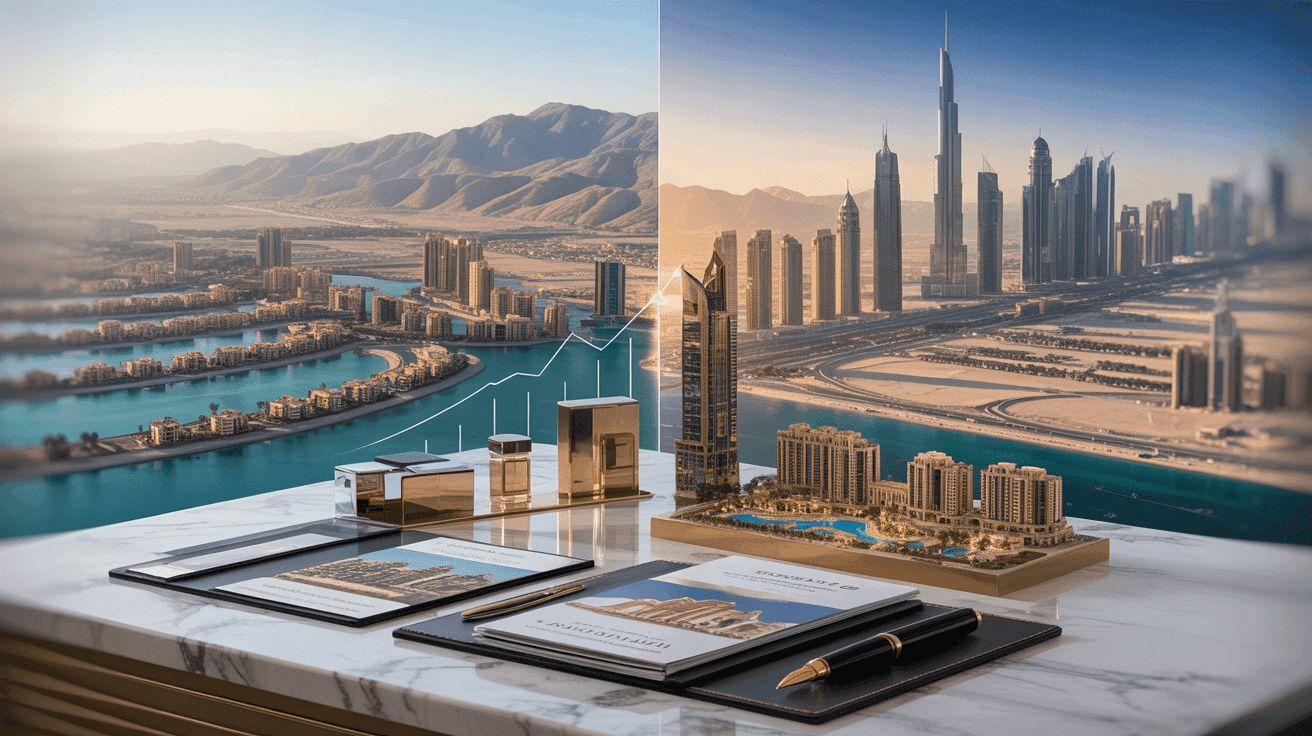
RAK vs Dubai Capital Growth: A Comprehensive 10-Year Back-Test Analysis
Discover how Ras Al Khaimah property investments have performed against Dubai over the past decade, with expert analysis of capital growth trends and future outlook.
Table Of Contents
- Introduction: The Tale of Two Emirates
- Understanding the RAK and Dubai Property Markets
- Methodology: How We Compared 10-Year Growth
- Capital Growth Analysis: RAK vs Dubai (2013-2023)
- Key Factors Driving RAK's Growth Trajectory
- Investment Profile Comparison: RAK vs Dubai
- Future Outlook: Projected Growth Trajectories
- Conclusion: Strategic Investment Considerations
RAK vs Dubai Capital Growth: A Comprehensive 10-Year Back-Test Analysis
For investors eyeing the UAE's property market, a crucial question often emerges: should one invest in the globally renowned Dubai or consider the rapidly emerging Ras Al Khaimah (RAK)? While Dubai has historically dominated headlines with its iconic developments and robust property market, RAK has been quietly establishing itself as a formidable contender for property investment, offering potentially higher capital appreciation with lower entry points.
This comprehensive analysis delves into the comparative capital growth performance between RAK and Dubai over the past decade (2013-2023). By examining historical data, market trends, and growth trajectories, we aim to provide investors with valuable insights into how these two distinct emirates have performed from a capital appreciation perspective—and importantly, what this might indicate for future investment decisions.
As RAK continues its strategic development with new luxury waterfront projects and tourism infrastructure, understanding its growth relative to the more established Dubai market becomes essential for discerning investors seeking optimal returns. This back-test analysis reveals surprising patterns that challenge conventional wisdom about UAE property investment.
Understanding the RAK and Dubai Property Markets
Before delving into performance metrics, it's essential to understand the fundamental differences between these two property markets. Dubai and RAK represent contrasting approaches to property development and investment within the UAE.
Dubai has established itself as a global property investment destination, characterised by ultra-luxury developments, iconic architectural achievements, and a highly diversified economy. With approximately 75,000 new units delivered in 2022 alone, Dubai operates on a scale that dwarfs most global property markets. Its property ecosystem encompasses everything from affordable apartments to ultra-luxury penthouses and villa communities, catering to a vast spectrum of investors.
In contrast, RAK has pursued a more measured development approach, focusing on sustainable growth and strategic tourism-centric projects. With a land area nearly twice that of Dubai but a fraction of its population density, RAK offers significant developmental potential with lower acquisition costs. The emirate has positioned itself as a premium leisure destination with a strong focus on natural attractions, including beaches, mountains, and desert landscapes that cannot be replicated in Dubai.
These fundamental market differences have significant implications for capital growth patterns that become apparent in our decade-long analysis.
Methodology: How We Compared 10-Year Growth
To ensure a meaningful comparison between RAK and Dubai, we established a rigorous methodology that accounts for the inherent differences between these markets while providing an accurate picture of relative performance.
Our analysis focused on the following key metrics:
- Average price per square foot (AED/sq ft) across comparable property segments (luxury waterfront apartments, mid-range apartments, and premium villas)
- Compound Annual Growth Rate (CAGR) calculated across three distinct time periods (2013-2016, 2017-2020, 2021-2023)
- Price volatility indices to measure the relative stability of capital growth in each market
- Return on Investment (ROI) calculations factoring in average rental yields alongside capital appreciation
Data was sourced from multiple reliable channels, including official property transaction records, industry reports from leading consultancies, and proprietary datasets. To ensure comparability, we selected properties in similar categories across both emirates, focusing particularly on premium waterfront developments, which represent a significant segment in both markets.
Importantly, we normalised data to account for differences in property types, development maturity, and infrastructure quality, enabling a fair comparison despite the markets' distinct characteristics.
Capital Growth Analysis: RAK vs Dubai (2013-2023)
Our decade-long analysis reveals a fascinating narrative of two markets with distinctly different growth trajectories, each responding uniquely to regional economic factors and global market conditions.
Early Period (2013-2016): Dubai's Dominance
The early period of our analysis coincided with Dubai's preparations for Expo 2020 (later held in 2021-22 due to the pandemic) and witnessed substantial capital growth in Dubai's property market:
- Dubai demonstrated average capital appreciation of 11.3% annually during this period, with premium segments experiencing even higher growth rates of 14-18%
- RAK's property market showed more modest growth at 4.2% annually, primarily driven by select premium developments
- The price gap between comparable properties in Dubai and RAK reached its peak in 2014, with Dubai commanding premiums of 150-200% over similar RAK properties
During this period, Dubai benefited from massive infrastructure investments, global marketing campaigns, and strong international investor interest. RAK, while growing steadily, remained largely a secondary consideration for most international investors.
Mid Period (2017-2020): Market Correction and Stabilisation
The middle period marked a significant shift in relative performance:
- Dubai experienced a market correction with average price declines of 5.2% annually as supply began outpacing demand
- RAK demonstrated remarkable resilience with modest but positive growth averaging 2.1% annually
- The price gap between comparable properties narrowed considerably, with Dubai premiums reducing to 90-120% over RAK equivalents
This period highlighted the different market dynamics at play. Dubai's higher supply volumes and speculative investor base led to greater price volatility, while RAK's more controlled supply and end-user focused market demonstrated greater stability during challenging economic conditions.
Recent Period (2021-2023): RAK's Remarkable Ascent
The most recent three-year period has witnessed the most dramatic shift in relative performance:
- RAK has outperformed Dubai with average annual capital growth of 16.8% compared to Dubai's 12.3%
- Premium waterfront properties in RAK have seen exceptional appreciation of 21.4% annually
- The price gap has narrowed further, with Dubai premiums now at 60-80% over comparable RAK properties
This recent outperformance can be attributed to several factors, including RAK's strategic investments in tourism infrastructure, international branding initiatives, and critically, its carefully managed supply pipeline which has avoided the oversupply issues that have periodically affected Dubai.
Exclusive RAK Off-Plan Projects have emerged as particularly strong performers, with new master-planned communities achieving pre-launch capital appreciation that rivals or exceeds similar Dubai developments.
Key Factors Driving RAK's Growth Trajectory
RAK's impressive capital growth performance, particularly in the recent period, can be attributed to several key factors that have fundamentally transformed its position within the UAE property landscape:
- Strategic government initiatives: RAK's leadership has implemented a cohesive development strategy focused on sustainable growth and premium tourism experiences rather than attempting to replicate Dubai's high-volume approach. This has included targeted tax incentives for property investors and streamlined processes for foreign ownership.
- Controlled supply pipeline: Unlike Dubai, where oversupply has periodically affected price stability, RAK has maintained a disciplined approach to new development approvals, ensuring demand consistently exceeds supply in key market segments.
- Tourism infrastructure investments: The emirate has strategically invested in tourism assets that leverage its natural advantages, including the world's longest zipline, luxury desert camps, and mountain resorts that offer experiences unavailable elsewhere in the UAE.
- Relative value proposition: RAK's significantly lower entry points compared to Dubai (despite the narrowing gap) continue to attract value-conscious investors seeking both capital appreciation and stronger rental yields.
- International brand partnerships: Strategic collaborations with global hospitality brands like Marriott, Intercontinental, and Anantara have elevated RAK's international profile and quality benchmarks.
Perhaps most significantly, RAK has successfully positioned itself not as a competitor to Dubai but as a complementary destination offering a different lifestyle proposition focused on natural beauty, space, and premium leisure experiences.
Investment Profile Comparison: RAK vs Dubai
Beyond pure capital growth figures, investors should consider the broader investment profiles of both markets when making allocation decisions:
| Investment Factor | RAK | Dubai |
|---|---|---|
| Average Entry Point (AED/sq ft) | 850-1,200 | 1,400-2,200 |
| Average Rental Yield (2023) | 7.2-8.5% | 5.8-7.1% |
| Recent Annual Capital Growth (2021-2023) | 16.8% | 12.3% |
| Market Volatility Index | Moderate (0.62) | High (0.85) |
| Avg. Time to Sell (2023) | 4.5 months | 2.8 months |
| Off-Plan Premium vs. Ready Units | 15-20% | 8-12% |
These comparative metrics reveal RAK's distinctive investment proposition: lower entry points, higher rental yields, and recently superior capital growth, balanced against somewhat longer liquidation periods and higher relative premiums for off-plan properties.
For investors with a medium to long-term horizon (5+ years), Investing in RAK Property: Unlocking Exceptional Returns and Growth potentially offers a compelling value proposition, particularly in premium segments where the quality gap with Dubai has narrowed significantly while the price gap remains substantial.
Future Outlook: Projected Growth Trajectories
While past performance never guarantees future results, our analysis suggests several likely scenarios for the next five years:
- Continued narrowing of the price gap: The valuation differential between comparable RAK and Dubai properties is likely to continue narrowing, though Dubai will maintain a premium position due to its global brand recognition and more developed infrastructure.
- RAK's growth advantage to moderate but persist: While the exceptional growth rates seen in RAK during 2021-2023 may moderate, we project RAK to maintain a growth advantage of 2-4 percentage points annually over Dubai for the next five years.
- Increasing market segmentation: Both emirates will likely experience increasing internal market segmentation, with premium segments demonstrating stronger performance than mid-market offerings.
- Supply-demand dynamics remain favourable for RAK: With Dubai's development pipeline remaining robust (estimated 120,000+ units by 2026) and RAK maintaining more controlled supply growth (estimated 15,000+ units by 2026), basic supply-demand fundamentals appear more favourable for sustained capital growth in RAK.
Four specific RAK market segments show particular promise for above-average capital appreciation:
- Waterfront apartments in master-planned communities with strong amenities
- Premium villa communities with golf or beach access
- Branded residences associated with international hospitality operators
- Unique developments leveraging RAK's natural settings (mountain, desert, beach)
Dubai will likely continue to set the ceiling for UAE property prices, while RAK's value proposition ensures it remains an attractive alternative with potentially stronger percentage growth from a lower base.
Conclusion: Strategic Investment Considerations
Our decade-long back-test of capital growth performance between RAK and Dubai yields several important insights for property investors considering the UAE market:
- The historical performance narrative has shifted significantly. While Dubai dominated capital growth in the early period of our analysis (2013-2016), RAK has emerged as the stronger performer in recent years (2021-2023), challenging conventional wisdom about UAE property investment hierarchies.
- Different market drivers create diversification opportunities. RAK and Dubai respond differently to regional and global economic factors, offering potential diversification benefits for investors with sufficient capital to invest across both markets.
- Investment horizons matter considerably. RAK appears particularly well-suited to medium and long-term investment horizons (5+ years), where its controlled supply environment and ongoing infrastructure developments support sustained appreciation.
- The value gap remains significant despite convergent growth. Despite RAK's stronger recent performance, the absolute price gap between comparable properties remains substantial, offering continued value opportunities for investors able to recognise quality equivalence.
- Market timing considerations differ between emirates. Dubai's greater market maturity and liquidity can make timing less critical, while RAK's steeper growth trajectory makes optimal entry timing potentially more impactful on overall returns.
While Dubai maintains its position as the UAE's premier property market with unmatched global recognition, liquidity, and comprehensive infrastructure, RAK has convincingly established itself as more than merely a secondary market. For investors seeking stronger percentage returns, higher yields, and emerging market growth potential with UAE stability, RAK presents a compelling investment case supported by a decade of increasingly impressive performance metrics.
The most sophisticated investors may well consider strategic allocation across both markets, using Dubai for stability and liquidity while leveraging RAK for enhanced growth and yield—a balanced approach that maximises the distinctive advantages each emirate offers.
Ready to explore exceptional investment opportunities in Ras Al Khaimah's high-growth property market? Contact Azimira Real Estate today for exclusive access to premium off-plan projects with strong capital appreciation potential. Our expert advisors provide personalised investment strategies tailored to your financial goals.
Related articles
What Counts as Good Real Estate Investments in 2026
Learn what makes good real estate investments in 2026, from net yield and demand signals to legal checks, exit plans and UAE opportunities.
Investors Needed for Real Estate? Start With This Plan
Investors needed for real estate? Use this practical plan to define strategy, numbers, due diligence and partners before raising capital.
Investment Marketing Tactics Developers Use at Launch
Understand investment marketing tactics developers use at launch, from scarcity to incentives, and learn how to assess UAE off-plan deals.