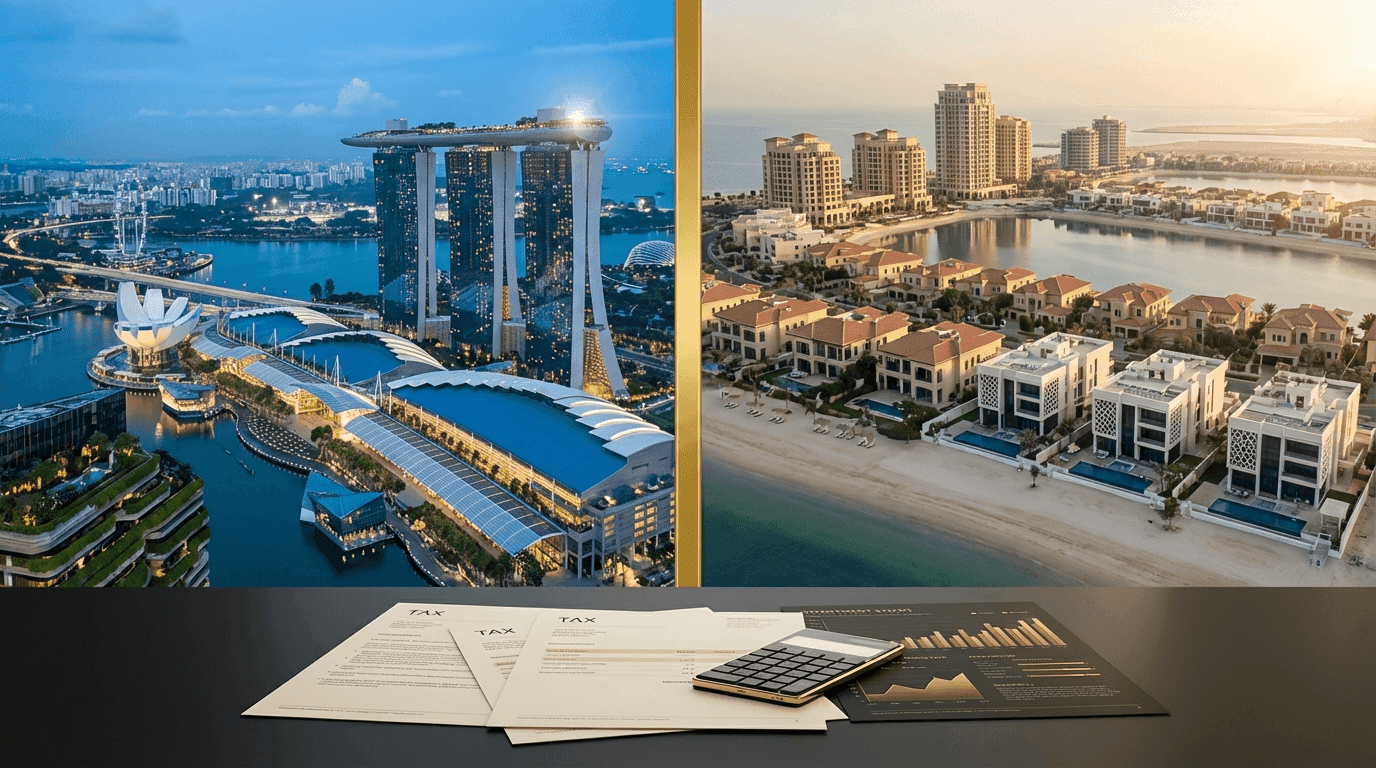
Tax Comparison: Owning Property in Singapore vs RAK - Complete Investor Guide
Discover the stark tax differences between Singapore and RAK property ownership. From zero property tax to capital gains exemptions, understand how each market impacts your returns.
Table Of Contents
- Understanding the Tax Landscape: Singapore vs RAK
- Property Acquisition Taxes and Fees
- Annual Property Taxation
- Rental Income Taxation
- Capital Gains and Disposal Costs
- Comparative Investment Scenarios
- Additional Considerations for Investors
- Making Your Investment Decision
For discerning international property investors weighing their options across Asia and the Middle East, the taxation framework can dramatically impact overall returns. Singapore and Ras Al Khaimah represent two compelling yet vastly different investment destinations—one renowned for stability and established governance, the other emerging as a tax-efficient haven with exceptional growth potential.
Whilst Singapore has long attracted global capital with its robust legal system and transparent market, its tax structure has become increasingly prohibitive for foreign investors. Multiple layers of stamp duties, annual property taxes, and income levies can consume a substantial portion of investment returns. In contrast, the UAE—and RAK specifically—offers a fundamentally different proposition: zero property tax, zero capital gains tax, and zero income tax on rental returns.
This comprehensive analysis examines every tax touchpoint across the property ownership lifecycle, from initial acquisition through to eventual disposal. Through detailed comparisons and real-world scenarios, we'll illuminate precisely how taxation influences net investment performance in each jurisdiction, enabling you to make informed decisions aligned with your financial objectives.
Understanding the Tax Landscape: Singapore vs RAK
The philosophical approaches to property taxation in Singapore and the UAE couldn't be more different. Singapore employs property taxation as both a revenue mechanism and a policy tool to moderate speculation and cool property markets. The government layers multiple taxes throughout the ownership cycle, with rates varying based on property type, usage, and owner residency status.
The UAE, by contrast, has built its economic model around attracting international capital and talent through fiscal advantages. There is no federal property tax system, no capital gains taxation, and no personal income tax on rental proceeds. RAK, as one of the UAE's seven emirates, maintains this tax-efficient framework whilst offering significantly lower entry costs than Dubai or Abu Dhabi.
For foreign investors particularly, this distinction becomes paramount. Singapore's Additional Buyer's Stamp Duty (ABSD) alone can add 60% to the purchase price for non-residents acquiring their second or subsequent property, whilst RAK imposes no such penalties.
Property Acquisition Taxes and Fees
Singapore Stamp Duties and ABSD
When acquiring property in Singapore, foreign investors encounter multiple upfront tax obligations that substantially increase the effective purchase price:
Buyer's Stamp Duty (BSD): This applies to all property purchases on a tiered structure:
- First SGD 180,000: 1%
- Next SGD 180,000: 2%
- Next SGD 640,000: 3%
- Next SGD 500,000: 4%
- Next SGD 1,500,000: 5%
- Remaining amount above SGD 3,000,000: 6%
For a SGD 2 million property (approximately AED 5.4 million), the BSD amounts to SGD 59,600 (approximately AED 161,000).
Additional Buyer's Stamp Duty (ABSD): This is where Singapore becomes particularly expensive for foreign investors:
- Foreign individuals purchasing any residential property: 60%
- Singapore Permanent Residents purchasing first property: 5%
- Singapore citizens purchasing second property: 20%
- Singapore citizens purchasing third and subsequent properties: 30%
For that same SGD 2 million property, a foreign buyer pays an additional SGD 1,200,000 (approximately AED 3,240,000) in ABSD—60% of the purchase price. Combined with BSD, the total stamp duties reach SGD 1,259,600 (AED 3,401,000), representing 63% of the property value.
Legal and Administrative Fees: Legal conveyancing typically costs between SGD 2,500-3,500, with additional costs for searches and disbursements.
RAK Transfer Fees and Registration Costs
The RAK acquisition cost structure is refreshingly straightforward:
Transfer Fee: A flat 2% of the property purchase price, payable to the RAK Real Estate Regulatory Authority. For an AED 2 million property, this amounts to AED 40,000.
Registration Fee: Typically around AED 2,000-5,000 depending on the property value and type.
Trustees Office Fee: A nominal fee of approximately AED 2,000-3,000 for processing the ownership transfer.
Agent Commission: Whilst not a tax, buyers should note that agent commissions (typically 2% plus VAT) may apply, though many developers include this in their pricing for off-plan projects.
For a like-for-like AED 2 million purchase, total acquisition costs in RAK amount to approximately AED 50,000-55,000—roughly 2.5% of the purchase price. This contrasts starkly with Singapore's 63% upfront tax burden on foreign buyers.
Annual Property Taxation
Singapore's Progressive Property Tax
Singapore imposes annual property tax based on the Annual Value (AV) of the property—the estimated annual rental income the property could fetch. The tax rates differ significantly between owner-occupied and investment properties.
Owner-Occupied Residential Properties: Progressive rates from 0% to 32%:
- First SGD 8,000 of AV: 0%
- Next SGD 22,000: 4%
- Next SGD 40,000: 6%
- Next SGD 40,000: 10%
- Next SGD 40,000: 14%
- Next SGD 40,000: 20%
- Above SGD 190,000: 32%
Non-Owner-Occupied Properties (Investment): Progressive rates from 12% to 36%:
- First SGD 30,000 of AV: 12%
- Next SGD 15,000: 16%
- Next SGD 15,000: 20%
- Next SGD 15,000: 24%
- Next SGD 15,000: 28%
- Above SGD 90,000: 36%
For an investment property with an AV of SGD 60,000 (SGD 5,000 monthly rental), the annual property tax calculation would be:
- First SGD 30,000 @ 12% = SGD 3,600
- Next SGD 15,000 @ 16% = SGD 2,400
- Next SGD 15,000 @ 20% = SGD 3,000
- Total: SGD 9,000 annually (approximately AED 24,300)
This represents 15% of the gross rental income, a substantial ongoing cost that directly impacts net rental yields.
RAK's Zero Property Tax Advantage
RAK, along with all UAE emirates, imposes zero annual property tax on residential real estate. Whether you occupy the property yourself or generate rental income, there is no recurring governmental levy based on property value or rental potential.
This creates a significant advantage for property investors in RAK, allowing them to retain 100% of their net rental income without annual tax erosion. The only recurring costs are:
- Service charges: For apartment communities, typically AED 8-15 per square foot annually
- District cooling charges: If applicable, usually consumption-based
- Utilities: Electricity and water for occupied properties
- Community association fees: For villa communities, varying by development
These operational costs are comparable to Singapore's maintenance and utilities, meaning the absence of property tax represents a pure saving for RAK investors.
Rental Income Taxation
Singapore Income Tax on Rental Returns
Rental income in Singapore is fully taxable as personal income. For non-residents, this is particularly significant:
Non-Resident Landlords: Taxed at 24% on gross rental income (with no deductions permitted), or at resident rates on net rental income (after permitted expenses) if this is more favourable. Net rental income is calculated by deducting allowable expenses including:
- Property tax
- Mortgage interest
- Insurance premiums
- Maintenance and repairs
- Agent fees
Most non-resident investors opt for the net rental income method, as the 24% gross rate would be prohibitive.
Resident Landlords: Taxed at progressive resident rates (up to 24% for income above SGD 320,000).
Example calculation for non-resident:
- Annual rental income: SGD 60,000 (AED 162,000)
- Less property tax: SGD 9,000
- Less mortgage interest: SGD 15,000
- Less insurance and maintenance: SGD 3,000
- Less agent fees: SGD 3,000
- Net rental income: SGD 30,000
- Tax at progressive rates (approximately 8-12% effective): SGD 3,000-3,600
Total tax burden on rental: Property tax of SGD 9,000 plus income tax of SGD 3,000-3,600 = SGD 12,000-12,600 (approximately AED 32,400-34,000), representing 20-21% of gross rental income.
UAE Tax-Free Rental Income
The UAE imposes zero income tax on rental proceeds. Landlords retain 100% of their net rental income after operational expenses, with no governmental levy whatsoever.
This creates a substantial advantage for property investors. Using the same rental figures:
- Annual rental income: AED 162,000
- Less service charges: AED 10,000
- Less maintenance reserve: AED 5,000
- Net rental income retained: AED 147,000
Compared to Singapore's AED 127,400-129,600 after-tax retention, RAK investors keep an additional AED 17,400-19,600 annually—a 13-15% improvement in net rental yield purely from tax efficiency.
For high-net-worth individuals with substantial rental portfolios, this advantage compounds dramatically. A portfolio generating AED 1 million in gross annual rental income would save approximately AED 200,000 annually in RAK compared to Singapore.
Capital Gains and Disposal Costs
Singapore Capital Gains:
Whilst Singapore doesn't impose a specific capital gains tax on property, profits from property sales may be taxed as income if the authorities determine the activity constitutes a trade or business. This is assessed based on:
- Holding period (sales within three years raise scrutiny)
- Frequency of transactions
- Circumstances of purchase and sale
- Financing arrangements
To discourage speculation, Singapore imposes a Seller's Stamp Duty (SSD) on residential properties sold within certain holding periods:
- Within 1 year: 12% of sale price or market value
- Within 2 years: 8%
- Within 3 years: 4%
For properties held beyond three years, there is no SSD. However, agent commissions (typically 2% of sale price) and legal fees (SGD 2,500-3,500) apply.
RAK Capital Gains:
The UAE imposes zero capital gains tax on property sales, regardless of holding period, appreciation percentage, or frequency of transactions. Whether you sell after six months or six years, the entire capital gain is yours to retain.
Disposal costs in RAK are minimal:
- Transfer fee: 2% of sale price (sometimes split with buyer, sometimes borne by seller depending on negotiation)
- NOC (No Objection Certificate): AED 500-2,000 from the developer
- Agent commission: 2% plus VAT if using an agent
For a property purchased at AED 2 million and sold at AED 2.6 million after five years:
Singapore scenario:
- Capital gain: SGD 600,000 (AED 1,620,000)
- SSD: SGD 0 (held beyond 3 years)
- Agent commission @ 2%: SGD 52,000 (AED 140,400)
- Legal fees: SGD 3,000 (AED 8,100)
- Net proceeds: SGD 545,000 (AED 1,471,500)
RAK scenario:
- Capital gain: AED 600,000
- Capital gains tax: AED 0
- Transfer fee @ 2%: AED 52,000 (often shared)
- Agent commission @ 2% + VAT: AED 53,040
- Net proceeds: AED 494,960
Whilst disposal costs are similar in percentage terms, the absence of any capital gains taxation in RAK means investors retain the entirety of their appreciation, whereas Singapore investors face potential taxation if authorities deem the activity as trading.
Comparative Investment Scenarios
Scenario 1: AED 2 Million Investment Property
Let's examine a foreign investor purchasing a AED 2 million property (approximately SGD 740,000) in each market, holding for five years as an investment.
Assumptions:
- Purchase price: AED 2 million (SGD 740,000)
- Annual rental yield: 8% gross (AED 160,000 / SGD 59,200)
- Annual appreciation: 5% compound
- Holding period: 5 years
- Sale price after 5 years: AED 2,553,000 (SGD 944,000)
Singapore - Total Tax Burden Over 5 Years:
Acquisition:
- BSD: AED 59,200
- ABSD (60%): AED 1,200,000
- Legal fees: AED 9,500
- Total acquisition costs: AED 1,268,700
Annual holding costs (averaged):
- Property tax: AED 24,300 annually
- Income tax on rental: AED 8,100 annually
- Total annual tax: AED 32,400
- 5-year total: AED 162,000
Disposal:
- Agent commission: AED 51,000
- Legal fees: AED 8,100
- Total disposal costs: AED 59,100
Total Singapore tax burden: AED 1,489,800
RAK - Total Tax Burden Over 5 Years:
Acquisition:
- Transfer fee (2%): AED 40,000
- Registration fees: AED 5,000
- Total acquisition costs: AED 45,000
Annual holding costs:
- Property tax: AED 0
- Income tax on rental: AED 0
- 5-year total: AED 0
Disposal:
- Transfer fee (2%): AED 51,000 (often shared)
- Agent commission: AED 53,000
- Total disposal costs: AED 104,000
Total RAK tax and fee burden: AED 149,000
Tax Savings in RAK: AED 1,340,800 (approximately 90% lower total tax burden)
Scenario 2: Owner-Occupier Purchase
For an owner-occupier purchasing their primary residence:
Singapore benefits:
- Lower ABSD (though still 60% for foreigners on residential)
- Owner-occupier property tax rates (0-32% vs 12-36%)
- No rental income taxation (not applicable)
RAK benefits:
- Same low acquisition costs (2%)
- Zero annual property tax regardless of occupancy
- No capital gains on eventual sale
Even for owner-occupiers, RAK's tax advantage remains substantial. A foreign buyer faces the same 60% ABSD in Singapore, whilst RAK's 2% transfer fee applies universally. The annual property tax savings, whilst smaller for owner-occupiers, still accumulate significantly over a typical 5-10 year ownership period.
Additional Considerations for Investors
Beyond direct taxation, several factors influence the comparative investment proposition:
Inheritance and Estate Planning:
Singapore imposes no inheritance tax or estate duty, having abolished it in 2008. The UAE similarly has no inheritance taxation. However, succession laws differ significantly—Singapore follows common law principles, whilst the UAE applies Sharia law unless the deceased registered a will at the DIFC Wills Service Centre (for Dubai) or equivalent structures.
Wealth Tax and Global Tax Reporting:
Neither Singapore nor the UAE imposes wealth taxes on property holdings. However, investors must consider their home country tax obligations. Many jurisdictions tax worldwide income and capital gains, potentially negating some advantages. Professional tax advice considering your specific residency and domicile is essential.
Corporate Ownership Structures:
Singapore allows corporate ownership with companies paying corporate tax rates (17% on profits). The UAE introduced corporate taxation in 2023 at 9% for profits exceeding AED 375,000, though rental income from real estate owned by individuals remains exempt. Specialist structures can optimise taxation in both jurisdictions.
Future Tax Policy Risk:
Singapore has progressively increased property taxation over the past decade, particularly the ABSD, which rose from 10% in 2011 to 60% in 2023 for foreign buyers. This trajectory suggests further increases remain possible, particularly during property market upswings.
The UAE has maintained its zero-tax stance for decades as a core competitive advantage, though the recent introduction of corporate taxation demonstrates policy can evolve. However, residential property taxation for individuals appears protected as a fundamental pillar of the UAE's economic model.
Financing Implications:
Singapore's higher upfront costs significantly impact leveraged investments. The 60% ABSD must typically be paid from equity, substantially increasing the deposit requirement and reducing leverage potential. RAK's lower entry costs enable higher loan-to-value financing strategies.
Market Maturity and Liquidity:
Singapore offers a highly mature, liquid market with transparent pricing and established legal frameworks. RAK represents an emerging market with exceptional growth potential but potentially lower liquidity and developing regulatory structures. The tax advantages in RAK must be weighed against these market characteristics based on your investment horizon and risk tolerance.
Making Your Investment Decision
The taxation comparison reveals a clear mathematical advantage for RAK across nearly every metric. Foreign investors face an immediate 60% ABSD penalty in Singapore before considering ongoing property taxes and income taxation on rentals. Over a typical five-year holding period, total tax and fee burdens in Singapore can exceed 90% of the equivalent costs in RAK.
For investment properties specifically, RAK's combination of zero property tax, zero income tax on rentals, and zero capital gains tax creates a structurally superior environment for wealth accumulation. The tax savings alone can represent 15-20% of gross rental income annually, compounding significantly over longer holding periods.
However, taxation represents just one dimension of investment decision-making. Singapore's established governance, legal certainty, market maturity, and international prestige carry value that extends beyond pure tax efficiency. RAK offers exceptional tax advantages combined with strong growth fundamentals, emerging infrastructure, and attractive entry valuations—a compelling proposition for investors prioritising returns and capital appreciation.
At Azimira Real Estate, we specialise in identifying exceptional opportunities within RAK's burgeoning property market, with particular expertise in exclusive off-plan projects offering superior capital growth potential. Our deep market knowledge and access to pre-launch opportunities enable our clients to maximise the tax advantages RAK offers whilst securing properties positioned for exceptional appreciation.
The taxation framework governing property ownership creates a fundamental structural advantage for RAK over Singapore, particularly for foreign investors. Whilst Singapore imposes acquisition taxes exceeding 60% of property value, annual property taxes up to 36%, and income taxation on rental proceeds up to 24%, RAK offers zero property tax, zero income tax, and zero capital gains tax—a truly exceptional environment for property investment.
For discerning investors seeking to maximise net returns whilst building wealth through real estate, the RAK proposition combines tax efficiency with strong growth fundamentals and attractive valuations. The savings from tax advantages alone can exceed AED 1.3 million over a five-year holding period on a AED 2 million investment, capital that can be redeployed for portfolio expansion or retained as enhanced returns.
As global tax environments become increasingly complex and burdensome, the UAE's commitment to maintaining its tax-advantaged status creates enduring value for international investors. RAK, as an emerging emirate within this framework, offers the optimal combination of fiscal benefits and growth potential for those willing to embrace an emerging market with exceptional fundamentals.
Ready to Explore RAK's Tax-Advantaged Property Market?
At Azimira Real Estate, we provide discerning investors with exclusive access to RAK's most promising off-plan developments and luxury properties. Our expertise in the RAK market, combined with our understanding of international tax considerations, positions us as your ideal partner in building a tax-efficient, high-growth property portfolio.
Discover pre-launch opportunities offering exceptional capital appreciation potential whilst benefiting from the UAE's unparalleled tax advantages. Our tailored investment strategies consider your specific financial objectives, risk profile, and tax circumstances to identify opportunities aligned with your wealth-building goals.
Contact our team today to schedule a confidential consultation and explore how RAK property investment can enhance your international portfolio whilst minimising your global tax burden.
Related articles
What Counts as Good Real Estate Investments in 2026
Learn what makes good real estate investments in 2026, from net yield and demand signals to legal checks, exit plans and UAE opportunities.

Investors Needed for Real Estate? Start With This Plan
Investors needed for real estate? Use this practical plan to define strategy, numbers, due diligence and partners before raising capital.

Investment Marketing Tactics Developers Use at Launch
Understand investment marketing tactics developers use at launch, from scarcity to incentives, and learn how to assess UAE off-plan deals.