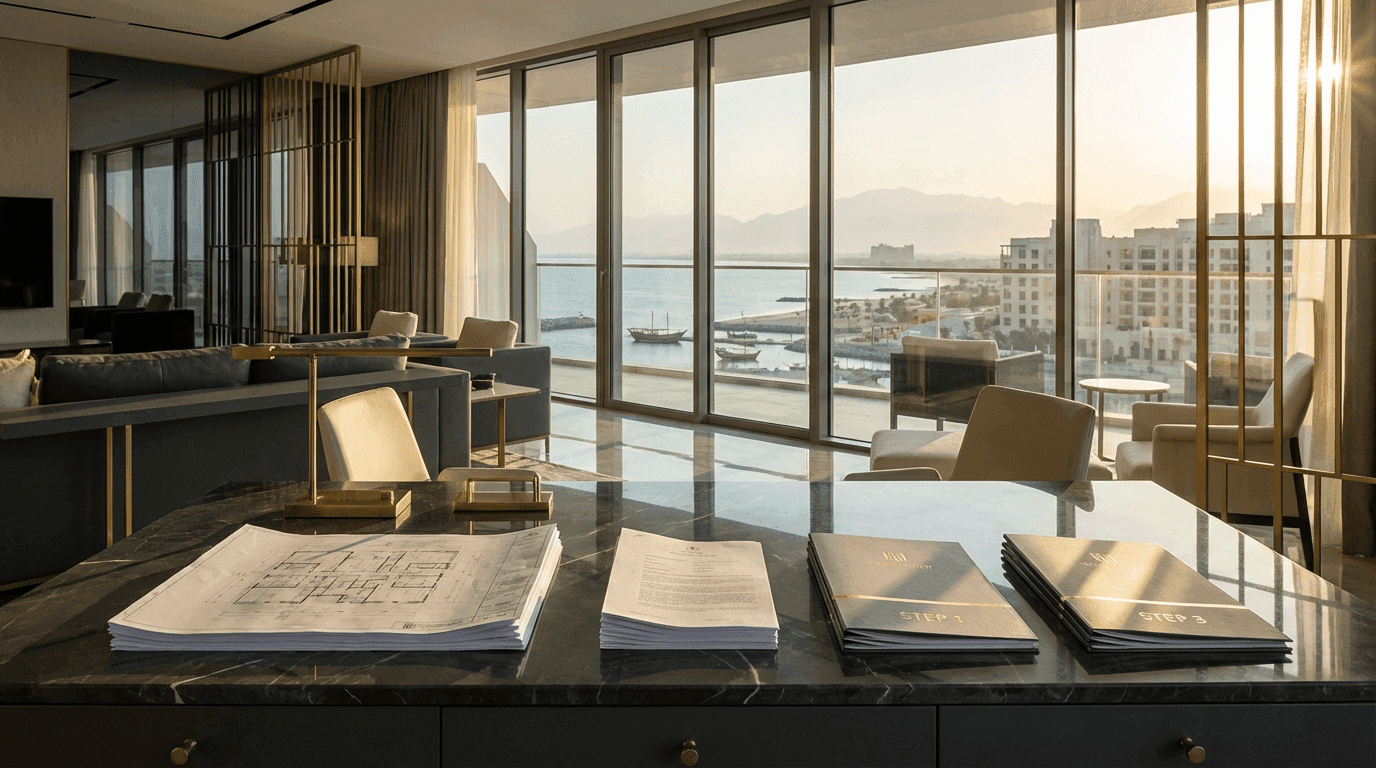
The 3-Step Formula to Price Your RAK Rental Right: Maximise Returns
Discover the proven 3-step formula to price your Ras Al Khaimah rental property correctly. Maximise rental yields and minimise vacancy with expert pricing strategies.
Table Of Contents
- Why Proper Rental Pricing is Critical in RAK's Emerging Market
- Step 1: Conduct Comprehensive Market Research
- Step 2: Calculate Your Optimal Price Range
- Step 3: Position and Adjust Strategically
- Common Pricing Mistakes RAK Landlords Make
- How RAK's Unique Market Dynamics Affect Pricing
- Final Thoughts: The Long-Term Pricing Strategy
Ras Al Khaimah's property market has experienced remarkable transformation over recent years, evolving from an overlooked emirate into one of the UAE's most promising investment destinations. With rental yields in RAK consistently outperforming Dubai and Abu Dhabi—often reaching 8-10% compared to Dubai's 5-7%—property investors are increasingly recognising the exceptional opportunities this northern emirate presents. However, achieving these impressive returns hinges entirely on one critical factor: pricing your rental property correctly from the outset.
Setting the right rental price is both an art and a science. Price too high, and your property languishes vacant whilst competitors secure tenants and generate returns. Price too low, and you leave thousands of dirhams on the table annually, undermining your investment's performance and long-term capital appreciation potential. In RAK's rapidly developing market, where new communities are emerging and tenant expectations are evolving, traditional pricing approaches often fall short.
This comprehensive guide reveals the proven 3-step formula that successful RAK property investors utilise to price their rentals strategically. Whether you've invested in a luxury waterfront apartment in Mina Al Arab, a family villa in Al Hamra Village, or an off-plan property in one of RAK's exciting new developments, this methodology will help you maximise rental income, minimise vacancy periods, and position your investment for optimal performance in both the short and long term.
The 3-Step Formula to Price Your RAK Rental Right
Maximise rental yields and minimise vacancy with expert pricing strategies
Your Proven Pricing Formula
Conduct Comprehensive Market Research
Gather intelligence to understand your competitive landscape
Calculate Your Optimal Price Range
Establish strategic boundaries for negotiation and decision-making
Position and Adjust Strategically
Monitor market response and adapt with data-driven precision
Common Pricing Mistakes to Avoid
Strategic Adjustment Timeline
Timeline in weeks: Properties vacant beyond six weeks face increasing market perception challenges
Ready to Maximise Your RAK Investment Returns?
Partner with RAK specialists who understand the market dynamics that drive exceptional yields
Expert guidance throughout your entire property investment journey
Why Proper Rental Pricing is Critical in RAK's Emerging Market
Ras Al Khaimah occupies a unique position within the UAE property landscape. Unlike the mature, established markets of Dubai and Abu Dhabi, RAK is experiencing rapid development alongside growing tenant sophistication. This dynamic environment creates both opportunities and challenges for property investors seeking to optimise rental returns.
The emirate's rental market has witnessed significant evolution over the past three years. International companies establishing regional headquarters in RAK, the expansion of tourism infrastructure, and improved connectivity through road networks have all contributed to increasing demand for quality rental accommodation. However, this growth has not been uniform across all property types and locations, making generalised pricing approaches ineffective.
Proper pricing directly impacts three critical investment metrics. Firstly, it determines your vacancy rate—research consistently demonstrates that competitively priced properties secure tenants 40-60% faster than overpriced alternatives. Secondly, it influences tenant quality, as appropriately priced properties attract serious, financially stable tenants rather than bargain hunters who may prove problematic. Thirdly, it establishes your property's market position for future rental negotiations and eventual resale value.
In RAK's emerging market, where comparable properties may be limited and pricing data less readily available than in Dubai, a systematic approach becomes essential. The following three-step formula provides the rigorous methodology needed to navigate these complexities successfully.
Step 1: Conduct Comprehensive Market Research
Effective rental pricing begins with thorough market intelligence. Unlike established markets with abundant historical data, RAK requires investors to gather information from multiple sources and synthesise insights carefully.
Analyse Comparable Properties
Begin by identifying 8-12 properties that closely match yours across key variables. The most critical comparability factors include:
- Location specificity: Properties within the same development or within a 2-kilometre radius
- Property type and size: Match bedroom count, built-up area (within 10%), and property category (apartment, townhouse, villa)
- Age and condition: Properties of similar age or renovation status
- Amenities and facilities: Swimming pools, gymnasiums, parking spaces, and community features
- View and orientation: Sea views, golf course views, or garden orientations significantly impact value
Document current asking prices for available rentals and, crucially, actual transacted prices for recently let properties. Asking prices typically run 5-15% higher than final transaction prices, so relying solely on advertised rates will skew your pricing upward. Estate agents with RAK specialisation can provide valuable transaction data that public listings don't reveal.
Understand Seasonal Demand Patterns
RAK's rental market exhibits distinct seasonal characteristics that differ from Dubai's patterns. The emirate experiences peak demand during three key periods: September-October (families seeking accommodation before the school year), January-February (expatriates relocating after year-end), and April-May (preceding the summer exodus but capturing early movers).
Conversely, June-August typically sees reduced demand as many expatriates travel and fewer relocations occur during summer months. Properties becoming available during off-peak periods may require modest pricing adjustments (3-5% below peak-season rates) to maintain competitive positioning and minimise vacancy.
Evaluate Tenant Demographics and Preferences
RAK's tenant population comprises several distinct segments, each with different priorities and price sensitivities. Families typically prioritise school proximity, community safety, and child-friendly amenities, showing willingness to pay premium rates for properties in established communities like Al Hamra Village. Young professionals and couples often seek modern apartments with lifestyle amenities, demonstrating strong demand for waterfront developments in Mina Al Arab and Al Marjan Island.
Understanding which demographic your property naturally appeals to enables more targeted pricing that resonates with actual tenant priorities rather than generic market averages. A three-bedroom townhouse near good schools commands different pricing dynamics than a one-bedroom apartment with marina views, even if crude per-square-foot calculations suggest otherwise.
Research Infrastructure and Development Plans
RAK's ongoing development significantly impacts rental values across different areas. Properties near planned infrastructure improvements—new road connections, upcoming shopping centres, announced leisure facilities—often justify premium pricing that reflects imminent value enhancement. Conversely, areas experiencing substantial new supply may face temporary pricing pressure as additional inventory enters the market.
The Investing in RAK Property guide provides detailed insights into development pipelines and infrastructure plans that informed investors utilise when assessing rental pricing sustainability.
Step 2: Calculate Your Optimal Price Range
With comprehensive market research completed, the next step involves calculating a strategic price range rather than a single fixed price. This approach provides flexibility whilst maintaining investment discipline.
Establish Your Pricing Floor
Your pricing floor represents the minimum rent that satisfies your investment objectives. Calculate this by determining your annual ownership costs and desired return:
Annual Ownership Costs typically include:
- Service charges (AED 8-25 per square foot annually, varying by development)
- Property management fees (typically 5-8% of annual rent if using professional management)
- Maintenance reserve (budget 1-2% of property value annually)
- Chiller fees or DEWA charges (if not tenant-paid)
- Home insurance (approximately AED 1,500-3,500 annually)
Add these costs to your target return on investment. If you've invested AED 800,000 and seek an 8% gross yield (AED 64,000 annually), and your annual costs total AED 16,000, your pricing floor becomes AED 80,000 annually (AED 6,667 monthly) to achieve your net return target.
This floor price represents your walk-away point. Renting below this threshold undermines your investment thesis and suggests either market timing issues or incorrect initial acquisition decisions.
Determine Your Pricing Ceiling
Your pricing ceiling reflects the maximum rent achievable given current market conditions and your property's competitive position. This derives from your comparable property analysis, specifically:
- Identify the highest rents achieved by genuinely comparable properties (not aspirational asking prices)
- Assess whether your property offers superior features justifying premium positioning
- Consider current market velocity—in rising markets, ceilings expand; in softening markets, they contract
Be rigorously honest when evaluating your property's competitive advantages. Landlords frequently overestimate their property's relative appeal, leading to extended vacancies. Unless your property offers genuinely distinctive features—superior views, recent high-quality renovations, unique amenities—pricing at the market ceiling proves counterproductive.
Create Your Strategic Range
Your optimal pricing range sits between these floor and ceiling parameters. For most RAK properties, this range spans 8-12%, providing sufficient flexibility for negotiation whilst maintaining investment integrity. For example, if your floor is AED 65,000 annually and market ceiling is AED 75,000, your strategic range becomes AED 68,000-74,000.
This range serves multiple purposes: it guides your listing price (typically positioned in the upper third), establishes negotiation boundaries, and provides decision-making clarity when evaluating tenant offers.
Adjust for Property-Specific Factors
Fine-tune your calculated range by considering factors that differentiate your specific property:
- Furnishing status: Furnished properties in RAK typically command 15-25% premiums over unfurnished equivalents, though demand varies significantly by location and tenant demographic
- Parking allocation: Additional parking spaces add value, particularly for family properties and villa communities
- Maintenance condition: Newly renovated properties justify 8-12% premiums; properties requiring cosmetic updates should price 5-10% below comparable well-maintained alternatives
- Tenure flexibility: Willingness to offer flexible lease terms (6-month options, corporate lease structures) may enable slight premium pricing for tenants valuing this flexibility
Step 3: Position and Adjust Strategically
With your optimal price range established, the final step involves strategic market positioning and responsive adjustment based on market feedback.
Set Your Initial Listing Price
Your listing price represents your opening position in eventual negotiations. In RAK's current market environment, strategic initial positioning follows these principles:
For newly completed or off-plan properties entering the rental market: List in the upper quarter of your range (approximately 5-8% above your target rent). These properties benefit from novelty appeal and attract tenants seeking the latest developments, justifying slightly aggressive initial pricing.
For established properties in competitive locations: List in the middle of your range (2-4% above target). This positioning signals quality whilst remaining competitively accessible, typically generating viewing requests within 5-7 days of listing.
For properties in markets with significant new supply: Consider listing at the lower third of your range to secure tenants quickly and avoid extended vacancy. In RAK's evolving market, three months of vacancy costs more than modest rent concessions.
Monitor Market Response Systematically
Once listed, track specific metrics that indicate pricing accuracy:
- Viewing request rate: Well-priced RAK properties typically generate 3-6 serious viewing requests within the first two weeks
- Viewer feedback: Agent feedback about pricing perceptions provides valuable market intelligence
- Competitor activity: Monitor how comparable properties are performing; multiple similar properties securing tenants whilst yours remains vacant signals pricing misalignment
- Offer quality: Low-ball offers (20%+ below asking) suggest significant overpricing; absence of any offers within three weeks indicates similar issues
Establish decision triggers before listing. For example: "If no serious viewings within 14 days, reduce price by 4%. If viewings but no offers within 30 days, reduce by additional 3%."
Execute Strategic Adjustments
When market response indicates pricing adjustment necessary, implement changes decisively:
First adjustment (after 2-3 weeks): Reduce by 3-5% to signal fresh pricing whilst maintaining positioning within your strategic range. Ensure agents actively re-promote the adjusted listing to prospects who previously viewed.
Second adjustment (after 5-6 weeks): If necessary, implement a more substantial reduction of 5-8%, potentially bringing pricing to the lower end of your range. At this point, minimising vacancy takes precedence over marginal rent optimisation.
Beyond six weeks: Properties vacant beyond six weeks face increasing challenges as they develop a "stale" market perception. Consider whether non-price factors (presentation, marketing quality, tenant requirements) require attention alongside further pricing adjustments.
Leverage Professional Expertise
RAK's market complexity often justifies professional property management and leasing expertise. Specialists with deep RAK knowledge bring several advantages: established tenant networks, nuanced understanding of micro-market pricing dynamics, professional presentation and marketing capabilities, and negotiation expertise that often secures better net outcomes than owner-managed approaches.
Exploring Exclusive RAK Off-Plan Projects with professional management structures can provide valuable insights into how experienced operators approach rental positioning and tenant acquisition in the emirate's premium segments.
Common Pricing Mistakes RAK Landlords Make
Understanding frequent pricing errors helps investors avoid costly mistakes that undermine rental performance.
Anchoring to Purchase Price
Many investors calculate desired rent by applying target yield percentages to their purchase price, ignoring actual market conditions. A property purchased at AED 900,000 doesn't automatically command higher rent than an identical property purchased at AED 750,000. The market prices rental accommodation based on utility value to tenants, not landlord acquisition costs. Your purchase price determines your investment return but shouldn't directly determine market rent.
Overlooking Vacancy Costs
Landlords frequently focus on headline rental rates whilst neglecting vacancy impact on actual returns. A property rented at AED 70,000 with consistent occupancy delivers superior returns to one theoretically priced at AED 75,000 but vacant 15% of the time (effective annual rent: AED 63,750). In RAK's emerging market, minimising vacancy through competitive pricing typically optimises long-term returns more effectively than maximising per-month rent.
Ignoring Market Momentum
Property markets exhibit momentum that savvy investors recognise and respond to. In strengthening markets with rising rents, initial conservative pricing can be adjusted upward upon renewal. Conversely, in softening markets, maintaining previous year's rents often proves unrealistic. RAK's market has shown strong momentum in certain segments (luxury waterfront, family villas) whilst others face supply pressures. Segment-specific understanding prevents costly misjudgements.
Neglecting Presentation Value
Investors sometimes underprice well-presented properties or overprice poorly presented ones. Professional photography, minor cosmetic improvements (fresh paint, modern fixtures, thorough cleaning), and strategic staging can justify 5-10% rent premiums that far exceed the modest investment required. Conversely, neglected properties with amateur marketing rarely achieve market rates regardless of underlying value.
Inflexibility During Negotiations
Approaching rental negotiations with excessive rigidity frequently results in lost opportunities. Tenants offering 95% of asking price with strong credentials, stable employment, and immediate availability often represent superior opportunities compared to holding out for full price, risking additional vacancy. Successful investors recognise that optimal outcomes emerge from balancing multiple variables, not single-minded focus on maximum rent.
How RAK's Unique Market Dynamics Affect Pricing
Ras Al Khaimah's property market exhibits several distinctive characteristics that informed pricing strategies must accommodate.
The Emerging Market Premium Paradox
Counterintuitively, RAK's emerging status creates both pricing opportunities and constraints. Established communities with proven track records (Al Hamra Village, certain Mina Al Arab phases) command premium pricing due to scarcity of quality alternatives. However, newer developments often face scepticism from tenants unfamiliar with the areas, requiring modest pricing discounts to overcome perceived risk—even when offering superior specifications.
This paradox means investors should resist assuming newer automatically commands higher rents. Community reputation, established amenities, and proven management frequently outweigh newer construction in tenant decision-making.
The Dubai Comparison Effect
Many RAK tenants relocate from Dubai, bringing pricing expectations shaped by that market. This creates opportunities, as comparable properties cost significantly less in RAK, but also challenges when tenants apply Dubai-centric location hierarchies that don't translate accurately. Effective pricing acknowledges these perceptions whilst educating prospects about RAK's specific value proposition: superior space, lower density, lifestyle amenities, and exceptional value ratios.
Limited Comparable Data Challenges
RAK's smaller market scale means fewer comparable transactions, making pricing analysis more challenging than in Dubai. When facing limited comparables, expand your research radius, consider older transaction data with appropriate adjustments for market movement, and weight expert agent opinion more heavily. This data scarcity reinforces the value of working with RAK specialists who maintain comprehensive transaction databases beyond publicly available information.
Infrastructure Development Impact
RAK's ongoing infrastructure development creates pricing volatility that investors must navigate. Areas near new developments (shopping centres, schools, leisure facilities) may justify anticipatory pricing premiums, whilst areas absorbing substantial new supply face temporary pricing pressure. Successful investors monitor development pipelines and adjust pricing expectations accordingly, recognising that micro-market conditions vary significantly across the emirate.
Final Thoughts: The Long-Term Pricing Strategy
Pricing your RAK rental property correctly extends beyond the initial letting. Sophisticated investors approach rental pricing as an ongoing strategic process that evolves with market conditions, property lifecycle, and investment objectives.
Annual renewals present opportunities to optimise pricing based on market movements and tenant relationships. Strong tenants maintaining properties well and paying promptly represent valuable assets worth retaining through modest pricing concessions if market conditions soften. Conversely, problematic tenancies may justify non-renewal regardless of rental rate, as tenant quality impacts property condition and long-term value.
RAK's property market continues maturing rapidly, with improving infrastructure, expanding amenities, and growing recognition amongst UAE residents and investors. Properties positioned correctly today can benefit from market appreciation whilst generating strong current yields—the dual return proposition that makes RAK increasingly attractive.
The three-step formula outlined here—comprehensive market research, calculated price range determination, and strategic positioning with responsive adjustment—provides the framework for rental pricing success. However, market expertise, local knowledge, and investment experience significantly enhance outcomes. Investors seeking to maximise their RAK property returns benefit enormously from partnering with specialists who understand the emirate's unique dynamics and possess the market intelligence networks that inform optimal decision-making.
By applying this systematic approach whilst remaining responsive to market feedback, RAK property investors can achieve the exceptional rental yields that make this emirate one of the UAE's most compelling investment opportunities. The difference between mediocre and outstanding investment performance often comes down to this foundational decision: pricing your rental right from the very beginning.
Pricing your Ras Al Khaimah rental property correctly represents one of the most consequential decisions affecting your investment's performance. The three-step formula—conducting comprehensive market research, calculating your optimal price range based on both investment requirements and market realities, and positioning strategically with responsive adjustments—provides a robust methodology for maximising rental yields whilst minimising vacancy risks.
RAK's emerging market status creates distinctive opportunities for investors who approach rental pricing with sophistication and market understanding. The emirate's exceptional rental yields, growing infrastructure, and increasing tenant demand make it one of the UAE's most attractive property investment destinations. However, realising these opportunities requires moving beyond simplistic pricing approaches and embracing the nuanced, data-driven methodology that successful investors employ.
Remember that rental pricing isn't a one-time decision but an ongoing strategic process. Market conditions evolve, new supply enters the market, infrastructure develops, and tenant preferences shift. Investors who monitor these dynamics and adjust their approach accordingly consistently outperform those who set prices and hope for the best.
Whether you're preparing to let your first RAK property or optimising a portfolio of rental investments, the principles outlined in this guide provide the foundation for pricing excellence. Combined with quality property presentation, professional marketing, and responsive tenant management, correct pricing positions your investment for both immediate income generation and long-term capital appreciation in one of the region's most dynamic property markets.
Maximise Your RAK Investment Returns
Pricing your rental property correctly is just one element of successful property investment in Ras Al Khaimah. At Azimira Real Estate, we specialise in identifying exceptional RAK investment opportunities and helping our clients maximise returns throughout the entire investment lifecycle.
Our deep market expertise, exclusive access to pre-launch and off-market properties, and comprehensive understanding of RAK's rental dynamics enable us to guide investors towards opportunities with outstanding capital growth potential and superior rental yields.
Whether you're considering your first RAK property investment or looking to optimise your existing portfolio, our team provides the market intelligence and strategic guidance that transforms good investments into exceptional ones.
Contact our RAK investment specialists today to discover how we can help you achieve your property investment objectives in one of the UAE's most promising markets.
Related articles
What Counts as Good Real Estate Investments in 2026
Learn what makes good real estate investments in 2026, from net yield and demand signals to legal checks, exit plans and UAE opportunities.

Investors Needed for Real Estate? Start With This Plan
Investors needed for real estate? Use this practical plan to define strategy, numbers, due diligence and partners before raising capital.

Investment Marketing Tactics Developers Use at Launch
Understand investment marketing tactics developers use at launch, from scarcity to incentives, and learn how to assess UAE off-plan deals.