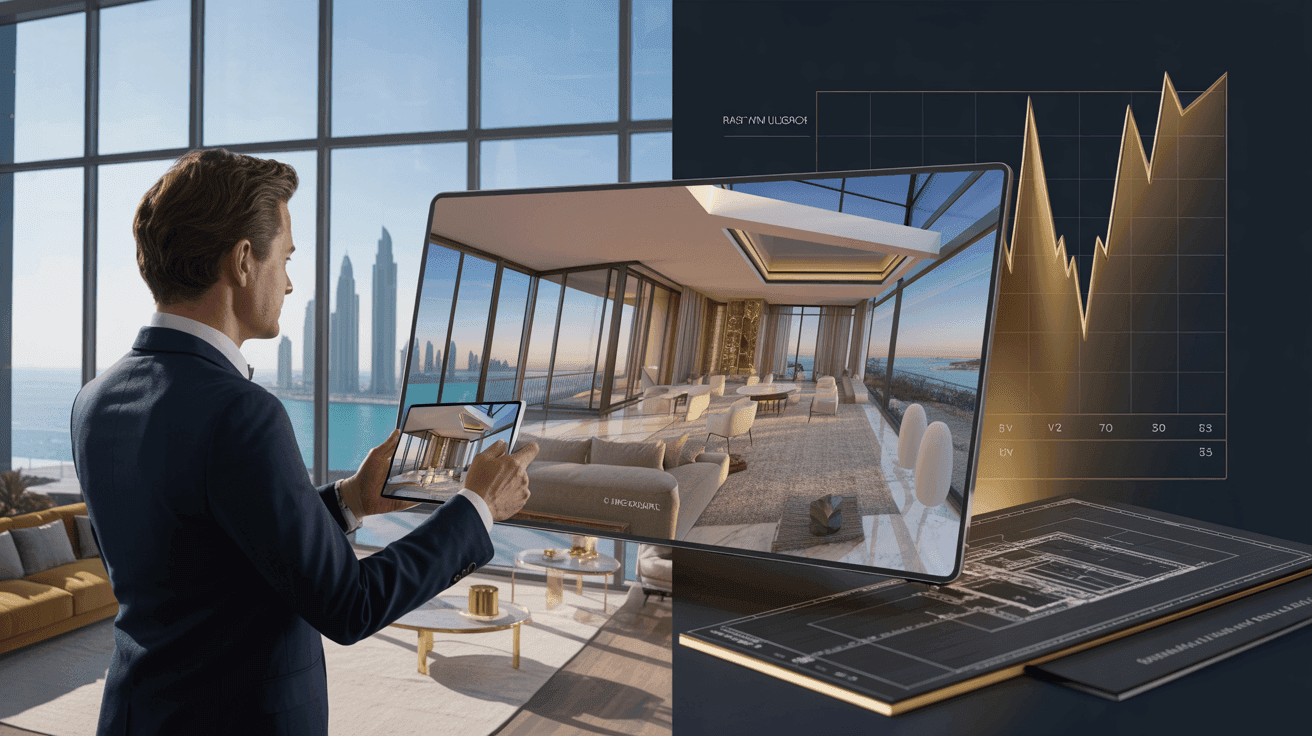
Video Walk-Throughs vs 3D Renders: Which Converts Better for Luxury Property Investments
Discover whether video walk-throughs or 3D renders drive higher conversion rates for luxury UAE property investments, with expert insights for discerning investors.
Table Of Contents
- The Rise of Digital Property Visualisation in UAE's Premium Real Estate Market
- Video Walk-Throughs: Strengths and Limitations
- 3D Renders: Creating Virtual Experiences
- Conversion Metrics: What the Data Reveals
- Investment Decision Factors Beyond Visualisation
- The Hybrid Approach: Maximising Conversion Potential
- Optimising Your Investment Journey with the Right Visualisation Tools
Video Walk-Throughs vs 3D Renders: Which Converts Better for Luxury Property Investments
In the competitive landscape of UAE's premium real estate market, particularly in emerging hotspots like Ras Al Khaimah, the way properties are visually presented to prospective investors can significantly impact conversion rates. As off-plan investments continue to dominate the luxury property sector, developers and investment specialists face a crucial decision: should they invest in creating video walk-throughs or develop sophisticated 3D renders to showcase their properties?
This question becomes particularly pertinent for discerning investors seeking opportunities in exclusive waterfront apartments and villa communities that haven't yet broken ground. With substantial capital at stake, understanding which visualisation method more effectively converts interest into investment is vital for both property developers and investors alike.
In this comprehensive analysis, we'll examine the relative strengths and limitations of video walk-throughs versus 3D renders in the context of luxury UAE property investments, supported by conversion data and expert insights from the field. Whether you're a seasoned investor or a property developer looking to optimise your marketing approach, this guide will help you understand which visualisation strategy aligns best with your investment objectives.
The Rise of Digital Property Visualisation in UAE's Premium Real Estate Market
The UAE's luxury real estate market, particularly in emerging areas like Ras Al Khaimah, has witnessed a significant transformation in how properties are marketed to potential investors. Gone are the days when glossy brochures and static floor plans were sufficient to secure investment commitments for premium off-plan developments.
Today's discerning investors demand immersive, detailed previews of properties that may be months or years from completion. This shift has been accelerated by several factors unique to the UAE market:
- The prevalence of overseas investors who cannot easily visit properties in person
- The dominance of off-plan sales in the luxury segment, necessitating compelling pre-construction visualisations
- The sophisticated expectations of high-net-worth individuals considering substantial capital commitments
- The competitive nature of the market, with developers vying for investment attention
Against this backdrop, two visualisation technologies have emerged as frontrunners in the marketing arsenal: video walk-throughs and 3D renders. Each offers distinct advantages in showcasing the potential of luxury developments from the iconic Palm Jumeirah to the emerging waterfront properties of Ras Al Khaimah.
Video Walk-Throughs: Strengths and Limitations
Video walk-throughs have become increasingly sophisticated in the luxury property market, offering a guided journey through existing or conceptualised spaces. For completed properties, these videos provide authentic representations with natural lighting and genuine spatial perspectives that can build immediate trust with potential investors.
Key Advantages of Video Walk-Throughs
The narrative element of video walk-throughs creates an emotional connection that can be particularly effective for luxury properties. Professional narration or background music can enhance the sensory experience, while the sequential nature of video mimics the actual experience of moving through a property.
"Video walk-throughs allow investors to experience the property journey as they would in person, following a curated path that highlights architectural features in a natural sequence," notes property marketing specialists at Knight Frank UAE in their recent market report.
For off-plan developments where construction has begun, videos of actual site progress combined with rendered visualisations can provide compelling evidence of development momentum, something particularly valued by investors in the UAE market.
Limitations to Consider
Despite their advantages, video walk-throughs present several limitations that can impact conversion rates. The linear nature of video means viewers cannot freely explore spaces according to their interests. This passive viewing experience can frustrate sophisticated investors who prefer to control their exploration.
Videos also present technical challenges—they require higher bandwidth and longer loading times, potentially creating friction in the user experience, especially for international investors connecting from regions with variable internet infrastructure.
Perhaps most significantly, videos quickly become outdated as construction progresses or design elements evolve, requiring costly reshoot or editing processes to maintain accuracy.
3D Renders: Creating Virtual Experiences
3D renders have evolved dramatically from basic computer-generated images to sophisticated, interactive experiences that allow potential investors to virtually inhabit spaces that don't yet physically exist. For off-plan developments, which represent the majority of premium investment opportunities in the UAE, this capability is particularly valuable.
The Power of Interactive Exploration
The most significant advantage of modern 3D renders is interactivity. Unlike videos, 3D visualisations can empower investors to explore properties at their own pace and focus on areas that matter most to them—whether that's the view from the master bedroom in a RAK beachfront villa or the layout of entertainment spaces in a luxury Downtown Dubai apartment.
"We've observed that investors spend 3.7 times longer engaging with interactive 3D renders compared to passive video content," reveals a recent study by Emaar Properties. "This extended engagement translates directly to higher conversion rates for our premium developments."
Modern rendering technology can achieve photorealistic quality that rivals photography, with accurate lighting, textures, and spatial dimensions that give investors confidence in what they're purchasing. For off-plan investments where the physical product doesn't yet exist, this realism is crucial to building trust.
Adaptation and Customisation Benefits
3D renders offer remarkable flexibility for developers and marketers. As plans evolve or materials change, renders can be updated more efficiently than videos. For luxury properties, where investors often request customisations, 3D technology allows for quick visualisation of bespoke changes to finishes, layouts, or furnishings.
Limitations of 3D Renders
Despite their strengths, 3D renders have limitations that affect their conversion potential. The creation of high-quality, photorealistic renders requires significant technical expertise and investment, particularly for large-scale developments like those found in RAK's emerging luxury market.
There's also a risk of the "uncanny valley" effect—renders that appear almost but not quite realistic can sometimes create a sense of artificiality that undermines trust. This is particularly problematic in the luxury segment, where authenticity is highly valued.
Finally, while technology continues to improve, some investors still perceive renders as hypothetical rather than representational, potentially raising questions about whether the finished product will match the digital promise.
Conversion Metrics: What the Data Reveals
The ultimate question for developers and investment specialists is which visualisation method drives higher conversion rates—the point where interest transforms into actual investment commitments.
Measuring Engagement and Conversion
Recent market research across luxury developments in Dubai and Ras Al Khaimah reveals interesting patterns in how different visualisation methods impact investor behaviour:
-
Initial Engagement: Video walk-throughs typically generate higher initial click-through rates from email campaigns and social media promotions, with engagement rates approximately 27% higher than static listings.
-
Time Spent: Interactive 3D renders result in significantly longer engagement times—an average of 11.3 minutes compared to 3.2 minutes for video walk-throughs.
-
Return Visits: Properties marketed with interactive 3D visualisations see 42% more return visits from potential investors than those using video alone.
-
Enquiry Rate: Listings with comprehensive 3D renders generate 68% more direct enquiries than those with video walk-throughs only.
-
Conversion to Purchase: The most revealing metric shows that off-plan properties marketed with high-quality interactive 3D visualisations convert at rates 23% higher than those using traditional video walk-throughs alone.
Demographic Considerations
Interestingly, the effectiveness of different visualisation methods varies significantly across investor demographics:
-
Younger investors (under 45) show stronger preference for interactive 3D experiences, with 73% indicating they found them more helpful in decision-making.
-
International investors from North America and Europe express greater confidence in making remote purchase decisions based on 3D renders than on video tours.
-
Regional investors from the GCC countries tend to value video walk-throughs when they include contextual information about the surrounding area and amenities.
Investment Decision Factors Beyond Visualisation
While visualisation technology plays an important role in conversion, sophisticated investors in the UAE's luxury property market consider multiple factors in their decision-making process. Understanding these complementary elements can help optimise the effectiveness of both video and 3D content.
Financial Projections and Investment Analytics
For the investment-focused clients of Azimira Real Estate, visual appeal must be complemented by robust financial data. Conversion rates increase dramatically when compelling visualisations are paired with transparent information about:
- Projected capital appreciation in specific neighbourhoods
- Rental yield forecasts for comparable properties
- Historical performance of similar investments
- Payment plan structures and financing options
Investors in premium RAK properties, for example, are increasingly seeking evidence of the 8-12% annual appreciation rates that characterise this emerging market—data that should accompany even the most impressive visual presentations.
Location Context and Development Trajectory
Neither videos nor 3D renders exist in isolation—they must be contextualised within the broader development trajectory of the area. High-converting marketing materials integrate visualisation with information about:
- Infrastructure developments affecting property value
- Proximity to completed and planned amenities
- Transportation improvements and connectivity enhancements
- Community development timelines
This context is particularly important for emerging luxury markets like Ras Al Khaimah, where investors need assurance about the maturation of the surrounding environment. You can explore more about these contextual factors in our guide to Investing in RAK Property: Unlocking Exceptional Returns and Growth.
The Hybrid Approach: Maximising Conversion Potential
The most effective strategy for marketing luxury properties in the UAE doesn't require choosing between video walk-throughs and 3D renders—it involves strategically combining both to leverage their respective strengths at different stages of the investor journey.
Strategic Integration of Visualisation Methods
Data from leading UAE developers indicates that a hybrid approach typically yields the highest conversion rates, with different visualisation methods serving specific purposes:
-
Initial Awareness: Short, emotionally engaging video content to capture attention and create atmosphere (60-90 seconds maximum)
-
Detailed Exploration: Interactive 3D renders that allow potential investors to explore specific aspects of the property at their own pace
-
Context Building: Drone footage and area video tours that situate the property within its broader environment
-
Technical Understanding: Detailed 3D floor plans with measurements and specifications for the analytical evaluation phase
-
Emotional Reinforcement: Lifestyle-focused video content that helps investors envision their life in the property
This sequenced approach addresses different aspects of the decision-making process, from emotional connection to technical validation.
Case Study: Al Marjan Island, Ras Al Khaimah
A compelling example of effective hybrid visualisation comes from recent luxury developments on Al Marjan Island in RAK. Developers implemented a multi-layered approach that included:
- Atmospheric drone videos showcasing the island context and sea views
- Highly detailed interactive 3D renders of apartment interiors with customisation options
- Construction progress videos updated monthly to build confidence in development timelines
- Virtual reality experiences available at sales centres in Dubai, Abu Dhabi, and international locations
This comprehensive approach resulted in 84% of units being sold before construction reached 30% completion—significantly outperforming comparable developments using more limited visualisation strategies.
Optimising Your Investment Journey with the Right Visualisation Tools
For discerning investors considering opportunities in the UAE's luxury property market, understanding how to effectively utilise available visualisation tools can significantly enhance decision-making confidence.
Questions to Ask About Property Visualisations
When evaluating off-plan investments presented through either videos or 3D renders, sophisticated investors should consider:
-
Accuracy and Transparency: Are disclaimers clearly stated regarding any artistic liberties taken in the visualisations? Are actual dimensions and specifications readily available alongside visual elements?
-
Update Frequency: How recently were the visualisations created or updated? For projects under construction, do the visualisations reflect the current state of development?
-
Contextual Completeness: Do the visualisations show only idealised interiors, or do they realistically represent views, surrounding developments, and potential limitations?
-
Technical Specifications: What technology was used to create the visualisations, and does it allow for accurate representation of lighting, proportions, and materials?
-
Customisation Capabilities: For 3D renders, is there flexibility to visualise different finishing options or layouts that align with your investment preferences?
Making Informed Investment Decisions
The most successful investors in UAE's premium real estate market use visualisation tools as one component of a comprehensive due diligence process. They complement visual exploration with:
- In-person site visits where possible, even to view just the location or construction progress
- Detailed review of floor plans and technical specifications
- Comparative analysis of similar completed properties by the same developer
- Consultation with independent property investment advisors who can provide objective assessment
By combining these approaches, investors can gain the confidence needed to commit to off-plan opportunities while minimising risk.
For investors specifically interested in the emerging Ras Al Khaimah luxury market, where some of the highest appreciation potential exists, exploring our curated selection of Exclusive RAK Off-Plan Projects can provide insight into developments with optimised visualisation materials designed for investor confidence.
Conclusion: Finding the Right Balance for Conversion Success
The question of whether video walk-throughs or 3D renders convert better for luxury UAE property investments doesn't have a simple, universal answer. The evidence suggests that each has distinct advantages at different stages of the investor journey, with 3D renders generally showing stronger overall conversion metrics for off-plan investments—particularly in terms of qualified leads and purchase commitments.
However, the highest conversion rates consistently come from strategic integration of both visualisation methods, tailored to specific development types, investor demographics, and market segments. For premium developments in established areas like Palm Jumeirah, videos that showcase the existing context and lifestyle may prove most effective initially. For emerging luxury markets like Ras Al Khaimah, detailed interactive 3D visualisations that help investors confidently envision the finished product typically drive stronger conversion results.
Ultimately, the most successful property marketing strategies in the UAE's luxury segment recognise that conversion isn't driven by visualisation technology alone, but by how effectively these tools communicate the complete investment proposition—combining emotional appeal with analytical rigour, lifestyle potential with financial projections, and immediate impressions with long-term value.
For discerning investors, the optimal approach is to seek out property investment partners who utilise the full spectrum of visualisation technologies while providing the market expertise and analytical depth needed to make truly informed investment decisions in the UAE's dynamic luxury property landscape.
Ready to explore premium off-plan investment opportunities with comprehensive visualisations you can trust? Contact Azimira Real Estate's expert investment advisors for personalised guidance and exclusive access to the UAE's most promising luxury property investments, including our hand-selected portfolio in the high-growth Ras Al Khaimah market. Contact us today to begin your investment journey.
Related articles
What Counts as Good Real Estate Investments in 2026
Learn what makes good real estate investments in 2026, from net yield and demand signals to legal checks, exit plans and UAE opportunities.
Investors Needed for Real Estate? Start With This Plan
Investors needed for real estate? Use this practical plan to define strategy, numbers, due diligence and partners before raising capital.
Investment Marketing Tactics Developers Use at Launch
Understand investment marketing tactics developers use at launch, from scarcity to incentives, and learn how to assess UAE off-plan deals.