
Capital Management in Real Estate: Smarter Ways to Scale
Capital management in real estate made practical: build reserves, time cash flows, use leverage wisely, and scale your portfolio without liquidity traps.
Most property investors don’t stall because they can’t find deals. They stall because their capital gets trapped, mis-timed, or over-committed.
Capital management in real estate is the discipline of keeping your money working (and protected) as you scale, across deposits, staged payments, mortgages, renovations, reserves, taxes, and exits. Done well, it turns a “one-property-at-a-time” approach into a repeatable portfolio system.
This guide breaks down the capital frameworks sophisticated investors use to scale without running out of liquidity.
What “capital management” really means in property
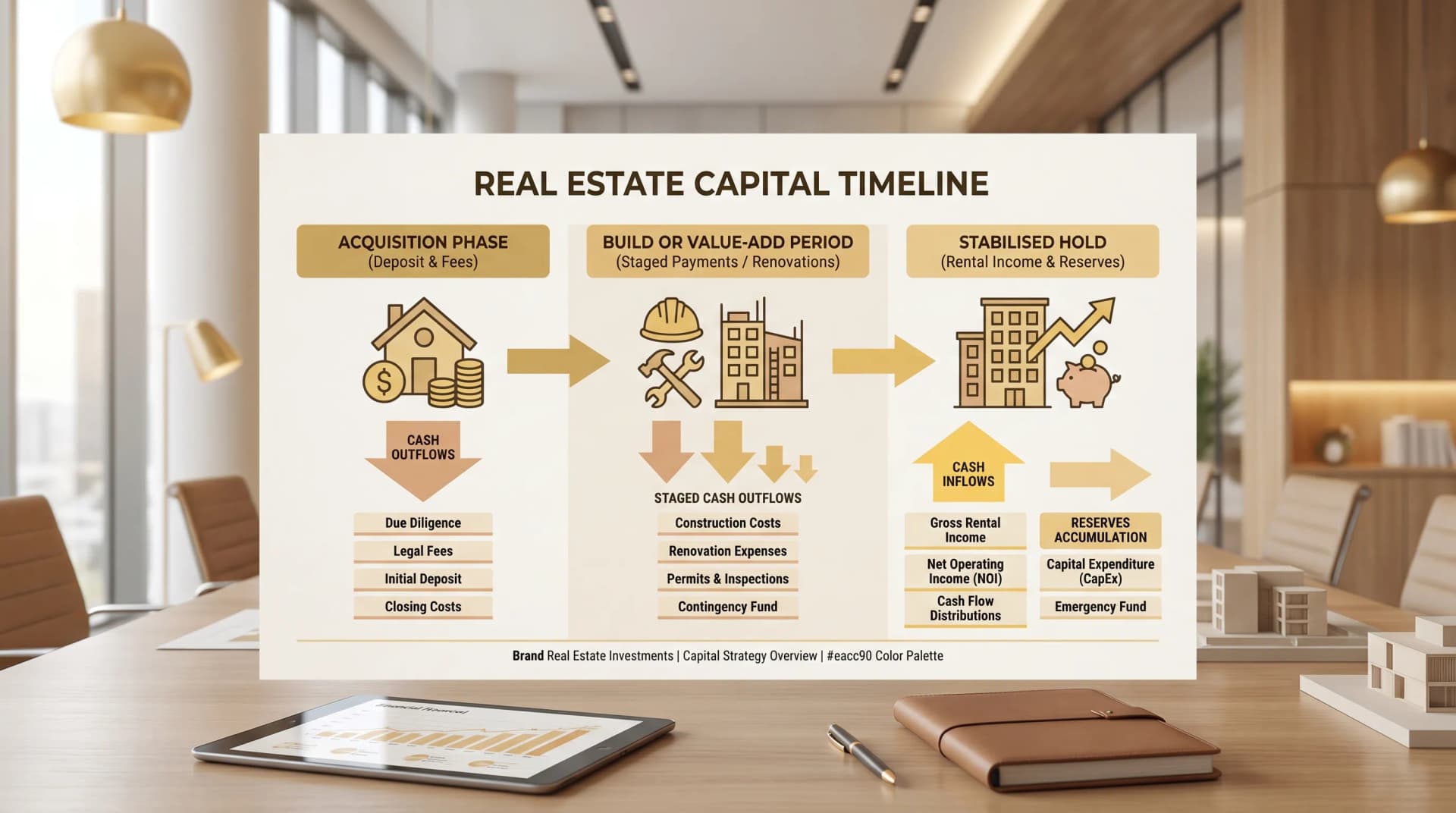
In equities, capital management is often about position sizing and rebalancing. In real estate, it’s more operational, because your capital moves through phases:
- Acquisition capital: deposits, fees, legal costs, furnishing, initial void periods.
- Hold capital: operating expenses, service charges, maintenance, insurance, capex reserves.
- Growth capital: equity release, refinancing costs, deposits for the next purchase, opportunistic buys.
The key is that each phase has a different risk profile and a different time horizon. Scaling gets hard when you treat all cash as the same.
A simple rule: separate your money into three buckets
If you want to grow faster with fewer surprises, manage capital as three distinct buckets:
| Capital bucket | Purpose | Typical risks if under-funded | Best practice |
|---|---|---|---|
| Operating cash | Keep properties stable and compliant | Forced sale, arrears, emergency borrowing | Build predictable monthly buffers |
| Strategic reserves | Absorb shocks and seize opportunities | Missing a great deal, panic refinancing | Hold reserves you refuse to “invest” |
| Deployment capital | Funds earmarked for new acquisitions | Overpaying, rushing into low-quality deals | Use a clear underwriting and timing plan |
This separation alone removes a common scaling failure: using “next deposit money” to cover operating surprises.
Build a capital plan before you buy the next property
Most investors underwrite the asset (price, yield, appreciation) but don’t underwrite the capital timeline.
A scalable capital plan answers:
- When will capital be called (today, monthly, at handover, at refinance)?
- How certain are those calls (fixed instalments vs variable capex)?
- What is the worst case for timing (delays, vacancies, rate resets)?
This is especially important for off-plan investing, where payment schedules are staged and your liquidity risk is time-based.
The “capital runway” metric (your scaling speed limiter)
Your capital runway is the number of months you can support your current portfolio plus committed future payments without relying on best-case assumptions.
If your runway is short, you will:
- accept weaker deals to keep momentum
- refinance at bad times
- sell earlier than planned
A practical approach is to calculate runway under a conservative scenario (lower rent, higher costs, slower leasing, interest-rate uplift). If that scenario breaks you, you’re over-deployed.
Use leverage like a tool, not a strategy
Leverage can accelerate scaling, but it also concentrates timing risk. “Can I get the loan?” is not the question. The better questions are:
- What happens if debt costs rise or refinancing is delayed?
- Can the property survive a long void period without me injecting cash?
- Is my debt structured to protect my cash flow or maximise growth?
A practical leverage framework for scaling
| Leverage choice | What it optimises | What it can break | Who it suits |
|---|---|---|---|
| Lower leverage | Stability, sleep-at-night cash flow | Slower scaling | Income-focused, conservative investors |
| Moderate leverage | Balance of growth and resilience | Requires discipline on reserves | Most long-term portfolio builders |
| Higher leverage | Faster expansion, higher IRR sensitivity | Liquidity during shocks | Experienced investors with strong buffers |
Leverage is not inherently good or bad. It becomes dangerous when it replaces reserves.
Manage liquidity at the portfolio level (not property by property)
A frequent mistake is making each property look “self-sufficient” on paper, while the portfolio as a whole is brittle.
Portfolio liquidity management means:
- tracking all recurring costs across properties (service charges, insurance, management)
- modelling vacancy overlap (two tenants move out in the same quarter)
- planning for clustered capex (multiple AC replacements in the same year)
The reserve policy that prevents forced sales
Rather than a vague “emergency fund,” set an explicit policy you can follow in any market.
Example reserve policy (adapt to your situation):
- Operating buffer: cover core costs for a defined period
- Capex reserve: fund predictable big-ticket items (refurb cycles, appliances)
- Opportunity reserve: optional, but powerful in down markets
The right numbers depend on your property type, rental strategy, and financing, but the discipline is universal: reserves are not idle cash, they are risk insurance.
Don’t confuse ROI with deployable capital
ROI can be strong while deployable capital is weak.
Why? Because real estate returns often arrive as:
- paper appreciation (not spendable)
- equity trapped behind mortgages
- cash flow that is real but slow
Scaling requires deployable capital: money you can commit to the next acquisition without destabilising the portfolio.
Equity release and refinancing as capital recycling
Capital recycling is how many investors scale: buy, improve or wait, refinance, redeploy.
But refinancing is not a guaranteed liquidity event. Your capital plan should assume:
- valuation uncertainty
- lender criteria changes
- processing delays
- fees and early settlement charges
If your next purchase depends on a refinance completing on a perfect date, you’re not scaling, you’re gambling on admin.
Time your capital, not just your entry price
Investors often obsess over getting a discount and ignore when the capital gets called.
In practice, the best deals for scaling often have:
- a payment structure that matches your income and liquidity profile
- a clear plan for reaching stable income (tenant depth, property management)
- a credible path to exit or refinance
Off-plan payment schedules: why they can help scaling (and when they don’t)
Staged payments can be capital-efficient if you manage them properly. They can also become a silent leverage trap if you commit to multiple schedules that peak at the same time.
A simple way to stress-test off-plan commitments:
| Question | Why it matters |
|---|---|
| Do multiple payment schedules peak in the same quarter? | Clustering creates liquidity crunches |
| Can you fund each instalment without assuming a refinance? | Reduces timing dependence |
| What happens if handover is delayed? | Delay can extend carrying costs and planning |
Treat “deal flow” as a capital efficiency lever
Capital management isn’t only about protecting cash, it’s also about reducing the cost of acquiring opportunities.
If you run a property business (sourcing, flipping, lettings, or portfolio acquisitions), consistent inbound enquiries can lower acquisition friction and improve your ability to be selective.
For UK-based investors or operators who want to improve visibility and generate higher-quality leads, working with a specialist in affordable SEO services for small businesses can be a surprisingly practical part of capital efficiency (better deal flow, less wasted time, fewer paid-lead costs).
Create a “portfolio dashboard” before you scale past 2 to 3 properties
Scaling breaks investors who manage everything in their head. A dashboard turns decision-making from reactive to systematic.
Track a small set of metrics consistently:
| KPI | What it tells you | Why it matters for scaling |
|---|---|---|
| Net cash flow (monthly) | True income after costs | Funds reserves and future deposits |
| Liquidity runway (months) | How long you can hold under stress | Prevents forced sales |
| Debt exposure (by reset date) | When financing risk hits | Avoids refinancing cliffs |
| Concentration (area, tenant type) | Hidden correlation risk | Improves resilience |
| Committed future payments | Off-plan or capex obligations | Protects your schedule |
Azimira’s platform notes investment performance tracking as part of its offer, which is exactly the kind of discipline that helps investors scale with clarity rather than guesswork.
Common capital management mistakes that stop portfolios from scaling
Over-committing deposits
Multiple deposits can feel like progress, but they also create a chain reaction if timelines slip. Commitments must fit the runway.
Underestimating “non-mortgage” ownership costs
Service charges, insurance, utilities (during voids), property management, and maintenance can quietly become the real constraint on growth.
Treating every deal as a one-off
Scaling requires repeatability: a consistent underwriting method, a reserve policy, and an exit framework.
Ignoring currency and transfer logistics (for international investors)
If you invest cross-border, the timing and cost of moving money can materially change your capital plan, especially with staged payments.
A practical scaling approach: one stable base, one growth engine
A balanced way to scale is to blend:
- Stability assets: properties designed to produce resilient cash flow
- Growth assets: properties designed to compound equity through appreciation, repositioning, or time-based catalysts
The mix depends on your personal goals, but the concept prevents a common failure mode: owning only “growth stories” with weak cash flow, then running out of liquidity before the growth arrives.
How Azimira supports smarter capital deployment
Azimira specialises in connecting investors and buyers with premium off-plan opportunities in the UAE, with a focus on high-growth markets like Ras Al Khaimah. If your goal is to scale, the advantage of a specialist partner is not only deal access, it’s reducing expensive mistakes in:
- project selection and due diligence
- aligning payment plans with your capital runway
- building a tailored investment strategy that matches risk tolerance and time horizon
If you want to explore curated opportunities, you can start at Azimira’s main site: azimira.com.
Frequently Asked Questions
What is capital management in real estate? Capital management in real estate is the process of planning, allocating, protecting, and recycling cash and equity across acquisitions, holding costs, debt, and future investments so you can scale sustainably.
How much cash should I keep in reserves when scaling a property portfolio? There is no universal number, but serious investors set a formal reserve policy (operating buffer, capex reserve, and optionally an opportunity reserve) and stress-test it against vacancies and cost shocks.
Is off-plan investing good for capital management? It can be, because staged payments may reduce upfront capital needs. However, it increases timing risk if multiple schedules overlap or if your plan depends on refinancing at a specific date.
What’s the biggest mistake investors make when trying to scale? Confusing strong projected returns with strong liquidity. Many portfolios fail due to cash timing and reserve shortfalls, not because the assets were “bad.”
Want a scaling plan built around your capital runway?
If you’re considering scaling through UAE property, Azimira can help you match the right opportunities and payment structures to your risk profile and liquidity plan. Explore options at Azimira and speak with a specialist about a tailored investment strategy.
Disclaimer: This article is general information and not financial, legal, or tax advice.
Related articles
What Counts as Good Real Estate Investments in 2026
Learn what makes good real estate investments in 2026, from net yield and demand signals to legal checks, exit plans and UAE opportunities.

Investors Needed for Real Estate? Start With This Plan
Investors needed for real estate? Use this practical plan to define strategy, numbers, due diligence and partners before raising capital.

Investment Marketing Tactics Developers Use at Launch
Understand investment marketing tactics developers use at launch, from scarcity to incentives, and learn how to assess UAE off-plan deals.