
How to Judge Real Estate Potential in Emerging UAE Areas
Learn how to judge real estate potential in emerging UAE areas using a practical scorecard: demand, infrastructure, supply pipeline, and risk checks.
Emerging UAE neighbourhoods can look irresistible on a brochure: bold masterplans, “future” transport links, and glossy projections. The challenge is that real estate potential is not a slogan, it is a probability. Your job as an investor or buyer is to stack those probabilities in your favour using evidence.
This guide gives you a practical way to judge real estate potential in emerging UAE areas, without relying on hype. It is designed for investors considering off-plan or early-cycle communities (including high-growth northern emirates), and for end-users who want to buy in the “right” place before it becomes expensive.
What “real estate potential” actually means (and what it does not)
In established markets, a good location is often obvious because pricing, leasing and resale activity have years of history. In emerging UAE areas, you are underwriting the next three to seven years.
A location has strong real estate potential when it has a credible pathway to:
- Capital appreciation (more buyers in future competing for limited, desirable stock)
- Rental depth (enough tenants at sufficient rent to support valuations)
- Liquidity at exit (a realistic resale market, not just developer-to-buyer transactions)
- Downside protection (if the cycle cools, the asset still lets and still holds value relative to nearby alternatives)
What it does not mean:
- “It’s the next Dubai”
- “A mega-project was announced”
- “The payment plan is easy, so it must be a good investment”
Start with a 3-layer approach: area, project, unit
Most mistakes come from judging an emerging area as if all properties within it are equal. They are not.
- Area: economic drivers, infrastructure, supply pipeline, regulation
- Project: developer quality, delivery risk, service charge profile, positioning
- Unit: view protection, layout efficiency, floor/location, rentability
You only get “high potential” when all three layers align.
1) Demand signals: who will live here, and why?
Demand is the engine of price growth. In emerging UAE areas, demand is usually built from a mix of:
- Employment and business formation (free zones, industrial clusters, office nodes)
- Tourism and leisure demand (resorts, attractions, event infrastructure)
- Population growth and residency pathways (including investor and long-term residency options)
- Lifestyle migration inside the UAE (people trading up in space, beaches, schools, commute)
A practical test: write down the top 2 tenant profiles you expect (for example, “Dubai commuters seeking value” or “tourism staff and hospitality managers” or “families prioritising schools”). Then ask if the area’s pipeline supports that profile.
Helpful starting points for policy and national initiatives include the UAE Government portal, which aggregates official programmes, sector priorities and updates.
2) Infrastructure: separate “announced” from “delivered”
Infrastructure creates step-changes in accessibility and desirability. In the UAE, emerging areas often re-rate when:
- New or upgraded road corridors reduce travel times
- Airport capacity expands and routes increase
- Rail or major public transport networks move from plan to delivery
- Utilities and public realm upgrades improve liveability
The key is timing certainty. A credible, budgeted, phased project affects pricing differently from an aspirational announcement.
Two questions to ask:
- What will be completed before my expected resale window? (not just “in the masterplan”)
- Does this infrastructure change behaviour? (commute time, visitor volume, business activity)
If you are tracking rail-led appreciation themes, use official project sources like Etihad Rail to anchor your assumptions to what is publicly committed.
3) Anchor assets: the “gravity” that pulls demand
Emerging areas grow fastest when they have one or more anchors that create repeat demand:
- Integrated resorts and hospitality clusters
- Universities, healthcare hubs, specialised schools
- Major business parks, logistics hubs, ports
- Signature waterfront promenades and destination retail
Anchors matter because they generate jobs, visitors and reputation, which increases buyer confidence and tenant depth.
Due diligence tip: anchors have their own evidence trail. Look for construction milestones, operator announcements, hiring activity and adjacent developer behaviour (serious developers tend to cluster where they see validated demand).
4) Supply discipline: the most underrated driver of appreciation
Many “promising” areas disappoint because supply arrives faster than demand can absorb it. In the UAE, the risk is not only total units, it is units similar to yours (same size, same view type, same target tenant).
When judging real estate potential, build a simple supply picture:
- How many units are scheduled within roughly a 10 to 15 minute drive?
- How much of that is directly comparable to your intended unit type?
- Are launches phased, or do multiple large projects complete at once?
Use this table as a practical way to interpret supply in an emerging area.
| Supply factor | What to look for | Why it matters |
|---|---|---|
| Comparable unit density | Many similar studios/1-beds launching together | Rent competition and weaker resale liquidity |
| Handover clustering | Several towers handing over in the same 6 to 12 months | Short-term oversupply, incentives, pricing pressure |
| Segment mismatch | Mostly luxury supply but mid-market demand (or vice versa) | Vacancy risk and longer resale periods |
| Pipeline transparency | Clear phasing, public updates, credible timelines | Helps you time entry and exit more safely |
If you want a deeper UAE off-plan risk lens, Azimira’s guide on off-plan investing in the UAE is a useful complement.
5) Regulation and ownership clarity: potential must be investable
Even the best demand story is weakened if investors cannot own clearly, register efficiently, finance sensibly, or resell without friction.
At minimum, validate:
- Foreign ownership rules in the specific zone (freehold vs other rights)
- Off-plan protections (escrow and registration mechanisms, where applicable)
- Transfer and registration process and typical documentation requirements
- Broker and developer legitimacy (licensing and official registration)
Useful official starting points include the Dubai Land Department and Abu Dhabi’s Department of Municipalities and Transport. For other emirates, use the relevant land department and regulator, and verify details in writing during your transaction.
For practical investor context, Azimira also maintains a regularly updated guide on UAE real estate regulations.
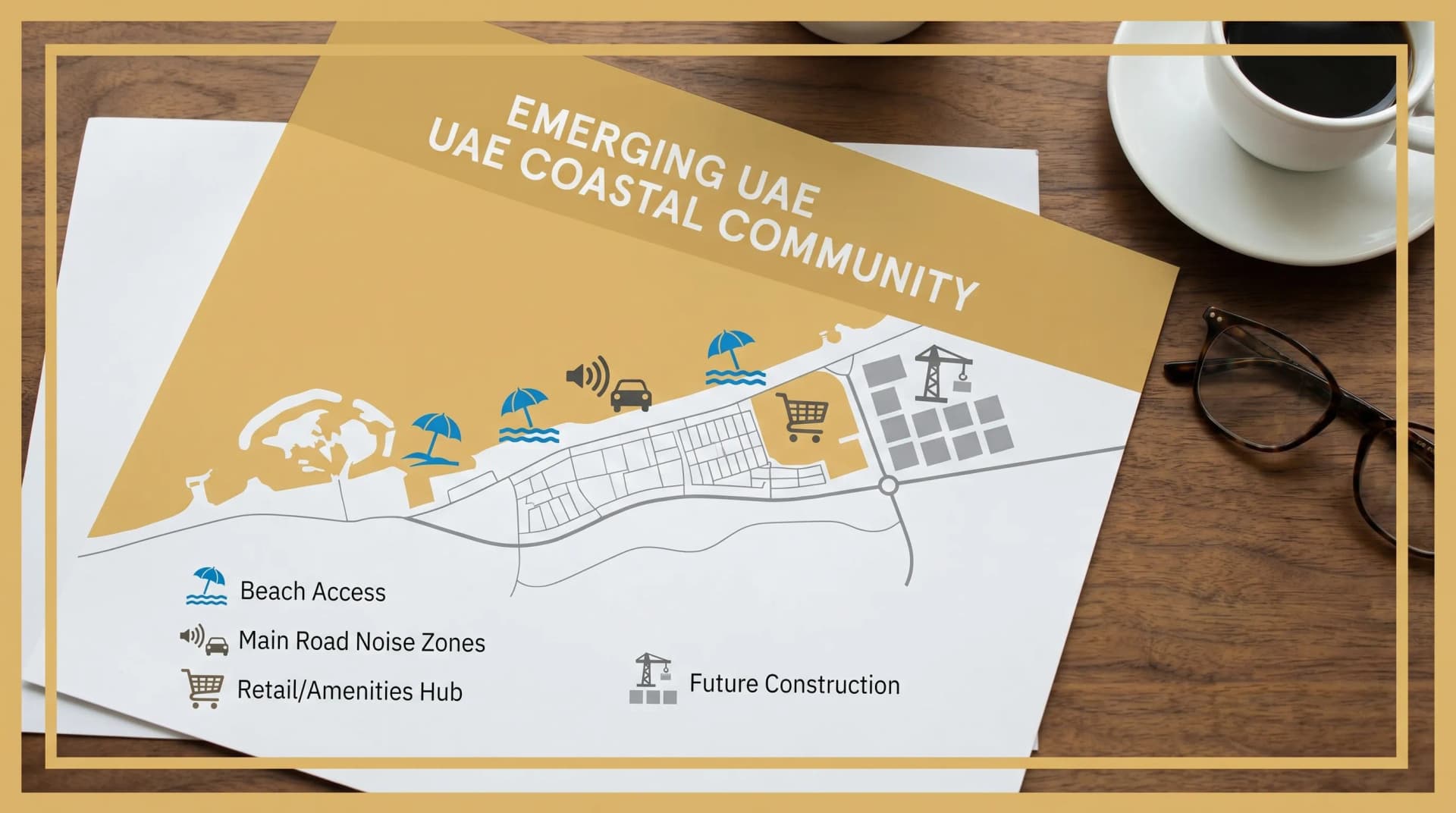
6) Micro-location: in emerging areas, “within the community” matters more
In early-stage communities, pricing often starts “flat” across a map because there is limited transaction history. Over time, micro-location differentiation becomes significant.
When comparing two units in the same emerging area, check:
- View protection (will another plot block your sea, marina or park view?)
- Walkability and liveability (promenade access, shade, crossings, noise)
- Access friction (junctions, school-run traffic, parking availability)
- Distance to anchors (beach, marina, retail, resort, business node)
A simple heuristic: if you were renting the unit yourself for a week, what would frustrate you? Those frustrations reduce rent, reviews (for short stays), and resale liquidity.
7) Project underwriting: treat the developer like credit risk
In emerging areas, the developer is part of your risk and part of your upside. Two projects in the same location can perform very differently depending on delivery quality and post-handover management.
Evaluate:
- Delivery track record (timelines, quality consistency, after-sales service)
- Specification that tenants will pay for (not just brochure features)
- Service charge realism (high fees can destroy “headline” yield)
- Operational model (especially for serviced or short-term rental positioning)
- Contract clarity (SPA terms, handover conditions, defect liability, variation rights)
If you want an investor-friendly way to sanity-check returns, start with Azimira’s 2-minute ROI calculation, then expand to a full net model.
8) The numbers that actually decide outcomes (a simple stress-tested model)
In emerging UAE areas, investors often focus on “price per square foot” and ignore the variables that control realised returns.
Build a basic model with:
- All-in purchase cost: price + registration fees + furnishing (if applicable) + initial setup
- Net yield: rent minus vacancy, management, service charges, maintenance, insurance, utilities (if owner-paid)
- Exit costs: agent fee, transfer fees, potential developer fees for off-plan assignment (if relevant)
- Time-to-liquidity: how long it might realistically take to resell (not the best-case scenario)
Then stress-test two things:
- Rent down: what happens if achieved rent is 10 to 15% lower than you expect?
- Vacancy up: what happens if you have a longer void period during a handover cluster?
If the investment only works in the best-case scenario, the “potential” is fragile.
A quick “real estate potential” scorecard you can reuse
You do not need a complex model to filter opportunities. Use this scorecard to compare emerging areas consistently.
| Category | Strong signal | Weak signal |
|---|---|---|
| Demand | Clear tenant/buyer profile + multiple demand sources | Demand relies on one narrative only |
| Infrastructure | Funded, phased delivery that changes accessibility | Unfunded or vague timelines |
| Anchors | Real operators, visible progress, clustering behaviour | Pure concept renders |
| Supply | Phased pipeline, limited direct comparables | Heavy handover clustering of similar units |
| Regulation | Clear ownership, registration, escrow rules | Unclear documentation or informal payment requests |
| Project quality | Proven delivery, realistic fees, solid aftercare | “Guaranteed returns”, unclear service charge story |
| Unit edge | Protected view, superior layout, best-in-line position | Easily replicated stock |
| Exit plan | Multiple buyer types likely (end-users + investors) | Only works if another off-plan buyer appears |
Common false positives in emerging UAE areas
Some signals feel persuasive but do not reliably predict performance:
- “Next [famous area]” comparisons without evidence of demand and supply balance
- Map pins that stretch the definition of proximity (for example, “near the beach” that is actually a drive)
- Guaranteed yield claims that do not disclose fees, vacancy assumptions, or restrictions
- Amenities that are not exclusive (if every tower has the same features, they stop being a differentiator)
Where Azimira fits if you want to move from research to execution
Once you can judge real estate potential, the next step is getting access to the right projects, early enough, with proper due diligence and underwriting.
Azimira specialises in curated off-plan and premium opportunities in the UAE, with a strong focus on high-growth markets (including Ras Al Khaimah). If you want to compare emerging areas, shortlist projects, and pressure-test returns with a realistic risk view, this is exactly where a specialist partner adds value.
Frequently Asked Questions
What is the best single indicator of real estate potential in an emerging UAE area? The best indicator is validated demand combined with supply discipline. Big announcements matter far less if comparable units flood the market at handover.
How do I check if an emerging area is becoming “real” rather than staying a concept? Look for delivered infrastructure, operating anchors (or visible progress), rising tenancy activity, and secondary-market transactions, not just developer launches.
Is off-plan always the best way to invest in an emerging area? Not always. Off-plan can offer better entry pricing and payment flexibility, but it adds delivery and timeline risk. In some cases, near-handover or ready stock can be a safer way to access the same area with clearer rental evidence.
How can I avoid buying into oversupply? Focus on the pipeline of comparable units, watch for clustered handovers, and prioritise units with a durable edge (protected views, best layouts, walkable positioning). Model conservative rents and higher vacancy during handover periods.
What should I verify before paying a reservation fee? Verify the developer and agent legitimacy, confirm payment goes to the correct account structure where applicable, review the key SPA terms, and ensure the unit details and price are fully documented.
Explore curated emerging-market opportunities with Azimira
If you would like a second opinion on an emerging UAE area, or you want access to vetted off-plan opportunities with a tailored investment strategy, explore Azimira at azimira.com or review the current approach to UAE off-plan investing.
Related articles
What Counts as Good Real Estate Investments in 2026
Learn what makes good real estate investments in 2026, from net yield and demand signals to legal checks, exit plans and UAE opportunities.

Investors Needed for Real Estate? Start With This Plan
Investors needed for real estate? Use this practical plan to define strategy, numbers, due diligence and partners before raising capital.

Investment Marketing Tactics Developers Use at Launch
Understand investment marketing tactics developers use at launch, from scarcity to incentives, and learn how to assess UAE off-plan deals.