
A Beginner's Real Estate Investment Plan for the UAE
Build a real estate investment plan for beginners in the UAE with clear goals, budgeting, due diligence, financing and first-purchase steps.
A first property purchase can feel intimidating, especially in a market as active and opportunity-rich as the UAE. There are different emirates, freehold rules, off-plan launches, payment plans, residency options, service charges, rental strategies and tax considerations to understand before you reserve a unit.
The good news is that beginners do not need to become property experts overnight. What they do need is a clear plan: one that turns “I want to invest in UAE real estate” into specific decisions, realistic numbers and a disciplined buying process.
This guide lays out a practical real estate investment plan for beginners, with a UAE focus and a particular eye on high-growth markets such as Ras Al Khaimah. It is designed for first-time investors, overseas buyers and professionals who want to build wealth through property without relying on hype or guesswork.
Start With the Outcome, Not the Property
Many beginners start by asking, “Which project should I buy?” That is the wrong first question.
A better starting point is: what job should this property do in your wider financial life?
Your answer will shape everything else, including emirate, unit size, payment plan, holding period, financing and exit strategy. A buyer seeking rental income today should not evaluate opportunities in the same way as someone targeting capital growth from an off-plan development over four to six years.
For most new UAE property investors, the goal usually falls into one of five categories:
| Beginner goal | What it means | Property strategy that may fit |
|---|---|---|
| Capital growth | You want the property to rise in value over time | Off-plan or early-stage projects in growth corridors |
| Rental income | You want recurring cash flow after costs | Ready or near-handover units with proven tenant demand |
| Lifestyle use | You may use the property yourself part of the year | Waterfront, resort, family or community-led locations |
| Residency planning | You want property to support a UAE visa pathway | Properties that meet current visa value and documentation rules |
| Portfolio diversification | You want exposure outside your home market | Tax-efficient UAE assets with clear management support |
This step matters because a “good” investment is only good if it matches your objective. A premium waterfront unit may be excellent for long-term capital growth but unsuitable for someone who needs immediate income. A ready apartment with a tenant may produce faster cash flow but offer less early-stage appreciation than a carefully selected off-plan asset.
Before you view projects, write down your priority in one sentence. For example: “I want to invest AED 500,000 to AED 1,000,000 in a UAE property with a five-year horizon, prioritising capital growth over immediate income.” That single sentence will remove many distractions.
Set a Realistic Budget for the Whole Investment
The purchase price is not the same as the investment cost.
A beginner-friendly investment plan should include the full capital requirement, not just the advertised property price or first instalment. In the UAE, your all-in budget may include reservation deposits, registration or transfer fees, agency or administration costs, mortgage fees if financing, valuation costs, legal review, service charges, furnishing, insurance, property management and contingency reserves.
This is especially important with off-plan property. A flexible payment plan can make entry easier, but you still need to know when each instalment is due and whether your income, savings or currency position can support it.
A simple beginner budget should separate three numbers:
| Budget item | Why it matters |
|---|---|
| Entry cash | The amount needed to reserve, sign and register the purchase |
| Lifecycle cash | Instalments, service charges, furnishing and handover costs over time |
| Safety buffer | Funds reserved for delays, vacancy, currency movement or unexpected expenses |
A useful rule is to stress-test the deal before you emotionally commit. Ask what happens if handover is delayed, rent is 10% lower than expected, service charges are higher than projected, or your home currency weakens against the dirham. The UAE dirham is pegged to the US dollar, which gives many international investors currency clarity, but buyers from the UK, Australia, Singapore, Hong Kong and Europe still need to consider exchange-rate movement against their home currency.
For a deeper look at cost modelling, Azimira’s guide to the real cost of owning RAK property is a useful next read.
Choose Your UAE Market by Fundamentals
The UAE is not one single property market. Dubai, Abu Dhabi, Ras Al Khaimah and other emirates have different pricing levels, demand drivers, regulations, liquidity profiles and growth stages.
For beginners, the key is not to chase the loudest market. It is to choose a location where demand, supply and pricing make sense for your objective.
Dubai often offers deep liquidity, global recognition and a large tenant base. Abu Dhabi can appeal to buyers seeking stability, government-backed economic growth and established communities. Ras Al Khaimah is increasingly attracting investors looking for earlier-stage growth, resort-led demand, relatively accessible entry pricing and major tourism catalysts.
RAK deserves particular attention from beginners because it can offer a clearer “why now” thesis in selected micro-markets. Growth is being supported by infrastructure, tourism expansion, waterfront development and international attention around projects such as the Wynn Al Marjan Island resort. That does not mean every RAK property is automatically a strong investment. It means the emirate has identifiable catalysts that can be tested through proper due diligence.
When comparing markets, focus on five fundamentals:
- Real tenant or visitor demand, not just brochure claims
- Supply pipeline and whether new units could outpace demand
- Infrastructure, tourism and employment catalysts
- Quality of developer, community and building management
- Exit liquidity, including who is likely to buy from you later
Beginners often underestimate micro-location. Two projects in the same emirate can perform very differently depending on view, access, phasing, amenities, construction quality and competition. In RAK, for example, waterfront communities such as Al Marjan Island, Mina Al Arab and Al Hamra can serve different investor profiles even though all sit within the same broader emirate.
For a buyer-friendly overview, see Azimira’s guide to properties and real estate in the UAE.
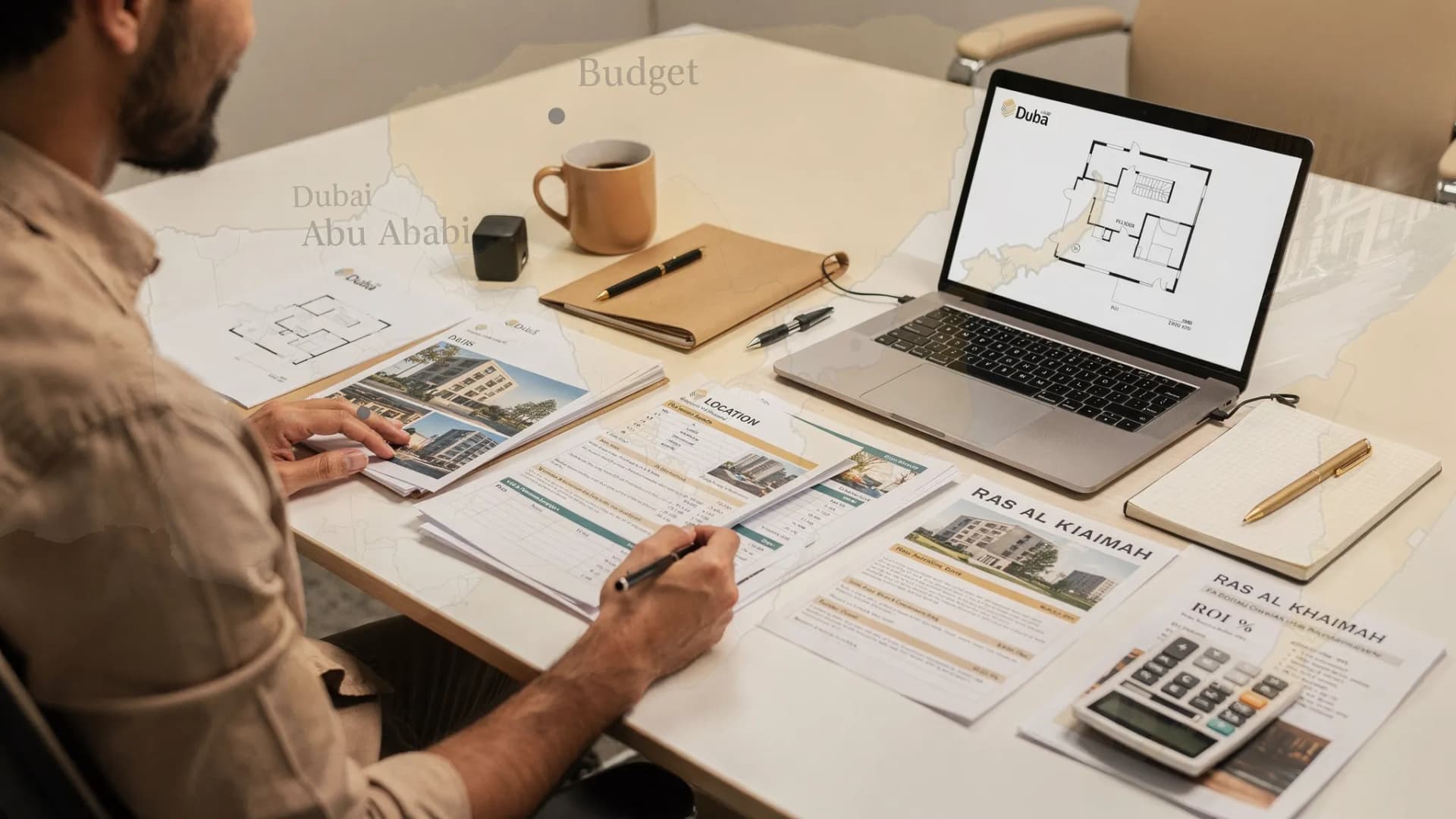
Decide Between Off-Plan and Ready Property
One of the biggest early decisions is whether to buy off-plan or ready property.
Off-plan property means buying before construction is complete, usually directly from a developer. Ready property means purchasing a completed unit, often on the secondary market. Both can work, but they serve different purposes.
| Factor | Off-plan property | Ready property |
|---|---|---|
| Cash flow | Usually no rent until handover | Potential rental income sooner |
| Payment structure | Often staged developer payments | Larger upfront capital or mortgage needed |
| Growth potential | Can benefit from early pricing and market re-rating | More dependent on current market value and rent |
| Risk profile | Developer, construction and delivery risk | Building condition, tenant and service charge risk |
| Due diligence focus | Developer track record, escrow, SPA, phasing | Title, inspection, tenancy, service charges, comparable rents |
For beginners, off-plan can be attractive because payment plans may reduce the initial capital burden and give exposure to growth before completion. However, it requires discipline. You need to verify the developer, understand escrow protections, review the Sales and Purchase Agreement, model all staged payments and plan for handover costs.
Ready property may feel simpler because you can inspect the unit, assess the building and potentially rent it faster. But it also demands careful review of title, maintenance history, existing tenancy terms, service charges and realistic net yield.
A balanced beginner approach is to match property stage to your goal. If you need income soon, a ready or near-handover unit may be more appropriate. If you have a longer horizon and can tolerate delivery risk, a vetted off-plan opportunity in a growth location may offer stronger upside.
Build a Simple Return Model Before You Reserve
You do not need a complex spreadsheet to make a better decision than most beginners. You do need a model that separates headline return from real return.
Start with four basic calculations:
| Metric | Simple formula | What it tells you |
|---|---|---|
| Gross yield | Annual rent ÷ purchase price | Headline income potential before costs |
| Net yield | Net annual income ÷ total investment cost | Income after estimated costs |
| Cash-on-cash return | Annual cash return ÷ cash invested | Return on your actual deployed capital |
| Total return | Net income + capital growth, less costs | Overall performance over the holding period |
The mistake beginners make is relying on advertised yield. A project claiming attractive rent may still disappoint if service charges, furnishing, vacancy, management fees or financing costs are not included.
Your model should include conservative, base and optimistic scenarios. For example, rather than assuming one fixed rent and one fixed resale price, test what happens if rent is lower, vacancy is longer, or you exit later than planned. If the deal only works in the optimistic case, it is not beginner-friendly.
You should also decide whether capital growth or income carries more weight in your expected return. In emerging growth markets such as RAK, a large share of the thesis may come from appreciation over time. In mature income markets, rental stability may be more important.
Azimira’s guide to the 2-minute ROI calculation every property investor should know can help you build this habit quickly.
Understand the Legal and Regulatory Basics
A beginner’s real estate investment plan in the UAE must include legal checks. This is not an optional final step after you fall in love with a project. It is part of the investment decision.
Foreign buyers can purchase in designated freehold areas, but rules, authorities and procedures vary by emirate. In off-plan purchases, investors should understand how escrow accounts work, what registration is required, how progress payments are structured and what protections apply if construction is delayed.
At a minimum, beginners should verify:
- The developer is properly registered and authorised to sell the project
- The property is in an area where foreign ownership is permitted
- Payments are made through official and documented channels
- The SPA clearly explains payment milestones, completion, penalties and handover obligations
- Registration or off-plan documentation is completed with the relevant authority
- Any mortgage, resale or assignment restrictions are understood before signing
If residency is part of your plan, check current rules before buying. The UAE Golden Visa can be available through qualifying property investment, subject to eligibility and documentation requirements. The official UAE Government portal is a useful starting point, but investors should seek current professional guidance because requirements and processes can evolve.
For off-plan buyers, Azimira’s guide to off-plan property in the UAE: 8 checks before you commit covers the main risk controls in more detail.
Plan Financing, Currency and Payments Early
Financing should be part of the plan before you shortlist properties, not after you have paid a reservation fee.
Some beginners buy in cash. Others use UAE mortgages, developer payment plans, home-country equity release or a combination. Each route affects risk and return. A low upfront payment can improve cash efficiency, but future instalments must be manageable. A mortgage can increase purchasing power, but interest rates, loan-to-value limits, approval timelines and early settlement costs need to be understood.
For international buyers, currency planning is equally important. A property priced in AED may be funded from GBP, AUD, SGD, HKD, EUR or another currency. If your payments are staged over several years, exchange-rate movement can change your real cost. Some buyers use staged conversions, multi-currency accounts or FX tools such as forward contracts to reduce uncertainty.
Your payment plan should answer three practical questions:
| Question | Why it matters |
|---|---|
| When is each payment due? | Prevents missed instalments and cash-flow pressure |
| What currency will fund it? | Helps manage FX risk and transfer timing |
| What is the fallback plan? | Protects you if income, markets or currencies move against you |
Beginners should keep a separate reserve for costs that arrive at handover, including furnishing, utility connections, insurance, management setup and potential vacancy. A property can be a sound long-term investment and still become stressful if the cash-flow plan is too tight.
Create a Due Diligence Scorecard
A scorecard helps beginners stay objective. Instead of asking, “Do I like this property?” you ask, “Does this property meet my investment rules?”
Give each shortlisted opportunity a simple score from 1 to 5 across the categories below:
| Due diligence area | What to check |
|---|---|
| Location strength | Demand drivers, access, amenities, future supply and lifestyle appeal |
| Developer quality | Track record, delivery history, build quality and after-sales reputation |
| Financial fit | Total cost, payment plan, rent assumptions, service charges and reserves |
| Legal clarity | Ownership eligibility, SPA terms, escrow, registration and documentation |
| Exit options | Likely buyer pool, rental demand, assignment rules and resale liquidity |
| Management practicality | Leasing, maintenance, furnishing, reporting and remote ownership support |
A property that scores highly on aesthetics but poorly on exit liquidity or contract clarity should not be treated as low risk. A less glamorous property with strong tenant demand, good documentation and manageable costs may be the better first investment.
This is also where professional support can add value. Azimira focuses on curated off-plan opportunities, expert market insight, access to selected pre-launch projects and tailored investment strategies for buyers seeking UAE property exposure, particularly in high-growth markets such as Ras Al Khaimah.
Map Your First 12 Months
A beginner’s plan should include a timeline. Without one, research can become endless and emotional decisions can happen too quickly.
Here is a practical 12-month structure for a first UAE property investment.
| Period | Main task | Desired outcome |
|---|---|---|
| Month 1 | Define goals, budget and risk limits | Written investment brief |
| Months 2 to 3 | Compare emirates, micro-markets and property types | Shortlist of suitable locations |
| Months 4 to 5 | Review projects, developers and return models | Two or three investable options |
| Month 6 | Complete legal, financing and currency preparation | Ready-to-act position |
| Months 7 to 8 | Reserve and sign only if due diligence passes | Controlled acquisition |
| Months 9 to 12 | Track payments, documents and performance plan | Managed investment, not passive guesswork |
This timeline can move faster if you already have capital ready and professional guidance in place. It can also take longer if you need mortgage approval, tax advice or family decision-making. The point is not to force urgency. The point is to create order.
Beginners should avoid the pressure of “last unit available” decision-making. Scarcity can be real in strong launches, but it should not override due diligence. A missed opportunity is better than a badly structured first purchase.

Prepare the Ownership and Management Plan
Buying the property is only the beginning. A successful investment needs an operating plan.
If the property will be rented, decide whether it will be a long-let, short-stay or hybrid strategy. Long-let rentals can be simpler and more predictable. Short-stay rentals may produce higher gross income in tourism-led locations, but they usually require more active management, furnishing, licensing, cleaning, guest communication and dynamic pricing.
If the property is off-plan, your management plan begins before handover. You should know who will inspect the unit, manage snagging, activate utilities, arrange furnishing, insure the property, photograph it, list it and report on performance.
For overseas buyers, remote ownership can work well when roles are clear. The risk is assuming that “someone will handle it later.” Later is when delays, vacancy and avoidable costs appear.
At minimum, your management plan should include:
- Who tracks developer updates and payment milestones
- Who reviews handover documents and snagging issues
- Who sets rental strategy and pricing
- Who manages tenant or guest communication
- Who pays service charges, insurance and maintenance bills
- How performance will be reviewed each quarter
This is where dedicated client support and investment performance tracking can be especially useful, because the investor’s job is not simply to buy. It is to own intelligently.
Beginner Mistakes to Avoid
Most first-time property errors are not caused by lack of intelligence. They are caused by poor sequencing. Buyers view before budgeting, reserve before checking, or trust rental projections before modelling costs.
The most common mistakes include chasing guaranteed returns without understanding the assumptions, choosing the cheapest unit without assessing liquidity, ignoring service charges, overlooking currency risk, underestimating furnishing and management costs, and failing to define an exit strategy before purchase.
Another major mistake is copying someone else’s strategy. A Dubai investor with five properties, local banking and high risk tolerance can make decisions that may not suit a first-time overseas buyer. Your plan should reflect your capital, timeline, tax position, liquidity needs and tolerance for operational complexity.
Finally, beginners should be careful with tax assumptions. The UAE is widely known for its tax-efficient environment, but your home country may still tax rental income, capital gains or worldwide assets depending on your residency and circumstances. Always take independent tax advice in the jurisdictions that apply to you.
A Simple One-Page Real Estate Investment Plan for Beginners
Before you commit to any UAE property, summarise your plan on one page. If you cannot explain the investment clearly, you probably are not ready to buy it.
Use this structure:
| Plan section | Your answer |
|---|---|
| Objective | Capital growth, income, lifestyle, residency or diversification |
| Budget | Entry cash, total cost and safety buffer |
| Market | Preferred emirate and micro-location |
| Property type | Apartment, villa, townhouse, serviced, branded, off-plan or ready |
| Holding period | Expected ownership timeline and review points |
| Return model | Conservative, base and optimistic scenarios |
| Risk controls | Developer checks, legal review, escrow, financing, FX and reserves |
| Operating plan | Letting, management, insurance, maintenance and reporting |
| Exit route | Resale, rental hold, refinancing, assignment or lifestyle use |
This one-page plan will not eliminate risk, but it will make risk visible. That is the real advantage for beginners.
Frequently Asked Questions
Is UAE real estate suitable for beginners? Yes, provided beginners use a structured plan, verify legal and developer details, model costs conservatively and avoid buying purely from marketing material. The UAE can offer strong opportunities, but results depend on property selection, timing and execution.
How much money do I need to start investing in UAE property? It depends on the emirate, project, property type and payment structure. Off-plan payment plans can reduce the initial cash requirement, while ready properties often require more upfront capital or mortgage approval. Beginners should budget for the full investment cost, not just the deposit.
Is off-plan property too risky for a first-time investor? Not necessarily. Off-plan can be suitable for beginners if the developer, escrow arrangements, contract, payment plan and location fundamentals are properly checked. The risk rises when buyers rely only on brochures, projected returns or launch pressure.
Which UAE emirate is best for a beginner investor? There is no universal answer. Dubai may suit investors prioritising liquidity and market depth, while Ras Al Khaimah may appeal to those seeking earlier-stage growth and resort-led demand. The right choice depends on your objective, budget and time horizon.
Can UAE property help with residency planning? In some cases, yes. Certain property investments may support UAE residency pathways, including the Golden Visa, subject to current eligibility rules and documentation. Always verify requirements before buying if residency is part of your plan.
Should I use a property advisor for my first UAE investment? A specialist advisor can help with market selection, project access, due diligence, payment planning and post-purchase coordination. This is particularly useful for overseas buyers or beginners considering off-plan investments.
Build Your UAE Property Plan With Confidence
A strong first investment is not about luck or timing a launch perfectly. It is about having a plan that connects your goals, budget, market choice, due diligence and management strategy.
Azimira helps investors and buyers explore premium UAE off-plan opportunities, with a focus on high-growth markets such as Ras Al Khaimah. Through curated projects, expert market insight, tailored investment strategies and dedicated client support, Azimira can help you move from early research to a more confident shortlist.
If you are building your first UAE real estate investment plan, start with a conversation. Explore Azimira’s investment opportunities or contact the team through Azimira to discuss which strategy may fit your goals.
Related articles
What Counts as Good Real Estate Investments in 2026
Learn what makes good real estate investments in 2026, from net yield and demand signals to legal checks, exit plans and UAE opportunities.

Investors Needed for Real Estate? Start With This Plan
Investors needed for real estate? Use this practical plan to define strategy, numbers, due diligence and partners before raising capital.

Investment Marketing Tactics Developers Use at Launch
Understand investment marketing tactics developers use at launch, from scarcity to incentives, and learn how to assess UAE off-plan deals.