
Advantages of Investment Property in the UAE: Real Numbers
Advantages of investment property in the UAE, with real numbers on taxes, fees, yields and 5-year ROI modelling to guide smarter buying decisions.
If you’re comparing global property markets in 2026, the UAE stands out for a simple reason: the numbers often work before you even add optimism. Not just because of strong headline yields, but because friction (tax, transaction drag, unstable currency) is relatively low compared with many mature markets.
This article breaks down the advantages of investment property in the UAE using the numbers investors actually model: taxes, fees, yields, financing structures, and a realistic five-year return example.
1) Tax advantage: what you keep is often more important than what you earn
Most property investors start with rental yield, but after-tax yield is what compounds.
For individual investors, the UAE is widely viewed as a low-tax jurisdiction for property ownership, particularly compared with countries where rental income and capital gains are taxed annually.
Key numbers to understand:
- 0% federal personal income tax in the UAE (so there is generally no UAE personal tax on rental income for individuals).
- 0% capital gains tax at the federal level for individuals (so UAE tax is typically not levied on gains when you sell, though home-country rules may still apply).
- 5% VAT exists, but it applies differently by asset type. Residential property is often treated as exempt or zero-rated in specific cases, while commercial property is generally taxable. The UAE’s Federal Tax Authority is the reference point for VAT rules.
- 9% UAE Corporate Tax (introduced recently) applies to taxable business profits above AED 375,000. Whether and how it applies to property income depends on structure and activity (for example, corporate ownership, property leasing as a business, and other factors). The UAE Ministry of Finance provides the baseline rules for Corporate Tax.
A quick “tax drag” comparison (illustrative)
To see why this matters, compare two investors each generating the same net operating income (NOI) from property.
| Metric | Typical high-tax market (illustrative) | UAE (illustrative for an individual) |
|---|---|---|
| Annual NOI | AED 60,000 | AED 60,000 |
| Local tax on rental income | 20% | 0% |
| Cash kept after local tax | AED 48,000 | AED 60,000 |
| Extra cash retained per year | AED 12,000 |
That “extra” AED 12,000 a year can become your renovation budget, your vacancy buffer, or your deposit for a second unit. (Always model your home-country tax separately. The UAE benefit is the reduced tax drag on the UAE side.)
2) Yield advantage: gross yields can be compelling, but net yield is the real KPI
The UAE’s rental yields vary dramatically by emirate, community, building quality, and strategy (long-let vs short-term rental). The point is not to chase the highest advertised percentage, it is to find repeatable net yield with manageable risk.
In Azimira’s Ras Al Khaimah focused analysis, long-let yields are often modelled around the mid to high single digits, with short-term rentals potentially higher but more operationally intensive. In other UAE prime areas, yields can compress, but liquidity and depth can improve.
A simple net yield model (worked example)
Assume a residential unit bought for AED 1,000,000, rented on a long-let.
- Annual rent (gross): AED 75,000 (7.5% gross)
- Vacancy allowance: 5% of rent (AED 3,750)
- Property management: 7% of rent (AED 5,250)
- Service charges/maintenance reserve/insurance (combined): AED 10,000 (varies widely by building and amenities)
| Line item | Amount |
|---|---|
| Gross rent | AED 75,000 |
| Less vacancy allowance | (AED 3,750) |
| Less management fee | (AED 5,250) |
| Less building costs reserve | (AED 10,000) |
| Estimated NOI | AED 56,000 |
| Estimated net yield (NOI / price) | 5.6% |
A net yield in the 5% to 7% range (depending on asset selection and costs) is often what makes UAE investment property competitive when compared with many global cities where net yields can be far lower.
3) Transaction cost advantage: the “all-in” cost is knowable and model-friendly
Property markets become investor-friendly when the purchase and sale costs are transparent and you can model them upfront.
In the UAE, the exact fee stack depends on emirate and deal structure, but most investors budget for the following categories:
| Cost category | What it usually covers | Why it matters |
|---|---|---|
| Government transfer/registration | Land department fees (varies by emirate) | Major one-off cost that impacts break-even time |
| Agency fee | Broker commission (market-standard practices vary) | Impacts entry and exit modelling |
| Mortgage-related fees | Valuation, processing, registration (if financing) | Impacts cash-on-cash return |
| Developer admin fees | Especially common in off-plan | Impacts up-front cash requirement |
| Furnishing and fit-out | If targeting higher rents | Impacts net yield and tenant profile |
The advantage here is not “cheap fees everywhere”, it is that the UAE tends to be structured and itemised, so investors can run clean sensitivity analyses.
4) Financing and payment-plan advantage: cash-on-cash returns can be engineered
One of the most overlooked advantages of investment property in the UAE is that returns are often shaped by capital deployment, not just headline yield.
Two common approaches:
Ready property with a mortgage
If you buy a completed unit and use bank financing, your return depends on the spread between:
- Net yield (after costs)
- Interest cost (plus fees)
- Capital appreciation (if any)
Off-plan with staged payments
Many UAE off-plan projects offer staged payment plans (structures vary by developer and project). For investors, this can create an unusual dynamic: your property exposure may increase faster than your cash deployed.
Illustrative example:
- Property price: AED 1,000,000
- Payment plan: 60/40 (60% during construction, 40% on handover)
- Cash deployed by mid-construction: AED 400,000
- If market prices rise 10% during that period, the asset value uplift (AED 100,000) is large relative to deployed cash
This does not eliminate risk (construction delays, specification changes, and market cycles still matter), but it explains why sophisticated investors care about IRR and cash-on-cash, not just annual yield.
5) Currency advantage: AED is pegged, which reduces a major planning variable
For international buyers, currency volatility can destroy otherwise good property returns.
The UAE dirham (AED) is pegged to the US dollar (commonly cited at AED 3.6725 per USD 1), which tends to reduce currency uncertainty relative to floating currencies. For investors whose home currency is GBP, EUR, or AUD, you still have FX exposure, but it is exposure to the USD bloc rather than to an unanchored currency.
For many investors, that is a meaningful advantage because it makes long-term modelling (and staged off-plan payments) more predictable.
6) Residency optionality: investment can unlock lifestyle and mobility benefits
Some markets offer returns but no “strategic optionality”. The UAE can offer both.
A key number that shapes investor behaviour is the AED 2,000,000 property value threshold often referenced for the UAE Golden Visa property route (subject to the latest regulations and documentation requirements).
Why this matters financially, even if you never relocate:
- It can reduce friction for banking, account opening, and ongoing administration (case-by-case).
- It can support longer-term holding decisions because the asset is tied to a tangible residency benefit.
You can confirm the broad framework through official UAE government portals such as The UAE Government’s Golden Visa overview.
7) Portfolio advantage: UAE property can diversify both geography and “return drivers”
A well-built UAE property portfolio can diversify across different return drivers:
- Income-driven assets (long-let demand, corporate tenancies, stable communities)
- Tourism-driven assets (short-term rentals in leisure destinations)
- Growth-driven assets (infrastructure catalysts, masterplan delivery, emerging locations)
Ras Al Khaimah is frequently discussed in this context because it combines tourism-led demand drivers with a market still in an earlier phase compared with Dubai, but the broader UAE thesis is diversification across emirates and asset types.
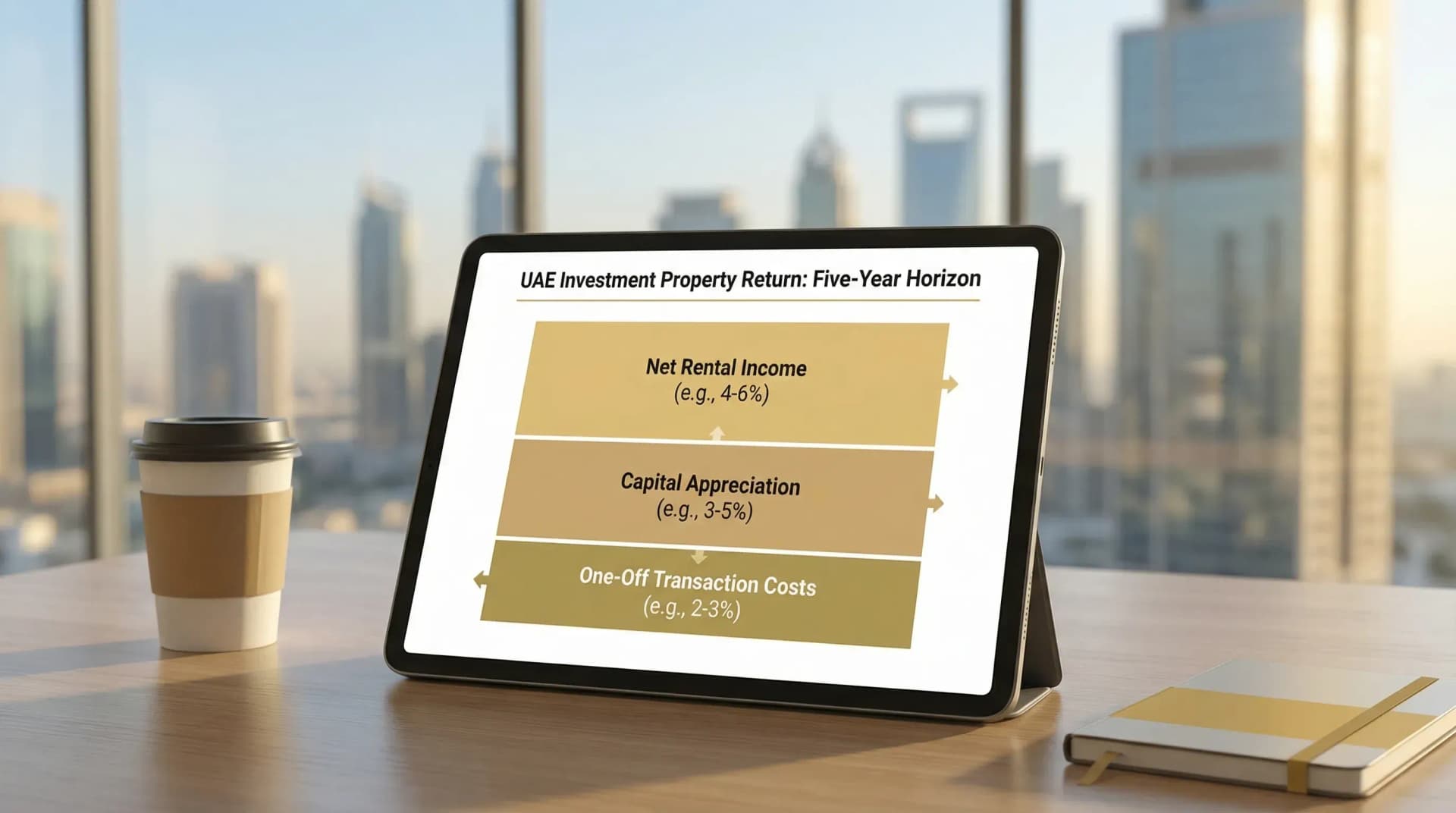
A five-year “real numbers” scenario (modelled, not promised)
To tie everything together, here is a straightforward five-year model you can adapt.
Assumptions (illustrative only):
- Purchase price: AED 1,000,000
- Net yield (after vacancy, management, operating costs): 5.6% per year
- Capital appreciation: 6% per year (compounded)
- Exit costs: 3% of sale price (varies by emirate and selling method)
| Year | Net income (estimated) | Property value (6% growth) |
|---|---|---|
| 1 | AED 56,000 | AED 1,060,000 |
| 2 | AED 56,000 | AED 1,123,600 |
| 3 | AED 56,000 | AED 1,191,016 |
| 4 | AED 56,000 | AED 1,262,477 |
| 5 | AED 56,000 | AED 1,338,226 |
End of year 5 (simplified):
- Total net income over 5 years: AED 280,000
- Estimated gross capital gain: AED 338,226
- Less estimated exit costs (3%): AED 40,147
- Estimated net profit (income + gain - exit costs): AED 578,079
That implies an approximate 57.8% total return over five years on the unleveraged purchase price in this model (before any home-country taxes and ignoring financing effects). Your actual outcome will depend on asset selection, costs, market timing, and your rental strategy.
The core advantage is that the UAE can offer a credible path where income plus growth can work together, and local tax drag may be relatively low.
Don’t lose the advantage: track performance like a business
Investors often underperform not because they chose the wrong market, but because they did not run the asset like an operating business.
If you own multiple units, invest via an entity, or manage properties across countries, strong bookkeeping and reporting becomes part of your return. Tools that consolidate invoicing and financial reporting can help operators stay organised, for example an invoicing and finance dashboard built for small businesses managing multiple workflows.
(You still need property-specific reporting from your agent or property manager, but clean financial data is what lets you optimise.)
Where Azimira fits (and what to ask before you buy)
Azimira specialises in connecting investors and buyers with curated off-plan opportunities in the UAE, with a focus on high-growth markets such as Ras Al Khaimah. If you want the advantages above to show up in your real results, the most important step is project selection and underwriting.
Before you commit, ask for:
- A net yield model that includes vacancy, service charges, management, and a maintenance reserve
- A sensitivity table (rent down 10%, occupancy down 10%, handover delayed 6 months)
- A clear view of the payment schedule and what protections apply (escrow, SPA terms)
- A realistic exit plan (resale depth, assignment rules for off-plan, and expected selling costs)
If you want a second pair of eyes on the numbers and access to vetted off-plan projects, you can explore Azimira’s approach at Azimira.
Related articles
What Counts as Good Real Estate Investments in 2026
Learn what makes good real estate investments in 2026, from net yield and demand signals to legal checks, exit plans and UAE opportunities.

Investors Needed for Real Estate? Start With This Plan
Investors needed for real estate? Use this practical plan to define strategy, numbers, due diligence and partners before raising capital.

Investment Marketing Tactics Developers Use at Launch
Understand investment marketing tactics developers use at launch, from scarcity to incentives, and learn how to assess UAE off-plan deals.