
Investment Property Portfolio: A Simple Allocation Template
Use this simple investment property portfolio allocation template to balance growth, income, and risk, with practical bucket ranges and guardrails.
Most investors don’t fail because they picked the “wrong” property. They fail because their portfolio becomes accidental: too much money tied up in one market, one completion date, one tenant type, or one financing structure.
A simple allocation template fixes that. It forces you to decide (before the next purchase) what each asset is meant to do, how much risk you are taking to achieve it, and what you will do if the market surprises you.
This guide gives you a practical, easy-to-use investment property portfolio allocation template you can adapt whether you are buying one off-plan unit, building a three-to-five property portfolio, or consolidating an existing mix across different markets.
Note: this article is educational and not financial advice. Always take regulated advice for your circumstances.
What “allocation” means in an investment property portfolio
In equities, allocation is often just “60/40”. In property, allocation is multi-dimensional. Two apartments in the same city can behave like completely different assets depending on when you buy, how you finance, and who rents them.
A useful property allocation template should cover four levers:
- Return engine: capital growth, rental income, or a blend.
- Delivery timing: completed (income now) vs off-plan (income later, growth earlier).
- Risk profile: development risk, tenant risk, interest-rate risk, currency risk.
- Liquidity and flexibility: cash buffers and the ability to pivot (refinance, sell, switch rental strategy).
If you only track the purchase price and expected yield, you are missing the part that keeps portfolios resilient.
Step 1: Write your portfolio “job description” (one paragraph)
Before you allocate percentages, define what success looks like. This sounds basic, but it prevents mismatched decisions like buying a completion-in-36-months off-plan unit when you need income in 12 months.
Use the table below to capture constraints that directly affect allocation.
| Planning input | What to decide | Why it matters for allocation |
|---|---|---|
| Time horizon | 3–5 years, 5–10 years, 10+ years | Off-plan and value-add strategies need time for compounding and liquidity windows |
| Income need | None, partial, essential | Determines how much must be in “income now” assets |
| Risk tolerance | Low, medium, high | Sets caps on leverage, off-plan exposure, and single-developer concentration |
| Cashflow resilience | How many months of costs you can cover | Drives your cash buffer and debt-servicing headroom |
| Currency exposure | Home currency vs AED (or others) | Influences FX planning, staged-payment risk, and reporting |
| Personal use / residency | Any owner-occupier need or visa alignment | Can shift allocation towards specific price thresholds or ready properties |
Once this is clear, you can allocate with intent.
The simple 4-bucket allocation template (use this as your starting point)
This template is designed to be easy to implement and review annually. Each bucket has a different role, and you can adjust the percentages based on your “job description”.
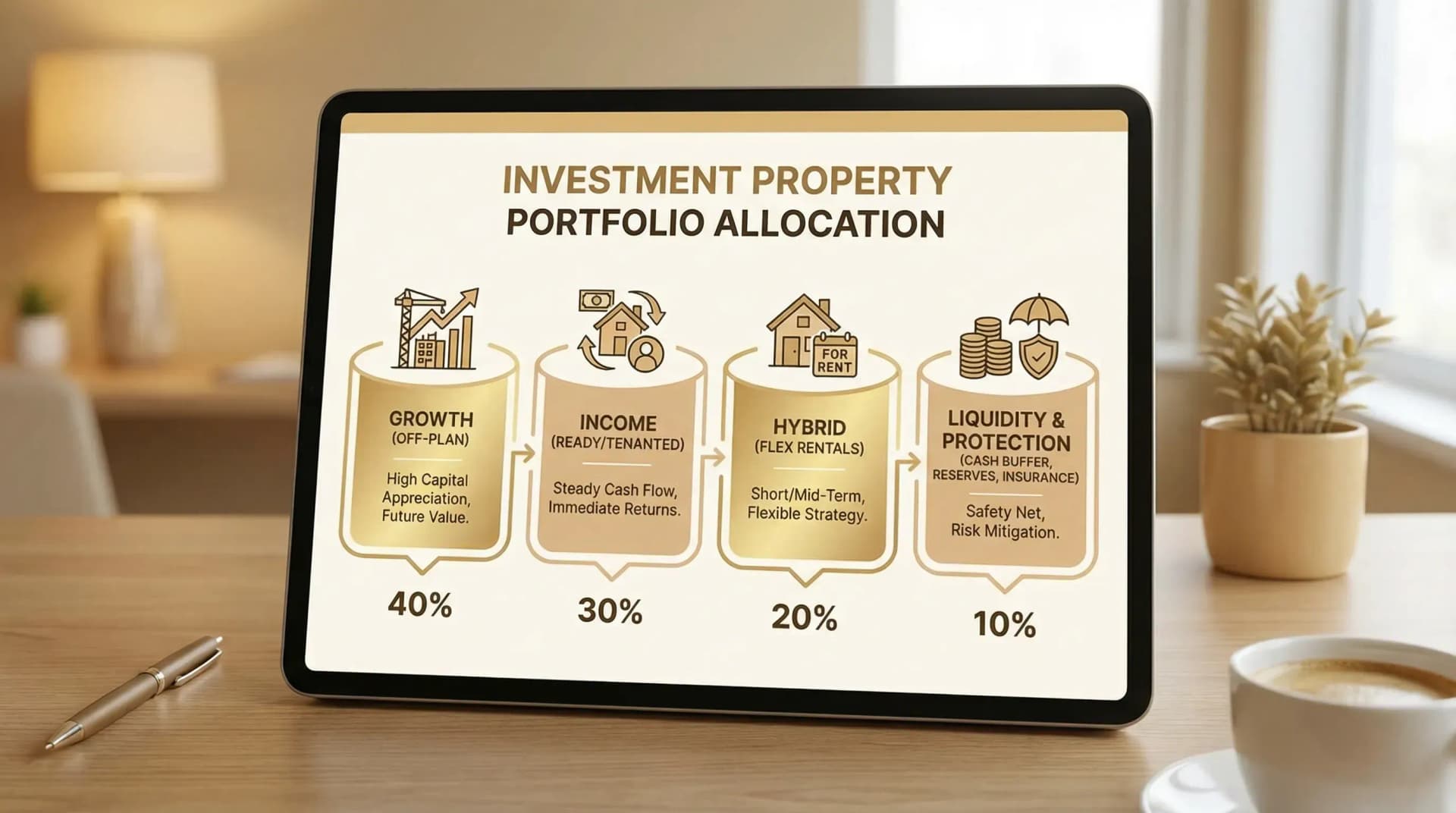
Bucket A: Growth (typically off-plan, pre-launch, or early-cycle opportunities)
Goal: maximise long-term equity growth and capture pricing inefficiencies (for example, early-launch pricing, phased masterplans, or infrastructure-led uplift).
This bucket is where many UAE investors place carefully selected off-plan positions, especially in emerging high-growth pockets. The trade-off is obvious: construction timelines, phased delivery, and a longer path to stabilised rent.
Bucket B: Income (completed or near-completion, rent-stable assets)
Goal: dependable rental income and portfolio stabilisation.
This bucket prioritises tenants, operational execution, and predictable holding costs. Even if growth is slower, this is often the “sleep-at-night” portion of a property portfolio.
Bucket C: Hybrid (flex strategies that can swing between income and growth)
Goal: adaptability.
Hybrid assets are properties where you can change the operating model if the market shifts. Examples include units suitable for either long-let or short-stay (subject to licensing), or properties that can be furnished/unfurnished to target different tenant profiles.
Bucket D: Liquidity & Protection (cash, reserves, and downside control)
Goal: keep the portfolio investable when reality happens.
In property, the best opportunities often appear when others are forced sellers. Liquidity is what stops you becoming one.
This bucket usually includes:
- A cash buffer for mortgage payments, service charges, and vacancies
- Planned capex and maintenance reserves
- Insurance and legal contingency planning
Here is how the four buckets typically map in practice.
| Bucket | Primary role | Common property examples | Primary risks to manage |
|---|---|---|---|
| A. Growth | Equity compounding | Off-plan, pre-launch, early-cycle locations | Delivery risk, market timing, liquidity |
| B. Income | Cashflow stability | Completed units with proven rent comps | Tenant risk, cost creep, rate sensitivity |
| C. Hybrid | Optionality | Units that can switch strategy (long-let/STR, furnished/unfurnished) | Operational intensity, regulation, seasonality |
| D. Liquidity & Protection | Staying power | Cash buffers, reserves, risk controls | Inflation drag, under-reserving |
A simple allocation range that works for most investors
If you want a default template, start with ranges rather than fixed numbers. You can then “dial up” the bucket that matches your priorities.
| Portfolio style | Growth (A) | Income (B) | Hybrid (C) | Liquidity & Protection (D) |
|---|---|---|---|---|
| Growth-led | 45–65% | 15–30% | 10–20% | 5–15% |
| Balanced | 30–45% | 30–45% | 10–20% | 5–15% |
| Income-led | 15–30% | 45–65% | 5–15% | 10–20% |
Two notes that keep this realistic:
-
Liquidity & Protection is not “dead money” if it stops a forced sale, covers a delay, or gives you negotiating power.
-
If you are highly leveraged, your effective risk is higher, even if your bucket percentages look conservative.
Portfolio guardrails (the rules that prevent concentration risk)
A template is only useful if it comes with constraints. Consider adopting a few “non-negotiables” that fit your risk tolerance.
- Single-market cap: set a maximum percentage of your portfolio value in one city or micro-market.
- Single-developer cap (for off-plan): avoid stacking multiple units with the same delivery and counterparty risk.
- Completion-date staggering: aim to avoid having most projects handing over in the same 6–12 month window.
- Debt headroom rule: keep a buffer so a rate move or vacancy does not force a sale.
- Reserve rule: maintain a defined cash buffer (often expressed as months of total property costs).
- Exit clarity: every asset should have a primary exit (hold, refinance, sell, assignment where permitted) and a backup.
If you want a deeper dive into execution mechanics, you can also read Azimira’s practical guide to off-plan investing in the UAE.
Implementation: a one-page “before you buy” checklist
Use this table as your pre-purchase sanity check. If you cannot confidently answer most of it, you are not allocating, you are guessing.
| Question | What a good answer looks like |
|---|---|
| Which bucket is this purchase? | A, B, or C, and why it fits your plan |
| What is the base-case return driver? | Clear: growth, income, or optionality |
| What would make it underperform? | Specific risks (delay, rent softness, costs, rates, FX) |
| What is the Plan B? | Switch rental strategy, refinance later, hold longer, sell at a trigger |
| What is the “cost to hold”? | Realistic service charges, management fees, insurance, vacancy allowance |
| How does it change concentration? | Post-purchase exposure by market, developer, strategy |
| What will you track monthly? | Cashflow, occupancy, arrears, expenses, progress milestones (off-plan) |
For a quick refresher on yield maths, Azimira also has a straightforward guide to the 2-minute ROI calculation.
Monitoring and rebalancing: what to track (and when to act)
Property feels slow, which tempts investors to “set and forget”. The better approach is to monitor a small set of indicators that tell you when the portfolio is drifting away from its intended allocation.
| Metric | Why it matters | Simple action trigger |
|---|---|---|
| Net yield (not gross) | Shows real income after costs | Investigate if it trends down despite stable rents |
| Portfolio vacancy | Measures income volatility | Review pricing, tenant quality, and property condition |
| Total cost inflation | Service charges, utilities, insurance creep | Re-quote, negotiate, or adjust strategy |
| Leverage (LTV) | Determines forced-sale risk | Set a maximum LTV per property and portfolio-wide |
| Exposure by delivery date | Concentrates risk in one period | Spread future buys across different handover windows |
If you work with a specialist, ask for reporting that ties back to your allocation buckets rather than just individual unit performance. Azimira’s focus on market analysis, tailored strategy, and investment performance tracking is designed to support exactly this kind of portfolio discipline.
Where Ras Al Khaimah (RAK) often fits in an allocation
For many international buyers, RAK plays a clear role in the template:
- Bucket A (Growth): selected off-plan and early-phase opportunities in a high-growth market.
- Bucket C (Hybrid): lifestyle-led locations where demand can support multiple rental strategies (depending on licensing and management capability).
Azimira specialises in connecting investors to premium off-plan opportunities in high-growth UAE markets, with a particular focus on Ras Al Khaimah. If you want the market context before you allocate, start with the overview on investing in RAK property and then sanity-check the end-to-end steps with the timeline for buying off-plan in RAK.
A quick note on “portfolio” diversification beyond property
Some investors also allocate a small percentage of their broader wealth to non-property cashflow assets such as private credit, businesses, or intellectual property (IP) licensing. If you do explore IP-based income, enforcement and licensing mechanics matter as much as yield projections. Specialists such as Third Chair for IP monitoring, enforcement, and licensing highlight how rights holders can audit usage and build defensible revenue streams.
That may sit outside a pure property plan, but the principle is the same: allocate deliberately, manage downside, and track performance against a defined role.
Frequently Asked Questions
What is the best allocation for an investment property portfolio? The best allocation is the one that matches your goals, time horizon, and cashflow resilience. A practical starting point is a balanced 30–45% growth, 30–45% income, 10–20% hybrid, and 5–15% liquidity and protection, then adjust based on your needs.
Should off-plan properties be a large part of a portfolio? Off-plan can be effective for growth, but concentration is the risk. Many investors cap off-plan exposure, stagger handover dates, and avoid over-allocating to one developer or one micro-market.
How much cash should I keep as a buffer in a property portfolio? Many investors hold a buffer expressed in months of total property costs (mortgage or payment plan instalments, service charges, utilities, management, insurance). The right level depends on leverage and income stability.
How do I rebalance a property portfolio when property is illiquid? Rebalancing often happens through the next purchase (buy more income assets if growth exposure is too high), refinancing after value uplift, changing rental strategy (where feasible), or selective disposals.
How can UAE property fit into a global investment plan? UAE property can provide a blend of capital growth and income, with different emirates playing different roles. Many investors use emerging high-growth markets as the “growth bucket” and more mature, rent-stable assets as the “income bucket”, while managing currency, legal, and operational considerations.
Build your allocation with real opportunities, not generic percentages
A template is only step one. The hard part is matching each bucket to specific properties, realistic cashflow assumptions, and a risk-managed acquisition timeline.
If you are building or refining an investment property portfolio in the UAE, Azimira can help you translate this allocation into a curated shortlist of premium off-plan and investment-grade opportunities, supported by market insight, tailored strategy, and dedicated client support. Explore Azimira at azimira.com and request guidance on which projects best fit your target bucket (growth, income, or hybrid) and your personal risk limits.
Related articles
What Counts as Good Real Estate Investments in 2026
Learn what makes good real estate investments in 2026, from net yield and demand signals to legal checks, exit plans and UAE opportunities.

Investors Needed for Real Estate? Start With This Plan
Investors needed for real estate? Use this practical plan to define strategy, numbers, due diligence and partners before raising capital.

Investment Marketing Tactics Developers Use at Launch
Understand investment marketing tactics developers use at launch, from scarcity to incentives, and learn how to assess UAE off-plan deals.