
Off the Market Real Estate: Pros, Cons, and Due Diligence
Learn how off the market real estate works, its pros and cons, and the due diligence checks that protect buyers in the UAE and beyond.
Off the market real estate sounds like an insider’s shortcut: properties that never hit the big portals, no public price history, and fewer competing buyers. Sometimes that discretion creates genuine opportunity. Other times it simply removes the transparency that protects you.
For serious buyers and investors (especially in fast-moving markets like the UAE), the difference between a smart off-market purchase and an expensive mistake is almost always process. In practice, the right due diligence matters more off-market than it does on-market.

What “off the market real estate” actually means
A property is “off-market” when it is not publicly advertised through the usual channels (major portals, public listing networks, broad agent distribution). That can include:
- Private listings shared to a short list of buyers (sometimes called pocket listings).
- Pre-launch allocations where buyers access units before a project is widely marketed (common in off-plan markets).
- Quiet sales driven by privacy (high-net-worth owners, public figures, sensitive business situations).
- Portfolio or bulk transactions where multiple units trade privately.
Off-market does not automatically mean discounted, distressed, or “secret”. Often it simply means the seller wants control over exposure, timing, and who knows the asset is for sale.
Why sellers choose off-market (and why it matters to your negotiation)
Understanding the seller’s motivation is a core part of valuation and negotiation, and off-market sellers tend to fall into a few repeatable patterns.
Privacy and reputation management
Luxury owners may avoid public listings to reduce visibility, manage security concerns, or prevent market speculation about their personal finances.
Price testing without public “days on market”
Some sellers want to explore a number without creating a public trail that weakens their position if the property fails to sell.
Speed and certainty
A seller might accept fewer viewings and less marketing in exchange for a cleaner close with a pre-qualified buyer.
Developer allocation strategy (common in the UAE)
Developers and their appointed partners may reserve early inventory for relationship-led buyers, repeat clients, or investors who can move quickly (often tied to pre-launch pricing, unit selection advantages, or payment plan structure).
Your job is to translate the motivation into a strategy: what the seller values most (speed, confidentiality, headline price, certainty) becomes your leverage.
Off-market vs on-market: what really changes
The property itself may be identical. What changes is information quality, market signalling, and friction.
| Factor | On-market purchase | Off-market purchase |
|---|---|---|
| Price discovery | Stronger (more comps, wider buyer feedback) | Weaker (less public validation) |
| Competition | Higher | Often lower, but not always |
| Transparency | More documentation and marketing material typically available | You may have to request everything and verify harder |
| Negotiation dynamics | Seller anchored to public pricing and market sentiment | Seller anchored to private expectations and relationship context |
| Risk profile | Generally lower operational risk | Higher risk of mispricing, incomplete facts, or bad actors |
The main takeaway: off-market can reduce competition, but it also reduces the market mechanisms that normally keep pricing and claims honest.
The real pros of off-market real estate
1) Access to constrained or “never listed” inventory
In some sub-markets, the best assets trade quietly because owners do not need the visibility. If your criteria is specific (view corridors, rare layouts, trophy locations), off-market may be the only place it appears.
2) Potentially cleaner negotiation
Less theatre, fewer bidders, fewer “offer deadlines”. When both parties are serious, the deal can move faster with fewer distractions.
3) Better unit selection in pre-launch and early-release phases
For off-plan buyers, early access can mean better stacks, better views, and more flexible payment structures, depending on the project and the release phase.
4) Less public exposure for sensitive strategies
Investors buying multiple units, executing a consolidation strategy, or repositioning a property may prefer discretion to avoid signalling to the market.
The main cons (and where buyers get hurt)
1) Mispricing risk
Off-market pricing is not “wrong” by default, but it is easier to be wrong when fewer reference points are visible. The buyer who skips independent valuation because the deal feels exclusive is taking the biggest risk.
2) Higher fraud and impersonation risk
Off-market channels can attract:
- Fake sellers or unauthorised intermediaries
- Forged documents
- Pressure to wire “reservation” funds quickly
This is especially dangerous cross-border, where buyers may not recognise local norms for escrow, licensing, and verification.
3) Conflicts of interest can be harder to spot
If an intermediary represents both sides (or prioritises speed over scrutiny), you can lose negotiating power and miss key disclosures.
4) Financing friction
Some lenders are cautious if the paper trail is thin, valuations are disputed, or the seller refuses standard access for inspections and documentation.
Due diligence is different off-market (you need a stronger standard, not the same one)
On a public listing, poor-quality deals are often filtered out by exposure: other buyers, other brokers, and public scrutiny. Off-market removes those filters, so your verification needs to be more systematic.
A strong approach is to treat every off-market opportunity as two parallel investigations:
- Asset truth: what exactly is being sold, what is its condition, what are the financials, and what future constraints exist.
- Counterparty truth: who is selling, who is authorised, who is paid what, and where funds are going.
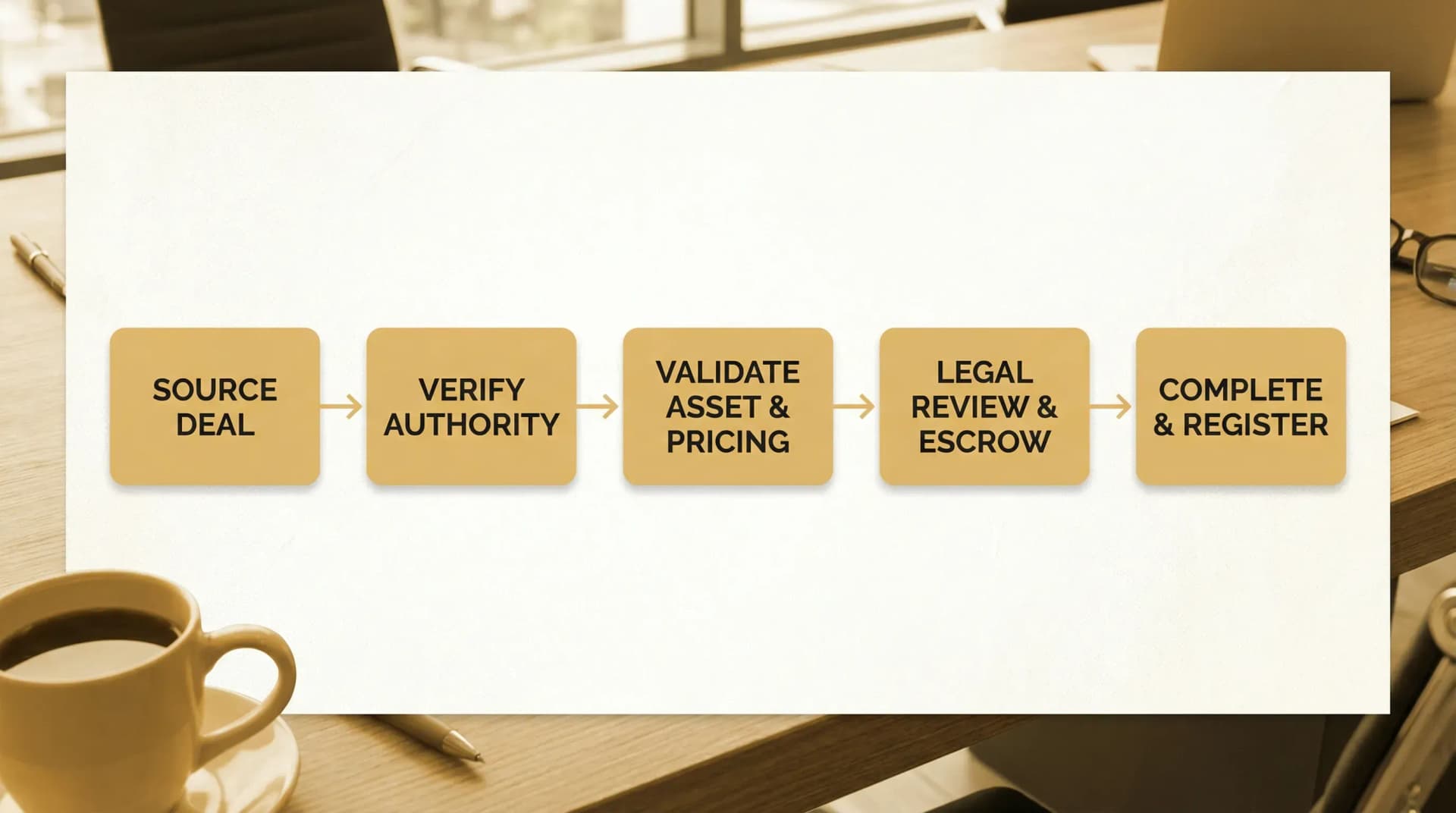
Off-market due diligence checklist (practical, deal-protecting steps)
The checklist below is deliberately “boring”. Boring is what protects capital.
| Due diligence area | What to verify | Why it matters |
|---|---|---|
| Seller identity and authority | Confirm the legal owner, signing authority, and that the intermediary is authorised to market the property | Prevents impersonation scams and unenforceable contracts |
| Broker/agent legitimacy | Verify licensing with the relevant local regulator and confirm who the agent is acting for | Reduces fraud risk and clarifies fiduciary duty |
| Title and encumbrances | Title status, liens, restrictions, mortgages, easements, pending disputes | Avoids buying a legal problem you cannot “renegotiate” later |
| Pricing evidence | Independent comps, rental comparables, and a valuation where appropriate | Avoids overpaying due to thin price discovery |
| Property condition | Professional inspection or snagging (as relevant), building systems, material defects | Off-market does not excuse physical risk |
| Building/community finances | Service charges, sinking fund health (if applicable), major upcoming works | Hidden operating costs destroy real yield |
| Contract terms | Sale and Purchase Agreement (SPA) terms, default clauses, timelines, handover standards for off-plan | The contract governs outcomes, not the sales pitch |
| Funds handling | Escrow mechanics, approved payment routes, name-matching of accounts, receipt trail | Prevents loss through misdirected payments |
| Compliance (AML/KYC) | Source of funds and identity checks, especially for cross-border buyers | Avoids delays, rejections, and regulatory exposure |
Step 1: Confirm “who is really selling” (and who gets paid)
In off-market real estate, authority is the first gate.
Practical checks:
- Ask for written confirmation of the intermediary’s mandate to market the property.
- Confirm the seller’s identity and signing authority early, before you share sensitive documents or transfer any funds.
- If a power of attorney is involved, have it reviewed by a qualified lawyer and verify it is valid for a property sale in that jurisdiction.
If the counterparty resists basic verification or pushes urgency, treat that as a signal, not a negotiation tactic.
Step 2: Rebuild price discovery from scratch
With fewer public signals, you need your own pricing model.
A disciplined approach usually includes:
- Comparable sales (same building or micro-location, similar view orientation, similar floor, similar condition)
- Comparable rents (for yield and tenant demand reality)
- A sensitivity range (best case, base case, downside case)
If you want to develop stronger technical skill here (valuation thinking, investment analysis, negotiation framing), structured learning can pay back quickly. Some investors use professional microlearning programmes such as the UpSkilling online courses to sharpen finance and decision-making fundamentals alongside deal experience.
Step 3: Verify title, registry facts, and transfer mechanics
Every jurisdiction has its own rules, but the principle is universal: do not rely on a PDF alone.
In the UAE, verification typically involves cross-checking details with the relevant land department and regulator for the emirate. For Dubai, for example, the Dubai Land Department provides official channels and guidance that buyers and owners can use to understand processes and services.
What you are trying to confirm is simple:
- The property exists as described in official records
- The seller has the right to transfer it
- There are no restrictions that block transfer or materially change value
Step 4: Treat off-plan “off-market” as a special case
Off-plan off-market opportunities can be excellent, but due diligence shifts toward developer execution and contract protections.
Focus areas that matter most:
- Escrow and payment routing: ensure funds go through the correct, officially designated channels.
- Specification clarity: what exactly is included in finishes, appliances, parking, storage, and upgrades.
- Handover standards and remedies: delays, defects, and variation clauses.
- Assignment and exit rules: if your plan includes resale before completion, you need to confirm the developer’s policy and fees in advance.
If you are considering UAE off-plan opportunities in particular, a specialist advisor with curated access can help you compare pre-launch pricing against the true risk profile, not just the marketing narrative. Azimira’s focus is precisely on connecting investors with vetted off-plan opportunities (including in high-growth markets such as Ras Al Khaimah) and aligning each deal with a tailored investment strategy.
Step 5: Make funds safety non-negotiable
The most common off-market loss events are not “bad investments”. They are bad payments.
Risk controls to insist on:
- A clear written payment schedule tied to contractual milestones
- Account name matching (the beneficiary account should match the legal counterparty as documented)
- No last-minute changes to banking details without independent verification
- A lawyer-reviewed process for deposits and completion funds
If a party asks you to send money to an unrelated third-party account “for speed”, walk away.
Red flags that should end the conversation
Off-market is not an excuse for informality. The more “exclusive” the deal sounds, the more you should demand standard protections.
These patterns are high-risk:
- Refusal to prove authority to sell (or vague stories about “family ownership” without documentation)
- Pressure to transfer a deposit before legal review
- No willingness to allow inspection, valuation, or registry verification
- Claims of “guaranteed returns” or unusually high yields without itemised cost assumptions
- Inconsistent property facts across documents, messages, and marketing material
A legitimate seller can still want privacy, but privacy is compatible with verification.
When off-market makes sense (and when it doesn’t)
Off the market real estate tends to work best when you have at least one of the following advantages:
- You have a very specific buy box (rare units, rare locations) and time is expensive
- You can verify pricing through strong local comps and professional support
- You are buying with a long horizon, where entry quality matters more than “winning” a bidding war
It makes less sense when:
- You are relying on off-market to compensate for weak research
- You need maximum liquidity and easy resale in the near term
- You cannot access independent verification (legal, valuation, inspection)
A practical way to source off-market deals without increasing risk
The safest off-market pipelines are typically relationship-led, but still professionalised.
Look for channels where you can enforce process:
- Specialist broker networks with clear licensing and track records
- Developer-appointed partners for early allocations (especially in off-plan)
- Repeat-seller relationships where prior transactions establish credibility
If you are buying internationally, insist on a workflow that includes legal review, registry verification, and documented payment routes. The goal is not to eliminate risk (real estate always has risk), it is to eliminate preventable risk.
Closing thought: exclusivity is not value, verification is
The best off-market deals are not defined by secrecy. They are defined by a clear investment rationale, clean documentation, and a buyer who can validate price and risk independently.
If you want support evaluating an off-market or pre-launch opportunity in the UAE, Azimira can help you compare options, pressure-test the numbers, and run a due diligence process that matches the reality of private-market transactions.
Related articles
What Counts as Good Real Estate Investments in 2026
Learn what makes good real estate investments in 2026, from net yield and demand signals to legal checks, exit plans and UAE opportunities.

Investors Needed for Real Estate? Start With This Plan
Investors needed for real estate? Use this practical plan to define strategy, numbers, due diligence and partners before raising capital.

Investment Marketing Tactics Developers Use at Launch
Understand investment marketing tactics developers use at launch, from scarcity to incentives, and learn how to assess UAE off-plan deals.