Dubai Investors: Where Smart Money Is Looking in RAK
Dubai investors are shifting to Ras Al Khaimah. Discover where smart money is looking in RAK, key areas to watch, and a due diligence filter.
Dubai’s real estate cycle has created life-changing returns, but it has also matured into a market where “easy upside” is harder to find. That is why more Dubai investors are increasingly treating Ras Al Khaimah (RAK) as the UAE’s next serious allocation, not as a speculative punt, but as a value and growth play with clear, identifiable catalysts.
RAK is not trying to be “another Dubai”. It is building a different proposition, resort-led tourism, lifestyle infrastructure, and premium waterfront communities at earlier-stage pricing. For investors who already understand UAE property mechanics, that combination can look like a familiar opportunity set.
Why Dubai investors are scanning RAK now (not later)
RAK has been “on the radar” for years, but the decision point for many Dubai-based buyers is happening in 2026 for three practical reasons.
First, the pricing gap between Dubai and RAK still exists in many comparable lifestyle segments (waterfront apartments, branded-style living, resort adjacency). When a market is earlier in its pricing curve, the same percentage move translates into meaningful absolute gains.
Second, RAK’s growth story is increasingly catalyst-driven, not just marketing-led. Tourism expansion, high-profile projects, and transport connectivity are tangible drivers that can change who visits, who rents, and who buys.
Third, a growing number of investors in Dubai are already overweight one micro-market (often a single corridor or asset type). RAK provides UAE exposure with different demand engines, which is attractive for diversification without taking on a new country risk.
If you want a broader foundation for the RAK case, Azimira covers it on the RAK investment page.

What “smart money” is actually looking for in RAK
In emerging or fast-transitioning markets, returns are rarely evenly distributed. The investors who tend to outperform usually focus on three levers: scarcity, demand quality, and delivery certainty.
1) Scarcity you can defend (not just “sea view”)
Scarcity is not a slogan, it is a supply constraint that holds up when new units hit the market. In RAK, that often means:
- Walkable waterfront positioning within master-planned communities
- Protected views and long-term planning controls
- Limited land parcels with direct resort adjacency
Sea view can matter, but defensible scarcity usually comes from the combination of view, proximity, and masterplan quality. If you want to pressure-test the view premium logic, see Azimira’s analysis on whether sea view is worth the premium in RAK.
2) Demand that is widening, not just getting louder
RAK’s demand is no longer only “weekend Dubai residents”. Investors are watching for broader demand drivers:
- Higher tourism throughput and longer stays
- Corporate and project-related mid-term rentals
- More international buyer participation and second-home use
RAK’s tourism strategy is publicly documented through the Ras Al Khaimah Tourism Development Authority, which is useful context for investors underwriting rental demand.
3) Delivery certainty and downside control
Dubai investors are typically already familiar with off-plan upside, and also off-plan risk. In RAK, smart money puts disproportionate weight on:
- Developer track record and financial strength
- Escrow and regulatory compliance
- Contract clarity (variation clauses, handover timeline language, assignment rules)
If you want a practical refresher on mechanics and risk, Azimira’s guide to off-plan investing in the UAE is a good baseline.
Where Dubai investors are focusing in RAK (and why)
The highest-conviction interest tends to cluster in a few zones because they align with how Dubai capital thinks: liquidity, lifestyle, and a visible narrative.
Al Marjan Island: the “institutional story” zone
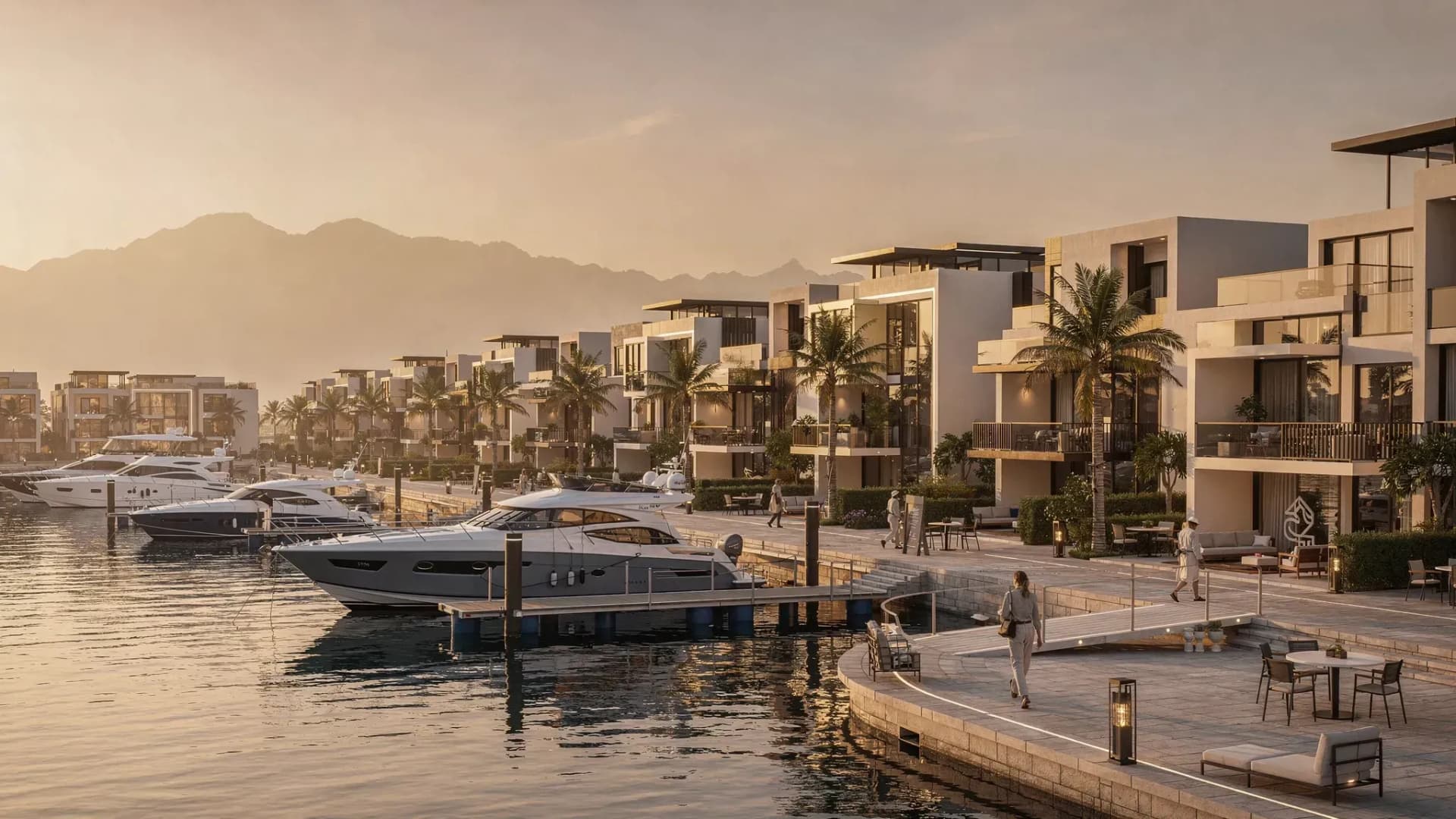
Al Marjan Island is where a lot of the international attention concentrates, because it has the clearest resort and hospitality narrative. For Dubai investors, it can feel familiar, a waterfront destination with a strong pipeline of tourism-led demand.
It is also where high-profile development news tends to reprice expectations faster than the rest of the emirate. For Wynn-related context, Wynn Resorts provides official project information via its corporate channels, see Wynn Resorts for investor and press updates.
Key investor logic here is less about “today’s rent” and more about owning in the zone where global visibility can change buyer composition.
Mina Al Arab and adjacent masterplans: the “repeatable family demand” zone
Dubai investors who prioritise stable leasing and wider tenant pools often like master-planned communities that work for day-to-day living, not just holidays.
Mina Al Arab’s appeal is the depth of community planning and the ability to target multiple tenant types (families, long-stay professionals, and lifestyle-driven residents). It is often where investors look for a balance between capital growth potential and a more resilient rental base.
For a deeper masterplan view, you can refer to Azimira’s Mina Al Arab masterplan deep-dive.
Al Hamra: the “mature liquidity” zone
Dubai investors who are wary of being too early sometimes prefer established communities where amenities, occupancy patterns, and resale comparables are easier to validate.
Al Hamra can be attractive for this reason, and it often fits investors who want fewer unknowns and a clearer rental story, especially if the unit is ready or near completion.
If you are deciding between major waterfront communities, Azimira’s Al Hamra vs Mina Al Arab comparison is a helpful framework.
RAK City Centre and redevelopment corridors: the “asymmetric upside” zone
Not all smart money is waterfront. Some Dubai investors look for undervalued urban nodes where redevelopment can change the rental base and exit liquidity over time.
City-centre positioning can suit investors who want exposure to local employment, education, and non-seasonal demand, as long as the specific micro-location and delivery timeline are clear.
Azimira explores this angle in the RAK City Centre redevelopment piece.
Jebel Jais corridor: the “experience economy” zone
A smaller subset of investors focus on experience-led destinations, where attractions, climate differentiation (relative to coastal humidity), and weekend travel demand can support premium short-stay performance.
This is not a blanket strategy, it is highly location-specific, and it depends on access, future supply, and how a unit can be positioned operationally.
Dubai vs RAK: a practical investor comparison
Dubai and RAK are not substitutes. They can play different roles inside the same UAE portfolio.
| Factor | Dubai (general investor reality) | RAK (general investor reality) | Why it matters |
|---|---|---|---|
| Market stage | Mature, highly liquid, globally priced in many segments | Earlier-stage repricing in select zones | Earlier-stage markets can offer larger upside if catalysts land |
| Transaction fee benchmark | Dubai transfer fee is widely known at 4% (DLD) | RAK has historically been lower (Azimira cites 2.25% total in RAK registration guidance) | Fees affect break-even hold time and exit flexibility |
| Primary narrative | Global city demand, corporate rents, established tourism | Resort tourism growth, new infrastructure, emerging luxury | Narratives drive buyer composition and liquidity |
| Portfolio role | Core UAE allocation, stability, liquidity | Satellite growth allocation, diversification, value | Helps avoid being concentrated in one emirate cycle |
For deeper, data-led perspective, see Azimira’s RAK vs Dubai capital growth back-test analysis.
The 6-point due diligence filter Dubai investors should apply in RAK
RAK rewards investors who are disciplined on project selection. A Dubai playbook works well, but it needs a few RAK-specific tweaks.
Developer quality and delivery discipline
Track record matters more than brochures. If you want a structured way to evaluate developers, Azimira provides a KPI template in what makes a Tier-1 developer.
Off-plan legal protections and escrow
Do not shortcut escrow verification and contract review. If you are investing off-plan, review Azimira’s escrow due diligence guide to align your process.
Micro-market supply risk
In a fast-growing emirate, “RAK” is not one market. Underwrite supply at the community level (and sometimes the building level), especially in zones where multiple launches cluster.
Unit selection, not just project selection
Dubai investors often win on unit selection: orientation, view protection, walkability, parking convenience, and proximity to future amenities. These factors can affect rentability and resale more than the headline brand.
Operating model clarity (holiday vs annual)
If your return relies on short-stay premiums, you need a realistic net model and a licensing plan, not just gross yield assumptions.
To compare strategies, Azimira’s holiday rental vs annual lease profitability analysis is a strong reference.
Exit path planning before you buy
Dubai investors are generally more exit-aware than international first-timers, and that discipline should carry over. Understand assignment rules (if off-plan), selling costs, and realistic liquidity.
Azimira breaks this down in exit costs explained.
Common mistakes Dubai investors make when entering RAK
Most underperformance is not about picking “the wrong emirate”. It is about importing assumptions that only work in Dubai.
- Assuming Dubai-level liquidity in every segment. Some RAK micro-markets are liquid, others are still developing.
- Buying a narrative instead of a unit. The island story may be strong, but the wrong stack or orientation can still underperform.
- Overweighting one strategy (for example, only short-stay). RAK can support short-stays, but it is not uniform across locations and property types.
- Underestimating ownership costs and set-up. Service charges, furnishing, and management decisions can materially change net yield.
If you want a prevention checklist, Azimira covers this in 5 costly mistakes first-time RAK investors make. Even experienced Dubai investors will recognise a few.
A simple allocation approach (how Dubai investors typically size RAK)
There is no universal rule, but many Dubai-based investors treat RAK as:
- A growth sleeve within a UAE property portfolio
- A way to diversify across demand engines (global city vs resort tourism)
- A tactical play around a defined catalyst window (often pre-handover to early stabilisation)
If you are building a multi-asset approach, Azimira’s diversified RAK portfolio strategy guide can help you think in portfolio terms rather than single-unit bets.
Frequently Asked Questions
Why are Dubai investors buying in Ras Al Khaimah now? Dubai investors are drawn by the value gap versus Dubai, visible tourism and infrastructure catalysts, and the chance to diversify UAE exposure while still investing under a familiar legal and transactional framework.
Which areas in RAK are most interesting for Dubai investors? Interest commonly concentrates around Al Marjan Island (resort and global visibility), Mina Al Arab (master-planned residential depth), Al Hamra (more established community liquidity), and selective city-centre redevelopment corridors.
Is RAK only a holiday rental market? No. While short-stay demand is growing, many investors target long-term residents, families, and mid-term corporate tenants, depending on community maturity and unit configuration.
Is off-plan in RAK safe? Off-plan can be safe when escrow protections are verified, the developer is vetted, and the contract is reviewed properly. The key is disciplined project and unit selection, plus realistic timeline and exit planning.
How should I compare Dubai vs RAK returns? Compare like-for-like assets, model net (not gross) yields, include fees, and stress-test assumptions on occupancy, service charges, and resale liquidity. Use scenario ranges rather than a single forecast.
Explore RAK opportunities with Azimira
If you are a Dubai-based investor considering RAK, the highest leverage step is not “finding listings”, it is building a short, high-conviction shortlist that matches your risk profile, holding period, and operating strategy.
Azimira specialises in premium off-plan opportunities in the UAE, with a strong focus on Ras Al Khaimah. If you want curated projects, market insight, and access to pre-launch allocations, you can start here:
- Explore Azimira’s RAK-focused investment approach
- Contact the team via Azimira to discuss your target budget, timeline, and preferred strategy (capital growth, yield, or blended)
Related articles
What Counts as Good Real Estate Investments in 2026
Learn what makes good real estate investments in 2026, from net yield and demand signals to legal checks, exit plans and UAE opportunities.

Investors Needed for Real Estate? Start With This Plan
Investors needed for real estate? Use this practical plan to define strategy, numbers, due diligence and partners before raising capital.

Investment Marketing Tactics Developers Use at Launch
Understand investment marketing tactics developers use at launch, from scarcity to incentives, and learn how to assess UAE off-plan deals.