
Off Market Real Estate: How to Access Deals Safely
Learn how to access off market real estate safely with a verification-first checklist, red flags to avoid, and practical deal-sourcing strategies.
Off market real estate can feel like a shortcut to better pricing, better terms, and less competition. It can also be where the worst scams and the most overpriced “exclusive” listings hide, precisely because there’s less public scrutiny.
If you want access without the risk, the goal is not simply to “find off-market deals”. The goal is to build a repeatable, verifiable process for sourcing, validating, and closing them.
What “off market real estate” actually means (and what it doesn’t)
In practical terms, off market real estate is a property opportunity that isn’t widely advertised on major portals or the open market at the time you’re negotiating.
Common forms include:
- Quiet listings shared only within a broker’s network
- Developer pre-launch allocations (especially common in off-plan markets)
- Direct-to-owner approaches (landlords, private sellers, corporate owners)
- Distressed or time-sensitive situations handled discreetly
What it does not automatically mean:
- A bargain
- A distressed seller
- A “guaranteed” high ROI
- A legitimate opportunity
The biggest mindset shift: off-market is a distribution method, not a quality label.
Why sellers go off-market (and why it matters to you)
Understanding seller motivation is the quickest way to judge whether a deal is real.
Typical reasons include:
- Privacy (high-profile owners, tenants in place, family situations)
- Speed (a seller wants certainty more than price discovery)
- Price testing (they want to “try a number” without days-on-market data)
- Operational complexity (tenanted assets, assets requiring specialised buyers)
- Developer strategy (controlling pricing, launching in phases, VIP allocations)
The safety implication: a legitimate off-market opportunity has a clear reason for being off-market, and that reason should be consistent with the paperwork and the process.
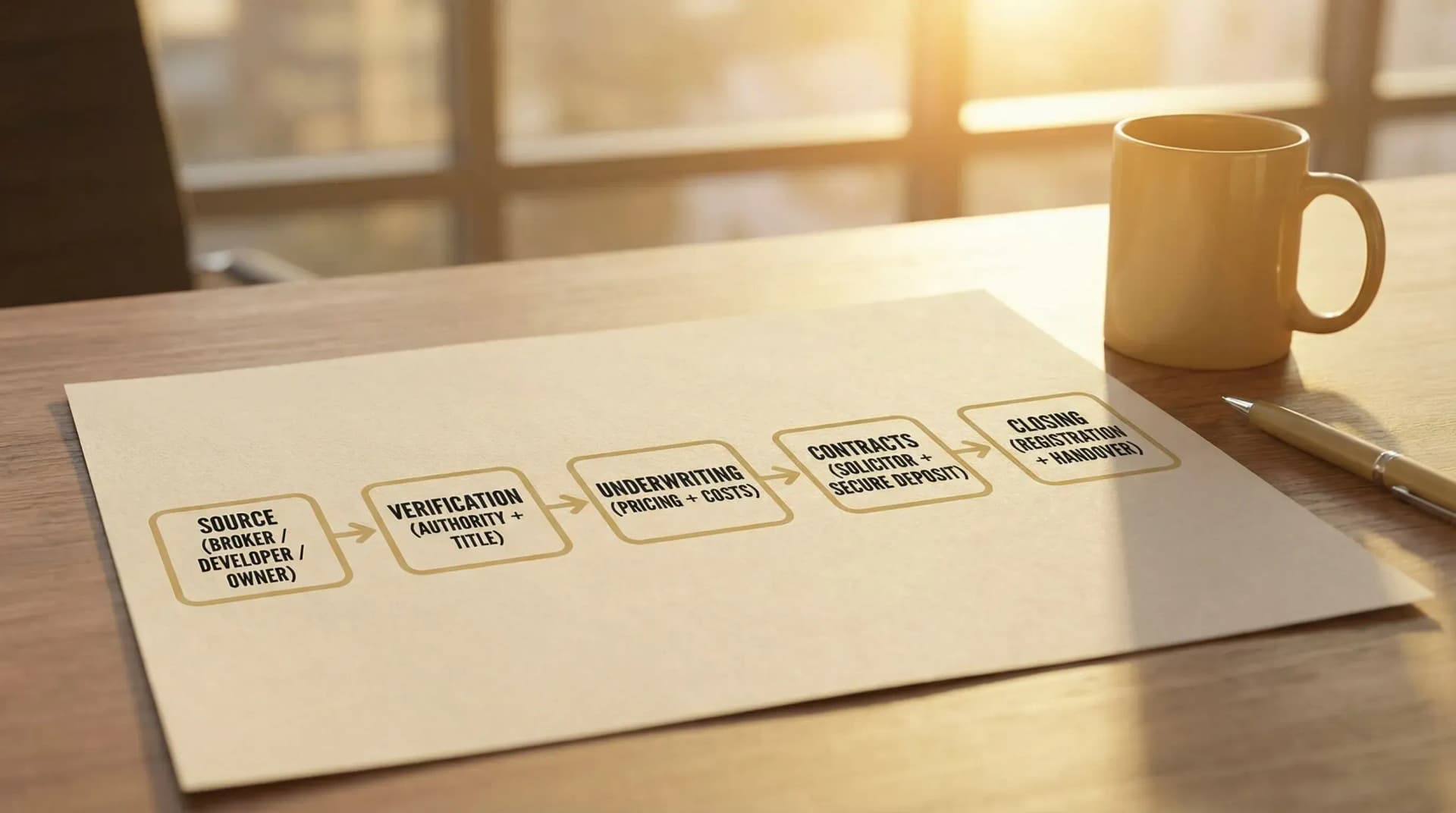
The safe-access framework: 6 steps to find and verify off-market deals
1) Define your buy box tightly (so you don’t get “sold”)
Off-market channels reward speed and clarity. If your criteria are vague, you’ll end up relying on someone else’s narrative.
Lock down:
- Target area(s) and asset type
- Budget and funding method (cash, mortgage, developer plan)
- Minimum acceptable yield or capital growth thesis
- Non-negotiables (view protection, handover timeline, developer tier, tenancy profile)
If you invest in emerging growth markets, add one more layer: your liquidity plan (how you expect to exit and who the next buyer is).
2) Choose deal sources that can be audited
Some channels are inherently safer because you can verify the chain of authority.
Here’s a practical comparison.
| Off-market channel | Why it works | Main risk | How to make it safer |
|---|---|---|---|
| Licensed broker networks | Faster matching, pre-vetted sellers | “Exclusive” claims, fee stacking | Confirm agent licence and written authority to market |
| Developer pre-launch / VIP | Best unit selection, staged pricing | Pressure selling, opaque allocations | Confirm developer, escrow/protections (where applicable), and reservation terms |
| Direct-to-owner | Fewer intermediaries, flexible terms | Identity fraud, unclear title | Verify ownership independently and insist on proper KYC |
| Wholesalers / finders (common in some markets) | Deal flow volume | Misrepresentation, non-binding contracts | Use solicitors, verify assignability, verify title before deposits |
A strong rule: if the deal source cannot clearly explain who they represent and how they’re paid, pause.
3) Verify “permission to sell” before you verify price
Many buyers start with comps. With off-market, start earlier.
Ask for documentary proof that the seller (or intermediary) has the right to transact:
- Proof of identity for seller or authorised signatory
- Proof of ownership (or official extract / deed equivalent)
- Written agency agreement or letter of authority if an agent is involved
- If corporate-owned: board resolution or signing authority evidence
In markets where escrow and official registries are part of the process, use them. In the UAE, for example, buyers commonly validate details via the relevant land department / regulator processes depending on emirate and asset status.
If any party resists basic verification, that’s not “privacy”. That’s risk.
4) Pressure-test the pricing (because off-market often hides weak pricing)
Off-market pricing is frequently anchored to hope, not market reality.
Your pricing discipline should include:
- Comparable sales (not just listings) where available
- Rent reality check (current achieved rents, not projected)
- Full cost model (fees, service charges, furnishing, management, vacancy, FX costs)
- Scenario range: base, conservative, and downside
If the opportunity is off-plan or pre-launch, pricing discipline becomes even more important. A small discount on launch day can disappear if the payment plan, delivery risk, or service charges are misread.
5) Use secure transaction mechanics (deposits are where most mistakes happen)
Off-market scams often focus on one moment: “send a deposit today to reserve.”
Safer mechanics:
- Never pay to a personal account
- Pay only to a clearly identified entity (developer / escrow / regulated brokerage client account, depending on jurisdiction)
- Use a solicitor or conveyancer where appropriate
- Match payer name, invoice name, and contract party exactly
- Keep a complete audit trail (invoice, receipt, bank confirmation)
For additional fraud prevention guidance, the UK’s HM Land Registry advises on property fraud risks and protective steps (useful even if you’re investing abroad, because the scam patterns are similar).
6) Make due diligence a checklist, not a feeling
Off-market is emotional by design: scarcity, exclusivity, urgency.
Counter it with a written checklist.
| Due diligence area | What you’re trying to confirm | Examples of evidence |
|---|---|---|
| Legal/title | The seller can legally transfer the asset | Title deed/extract, ID checks, authority to sign |
| Counterparty risk | You’re dealing with a real, solvent party | Developer track record, broker licence, corporate docs |
| Asset reality | The property is what you think it is | Floor plan, spec sheet, unit number, view confirmation |
| Financial viability | The return survives real costs | Service charges, management fees, vacancy assumptions |
| Exit/liquidity | There is a credible resale or rental market | Comparable transactions, demand drivers, supply pipeline |
When this checklist is done properly, you will walk away from more “exclusive” deals than you accept. That’s a feature, not a bug.
A note on off-market “adjacent” opportunities (and why reputable suppliers matter)
Some investors also pursue off-market or lightly marketed opportunities that sit next to real estate, for example:
- Land with immediate use potential
- Storage or yard strategies
- Modular solutions for site offices or temporary accommodation
If you’re looking at container-based options, treat it with the same diligence mindset: verify specifications, delivery terms, and payment security. A starting point for understanding what a professional, transparent supplier looks like is this option to buy shipping containers online with published delivery and inspection standards.
How off-market access works in the UAE (especially for off-plan)
In the UAE, “off-market” often shows up as pre-launch or private allocations rather than hidden resale listings. This is particularly relevant in high-growth areas where developers release inventory in phases.
What safe access typically looks like:
- Working through experienced advisors with direct developer relationships
- Getting clear documentation on reservation terms, payment plan, and unit details
- Treating “VIP access” as a chance to improve selection and structure, not to skip due diligence
This is where specialist platforms can add real value. Azimira focuses on curated off-plan opportunities and exclusive access in the UAE, with a particular emphasis on high-growth markets such as Ras Al Khaimah.
If you want a deeper primer on risk controls for new-build purchases, Azimira’s guide on off-plan investing in the UAE pairs well with the off-market safety framework above.
Red flags that should stop you immediately
Off-market opportunities can move fast. Scams move faster.
Be prepared to pause if you see:
- “Exclusive” deal but no written authority to market
- Deposit requests before paperwork review
- Guaranteed returns or unrealistic yield promises
- Refusal to disclose ownership proof or developer documentation
- Constant deadline resets (“price changes in 2 hours”) without any formal process
If you want a dedicated scam-focused lens, you can also read Azimira’s warning guide on property scam red flags in the UAE.
Frequently Asked Questions
Are off market real estate deals cheaper than listed properties? Not always. Off-market can mean better terms or better selection, but pricing can be optimistic because there’s less public competition. You still need comps and a full cost model.
How do I verify an off-market seller is legitimate? Start with proof of identity and proof of ownership (or formal authority to sell). If an agent is involved, confirm they are licensed and have written authority to market the property.
What’s the safest way to pay a deposit on an off-market deal? Only pay once you have written terms and a clear contract path. Use secure payment routes appropriate to the jurisdiction (for example, regulated client accounts or developer/escrow mechanisms where applicable), never personal accounts.
Is off-market the same as pre-launch off-plan in the UAE? It can overlap, but they’re not identical. In the UAE, off-market often means private allocations or pre-launch access to off-plan units, not necessarily secret resales.
Do I need a lawyer or conveyancer for an off-market purchase? In most cases, yes. Off-market reduces transparency, so professional legal review becomes more important, not less.
Want safer access to off-market and pre-launch opportunities in the UAE?
If your goal is to access premium off-plan and discreet opportunities without taking avoidable risk, Azimira can help you source and evaluate deals with a disciplined, investor-first process.
Explore Azimira at azimira.com or review the Ras Al Khaimah investment case on the investment page and request a private consultation.
Related articles
What Counts as Good Real Estate Investments in 2026
Learn what makes good real estate investments in 2026, from net yield and demand signals to legal checks, exit plans and UAE opportunities.

Investors Needed for Real Estate? Start With This Plan
Investors needed for real estate? Use this practical plan to define strategy, numbers, due diligence and partners before raising capital.

Investment Marketing Tactics Developers Use at Launch
Understand investment marketing tactics developers use at launch, from scarcity to incentives, and learn how to assess UAE off-plan deals.