
High Growth Real Estate Markets: UAE Hotspots Beyond Dubai
High growth real estate markets in the UAE beyond Dubai: compare RAK, Abu Dhabi, Sharjah and more, plus how to evaluate growth and de-risk off-plan buys.
Dubai will likely remain the UAE’s headline market, but in 2026 the most interesting high growth real estate markets are increasingly found in places where pricing is still “early cycle”, infrastructure is accelerating, and international demand is widening.
If you are looking for capital growth, diversification, or simply better value per dirham, this guide breaks down the UAE hotspots beyond Dubai and, crucially, the indicators that separate sustainable growth from short-lived hype.
Why investors are looking beyond Dubai in 2026
Dubai’s liquidity and global brand are hard to match. The trade-off is that, in many prime submarkets, buyers are paying for maturity: established infrastructure, deep resale demand, and tight competition for the best stock.
“Beyond Dubai” markets can offer a different risk-reward profile:
- Lower entry prices (which can lift potential upside if the location re-rates)
- New demand engines such as tourism mega-projects, industrial corridors, and new residency pathways
- Diversification across emirates, regulations, tenant bases, and supply cycles
In other words, the question is no longer “Is Dubai the only option?” but “Which UAE market best matches my objective: growth, income, lifestyle, or a blended strategy?”
What actually defines a high growth real estate market?
High growth is not just “prices going up”. In property, the best growth markets usually show a combination of demand expansion and supply discipline.
Here are the signals professional investors typically track.
1) New demand that is structural, not seasonal
Look for drivers that remain relevant even if global sentiment softens:
- Jobs and business formation (new employers, free-zone expansion, industrial strategy)
- Long-term tourism positioning (events, resorts, airlines, cruise plans)
- Population inflows and household formation
2) Infrastructure that changes behaviour
Infrastructure matters most when it changes what people will tolerate:
- Commute times to major employment zones
- Access to airports and new flight routes
- New marinas, waterfronts, cultural districts, hospitals, schools
3) A clear premium segment
The UAE’s growth is increasingly “premium-led”. Markets with credible luxury and branded inventory often attract:
- International cash buyers
- Lifestyle-driven second-home demand
- Higher nightly rates for short-stay models (where permitted)
4) Regulatory clarity for foreign buyers
For international demand to scale, investors want predictable rules around:
- Freehold ownership areas
- Off-plan protections and escrow processes
- Registration and transfer procedures
- Landlord-tenant enforceability
For a plain-English overview of the country-level landscape, the UAE Government portal is a useful starting point.
UAE hotspots beyond Dubai: where growth narratives are forming
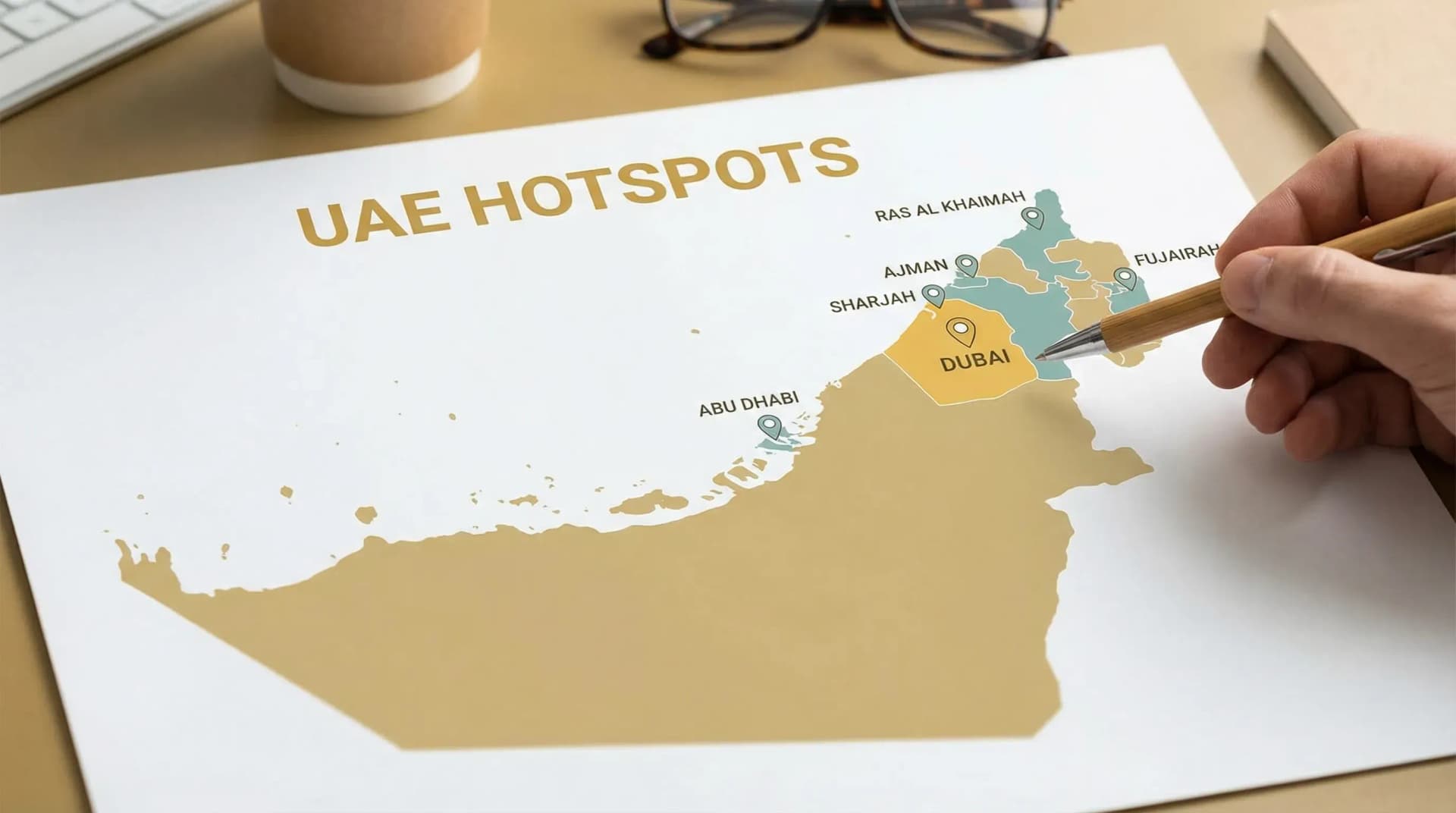
Below are the non-Dubai markets investors most commonly consider when searching for high growth real estate markets in the UAE.
Ras Al Khaimah (RAK): the “re-rating” market
RAK has moved from being a value alternative to becoming a destination in its own right, especially in premium waterfront and resort-led communities.
Why it is on investor radar:
- Tourism-led demand expansion and destination building
- Major developments and international branding, which can change buyer perception and price anchors
- Value gap versus Dubai, which can support a re-rating if infrastructure and liquidity keep improving
RAK is also increasingly relevant to investors who prefer off-plan strategies, where early-phase entry and developer payment structures can improve cash efficiency (assuming due diligence is done properly).
If you want a deeper RAK-specific investment case (including what Azimira focuses on), see: Investing in RAK property.
Abu Dhabi: stability plus premium district growth
Abu Dhabi tends to attract investors who prioritise resilience, institutional-grade development, and long-term city planning.
Common reasons buyers look here:
- A strong “capital city” profile with ongoing government-backed development
- High-quality lifestyle districts (particularly cultural, waterfront, and entertainment-led zones)
- A tenant base that often includes long-term residents and professional households
For many portfolios, Abu Dhabi plays the role of a core holding: potentially lower volatility, steady demand, and strong build quality in established areas.
Sharjah: end-user demand and affordability dynamics
Sharjah is frequently evaluated through a different lens: it is heavily influenced by end-user fundamentals and commuter patterns. Investors often explore Sharjah when they want:
- Lower entry points relative to Dubai
- Demand tied to family living, education, and long-term residency
- Potential upside from improving accessibility and new community developments
Where Sharjah can be attractive is when the product matches the dominant tenant profile: practical layouts, family-friendly communities, and realistic service charges.
Ajman: entry-level pricing with yield potential (and liquidity considerations)
Ajman is often discussed for affordability. That can create opportunity, but it also requires stricter underwriting.
What to like:
- Lower ticket sizes for investors building UAE exposure gradually
- Potentially strong yields in specific segments where rental demand is consistent
What to watch:
- Resale liquidity can be thinner than Dubai or Abu Dhabi
- Not every project has the same level of developer track record and deliverability
In Ajman, “deal quality” matters more than the emirate headline.
Fujairah and the East Coast: niche strategies, thinner markets
Fujairah can work for specialised objectives, for example lifestyle-led holdings or specific local demand pockets. However, it is generally considered a thinner market, so investors should be conservative about exit assumptions and focus on properties with clear end-user appeal.
Quick comparison: choosing the right emirate for your objective
This table is not a performance guarantee, it is a practical way to match strategy to market structure.
| Emirate | Why investors consider it | Often suits | Key watch-outs |
|---|---|---|---|
| Ras Al Khaimah | Tourism and premium destination build-out, value gap vs mature markets | Growth-focused, off-plan, waterfront and lifestyle assets | Project selection and supply pipeline discipline matter |
| Abu Dhabi | Institutional planning, premium districts, resilience | Core holdings, longer-term stability, quality-led demand | Pricing can reflect maturity in prime zones |
| Sharjah | End-user demand, affordability, family renter base | Long-let income, owner-occupier aligned stock | Product-market fit (layout, parking, schools, commuting) |
| Ajman | Lower entry cost, selective yield plays | Budget-conscious investors with strict criteria | Liquidity and developer quality dispersion |
| Fujairah | Niche coastal lifestyle and local demand pockets | Niche or hybrid lifestyle holdings | Smaller buyer pool, be realistic on exit timelines |
Off-plan in emerging hotspots: where upside comes from (and how to de-risk)
In high growth markets, off-plan can amplify returns because you are buying into:
- The market’s future pricing (if the area re-rates)
- The project’s delivery quality (which can create a premium at handover)
- Payment timing advantages (depending on the developer structure)
But off-plan also introduces risks that must be priced in: delivery delays, specification changes, and market-cycle timing.
If you want a broader UAE-focused primer, Azimira’s guide is a strong foundation: Beyond the hype: a practical guide to off-plan investing in the UAE.
A simple due diligence checklist before you commit
- Verify the developer’s track record (delivered projects, not just renders)
- Confirm the legal structure and escrow protections that apply in that emirate
- Read the Sale and Purchase Agreement carefully, especially handover terms and fee clauses
- Model conservative scenarios: slower handover, softer rents, higher running costs
A portfolio approach: “beyond Dubai” does not mean “anti-Dubai”
Many sophisticated buyers keep Dubai as a liquidity anchor and add exposure to other emirates for higher growth potential.
A practical way to think about allocation is by “role”:
- Core: markets/communities with deep resale demand and long-term tenant pools
- Growth: emerging premium districts where perception and infrastructure are improving fast
- Opportunistic: selective deals where pricing is compelling but liquidity is thinner
If you are following market sentiment and positioning, Azimira’s quarterly survey offers context on what high-net-worth investors are prioritising right now: UAE Property Investor Sentiment Barometer: Q1 2026.
Common mistakes investors make when chasing high growth markets
Over-optimising for headline ROI
A market can show exciting projected returns, yet still disappoint if:
- Service charges erode net yield
- The unit is hard to re-sell
- The tenant base does not match the product
Ignoring micro-location and future supply
“RAK” or “Sharjah” is not a strategy. The investable reality is the specific community, its pipeline, and its comparables.
Assuming the exit will be easy
In thinner markets, the exit is usually the weakest link. If you need a short holding period, prioritise liquidity and proven demand.
Frequently Asked Questions
Which are the best high growth real estate markets in the UAE beyond Dubai? Ras Al Khaimah is widely viewed as the standout growth story due to tourism and premium destination development. Abu Dhabi offers premium district growth with a more stability-led profile. Sharjah can suit end-user and long-let demand dynamics.
Is Ras Al Khaimah a good alternative to Dubai for property investment? It can be, especially for investors seeking earlier-cycle pricing and tourism-led growth. The key is selecting the right community and developer, and underwriting exits conservatively.
Is Abu Dhabi or Ras Al Khaimah better for capital growth? It depends on your risk tolerance. Abu Dhabi may suit buyers who want institutional stability and mature premium districts, while RAK may suit those targeting a re-rating story with potentially higher variability.
Are off-plan properties riskier in emerging markets? They can be, because delivery and market-cycle timing matter more. Strong due diligence, realistic financial modelling, and developer selection are essential.
How do I compare rental yields across different emirates? Compare net yield, not just gross yield, and include service charges, vacancy assumptions, maintenance, management, and compliance costs. Ensure you are comparing similar property types and similar tenant profiles.
Can international buyers own freehold property outside Dubai? Yes, but the rules depend on the emirate and designated areas. Always verify the specific freehold zones and the applicable registration process before reserving.
Explore UAE hotspots with a strategy, not guesswork
If you are assessing high growth real estate markets beyond Dubai, the biggest advantage is not finding “a deal”, it is matching the right project, in the right micro-market, with the right plan.
Azimira specialises in connecting investors and buyers with premium off-plan opportunities in the UAE, with a focus on high-growth markets like Ras Al Khaimah, supported by expert market insight and tailored investment strategies.
Learn more here: Azimira Real Estate investments.
Related articles
What Counts as Good Real Estate Investments in 2026
Learn what makes good real estate investments in 2026, from net yield and demand signals to legal checks, exit plans and UAE opportunities.

Investors Needed for Real Estate? Start With This Plan
Investors needed for real estate? Use this practical plan to define strategy, numbers, due diligence and partners before raising capital.

Investment Marketing Tactics Developers Use at Launch
Understand investment marketing tactics developers use at launch, from scarcity to incentives, and learn how to assess UAE off-plan deals.