
Home Investment Properties: How to Pick One That Rents Fast
Home investment properties that rent fast rely on demand, micro-location, layout, pricing and readiness. Use this checklist to choose smarter in the UAE.
Vacancy is the silent killer of property returns. Two homes can show the same “headline yield” on a spreadsheet, yet one rents in days while the other sits empty, burns cash on service charges, and forces repeated price drops.
If your goal is to buy home investment properties that rent fast, you need to select the asset the way tenants choose it, not the way brochures sell it. That means starting with demand, then working backwards into location, layout, building quality, furnishing, and operational readiness.
What “rents fast” really means (and why it matters more than the rent)
“Rents fast” is a time-to-let problem.
- For a long-let, it is the number of days between listing and signed contract.
- For a short-term rental, it is how quickly you reach stable occupancy at your target nightly rate.
In either case, speed matters because:
- Every empty week reduces annual return.
- Longer marketing periods attract bargain-hunters and lower-quality applicants.
- Frequent relisting and discounting can “train” the market to expect reductions.
So the aim is not just “high rent”, it is high rent at low vacancy.
Start with demand, not the property: pick your tenant before you pick your unit
The fastest-renting homes are designed (or positioned) for a clear tenant profile. In the UAE, most demand tends to cluster into a few repeatable segments:
- Professionals and couples who value commute time, parking, building quality, and ease of move-in.
- Families who prioritise schools, play areas, community safety, and storage.
- Lifestyle-led renters who pay for waterfront access, walkable F&B, gyms, and “weekend living”.
- Corporate and mid-term tenants who want reliable internet, furnished convenience, and strong maintenance response.
- Tourism-driven demand (where regulations allow) that depends on attractions, seasonality, and operational standards.
Before you view a single unit, answer:
- Is this a long-let, a short-term rental, or a hybrid strategy?
- What is the renter’s reason for living here (work, family, lifestyle, tourism)?
- What is the “non-negotiable” feature they will filter for first (parking, beach access, balcony, school run time, furnished)?
If you are investing in Ras Al Khaimah, Azimira’s tourism vs resident analysis is a useful lens because it forces this decision early, rather than after purchase: RAK rental demand forecast.
Micro-location beats macro-location: the 15-minute rule
Most investors understand “good area”. Fewer investors measure what tenants actually experience day-to-day.
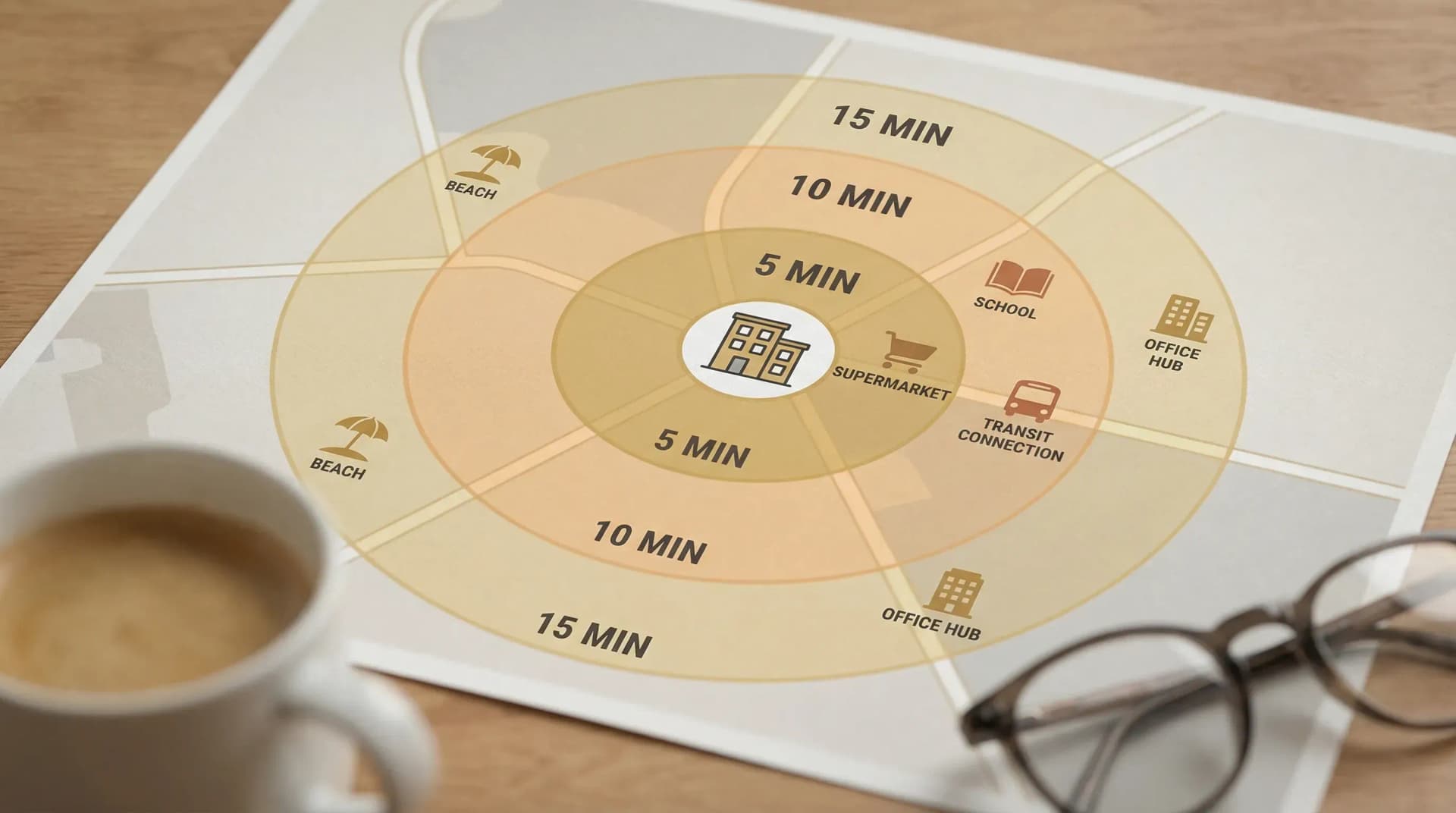
A practical approach is to treat location as a set of 15-minute questions:
- Can a tenant reach their work zones, schools, supermarkets, gyms, and main roads in 15 minutes?
- Can guests reach beaches, resorts, attractions, or conference venues in 15 minutes?
- Is there reliable parking and straightforward access at peak times?
Then pressure-test the micro-location for “deal-breakers” that slow rentals:
- Noise and nuisance (construction sites, loading zones, night venues).
- Heat and humidity exposure (direct afternoon sun without shading, poor glazing).
- Unpleasant walking experience (no shade, no pavements, awkward crossings).
- Overbuilding risk: heavy future supply in the immediate radius can increase choice and extend your letting time.
If you are buying off-plan, micro-location also includes the future reality. A “water view” can become “construction view” for two years.
Pick the unit like a tenant: layout, usability, and “photographability”
Tenants rarely rent square metres. They rent how a home feels.
That is why two units with the same size and the same building can perform very differently. Prioritise:
Layout features that shorten time-to-let
- A rectangular living area that fits a sofa, TV wall, and dining without awkward corners.
- A bedroom that fits a proper bed with bedside clearance (tenants notice immediately).
- A functional kitchen (even in smaller apartments) with workable counter space.
- Storage and utility: built-in wardrobes, a place for suitcases, a laundry nook.
- A balcony or terrace in lifestyle markets, it often becomes a filter requirement.
Avoid “slow-rent” layouts
- Wasted corridors and unusable “dead zones”.
- Low natural light or permanently shaded units.
- Strange window placement that makes furnishing difficult.
- Bedrooms that only work with custom furniture.
In practice, your first screening should be done through listing photos and floorplans. If the home does not look easy to live in, it will not rent quickly.
Building quality and community operations: the hidden driver of rental speed
Tenants are not only choosing your unit, they are choosing the building’s everyday experience.
Fast-renting buildings usually have:
- Strong first impression: clean lobby, clear signage, reliable access control.
- Lift reliability: enough lifts for the number of units, good maintenance.
- Stable cooling performance: comfortable interiors without noise issues.
- Amenities that match the tenant profile (family pool, gym, co-working, kids’ play areas).
- Predictable building management: quick response to issues, clear move-in procedures.
This is where investor thinking should shift from “purchase price” to “operational friction”. Operational friction creates slower rentals, more negotiation, and more turnover.
If you are buying in an emerging, high-growth market, build-quality discipline becomes even more important. Azimira’s approach of curated projects and market insight is designed to reduce this risk, especially with off-plan inventory: Azimira investment overview.
Furnished vs unfurnished: speed versus durability of income
Furnishing is one of the few levers you can control after purchase that can materially change time-to-let.
- Furnished often rents faster for professionals, corporate tenants, and mid-term demand.
- Unfurnished can reduce wear-and-tear disputes and may attract longer-staying family tenants.
The right choice depends on your tenant segment and management capacity. If you want a detailed ROI trade-off (not just a “furnished gets more rent” assumption), start with Azimira’s analysis: Furnished vs unfurnished ROI impact.
Even if you go unfurnished, presentation still matters. Simple staging decisions can cut vacancy, particularly at handover when competing listings look similar: Budget-friendly staging tips.
Your pricing strategy determines your rental speed more than you think
Many “slow rentals” are not slow because the property is wrong, they are slow because the landlord anchored to the wrong price.
A fast rental price is not the highest comparable, it is the price that:
- Is defensible against current listings.
- Matches the unit’s true differentiators.
- Clears the market quickly enough to protect annual net income.
For a practical, repeatable method, use a structured approach like Azimira’s: 3-step formula to price your RAK rental.
If you are deciding between short-term and long-let (or a hybrid), run the numbers properly. A “high nightly rate” does not equal high annual income once seasonality, fees, and vacancy are included. Azimira provides a framework here: STR vs long-let ROI calculator guide.
Operational readiness: the fastest renters are the fastest to launch
In the UAE, the speed at which you can start earning depends heavily on execution.
A property can be perfect, yet still sit vacant if:
- Utilities are not activated.
- Snagging issues are unresolved.
- Photos are rushed.
- The contract is missing key clauses.
- Screening is weak, so you lose time to unqualified applicants.
If your goal is “rent fast”, plan backwards from your ideal launch date and prepare a readiness checklist. Two strong resources to align your process:
- Tenant protection and contract readiness: Essential clauses for your RAK rental agreement
- Tenant quality and speed-to-sign: How to screen tenants in RAK
In short, speed is operational. The better your process, the fewer delays between “handover” and “first rent received”.
Off-plan vs ready: which one rents faster in practice?
A ready property can rent sooner, but that does not automatically mean it is the better “rent fast” choice.
Here is the practical distinction:
- Ready property: faster start, clearer comps, easier to inspect building operations.
- Off-plan property: potential to secure a more tenant-friendly unit (layout, view, floor), brand-new finish (often easier to market), and sometimes better capital efficiency through payment structures.
If your priority is speed-to-income (for example, you are replacing a salary or you need the property to service financing), a near-completion or ready asset often fits better.
If your priority is “rent fast after handover” (rather than “rent immediately”), then off-plan can still win, provided you manage delivery risk and handover readiness. If you want the modelling perspective, see: Off-plan vs ready IRR modelling.
A simple “Rents Fast” scorecard you can use before you buy
To make decisions consistent across viewings, use a scorecard. The point is not to pretend you can predict the market perfectly, it is to stop emotional purchases.
| Factor that drives rental speed | What “good” looks like | What slows rentals |
|---|---|---|
| Tenant-fit clarity | One clear tenant profile with strong demand | “It could work for anyone” positioning |
| Micro-location convenience | Easy access to essentials and main routes | Traffic friction, poor access, nuisance |
| Layout usability | Functional living space, storage, good light | Awkward rooms, tiny bedroom, poor flow |
| Building operations | Clean, maintained common areas, reliable lifts | Visible wear, chaotic move-in rules |
| Amenities match | Amenities align with tenant segment | Costly amenities tenants do not value |
| Launch readiness | Snagging solved, utilities on, pro photos | Delays, unclear handover status |
| Pricing defensibility | Supported by live comps, not wishful anchors | Above-market listing, repeated reductions |
| Management capacity | Either you have systems, or a manager in place | “Figure it out later” approach |
Use this table during selection and insist on evidence (comparable listings, building visit feedback, realistic furnishing budget, and a launch timeline).

The most common reasons “good” investment properties rent slowly
These mistakes show up repeatedly, especially with first-time international buyers:
- Buying for the brochure view, not the tenant: views can help, but layout and convenience rent first.
- Underestimating friction costs: service charges, maintenance responsiveness, and move-in processes shape reviews and renewals.
- Copying Dubai assumptions into other emirates: tenant mix, seasonality, and supply behave differently by micro-market.
- Overpricing at launch: the first two weeks of a listing often determine whether you get a quick, strong tenant.
- Leaving furnishing and photos until the last minute: presentation is your quickest lever to reduce vacancy.
How Azimira helps investors choose properties that rent faster
Speed-to-rent is rarely one decision. It is a chain of decisions, from asset selection and unit type through to pricing, furnishing, and launch execution.
Azimira focuses on off-plan opportunities and high-growth UAE markets (including Ras Al Khaimah), supporting investors with curated projects, market insight, and tailored investment strategy. If you want to shortlist home investment properties designed to attract tenants quickly, start with a clear brief (your tenant profile, target lease type, timeline to income, and risk tolerance) and speak with a specialist team: contact Azimira.
The right property is the one that the market chooses quickly, not the one that looks best on paper.
Related articles
What Counts as Good Real Estate Investments in 2026
Learn what makes good real estate investments in 2026, from net yield and demand signals to legal checks, exit plans and UAE opportunities.

Investors Needed for Real Estate? Start With This Plan
Investors needed for real estate? Use this practical plan to define strategy, numbers, due diligence and partners before raising capital.

Investment Marketing Tactics Developers Use at Launch
Understand investment marketing tactics developers use at launch, from scarcity to incentives, and learn how to assess UAE off-plan deals.