
Capital Growth Potential: Locations Winning in 2026
Capital growth potential in 2026: discover the UAE locations winning now, what’s driving demand, and a checklist to pick the best-performing areas.
In a market as fast-moving as the UAE, capital growth potential in 2026 is less about “UAE property” in general and more about which locations are capturing the next wave of infrastructure, tourism, population inflows, and premium demand.
What’s changed versus earlier cycles is how quickly value concentrates around specific catalysts: transport upgrades, mega-developments, branded hospitality, and masterplanned waterfront communities. Investors who win in 2026 are usually the ones who:
- Enter early in areas where demand is about to broaden (not already fully priced-in).
- Choose sub-markets with strong resale liquidity, not just attractive brochure projections.
- Match the asset type to the demand source (resident, corporate, tourism, or mixed).
Below is a practical, investor-focused view of locations winning in 2026, with a framework you can use to compare opportunities across emirates.
What drives capital growth potential in 2026 (and what matters less than it used to)
UAE real estate is increasingly institutional and globally visible, which tends to compress “average” mispricing. In plain English, you can still find upside, but it sits in the right micro-locations and the right project phases.
The growth drivers that matter most in 2026:
- Infrastructure that changes behaviour, not just convenience. Think faster commutes, new districts, expanded airports, and upgraded waterfront access.
- Tourism and experience-led demand (especially where hotel supply, attractions, and short-stay regulation support a sustainable STR ecosystem).
- Masterplanning and place-making (retail, schools, marinas, parks, walkability). These reduce “new area discount” over time.
- Premiumisation (branded residences, wellness, sustainability). This is where pricing power concentrates when buyers pay for trust and lifestyle.
- Supply discipline and absorption, not simply headline demand. Rapid unit launches without end-user depth can cap appreciation.
What matters less than many investors think:
- “The emirate is booming” without pinpointing where transactions and premium tenants are clustering.
- Pure yield-chasing without considering resale depth, service charges, and vacancy resilience.
- Short-term hype around a single announcement if the delivery timeline is long and competing supply is heavy.
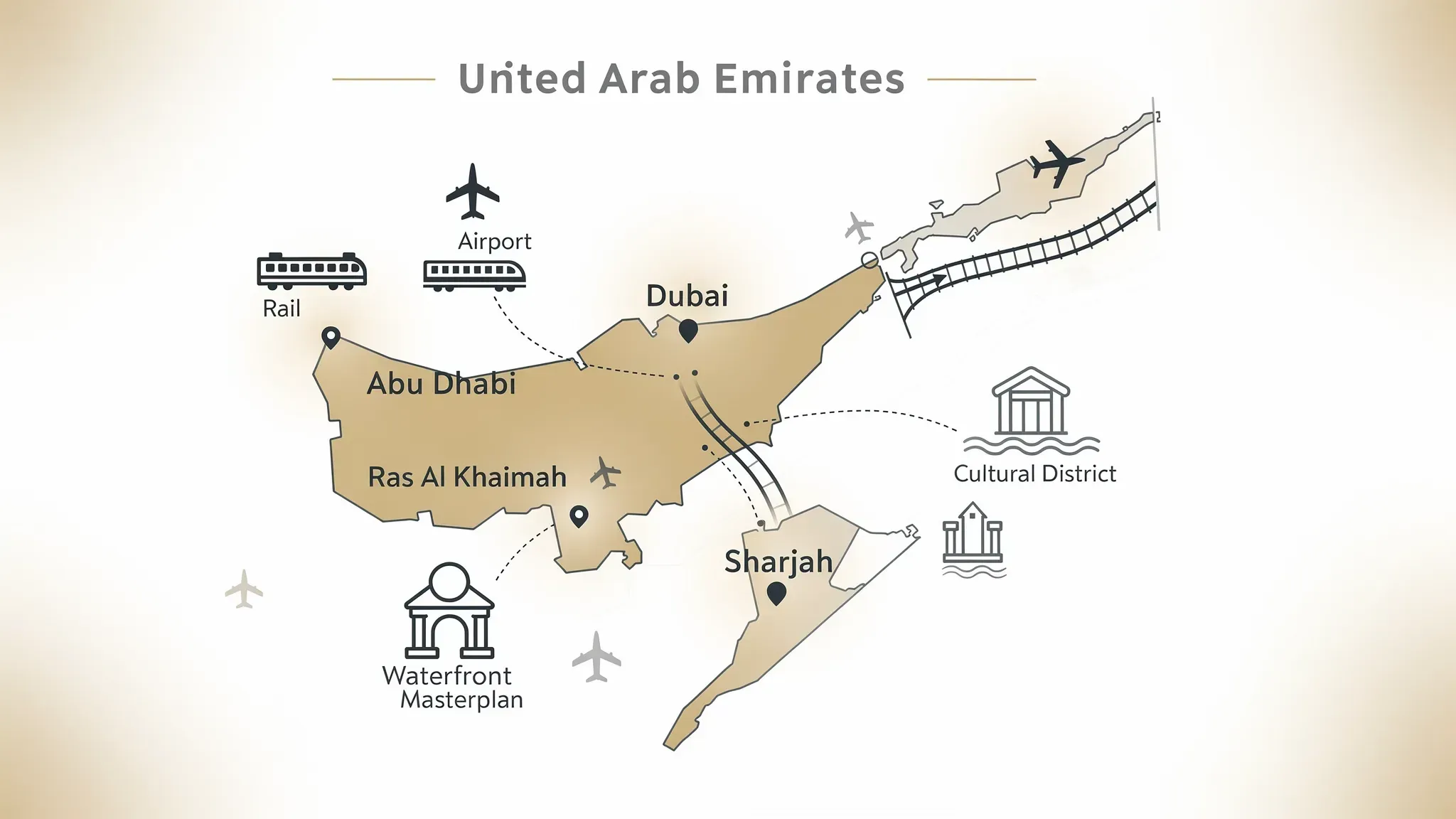
Locations winning in 2026: where growth is concentrating
Dubai: prime liquidity plus selective “next corridor” upside
Dubai remains the UAE’s benchmark for liquidity, depth of financing, and global buyer reach. For capital growth in 2026, the strongest performance tends to appear in one of two buckets:
1) Proven premium nodes that keep upgrading
These locations typically benefit from persistent international demand, high-quality masterplanning, and strong resale markets.
- Established waterfront and lifestyle districts: areas where scarcity, views, and walkable amenities sustain pricing power.
- Brand-led projects: branded residences and hospitality-linked communities often hold value better in risk-off periods because buyers trust delivery standards.
2) Growth corridors tied to employment and transport
Dubai’s upside in 2026 increasingly comes from areas that are being reshaped by major infrastructure and the city’s expansion pattern.
- Dubai South and the wider Al Maktoum International Airport (DWC) corridor: long-term growth narratives are strongest where aviation, logistics, and new residential supply are integrated with employment.
- Expo City ecosystem: the “city within a city” effect supports sustained demand when live-work-play fundamentals keep improving.
Dubai’s edge is simple: exit options. If your strategy includes a shorter hold period or a potential resale before handover (where permitted), Dubai’s liquidity can be a material advantage.
Source note: For long-term infrastructure direction, Dubai’s official announcements and planning updates are typically published via the Dubai Media Office.
Abu Dhabi: stability, end-user depth, and culture-driven premiums
Abu Dhabi is often underestimated by growth-focused investors because it can look “slower” than Dubai. In reality, it can deliver attractive capital appreciation where demand is anchored by government, high-income employment, and long-term liveability.
Where Abu Dhabi tends to win in 2026:
- Cultural and beachfront premium zones: locations benefiting from cultural institutions, beach access, and ultra-prime positioning tend to command durable premiums.
- Lifestyle islands and destination communities: where entertainment, marinas, retail, and events create year-round demand.
Abu Dhabi’s advantage for 2026 is risk-adjusted growth. For investors who prioritise a smoother volatility profile, it can balance a UAE portfolio that also includes higher-beta, early-cycle markets.
Ras Al Khaimah: early-cycle luxury, tourism momentum, and pre-maturity pricing
Ras Al Khaimah (RAK) continues to attract attention as a high-growth market because it is still in a comparatively earlier phase of premium-market maturation. The “win” in 2026 is not simply buying anywhere in RAK, it is choosing the locations most exposed to:
- Destination-led tourism growth
- Waterfront scarcity and masterplanned amenities
- Improving connectivity (including inter-emirate access)
RAK sub-markets most aligned with capital growth potential in 2026:
- Al Marjan Island: typically the clearest expression of tourism and luxury positioning, particularly where projects benefit from proximity to major hospitality anchors and beach quality.
- Mina Al Arab: often attractive for investors seeking masterplan expansion upside, community depth, and broader end-user appeal.
- Al Hamra: an established community profile that can appeal to buyers wanting operational maturity, golf and marina lifestyle, and clearer rental comparables.
- Emerging waterfront and city-redevelopment zones: areas where infrastructure and place-making can narrow the “perception gap” versus more established communities.
If you want a deeper RAK-specific view, Azimira has dedicated resources on investing in Ras Al Khaimah property and forward-looking market coverage through its research posts.
Sharjah (select pockets): value plus end-user demand, but be precise
Sharjah can offer strong upside in specific masterplanned communities, supported by end-user demand, affordability relative to Dubai, and growing lifestyle infrastructure.
Sharjah is not a blanket “capital growth” story across the board. It is a micro-market story. Investors should be especially strict on:
- Ownership structure and eligibility (freehold vs leasehold constraints)
- Rental demand profile (commuter vs local end-user)
- Service charge realism and long-term maintenance planning
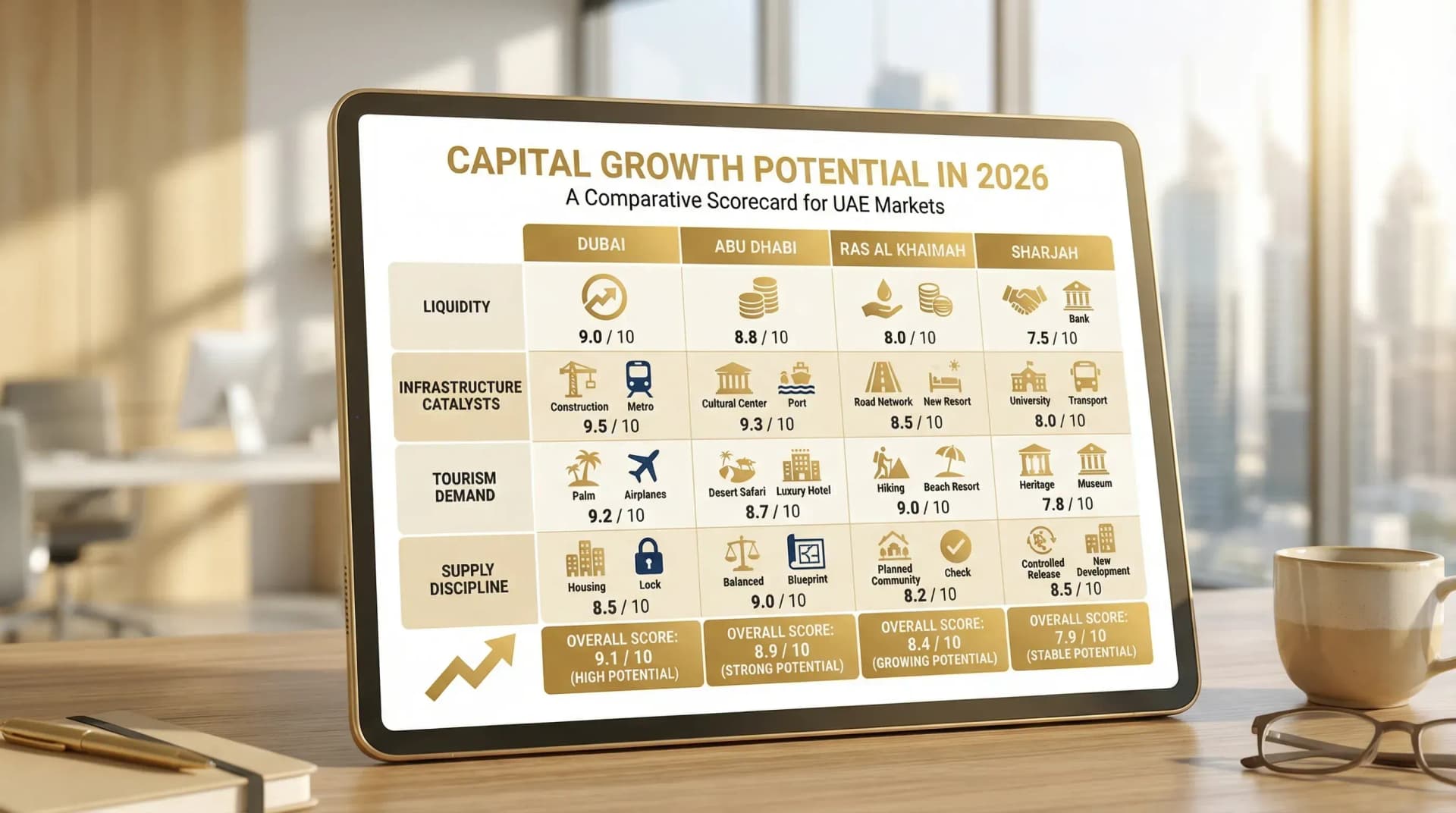
A quick comparison table: choosing the right “winner” for your strategy
Use the table below to match location to objective. The goal is not to declare one emirate “best”, it is to identify what is most likely to outperform for your hold period and risk tolerance.
| Location theme (2026) | Best for | Typical growth engine | What to watch closely |
|---|---|---|---|
| Dubai established prime | Liquidity and defensiveness | Global demand, scarcity, premiumisation | Entry pricing, net yield after service charges |
| Dubai growth corridors | Medium to long holds | Infrastructure, employment nodes | Competing supply, delivery phasing |
| Abu Dhabi premium nodes | Risk-adjusted growth | End-user depth, cultural and lifestyle anchors | Project differentiation, resale comparables |
| Ras Al Khaimah waterfront growth | Early-cycle upside | Tourism, masterplanning, new demand layers | Developer selection, handover timing, supply pipeline |
| Sharjah select masterplans | Value growth | End-user demand, affordability, community buildout | Ownership rules, tenant profile, liquidity |
The 2026 micro-location checklist (how professionals underwrite capital growth)
When two projects are “in the same area”, the better performer is often the one with superior micro-location and execution quality. Here’s a practical checklist you can apply before you commit.
Demand signals that usually precede stronger appreciation
- Multiple demand sources, not just one. For example, a location that attracts residents and short-stay guests is often more resilient.
- Amenity gravity: marinas, beaches, promenades, retail streets, parks, and schools within a realistic walking or short-drive radius.
- Transport advantage: time savings that change renter and buyer behaviour, not just marketing claims.
Supply signals that can cap growth (even in good markets)
- Too many similar unit types completing at once (especially small apartments) without clear demand depth.
- Investor-heavy towers with limited differentiation (leads to price competition at resale and on rents).
- Masterplans where the “nice future vision” is doing too much of the value work, and near-term delivery is thin.
Project and developer factors that affect your exit price
- Delivery track record and after-handover reputation.
- Specification longevity (materials, layouts, parking, storage, shading, acoustics).
- Service charge realism (high recurring costs can reduce buyer willingness to pay a premium later).
Azimira regularly covers investor due diligence topics and market timing. If you are actively comparing opportunities, you may find it useful to review the latest sentiment and positioning insights in the UAE Property Investor Sentiment Barometer (Q1 2026).
How investors are capturing 2026 upside (without relying on hype)
Winning strategies in 2026 tend to be structured, not reactive. Three approaches show up repeatedly among sophisticated buyers.
Phase-based entry (pre-launch and early-launch discipline)
Early phases can offer meaningful pricing advantages, but only when the developer quality, escrow protections, and unit selection are strong. The discipline is in not chasing every launch, instead focusing on:
- Projects where the masterplan is already proving demand
- Locations with a visible catalyst timeline (infrastructure, hospitality, transport)
- Units with enduring appeal (views, corner layouts, larger terraces, better stack positions)
For investors who prioritise early access, Azimira publishes forward-looking pipeline coverage such as its 2026 UAE property launch calendar.
Barbell portfolios (liquidity on one side, early-cycle growth on the other)
A common 2026 structure is:
- One liquidity anchor (often Dubai prime or a proven community)
- One growth engine (often early-cycle waterfront or emerging masterplans)
This can improve overall portfolio behaviour by balancing resale depth with higher capital growth potential.
Pre-defined exits (so you do not improvise under pressure)
Capital growth is only real when you can crystallise it. Before you buy, clarify whether your most likely outcome is:
- Resale after handover
- Hold for rental and refinance later
- Assignment sale before completion (where applicable)
Different locations favour different exits. Dubai often favours liquidity-driven exits. Emerging markets can reward patience, provided you pick the right sub-market and project.
Where Azimira fits (and how to use this article in a real decision)
Azimira specialises in connecting investors with premium off-plan opportunities in the UAE, with a strong focus on high-growth markets such as Ras Al Khaimah. If you are evaluating capital growth potential in 2026, the most productive next step is usually not browsing more listings, it’s building a short, underwritten comparison set.
Azimira can help you:
- Narrow the market to curated projects aligned with your target hold period
- Access pre-launch or early-phase opportunities where available
- Structure a tailored investment strategy across locations and asset types
- Maintain dedicated support through selection, purchase, and ongoing ownership
If you want an adviser-led comparison of locations and projects based on your objective (growth, income, or balanced), start with Azimira’s investment overview and then request a tailored shortlist.
Related articles
What Counts as Good Real Estate Investments in 2026
Learn what makes good real estate investments in 2026, from net yield and demand signals to legal checks, exit plans and UAE opportunities.

Investors Needed for Real Estate? Start With This Plan
Investors needed for real estate? Use this practical plan to define strategy, numbers, due diligence and partners before raising capital.

Investment Marketing Tactics Developers Use at Launch
Understand investment marketing tactics developers use at launch, from scarcity to incentives, and learn how to assess UAE off-plan deals.