
Growth Premium Explained: When Paying More Pays Off
Growth premium explained for UAE property investors: when paying more boosts returns, how to model it, and the red flags that signal overpricing.
Paying “top of the market” can feel like breaking the first rule of investing. Yet in most asset classes, the best returns often come from buying the right quality, in the right place, at the right time, even if it costs more upfront.
That extra amount you pay is what investors often mean by a growth premium: a higher price justified by stronger expected future growth (in value, income, or both). The mistake is assuming every premium is a growth premium. In real estate, some premiums are simply marketing, scarcity theatre, or late-cycle optimism.
This guide breaks down growth premium explained in plain terms and gives you a practical framework for deciding when “paying more” is rational, and when it is a trap.
What is a growth premium?
A growth premium is the additional price you pay today for an asset because you expect it to grow faster than comparable alternatives.
In equities, growth companies often trade at higher valuation multiples because investors expect faster earnings growth. Professor Aswath Damodaran’s work on valuation is a useful reference point for how markets “price in” growth assumptions (see Damodaran Online).
In property, the same logic shows up differently. You pay more because you expect one or more of the following to outperform:
- Capital appreciation (resale value growth)
- Rental growth (higher rents over time)
- Occupancy resilience (lower vacancy, better tenant demand)
- Liquidity (easier resale, deeper buyer pool)
- Risk reduction (delivery quality, management, community maturity)
The key idea: a growth premium is only “real” if the future cash flows and exit value justify it under reasonable assumptions.
How growth premiums form in real estate (the mechanics)
Real estate pricing is essentially a debate about future demand, future supply, and execution risk.
A growth premium appears when buyers believe a specific property will benefit from stronger demand (or tighter supply) than other options, and therefore deserve a higher price today.
| Growth-premium driver | What it looks like in property | Why it can raise returns |
|---|---|---|
| Demand catalysts | New infrastructure, tourism expansion, job creation, new lifestyle districts | Higher resale demand and stronger rental pricing power |
| Scarcity (true scarcity, not sales talk) | Limited waterfront stock, limited branded inventory, height/view constraints | Price support in down cycles and better exit liquidity |
| Quality and execution | Proven developer delivery, strong building specs, reliable facilities management | Lower “surprise costs” and stronger tenant retention |
| Market positioning | Branded residences, resort-linked living, sustainability features buyers actively seek | Ability to hold pricing and maintain premium rent |
| Timing advantage | Early-phase off-plan entry, pre-launch access, favourable payment terms | You capture growth during the construction period |
Not every premium is a growth premium. Some are simply “late entry” pricing when the upside has already been largely priced in.
When paying a growth premium pays off (a decision framework)
Use this as a filter. The more boxes you can tick with evidence (not hope), the more likely a premium is justified.
1) There is a credible growth catalyst with a clear demand pathway
A credible catalyst is not just a headline. It needs a mechanism that increases demand for your specific unit type.
Examples of demand pathways:
- Tourism growth that increases short-stay demand for studios and 1-beds in resort districts
- Corporate expansion that increases long-let demand for family-sized units near schools and commuting corridors
- New transport links that reduce friction for residents and weekenders
If you want a Ras Al Khaimah-specific overview of why certain catalysts matter, Azimira’s investment page provides a market-level snapshot.
2) Supply is constrained where it matters
“Supply is coming” is not automatically bad. It becomes a problem when supply is:
- Similar (same micro-location, same positioning)
- Rapid (large volume delivered in a short period)
- Competing on the same tenant and buyer segment
True scarcity tends to be micro, not macro. Waterfront frontage, protected views, walkable access to a marina, limited branded stock within a district, these are the kinds of constraints that can preserve a premium.
3) The developer and operator reduce execution risk
In off-plan investing, execution risk is a hidden cost. Delays, specification downgrades, and weak facilities management can destroy the very outperformance you paid for.
If you are buying off-plan, pair the “growth premium” question with delivery risk thinking. Azimira’s guide on the process of buying an off-plan property in RAK is helpful for understanding the milestones where risk concentrates.
4) The unit itself has structural advantages inside the project
Even in a premium development, not all units deserve a premium.
A rational growth premium usually attaches to features that remain valuable at resale:
- Best-in-stack layouts (efficient floorplan, minimal dead space)
- View corridors that cannot be built out
- Privacy advantages (corner positions, fewer shared walls)
- Walkability to the project’s core amenities
If the “premium unit” is mostly cosmetic (marketing package, trend finishes), be cautious.
5) The premium is small relative to the upside, not large relative to your assumptions
This is the simplest sanity check.
If you must assume perfect delivery, perfect market conditions, and aggressive appreciation to break even on the premium, you are no longer investing, you are forecasting.
A simple way to test a growth premium (with a worked example)
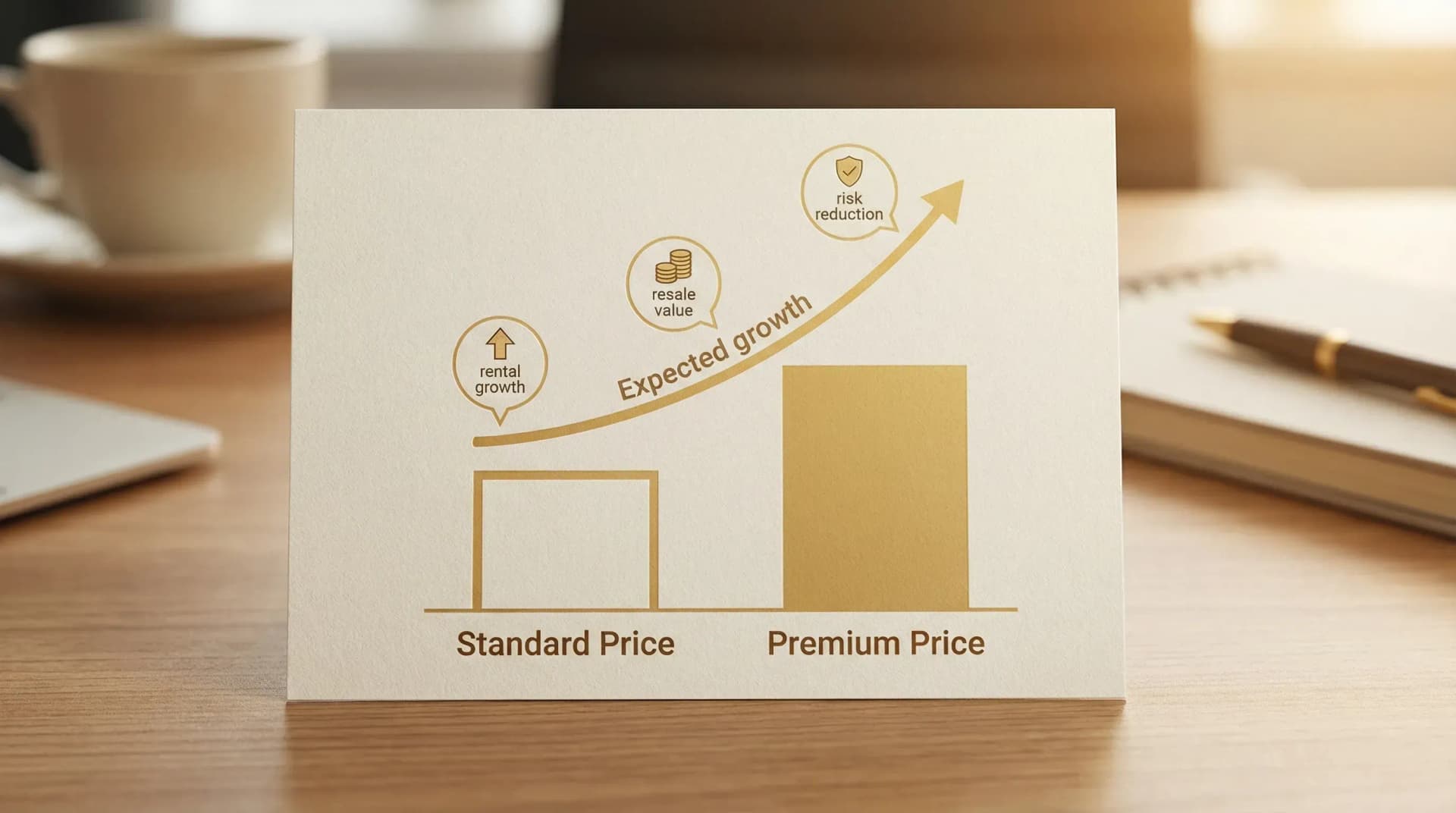
A growth premium is justified when the incremental price is smaller than the incremental value created.
Here is a simplified illustration comparing two similar properties (numbers are illustrative only). The point is the method, not the figures.
| Item | “Standard” unit | “Premium-growth” unit |
|---|---|---|
| Purchase price | 1,000,000 | 1,120,000 |
| Premium paid | 0 | 120,000 |
| Expected annual rent (Year 1) | 70,000 | 77,000 |
| Expected annual rental growth | 2% | 4% |
| Expected resale growth | 5% p.a. | 7% p.a. |
| Vacancy/tenanting risk | Medium | Lower |
What makes the premium pay off?
- The higher rent compounds, especially if demand supports consistent occupancy.
- The higher resale growth compounds, and the absolute difference at exit can be larger than the initial premium.
If you want to go beyond back-of-envelope, use an IRR model that includes costs, payment plans, and exit fees. Azimira’s article on off-plan vs ready property IRR modelling shows how professional-grade comparisons are typically structured.
When a “growth premium” is actually a trap
Most bad premium purchases share one issue: the premium is real, but the growth is not.
Watch for these red flags.
| Red flag | Why it matters | What to ask before you pay more |
|---|---|---|
| The story is bigger than the maths | Narrative-driven pricing can unwind quickly | “What assumptions must be true for this premium to break even?” |
| Too much similar supply is due at the same time | Rent and resale can soften if absorption is slow | “What is delivering within 12–24 months nearby, and who is it for?” |
| Premium is based on incentives, not fundamentals | Discounts and “guarantees” can mask overpricing | “What is the net price after all incentives, compared to true comps?” |
| Developer execution risk is underpriced | Delays and spec changes erode returns | “Track record, escrow protections, contractual terms, handover history?” |
| Exit liquidity is assumed, not proven | Premium units can be harder to sell in a risk-off market | “Who is the resale buyer, and why will they pay this premium later?” |
If you are investing abroad, also treat “unknown unknowns” as a cost. Legal processes, registration, service charges, and management standards can materially change your net return.
How to quantify a growth premium in UAE off-plan property
You do not need a 20-tab spreadsheet to be disciplined. You need three things: comparables, a base-case model, and stress tests.
Build a base-case model (net, not gross)
At minimum, include:
- Purchase price and payment schedule
- Known transaction costs (registration, admin fees, broker fees where applicable)
- Operating costs (service charges, maintenance allowance, management)
- Expected rent and vacancy assumption
- Exit costs and a conservative resale assumption
If you already use quick ROI methods, keep them, but do not stop there. Growth premiums often “look fine” on gross yield and fail on net IRR.
Stress test the one variable you are paying for
If you pay a growth premium for rental growth, stress test rental growth.
If you pay for capital growth, stress test exit price.
A simple stress test question:
- “If my exit price is 10% lower than expected, does the premium still make sense?”
If one small haircut breaks the investment case, your premium is too fragile.
Compare like-for-like, then adjust for quality
Start with comparable units (size, view, building age, location). Then adjust explicitly for:
- Developer reputation and delivery record
- Building management quality
- Furnishing level and fit-out (if relevant)
- Walkability and amenity access
Do not “hand-wave” these adjustments. If you cannot explain the adjustment in one sentence, it is probably not measurable enough to support a premium.
Common real estate situations where a growth premium can be rational
These are not guarantees, but they are patterns where paying more can be logically defensible.
Early-entry in a genuinely improving micro-market
Early-stage entry can create a growth premium opportunity because the market reprices as infrastructure and amenities become real.
The discipline is separating:
- “Improvement that is funded, permitted, and scheduled”
- from “improvement that is conceptual”
Branded residences (when the brand changes liquidity)
A brand premium can be justified if it expands the buyer pool and improves resale liquidity, especially among international buyers.
The brand must translate into something tangible, such as operational standards, investor demand, and sustained positioning. If it is just a logo, treat it as marketing.
Azimira has a deeper comparison on branded residences vs standard properties in RAK.
Sustainability and efficiency (when it reduces operating drag)
Sustainability premiums can pay off when they reduce ownership costs and improve tenant appeal (comfort, utility efficiency, resilience). The exact uplift varies by asset type and market, but major real estate consultancies regularly track how “green” features influence pricing and demand (see JLL’s sustainability research hub: JLL sustainability).
“Best-in-class” unit selection inside a strong project
Sometimes the best investment is not the cheapest unit, it is the unit that remains easiest to rent and sell.
In premium districts, the resale market often concentrates on the “obvious winners” inside each project (best views, best layouts, best access). Paying a measured premium for that can be rational.
Applying the concept to Ras Al Khaimah in 2026
Ras Al Khaimah is a useful case study for growth premiums because it combines:
- Rapid tourism and lifestyle expansion
- Major pipeline projects that can shift global perception
- A market that is still in the process of “repricing” relative to more mature UAE destinations
The practical takeaway is not “pay any premium in RAK”. It is this:
- Pay a premium only where demand will be deepest (micro-location, positioning, unit type)
- Prefer premiums backed by scarcity and execution quality
- Be wary of premiums that assume the entire market rises equally
If you want ongoing data signals rather than one-off headlines, Azimira’s market updates (for example, the UAE Property Investor Sentiment Barometer Q1 2026) can help you understand what other sophisticated buyers are currently paying up for, and why.
Frequently Asked Questions
What does “growth premium” mean in property investing? A growth premium is the extra price you pay for a property because you expect it to outperform on capital appreciation, rental growth, occupancy resilience, or resale liquidity.
Is paying a premium always bad for ROI? No. A premium can improve ROI if it buys faster growth or reduces risk in a way that compounds over time (higher rent, stronger resale demand, fewer voids, lower surprise costs).
How do I know if a premium is justified? Model a base case and then stress test the variable you are paying for (rent growth or resale price). If modest downside scenarios wipe out your advantage, the premium is likely unjustified.
Are branded residences always worth the premium? Not always. A brand premium tends to be worth it when it measurably improves demand, management standards, and resale liquidity. If the brand does not change buyer behaviour, treat the premium with caution.
What’s the biggest mistake investors make with growth premiums in off-plan deals? Confusing marketing scarcity with real scarcity, and underestimating execution risk (delivery timelines, specification changes, building management quality, and exit liquidity).
Want help identifying growth premiums that are actually worth paying?
Azimira specialises in curated off-plan opportunities in high-growth UAE markets, with a focus on premium segments in Ras Al Khaimah. If you want a second set of eyes on whether a “premium” unit is genuinely priced for growth (or simply priced high), explore Azimira’s approach on the investment page or get in touch via Azimira.com for tailored guidance based on your objectives, holding period, and risk tolerance.
Related articles
What Counts as Good Real Estate Investments in 2026
Learn what makes good real estate investments in 2026, from net yield and demand signals to legal checks, exit plans and UAE opportunities.

Investors Needed for Real Estate? Start With This Plan
Investors needed for real estate? Use this practical plan to define strategy, numbers, due diligence and partners before raising capital.

Investment Marketing Tactics Developers Use at Launch
Understand investment marketing tactics developers use at launch, from scarcity to incentives, and learn how to assess UAE off-plan deals.