
Investment and Planning: Align Your Property With Your Goals
Investment and planning made simple: define your property goals, model cash flow and risk, then choose an off-plan or ready home that fits.
Property can be a powerful wealth-building tool, but only when the investment and planning are aligned. The same two-bedroom apartment can be a high-growth play for one buyer, a cash-flow headache for another, and the perfect lifestyle base for a third.
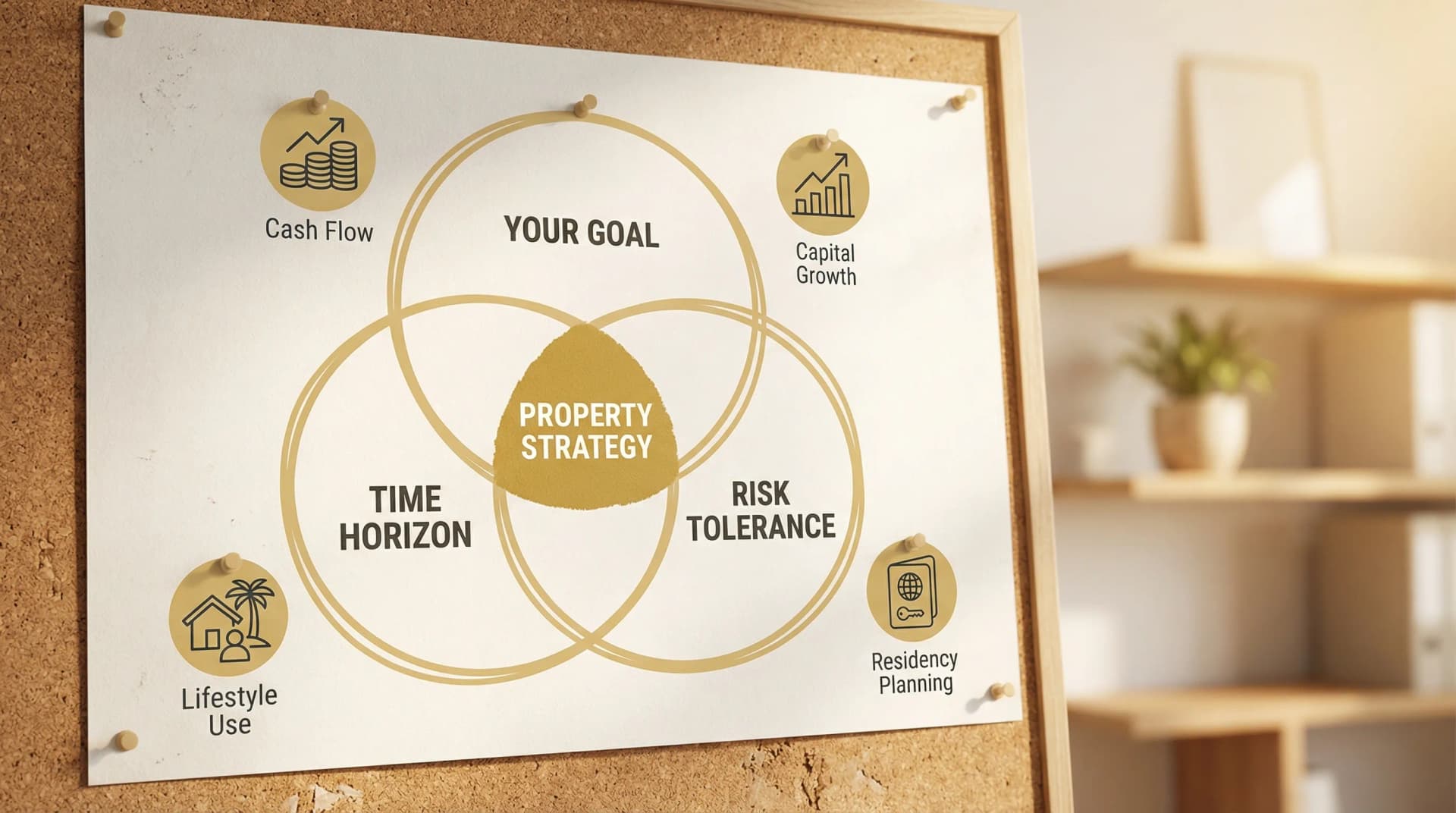
This guide helps you align what you buy (asset type, location, payment structure, and holding plan) with why you are buying (income, capital growth, residency, lifestyle, or legacy). The aim is not to push a single “best” strategy, but to give you a clear framework you can apply to UAE property, including off-plan opportunities.
Start with the goal (not the brochure)
Most costly property mistakes begin with a shortcut: falling in love with a unit before defining the outcome.
A practical planning process starts with a “goal statement” you can actually measure. Examples:
- Capital growth goal: “Grow equity over 4–7 years, accept limited income during construction.”
- Income goal: “Achieve stable net cash flow within 3–6 months of completion.”
- Lifestyle goal: “Use the property 8–12 weeks per year, prioritise enjoyment and low hassle.”
- Residency goal: “Qualify for a long-term UAE residency pathway and maintain eligibility.”
- Legacy goal: “Hold long term, minimise operational risk, and plan succession cleanly.”
Once you know which goal is primary, your decisions become more consistent: location, unit mix, furnishing strategy, financing, and exit plan start to follow logic.
Turn your goal into numbers you can stress-test
Aligning property with your goals requires you to translate intent into a model. Even a simple model is better than guesswork.
At minimum, define:
- Time horizon: 2–3 years (short), 4–7 years (medium), 8+ years (long)
- Return mix: how much you expect from rental income versus appreciation
- Liquidity needs: whether you might need to sell quickly, refinance, or hold through a downturn
- Operating tolerance: how hands-on you are willing to be (especially relevant for short-term rentals)
Here is a decision table you can use as a starting point.
| Primary goal | What matters most | Typical fit (UAE context) | What to watch closely |
|---|---|---|---|
| Capital growth | Entry price, growth drivers, timing | Early-phase off-plan, pre-launch access, supply-disciplined communities | Delivery risk, resale liquidity, developer quality |
| Reliable income | Net yield, vacancy risk, tenant demand | Ready or near-completion units, established rental corridors | Service charges, management quality, realistic net yield |
| Balanced (growth + income) | Risk-adjusted total return | Mix of near-completion plus selective off-plan | Over-optimistic rent assumptions, over-leverage |
| Lifestyle + occasional income | Enjoyment, ease of use, resale desirability | Waterfront or amenity-led communities, flexible usage | High operating costs, seasonality, furnishing decisions |
| Residency planning | Eligibility, documentation, continuity | Properties that match visa thresholds and renewal rules | Valuation, ownership structure, exit timing |
If you want a market-based “temperature check” before you model anything, Azimira publishes periodic sentiment and market insight, for example the UAE Property Investor Sentiment Barometer (Q1 2026).
Choose the right risk profile (then buy within it)
Every property strategy has risk. Planning is the discipline of choosing which risks you are willing to take, and which you want to avoid.
In UAE off-plan investing, common risk categories include:
- Market risk: price cycles, new supply, changing buyer sentiment
- Delivery risk: construction delays, specification changes
- Financing risk: rate changes, refinance constraints, cash flow strain
- Currency risk: if your income or savings are in GBP, AUD, SGD, HKD, EUR, etc.
- Operational risk: tenant quality, vacancy, holiday-home compliance, maintenance response times
A useful approach is to map each risk to a mitigation you will commit to before reserving a unit.
| Risk | What it looks like in practice | Planning mitigation |
|---|---|---|
| Construction delay | Rental income starts later than expected | Build a time buffer, prefer milestone-based payment structures, maintain reserves |
| Underestimated running costs | Net yield disappoints despite “headline” rent | Model service charges, insurance, utilities, management, and void periods |
| Developer quality gap | Finishes, amenities, after-sales service fall short | Perform due diligence, compare track record, review contract terms |
| Currency swings | Your staged payments cost more in home currency | Consider staged conversions or hedging tools where appropriate |
| Exit friction | Selling takes longer or costs more than planned | Define exit triggers, understand transfer/agency costs, build a hold plan |
If your plan depends on off-plan delivery dates, it’s worth reading a dedicated guide such as Risk Matrix: Balancing Construction Delays Against ROI in UAE Property Investments.
Build a property plan in three layers: buy, operate, exit
Many investors do “purchase research” but skip “ownership planning”. Aligning property with your goals means planning the full lifecycle.
1) Buy: define the non-negotiables
Your non-negotiables should come from your goal, not market hype.
Examples:
- If income is the priority, you may require a proven rental corridor, an operating budget, and a professional management plan.
- If growth is the priority, you may focus on early-stage entry, developer quality, and unit scarcity (views, corner stacks, larger terraces).
2) Operate: decide how the asset will actually be used
Usage determines cash flow, costs, and even wear-and-tear.
- Long-let (annual lease): typically simpler operations, often more predictable cash flow.
- Short-term rental: potentially higher gross revenue in tourism-led markets, but higher management intensity and more variable net income.
If you are still deciding between these, Azimira’s STR vs Long-Let ROI calculator guide is a practical starting point for modelling.
3) Exit: pick your likely outcome in advance
Your “exit plan” is not a promise to sell, it’s a set of decisions that keeps you in control:
- Hold for income (and optimise rents)
- Sell on completion or after stabilised tenancy
- Refinance to release equity (if suitable)
For timing considerations, see Exit Strategy Timeline: How Long to Hold RAK Property for Maximum Returns.
Match the property to the plan (unit type, location, and micro-market)
Once the plan is clear, the property selection becomes far more objective.
Unit type: pick what your target tenant or future buyer actually wants
A common planning error is buying the “most popular” unit type rather than the one that fits your strategy.
- Smaller units can suit yield-focused models, but may have higher tenant turnover.
- Family-sized units can be more stable, but the tenant pool is narrower and costs can be higher.
If you are weighing size for returns, this comparison is helpful: Studio vs 2-Bedroom in RAK: Which Size Delivers Better Returns?.
Location: focus on demand engines and future liquidity
“Location” in UAE investing is not just prestige. It is a combination of:
- Depth of end-user demand (residents, families, corporate leases)
- Tourism and hospitality gravity (for short-stay strategies)
- Infrastructure and connectivity improvements
- Supply pipeline and absorption
Azimira’s market-led resources can support this step, including:
- Interactive heat-map: analysing rental yields across UAE communities
- RAK real estate market outlook through 2027
Funding and cash-flow planning (where most strategies break)
A property can be “a great investment” and still be a poor fit for you if the cash flow timing clashes with your life.
When aligning funding with goals, plan for:
- Upfront capital: deposit, registration, furnishing (if required), contingency
- Staged payments (off-plan): ensure they match your income schedule
- Financing structure: developer financing versus bank mortgage versus cash
- Operating reserves: vacancies, maintenance spikes, currency slippage
If you are deciding between a mortgage and a payment plan, use this guide as a planning reference: Developer Financing vs Bank Mortgage: Which Is Better in RAK?.
For budgeting realism, it also helps to model the “all-in” ownership cost. See The Real Cost of Owning RAK Property: A 7-Point Breakdown.
Treat it like a portfolio: track performance against your goal
Property is often managed emotionally, but high-performing investors manage it like an asset.
A simple KPI set keeps your plan honest.
| KPI | Why it matters | Suggested review frequency |
|---|---|---|
| Net rental yield (not just gross) | Measures real income after costs | Quarterly |
| Vacancy and days-on-market | Signals pricing and demand fit | Quarterly |
| Service charges and utilities trend | Protects net yield and resale appeal | Annually |
| Maintenance spend vs budget | Prevents silent ROI erosion | Quarterly |
| Market comparables | Anchors rent and resale pricing | Quarterly |
If you are investing in Ras Al Khaimah specifically, administrative steps also affect planning. For example, registration and fee processes can influence timing and cash flow. A practical reference is RAK property registration: fees, process, and timeline.
Where Azimira fits (and how to use expert support without losing control)
Advisers add the most value when you already have a clear goal and a planning framework, because you can evaluate recommendations objectively.
Azimira focuses on curated off-plan projects and premium opportunities in high-growth UAE markets, with expert market insight, exclusive pre-launch access, and tailored investment strategies. If your plan requires a specific outcome, for example early-phase pricing, a defined holding horizon, or a balanced growth-and-income mix, specialist guidance can help you avoid mismatches that only show up after purchase.
You can explore Azimira’s investment focus here: Azimira Real Estate Investment.
Frequently Asked Questions
What does “investment and planning” mean in property, in practical terms? It means defining your goal (income, growth, lifestyle, residency, legacy), converting it into measurable targets (timeline, cash flow, risk limits), then choosing a property and funding structure that matches those targets.
Should I choose off-plan or ready property to align with my goals? Off-plan often suits capital-growth and early-entry strategies, while ready property can suit near-term income goals. The best fit depends on your time horizon, risk tolerance, and cash-flow needs.
How do I avoid overestimating rental returns? Model net yield, not gross. Include service charges, management fees, insurance, utilities (where applicable), maintenance, and vacancy assumptions. Compare against real local comparables.
How do I align a property purchase with UAE residency goals? Treat residency as a planning constraint: confirm eligibility thresholds, documentation requirements, valuation considerations, and how a sale or refinance could affect renewal. Seek specialist legal and immigration advice for your situation.
What if I have two goals, like lifestyle and income? Pick a primary goal and a minimum acceptable threshold for the secondary goal. For example, prioritise lifestyle but require a net yield floor, or prioritise income but require personal-use flexibility.
Align your next property decision with a clear plan
If you want your next purchase to support a specific outcome, not just “own property in the UAE”, start with a structured strategy conversation.
Azimira can help you clarify objectives, compare off-plan and ready opportunities, and access curated projects aligned to your time horizon and risk profile. Explore Azimira or review the current investment focus at azimira.com/investment.
Related articles
What Counts as Good Real Estate Investments in 2026
Learn what makes good real estate investments in 2026, from net yield and demand signals to legal checks, exit plans and UAE opportunities.

Investors Needed for Real Estate? Start With This Plan
Investors needed for real estate? Use this practical plan to define strategy, numbers, due diligence and partners before raising capital.

Investment Marketing Tactics Developers Use at Launch
Understand investment marketing tactics developers use at launch, from scarcity to incentives, and learn how to assess UAE off-plan deals.