
Curated Portfolio: Build a Balanced UAE Property Mix
Curated Portfolio guide for a balanced UAE property mix. Learn how to combine growth, income, and diversification across emirates with clear rules.
A “curated portfolio” approach to UAE property is not about collecting the most talked-about launches. It is about building a deliberate mix of assets that behave differently across market cycles, tenant demand shifts, interest-rate changes, and construction timelines.
In 2026, that discipline matters more than ever. The UAE remains one of the world’s most investable real estate environments, but outcomes increasingly depend on selection and structure, not just “being in the market”. Below is a practical framework to build a balanced UAE property mix, with clear roles for each asset and a method to keep your risk controlled as your portfolio grows.
What “curated portfolio” really means in UAE property
A curated portfolio is a small, intentional set of properties chosen for complementary performance. Instead of asking “What is the best project?”, you ask:
- What job should this property do in my overall plan?
- What risk is it taking (construction, vacancy, liquidity, currency, tenant concentration)?
- Which other asset balances that risk?
In practice, most balanced UAE portfolios include a combination of:
- Growth exposure (often off-plan, ideally secured at strong entry pricing)
- Income stability (often ready or near-completion units with predictable leasing)
- Defensive diversification (different emirate, tenant base, or rental strategy)
Step 1: Set your “portfolio rules” before choosing properties
Before looking at units, set rules that prevent emotional decisions.
Your objective (choose the primary goal)
Most investors fall into one of these camps:
- Capital growth first: you can tolerate construction timelines and want to compound equity.
- Income first: you want net cash flow and lower execution risk.
- Residency plus returns: you want properties that support longer-term UAE plans.
- Lifestyle optionality: you want the ability to use the property without destroying ROI.
It is fine to have secondary goals, but you want one “north star” so trade-offs are clear.
Your risk limits (write them down)
Examples of useful limits:
- Maximum allocation to off-plan exposure (for example, you may cap at 50–70% depending on risk tolerance).
- Maximum exposure to one developer.
- Maximum exposure to one micro-market (one island, one district, one building).
- Minimum liquidity buffer (to cover service charges, vacancies, furnishing, snagging, and unexpected fees).
These rules are what make a curated portfolio possible.
Step 2: Give each property a role (so the mix stays balanced)
The easiest way to avoid an unbalanced portfolio is to assign each acquisition a role.
| Portfolio role | What it’s for | Typical profile | Common risk | How you balance it |
|---|---|---|---|---|
| Growth anchor | Maximise equity growth over 3–7 years | Off-plan in a high-growth corridor | Delays, handover timing, market cycle | Pair with income-producing asset and cash buffer |
| Income stabiliser | Produce rent and smooth cash flow | Ready or near-completion, long-let focus | Vacancy, rent reversion, tenant quality | Choose strong lettability, professional management |
| Premium diversifier | Add resilience and quality-driven demand | Luxury, branded, waterfront, or unique-view stock | Higher entry cost, higher service charges | Keep allocation smaller, focus on resale liquidity |
| Personal-use hedge | Lifestyle access without killing returns | Flexible-use unit with strong holiday appeal | Seasonality, higher operating complexity | Tight underwriting, plan for pro management |
A balanced UAE property mix usually includes at least two different roles from the start, even if you only buy one unit at first (you plan the next role before you buy the first).
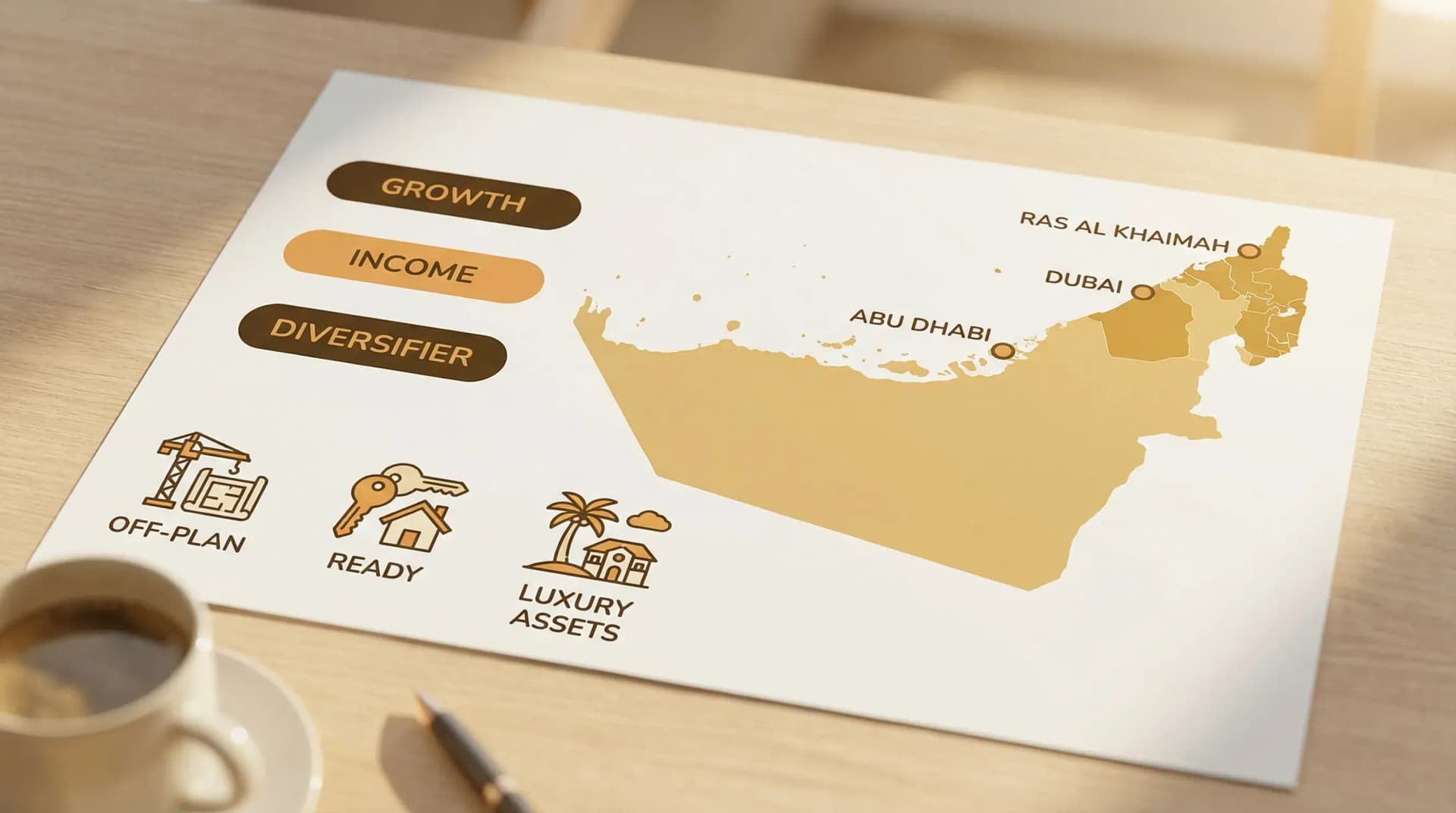
Step 3: Diversify across emirates (for different demand drivers)
Many investors start with one emirate and expand. That can work, but the “balanced mix” improves when your portfolio is not dependent on a single demand engine.
Dubai: liquidity and global depth
Dubai often provides:
- High transaction volume and faster resale liquidity in many segments
- Broad tenant depth (corporate, professional, tourism)
- Constant launch pipeline (opportunity, but also noise)
Dubai can be excellent for a liquidity-aware income stabiliser or a selective growth play, especially when you are clear on supply risk within a micro-market.
Abu Dhabi: institutional stability
Abu Dhabi tends to appeal to investors seeking:
- Policy-driven stability and large employer demand
- A more measured rhythm versus Dubai
It can fit well as a defensive counterweight in a broader UAE mix.
Ras Al Khaimah: asymmetric growth potential
Ras Al Khaimah (RAK) has become a core allocation for investors who want:
- Earlier-cycle entry points
- Tourism and infrastructure catalysts
- A strong off-plan opportunity set in premium lifestyle locations
For many portfolios, RAK plays best as the growth anchor (with disciplined project selection), balanced by an income stabiliser elsewhere, or in a more mature RAK sub-market.
If you are building your strategy around RAK, Azimira’s investment overview is a useful starting point: Ras Al Khaimah property investment.
Step 4: Balance “construction risk” with “cash-flow certainty”
A common portfolio mistake in the UAE is becoming overexposed to one timeline, for example, three off-plan units all handing over in the same quarter.
A practical balancing method is to mix:
- One longer-dated off-plan (growth anchor)
- One near-handover or ready unit (income stabiliser)
- One optionality asset (premium diversifier or personal-use hedge)
This spacing helps with:
- Staged capital calls (deposits and milestones)
- Smoother leasing and furnishing workload
- Lower refinancing pressure at a single point in time
Step 5: Diversify by rental strategy (not just by location)
A balanced UAE property mix also means you are not dependent on a single leasing model.
Long-let (annual) focus
Generally suits:
- Investors who prioritise stability, simpler operations, and predictable cash flow.
- Family-oriented communities and “commuter” locations.
Short-term rental (holiday) focus
Generally suits:
- Lifestyle-led areas, beachfront stock, and tourism-heavy micro-markets.
- Investors willing to accept higher operational intensity.
Hybrid strategy
Some investors keep the option to switch (seasonal or market-led). This is useful, but only if you underwrite conservatively and understand licensing and management realities.
The key is not which strategy is “best”, it is whether your portfolio relies on only one demand stream.
Step 6: Underwrite the mix using portfolio-level metrics (not property-level hype)
Property marketing can make every unit sound like a winner. A curated portfolio uses a small set of consistent metrics across every deal.
Portfolio metrics that keep you honest
| Metric | Why it matters | What “good” looks like in practice |
|---|---|---|
| Net yield (not gross) | Covers service charges, management, vacancy, furnishing | Conservative assumptions, stress-tested vacancy |
| Cash buffer months | Protects you from voids and surprise costs | Enough to cover multiple properties at once |
| Handover clustering | Too many handovers together raises execution risk | Staggered timelines where possible |
| Developer concentration | One failure should not hurt the whole portfolio | Set a max % allocation per developer |
| Micro-market concentration | Prevents local oversupply risk | Avoid “all-in” on one island/tower |
If you want a balanced UAE property mix, you track these metrics at the portfolio level, not just “ROI per listing”.
The human factor: decision quality is part of portfolio performance
Investing well requires consistency under uncertainty. If you are making decisions while sleep-deprived, stressed, or burnt out, you are more likely to chase noise, over-allocate to one theme, or ignore risk limits.
If the pressure of high-stakes decisions is affecting your wellbeing, getting support can be a rational part of protecting performance. For readers who want to speak to a clinician, comprehensive psychiatric services can be a helpful resource for issues like anxiety, depression, and ADHD, which can materially impact focus and risk judgement.
Example “curated portfolio” mixes (conceptual, not one-size-fits-all)
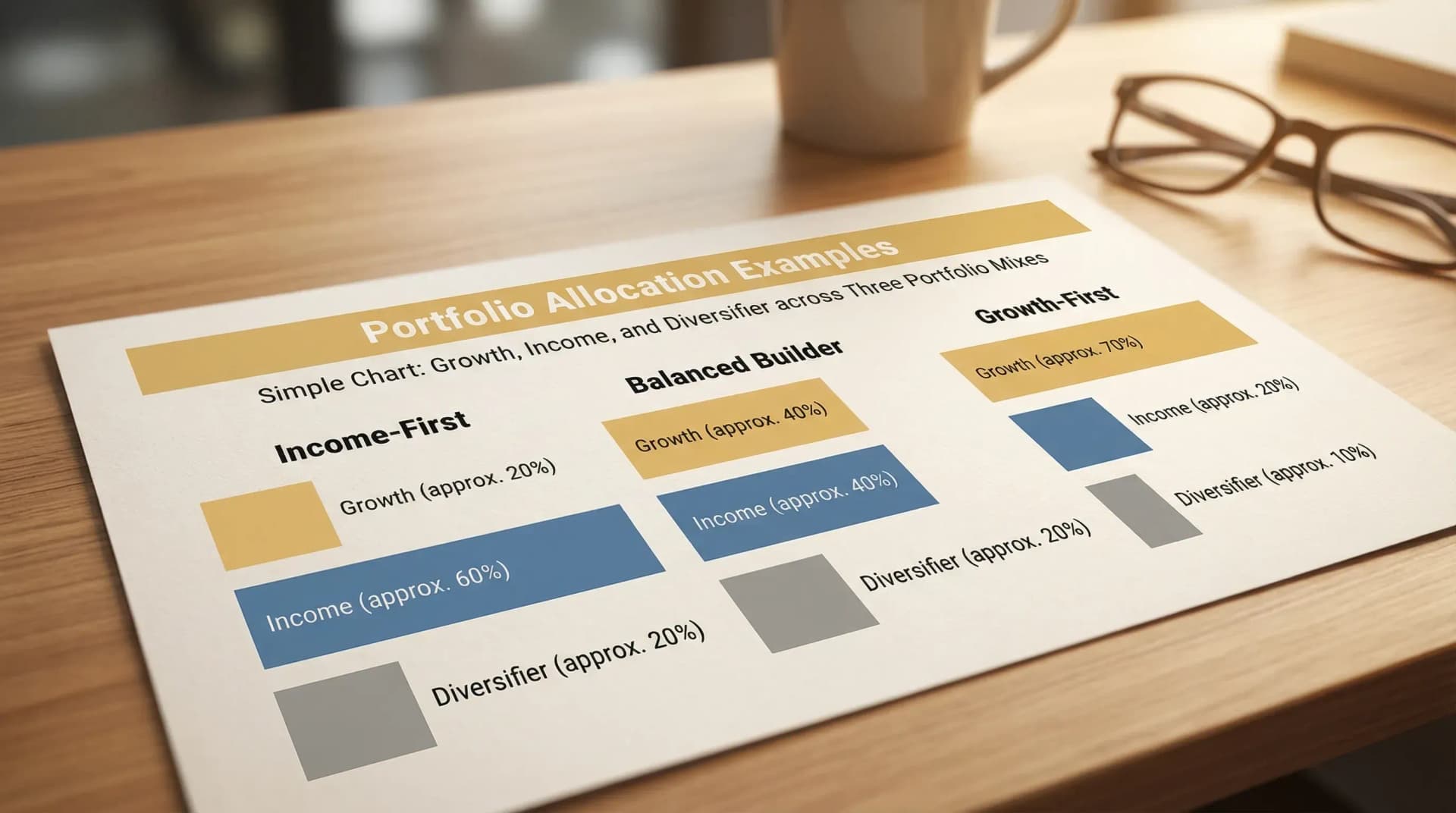
Below are three conceptual mixes to illustrate balance. The right allocation depends on your capital, timeframe, and risk tolerance.
The “Balanced Builder” (typical for a 2–3 property plan)
- Growth anchor: off-plan in a high-growth corridor.
- Income stabiliser: ready or near-handover unit chosen for lettability.
- Optionality: premium diversifier or flexible-use unit.
The “Income-First” mix
- Majority allocation to ready or near-completion units.
- Smaller off-plan position for upside.
- Tight property management and tenant-quality focus.
The “Growth-First” mix (higher risk tolerance)
- Two off-plan positions with staggered delivery.
- One defensive income stabiliser to protect cash flow.
- Strong liquidity buffer and strict developer selection.
How Azimira supports a curated portfolio approach
A curated portfolio is difficult to build with public listings alone, because many of the best risk-adjusted entries come from timing, access, and selection.
Azimira focuses on helping investors and buyers build a balanced UAE property mix through:
- Curated off-plan projects in high-growth markets (including Ras Al Khaimah)
- Expert market insight and market analysis
- Exclusive pre-launch access where available
- Tailored investment strategies aligned to your portfolio goals
- Dedicated client support through selection, acquisition, and ownership
- Investment performance tracking to support ongoing portfolio decisions
Frequently Asked Questions
What is a curated portfolio in UAE real estate? A curated portfolio is a deliberately selected mix of properties where each asset has a clear role (growth, income, diversification) and the combined risk is controlled through rules like allocation limits and timeline staggering.
How do I build a balanced UAE property mix if I can only buy one property now? You design the portfolio in phases. Pick the first property with a defined role (for example, an income stabiliser), then pre-plan the second role (for example, a growth anchor) so your next purchase restores balance instead of repeating the same exposure.
Is it better to diversify across emirates or focus on one area like Ras Al Khaimah? Both can work. Focusing can improve expertise and deal flow, while cross-emirate diversification can reduce reliance on one demand engine. Many investors start focused, then diversify once they have a stable base.
How much should I allocate to off-plan property? It depends on risk tolerance, liquidity buffer, and time horizon. A practical approach is to cap off-plan exposure and ensure you have at least one income-producing asset (or sufficient cash reserves) to handle delays and handover costs.
What is the biggest mistake people make when building a UAE property portfolio? Over-concentration, buying multiple properties with the same risk profile (same developer, same micro-market, same handover window, same rental strategy), which can magnify downside when conditions change.
Build your curated UAE portfolio with Azimira
If you want to build a curated portfolio rather than a random collection of units, Azimira can help you structure a balanced UAE property mix, source opportunities aligned with your objectives, and apply disciplined selection across growth, income, and diversification.
Explore Azimira’s approach to investing in Ras Al Khaimah, or start a conversation about your target allocation and timelines: azimira.com.
Related articles
What Counts as Good Real Estate Investments in 2026
Learn what makes good real estate investments in 2026, from net yield and demand signals to legal checks, exit plans and UAE opportunities.

Investors Needed for Real Estate? Start With This Plan
Investors needed for real estate? Use this practical plan to define strategy, numbers, due diligence and partners before raising capital.

Investment Marketing Tactics Developers Use at Launch
Understand investment marketing tactics developers use at launch, from scarcity to incentives, and learn how to assess UAE off-plan deals.