
Property Market Analysis: The Data Signals to Track Monthly
Property market analysis made practical: track monthly price, volume, supply, rents and financing signals so you can time UAE deals with confidence.
Property markets rarely change direction in a single headline. They usually turn because a handful of measurable variables shift quietly month after month: transaction volumes soften, discounts creep in, new launches surge, or rental demand tilts from residents to short-stay.
A disciplined monthly review is the investor’s edge. It stops you relying on “market mood” and forces a simple question: what does the data say is happening right now, and what is most likely to happen next?
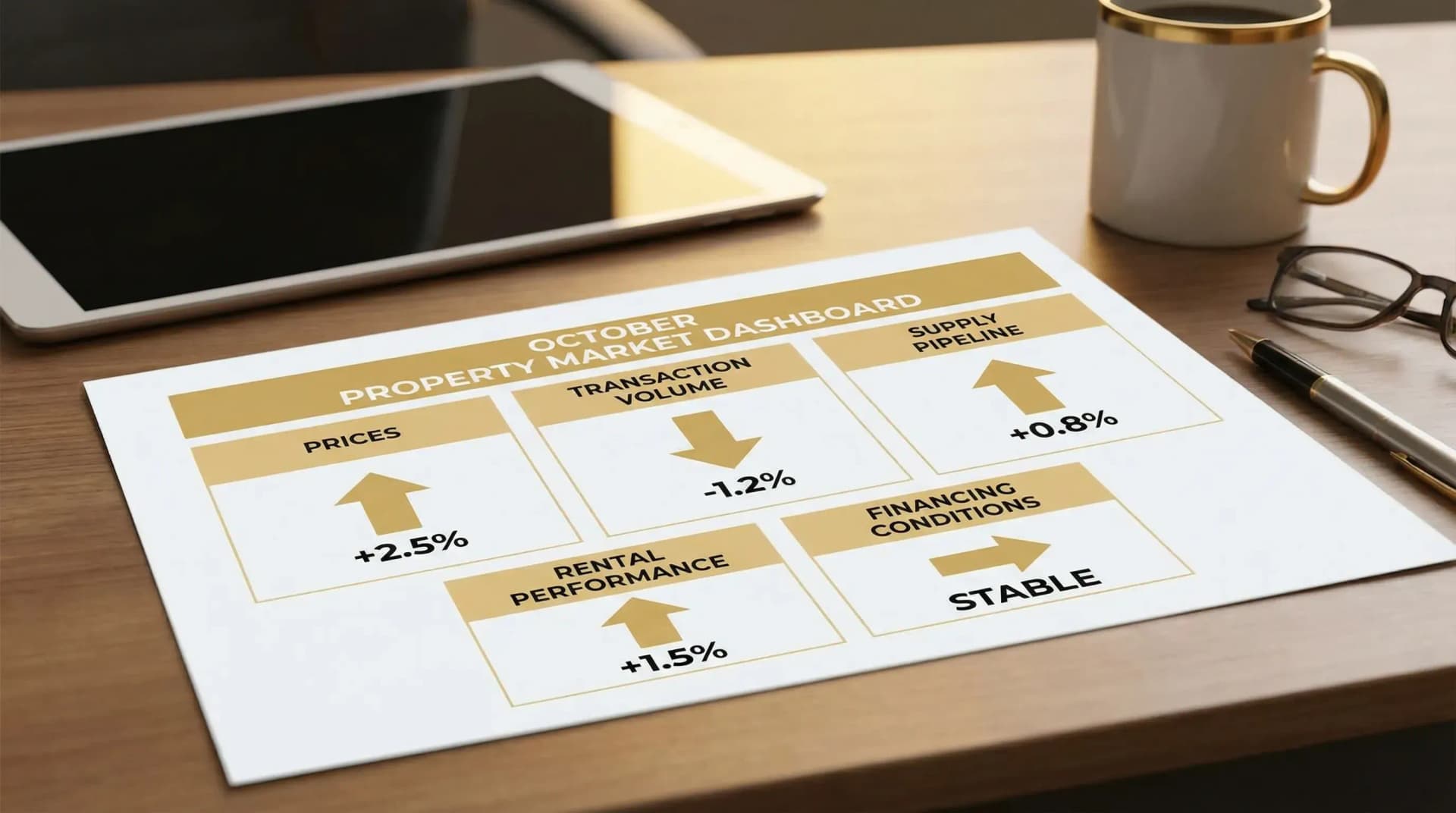
Build a monthly property market dashboard (leading vs lagging signals)
A useful property market analysis separates indicators into three groups:
- Leading indicators (tend to move first): new launches, mortgage conditions, search demand, tourism bookings, developer incentives.
- Coincident indicators (confirm the present): transaction volumes, days on market, achieved rents.
- Lagging indicators (confirm after the fact): official price indices, valuation reports, completion-driven oversupply.
The goal is not to track everything. It is to track the few signals that change investor outcomes, especially in off-plan heavy markets where the “paper market” (new sales) can diverge from the “lived market” (handover, leasing, resale liquidity).
1) Prices: track how prices move, not just the headline
Price growth is easy to quote and easy to misread. Each month, focus on structure:
Price per sq ft (or sq m) by segment
A blended average can hide what matters. Track price changes separately for:
- Off-plan vs ready
- Apartments vs villas/townhouses
- Waterfront/luxury vs mid-market
- Studio/1-bed vs family stock
Why it matters: If studios are rising but family units are flat, that often signals investor-led demand rather than resident depth.
New listing prices vs achieved prices
Portals show asking prices quickly, but the market clears on achieved prices (registered transactions). Watch the gap.
- If asking prices rise while achieved prices are flat, vendors are optimistic, not necessarily correct.
- If achieved prices rise faster than asking, buyers are competing, and supply may be tight.
Where to source it: registered sales data from relevant land departments and market reports from brokerages and research firms.
Incentives and “silent discounts” (especially in off-plan)
Off-plan markets often adjust through incentives rather than sticker prices:
- fee waivers
- upgraded finishes
- extended payment plans
- guaranteed buy-back language (treat cautiously and verify)
Monthly question: Are developers competing more on incentives than last month? If yes, supply pressure may be building even if advertised prices look firm.
2) Demand and liquidity: volumes, time-to-sell, and the quality of buyers
Prices can stay elevated for a period even when demand weakens. Liquidity indicators surface shifts earlier.
Transaction volume and transaction value
Track both.
- Rising volume with stable prices usually indicates a healthy, broad market.
- Rising value without volume can simply mean higher-ticket deals, not wider strength.
Also track the mix (cash vs mortgage where available). In many UAE sub-markets, cash-heavy demand can keep prices resilient, but it can also make the market more sensitive to sentiment and geopolitical flows.
Days on market (DOM) and inventory turnover
If you can access it (via portals, brokers, or your own deal flow), DOM is one of the cleanest monthly indicators:
- DOM falling: demand outpacing supply.
- DOM rising: market requiring more negotiation.
Price reductions and “back on market” listings
Monitor how often listings are reduced and relisted. A rising trend often precedes softer achieved prices.
Mortgage approvals and rate direction
Financing conditions influence buyer behaviour even in premium segments. For UAE, keep an eye on central bank communications and interbank benchmark direction (EIBOR-linked dynamics), because monthly affordability changes affect marginal buyers first.
Useful public sources: the UAE Central Bank for macro banking context and policy updates.
3) Supply pipeline: launches, completions, and absorption
Supply is the long-term “gravity” in property markets. In off-plan focused locations, pipeline analysis is non-negotiable.
New launches (monthly and rolling 3-month)
Track:
- number of projects launched
- unit counts by type
- launch pricing vs last comparable launch
A surge in launches can be bullish (confidence) or bearish (developers rushing to sell into peak demand). The difference is seen in absorption.
Completion schedule and handover clustering
Monthly, map upcoming handovers in your target communities.
- If multiple towers hand over together, rental competition increases.
- If handovers are staggered and supply is disciplined, achieved rents tend to hold.
Absorption rate
Absorption is simply: how many units the market is buying/leasing versus how many are being delivered.
- Falling absorption with rising launches often leads to incentives and longer resale timelines.
- Strong absorption with limited launches supports price firmness.
Where to source it: developer updates, master developer announcements, and periodic reports from established real estate research houses (for example, JLL MENA research often frames supply/demand and pipeline themes).
4) Rental market performance: treat rent as your reality check
Rents are the “cashflow truth serum” of a market. They also reveal whether price appreciation is supported by end-user demand.
Achieved rents vs asking rents
As with sales, portals move faster than reality. Each month, try to validate achieved rents via:
- recent lease registrations (where accessible)
- property manager rent rolls
- broker-verified comps
Vacancy and tenant mix
Track what is driving occupancy:
- corporate leases
- long-term families
- mid-term contractor demand
- short-term tourism demand
A market leaning heavily on short stays can be lucrative, but it also increases sensitivity to seasonality and tourism shocks.
Short-term rental (STR) health (if relevant)
If you invest in resort-leaning or tourism-led areas, track:
- occupancy trend
- ADR (average daily rate)
- RevPAR
STR performance is one of the best leading indicators for tourism-driven micro-markets because it reacts quickly to flight capacity, events, and brand announcements.
5) Cost of ownership and operating margins (investors often forget this)
Two investors can buy the same unit and get completely different results based on operating discipline. Monthly tracking here is less about “market direction” and more about protecting net yield.
Track changes in:
- service charges (announcements, budget revisions)
- insurance quotes (especially for higher-value contents or coastal exposure)
- maintenance and contractor pricing
- utilities and cooling costs (seasonal reality in the Gulf)
This is also where your personal financial system matters. If you hold multiple properties, consider using a dedicated tool to keep everything auditable, from recurring bills to one-off repairs. A free personal finance dashboard like MoneyPatrol’s expense tracker can help you categorise property expenses, monitor cashflow, and avoid missing payment deadlines.
6) Macro catalysts: the “why now” behind local price moves
Monthly property market analysis should include a simple catalyst log. You are not trying to predict politics. You are trying to track material drivers that change demand, supply, or buyer eligibility.
Tourism and visitation signals
In tourism-sensitive markets, track:
- visitor arrivals and hotel performance commentary (where published)
- airline route announcements and seat capacity expansions
- major event calendars and new attractions
Tourism changes rental demand, which changes yields, which changes investor appetite.
Infrastructure delivery milestones
Infrastructure impacts values most when it moves from promise to visible delivery. Create a timeline of:
- road upgrades
- rail developments
- airport expansion phases
- major resort openings
Then each month mark what actually progressed (tenders awarded, construction updates, opening dates reaffirmed).
Regulation and residency rules
In the UAE context, regulatory clarity can quickly widen the buyer pool. Track updates related to:
- off-plan escrow and registration procedures
- residency pathways (such as property-linked visas)
- taxation rules that affect corporate or portfolio structures
Use primary sources where possible (government portals, regulators, official press releases) and treat social media summaries as unverified until confirmed.
7) Project-level signals: what to track when you own (or plan to buy) off-plan
Market-level data tells you “wind direction”. Project-level data tells you whether your specific asset will outperform.
Construction progress vs payment schedule
Each month, compare:
- reported construction progress
- your payment milestones
- likely handover window shifts
If progress slows but the payment plan remains front-loaded, your risk profile changes.
Developer delivery track record
Not all “big names” deliver the same experience in every sub-market. Track:
- on-time delivery history
- post-handover defect resolution reputation
- quality consistency across phases
Resale liquidity inside the same development
Even before handover, watch assignment/resale activity (where legal and applicable):
- Are units trading at premiums?
- Are sellers discounting to exit?
This often reveals investor crowding earlier than formal indices.
The monthly tracker template (what to record in 30 minutes)
If you want a practical system, use a consistent monthly snapshot. The point is comparability.
| Signal category | Metric to track monthly | What it tells you | Early warning sign |
|---|---|---|---|
| Prices | Achieved price trend by segment | Whether appreciation is broad-based | Prices “up” only because mix shifted to luxury |
| Demand | Transaction volume and DOM | Liquidity and buyer urgency | DOM rising for 2 consecutive months |
| Supply | Launch count and completion pipeline | Future competition and rent pressure | Launch surge + weak absorption |
| Rentals | Achieved rent trend and vacancy cues | Yield support and tenant depth | Asking rents steady but achieved rents falling |
| Financing | Mortgage rate direction and approvals tone | Marginal buyer affordability | Mortgage activity slowing while inventory rises |
| Catalysts | Infrastructure/tourism/regulation log | Why the market is moving | Catalysts delayed without price adjusting |
How to interpret the combinations (a simple decision lens)
Single metrics mislead. Combinations guide decisions.
| What you observe | Most likely interpretation | Investor action to consider |
|---|---|---|
| Prices up, volumes up, DOM down | Demand-led growth | Move early, prioritise best units, negotiate less, focus on quality |
| Prices flat, volumes down, incentives rising | Market is softening under the surface | Increase selectivity, demand better terms, stress-test exit options |
| Rents rising, completions low | Yield expansion phase | Consider income assets or near-handover units |
| Many handovers arriving, asking rents unchanged | Rent competition is about to increase | Underwrite conservatively, plan furnishing/marketing early |
| Mortgage costs rising, listings rising | Affordability squeeze | Target cashflow resilience, avoid overpaying for speculative premiums |
Why this matters for UAE and high-growth off-plan markets
In fast-developing UAE sub-markets, monthly tracking is particularly valuable because:
- Supply arrives in waves, not smoothly.
- Investor behaviour can dominate short-term pricing.
- Off-plan incentives can change real returns without changing headline prices.
- Tourism and infrastructure can alter rental demand faster than many mature markets.
For investors exploring premium off-plan opportunities, Azimira focuses on connecting buyers with curated UAE projects (including high-growth markets such as Ras Al Khaimah) and provides guidance built around market insight and deal selectivity. The same monthly dashboard approach above is also what separates a “nice brochure purchase” from a properly underwritten investment.

A final note on discipline: track monthly, decide quarterly
Monthly tracking is for signal detection, not over-trading. A practical rhythm is:
- Monthly: update the dashboard, record changes, note anomalies.
- Quarterly: make decisions (rebalance, buy, refinance planning, exit timing) using three months of context.
If you do this consistently, your property market analysis becomes less about opinions and more about evidence. That is exactly what you want when you are allocating serious capital, especially across borders.
Related articles
What Counts as Good Real Estate Investments in 2026
Learn what makes good real estate investments in 2026, from net yield and demand signals to legal checks, exit plans and UAE opportunities.

Investors Needed for Real Estate? Start With This Plan
Investors needed for real estate? Use this practical plan to define strategy, numbers, due diligence and partners before raising capital.

Investment Marketing Tactics Developers Use at Launch
Understand investment marketing tactics developers use at launch, from scarcity to incentives, and learn how to assess UAE off-plan deals.