
First Investment: The Fastest Way to Avoid Beginner Mistakes
First investment made simple: use a fast pilot framework to set goals, underwrite conservatively, avoid beginner mistakes, and repeat what works.
Most beginner investing mistakes are not caused by “bad markets”. They come from a bad first process: vague goals, optimistic numbers, and decisions made too late.
The fastest way to avoid those mistakes is to treat your first investment as a controlled pilot, built on a repeatable system you can use again and again.
This article gives you that system.
Why beginners lose money (even when the asset is “good”)
First-time investors tend to focus on what to buy (a unit, a stock, a business) and ignore how to buy. That gap shows up in four common patterns:
- They buy a story, not a cash-flow and risk profile. A great narrative can hide weak downside protection.
- They under-budget the “invisible” costs. Fees, financing friction, vacancies, maintenance, FX costs, furnishing, and time.
- They confuse activity with progress. Endless browsing feels productive but delays the only thing that matters, decisive underwriting and due diligence.
- They skip decision points. Without clear “go/no-go” gates, you discover deal-breakers after you have paid a deposit, signed, or wired funds.
A better first investment is usually not a different asset, it is a better sequence.
The fastest path: build a “First Investment Operating System”
If you want speed without recklessness, you need a lightweight operating system that forces clarity early and reduces surprises later.
Step 1: Define the job your first investment must do
Before you look at listings, decide what success means for this first deal. Not for your future portfolio, for this first one.
Write one sentence:
“My first investment is meant to achieve X, with Y risk, over Z timeframe.”
Examples (pick one archetype):
- Capital growth pilot: You can tolerate lower income now, you want price appreciation over 4 to 7 years.
- Income stability pilot: You prioritise tenancy depth, net yield, and lower volatility.
- Residency-linked pilot (where relevant): You want the investment to align with a residency plan and long-term lifestyle optionality.
Then add three constraints that prevent overreach, for example:
- Maximum total budget (including fees and buffers)
- Maximum monthly cash contribution you can sustain (worst-case)
- Minimum holding period you are willing to commit to
This step alone prevents the classic beginner error of buying an asset that is “good”, but wrong for you.
Step 2: Choose one market, one strategy, one property type (for now)
Speed comes from focus. Your first investment is not the time to run five strategies at once.
For a real estate first investment, define:
- Market: one geography you can learn deeply
- Strategy: growth, yield, hybrid, or short-stay (each has different operational demands)
- Property type: apartment, townhouse, villa, serviced unit, off-plan, ready
If you are looking at the UAE, this is where many beginners get trapped by comparison. Dubai, Abu Dhabi, and emerging high-growth markets can all work, but the “best” one depends on your objective and constraints.
A practical rule: if you cannot clearly explain why this market fits your objective in two sentences, you are not ready to deploy capital.
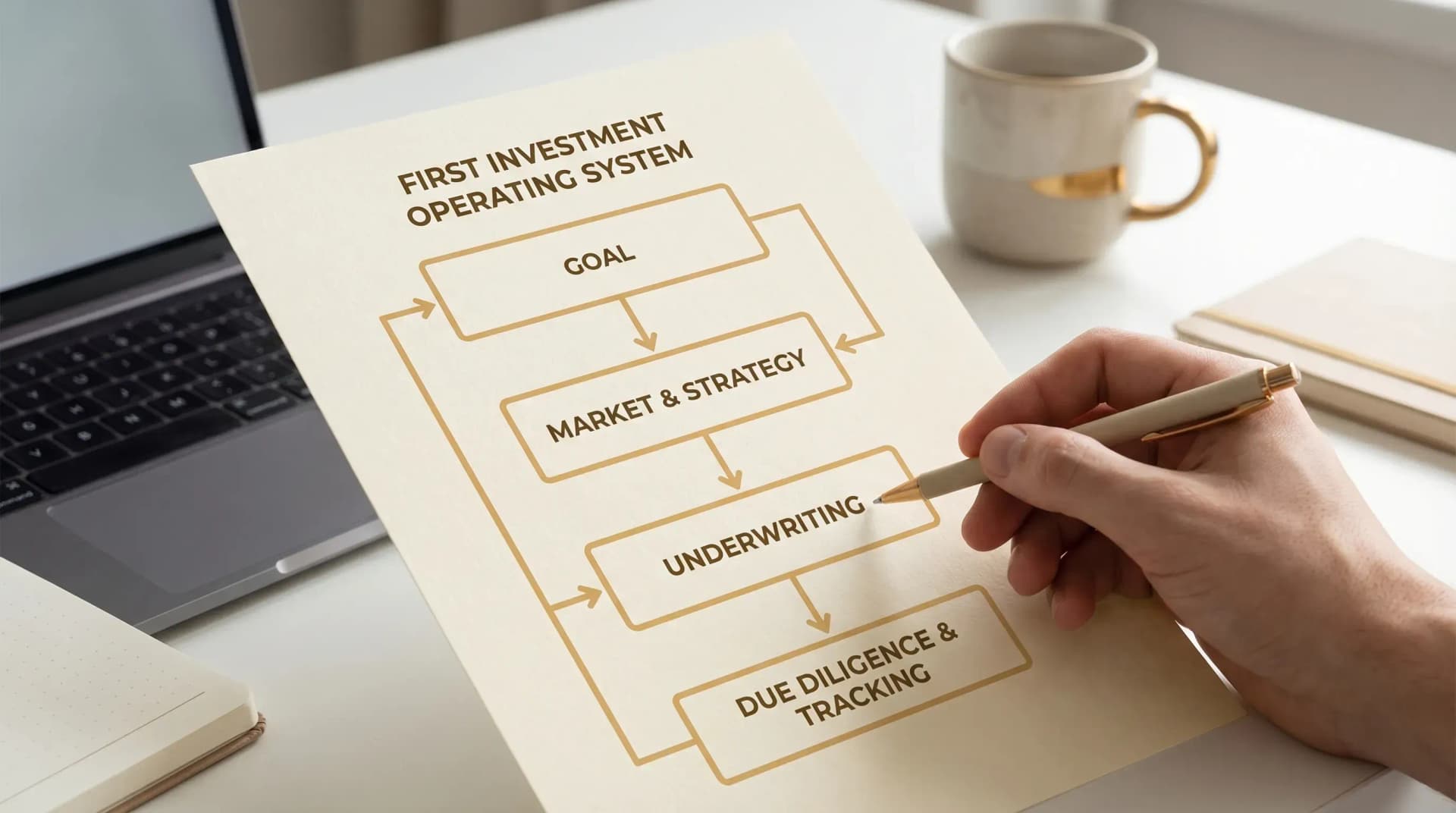
Step 3: Underwrite conservatively (your first deal should survive bad luck)
Most beginner underwriting fails in one of two ways:
-
It uses optimistic rent and ignores downtime.
-
It ignores real ownership costs because they feel “small” next to the purchase price.
You do not need a complex spreadsheet to be disciplined, you need a base case, downside case, and stress case.
Here is a simple table you can use for almost any property investment.
| Underwriting item | Base case | Downside case | Stress case |
|---|---|---|---|
| Rent assumption | Market rent today | 5% to 10% below market | Extended vacancy or lower rent reset |
| Occupancy | Normal turnover | Longer letting time | Tenant gap + re-letting costs |
| Operating costs | Expected annual costs | +10% buffer | +20% buffer + one major repair |
| Financing (if any) | Current rate | Rate increases at refix | Higher rate + tighter lending |
| Exit | Normal resale market | Slower resale | Forced sale timing or discounted exit |
If the deal only works in the base case, it is not an investment, it is a bet.
Step 4: Put “go/no-go gates” before you commit
Speed comes from doing the right checks in the right order.
Create three gates:
Gate A (before any money moves): Clarify objective, rough returns, and non-negotiables. If it fails, you walk with zero friction.
Gate B (before deposit or reservation): Confirm the legal ownership pathway, developer/agent legitimacy, fee schedule, and the document set you will require to proceed.
Gate C (before signing and staged payments): Validate the contract terms, delivery timeline assumptions, handover responsibilities, and your plan for letting or resale.
In off-plan markets, Gate C is where beginners often discover critical clauses too late. If you are not confident reviewing contracts, this is where specialist legal review and experienced local guidance pay for themselves.
Step 5: Track performance from day one (so you learn fast)
Most people think “tracking” starts when you receive rent. In reality, performance tracking starts the moment you commit, because that is when risk becomes real.
At minimum, track:
- Total cash deployed to date (including fees)
- Payment schedule and upcoming liabilities
- Key milestones (handover dates, registration, snagging, furnishing, licensing if needed)
- Net income once operational (rent minus all recurring costs)
- A short decision log (why you chose this, what assumptions you made)
This creates a feedback loop. Your second deal becomes dramatically easier because you know which assumptions were realistic.
If you are investing through a company, or you are scaling beyond one asset, consider setting up proper reporting early. Many investors only “systemise” after they feel overwhelmed, which is too late. A managed service team that understands AI automation and finance systems can help implement clean tracking and predictable reporting (for example, AI & NetSuite consulting support for mid-market operations).
A quick “mistake prevention” checklist you can use today
The goal is not perfection. The goal is to eliminate the costly, repeatable errors.
| Beginner mistake | What it looks like in real life | Prevention move |
|---|---|---|
| Buying without a defined objective | “It’s a great unit, I’ll figure out the plan later.” | Write the one-sentence job-to-be-done and 3 constraints first |
| Using headline returns | Trusting marketing yield numbers | Underwrite with downside and stress cases, include all ownership costs |
| Discovering legal issues late | Scrambling after deposit to understand documents and terms | Use Gate B and Gate C, insist on the full document set before signing |
| No buffer | “I’ve used all my cash on the deposit.” | Hold a contingency fund for fees, delays, voids, and setup |
| No exit plan | “I’ll sell when it feels right.” | Define a holding period and at least two exit options (resale, let, refinance where appropriate) |
How this applies to a first UAE property investment (especially off-plan)
If your first investment is in UAE real estate, the “operating system” matters even more because execution is multi-step: reservation, contracts, registration, staged payments, handover, and then operations.
A few high-level points to keep your first deal clean:
Do not treat off-plan like a simple pre-order
Off-plan can be a powerful way to access growth and structured payment plans, but the risks are different from a completed unit. Your underwriting must account for timeline variation and your due diligence must focus heavily on developer track record, escrow protections, and contract terms.
Understand the full cost structure, not just the purchase price
Even in tax-advantaged jurisdictions, property ownership still involves transaction fees, registration costs, service charges, insurance, utilities setup, and ongoing maintenance. Beginners often underestimate how these affect net yield.
Align the property with your operational reality
Short-stay strategies can look attractive on paper and become a job in practice. Long-let strategies can be smoother but may cap upside in certain micro-markets. Your first investment should match your willingness to manage complexity, especially if you are buying from abroad.

Frequently Asked Questions
What is the best first investment? The best first investment is the one that matches a single clear objective (growth, income, or a hybrid), survives a conservative downside case, and has a realistic execution plan you can follow.
How much time should I spend analysing my first investment before acting? Spend enough time to complete your three gates (objective, feasibility, due diligence). If you cannot complete those gates, waiting is rational. If you can, delaying often increases the risk of emotional decisions and missed opportunities.
Should my first investment be high-return or low-risk? For most beginners, a balanced deal with strong downside protection is the fastest teacher. A high-return deal with fragile assumptions often teaches the wrong lesson (that luck equals skill).
How do I avoid overpaying on my first investment property? Underwrite using conservative assumptions, compare multiple comparable transactions where possible, and focus on net returns after costs. If a deal only works at a perfect price, it is not robust enough for a first investment.
Is it smarter to invest locally for my first deal? Not always. Local can be easier operationally, but some investors have better risk-adjusted opportunities abroad. The key is specialist support, clear documentation, and a tracking system so distance does not create blind spots.
Make your first investment a repeatable win
If you want your first investment to be a foundation, not a costly lesson, treat it like a pilot with a clear objective, conservative underwriting, and disciplined due diligence.
Azimira helps investors access curated off-plan opportunities in the UAE, with a focus on high-growth markets like Ras Al Khaimah, and supports the full process from strategy to execution.
When you are ready, explore Azimira at Azimira and request a conversation about a first investment plan that fits your goals and risk tolerance.
Related articles
What Counts as Good Real Estate Investments in 2026
Learn what makes good real estate investments in 2026, from net yield and demand signals to legal checks, exit plans and UAE opportunities.

Investors Needed for Real Estate? Start With This Plan
Investors needed for real estate? Use this practical plan to define strategy, numbers, due diligence and partners before raising capital.

Investment Marketing Tactics Developers Use at Launch
Understand investment marketing tactics developers use at launch, from scarcity to incentives, and learn how to assess UAE off-plan deals.