
Real Estate Management Investment: Costs, Fees, ROI Impact
Real estate management investment guide: understand costs, fees and how management choices affect ROI. Model net yields, spot hidden charges, protect returns.
Most property investors obsess over purchase price and headline rental yield, then lose thousands quietly through management decisions that compound over years. In the UAE, where many owners are overseas and off-plan handovers create tight “time to revenue” windows, real estate management is not just an operating cost, it is an investment lever that can protect occupancy, reduce risk, and materially change net ROI.
This guide breaks down the main costs and fee structures you will see in real estate management, how to model their ROI impact properly, and the practical questions to ask before you sign.
What “real estate management investment” really means
A property manager is not simply a key-holder. In investment terms, management is the function that converts an asset into predictable cash flow, keeps the asset compliant, and preserves resale value. The “investment” part is the trade-off between:
- Explicit costs (management fees, leasing fees, maintenance coordination)
- Implicit value created or lost (vacancy days, rent achieved, tenant quality, claim handling, preventive maintenance)
The right way to evaluate management is not “What is the fee?” but “What is the fee doing to my net yield, my risk, and my exit value?”
The cost stack: fees vs pass-through expenses
Management costs are often misunderstood because they mix two different things:
- Fees: what you pay the manager for their service
- Pass-through costs: what you pay third parties (or reimburse the manager) to run the property
Here is a practical map of the usual cost stack you should expect to review for any rental investment.
| Cost item | How it is usually charged | What to watch | ROI impact if mis-scoped |
|---|---|---|---|
| Ongoing management fee | Percentage of collected rent (in many markets, often quoted in single-digit percentages) | Is it based on “rent due” or “rent collected”? Any minimum monthly fee? | Inflates costs in vacancy periods if calculated incorrectly |
| Letting or leasing fee | One-off fee for finding a tenant (fixed fee or a percentage of annual rent) | Is renewal charged again? What marketing is included? | Erodes year-1 yield, especially on shorter tenancies |
| Short-stay management fee (if applicable) | Percentage of revenue, sometimes with extra line items | Who controls pricing, channel mix, and guest screening? | Can wipe out “high gross yield” if costs scale with revenue |
| Maintenance coordination | Included or charged per job | Are there call-out charges? Are quotes required above a threshold? | Death by a thousand small invoices |
| Contractor mark-ups | Either none, or embedded in vendor pricing | Ask explicitly if mark-ups exist | Hidden reduction in NOI even when rents look strong |
| Reporting and accounting | Included or charged monthly/quarterly | Quality and frequency of owner statements | Poor visibility leads to delayed decisions and avoidable losses |
| Tenant move-in/out handling | Included or charged per event | Inventory condition reports, inspection cadence | Impacts deposit recovery and end-of-lease repair bills |
The goal is clarity: separate what the manager earns from what your property costs to operate, then test how both behave under vacancy, repairs, and renewals.
How management fees change ROI (with a simple net-yield model)
Investors often quote gross yield:
Gross yield = Annual rent / Purchase price
But management decisions show up in net yield:
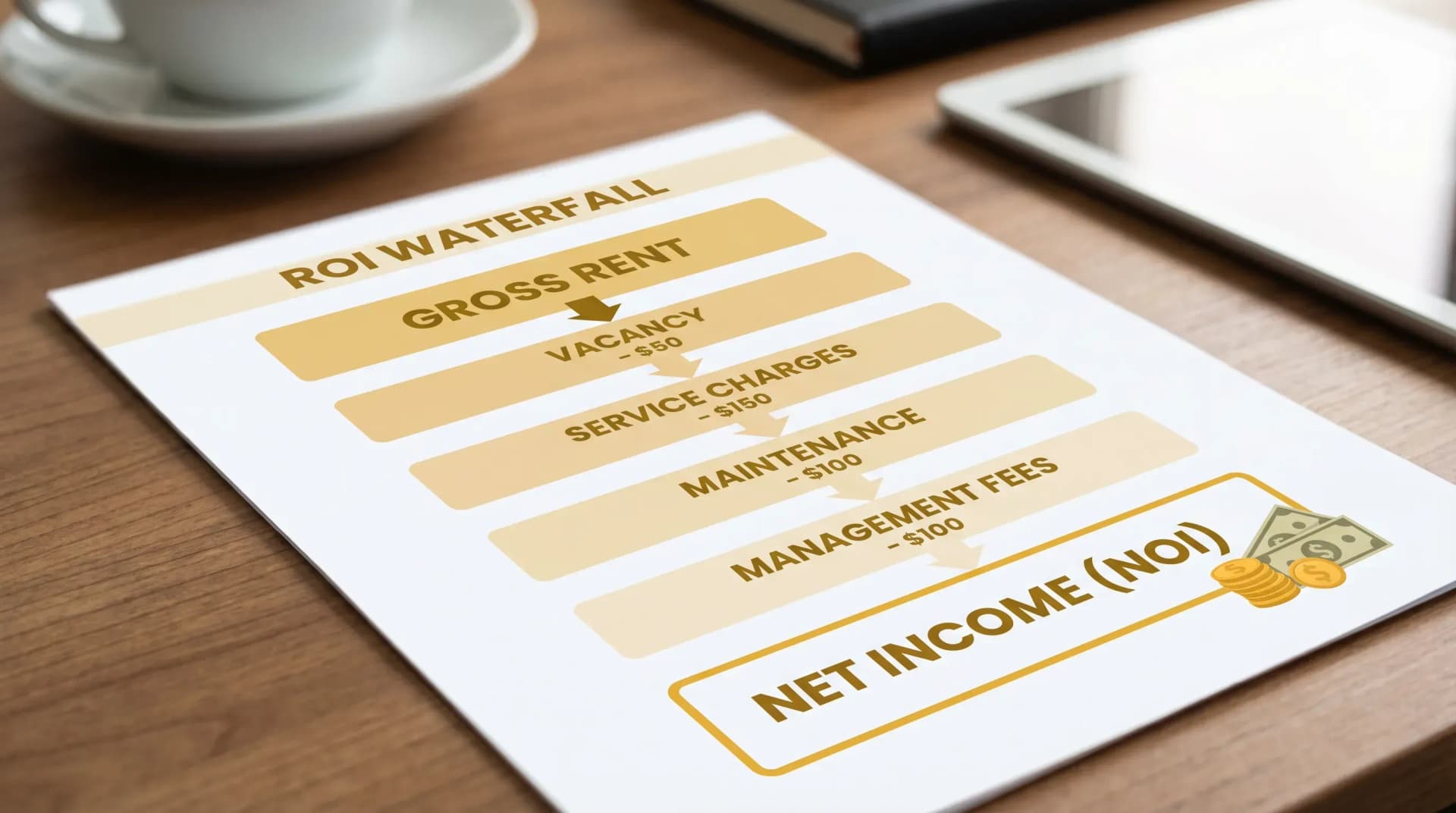
Net yield = (Annual rent - vacancy loss - operating costs - management fees) / Total invested capital
To see the ROI impact, you need to model the fee against the manager’s ability to improve (or protect) the numerator.
A quick sensitivity check you can do in 2 minutes
If a manager charges a percentage of collected rent, the fee is only “expensive” if it does not change any of the following:
- Rent achieved
- Vacancy days
- Maintenance outcomes (cost and frequency)
- Tenant quality (arrears, disputes, damages)
A simple break-even test:
- If your management fee is F (as a fraction of rent collected), the manager must create at least F / (1 - F) in additional net rent (or cost savings) to break even.
Example using a hypothetical fee (for illustration):
- If F = 7%, break-even uplift requirement is 0.07 / 0.93 ≈ 7.5%.
That uplift can come from a mix of better pricing, fewer vacant weeks, fewer disputes, and tighter maintenance control.
The ROI levers a good manager can actually control
When management improves ROI, it is typically through a few repeatable mechanisms.
1) Vacancy reduction (the most underestimated lever)
Even small vacancy differences dominate fees.
If a manager fills a unit 2 to 4 weeks faster each year (or reduces turnover frequency by improving tenant experience), the gain often outweighs the management fee. This is especially relevant in:
- Newly handed-over communities where many owners list at the same time
- Emerging, high-growth markets where demand exists but “time to match” varies by positioning
2) Rent optimisation (not the same as “highest advertised rent”)
Professional rent optimisation is about achieving the highest collected rent over the year, not the highest asking price that causes longer vacancy.
In practical terms it includes:
- Comparable analysis, updated frequently
- Unit positioning (view, floor, furnishing level, inclusions)
- Pricing strategy by season and tenant segment
If you want an owner-friendly introduction to improving listing performance through better marketing, the no-fluff guidance on Saaga Solve’s marketing and SEO blog is a useful reference point.
3) Maintenance as preventive capex planning (not reactive fixes)
Reactive maintenance is expensive. Preventive maintenance protects both:
- Cash flow (fewer emergencies, fewer insurance headaches)
- Asset value (condition at resale, fewer long-term system failures)
In hot, coastal Gulf climates, preventive checks for AC performance, water leaks, and corrosion are not “nice to have”, they are part of preserving the investment.
4) Compliance and dispute avoidance
Every market has its own rental rules, registration expectations, notice periods, and dispute processes. The ROI impact is real:
- Incorrect paperwork can delay move-in
- Poor documentation can weaken your position in disputes
- Late actions can prolong vacancy or increase repair costs
Common fee structures and what they incentivise
A subtle but important point: fee design drives behaviour.
| Fee design | Incentive created | Best for | Risk to manage |
|---|---|---|---|
| % of rent collected | Manager is rewarded when income is stable | Standard long-term rentals | Manager may be less motivated on leasing speed unless measured |
| Leasing fee per new tenant | Manager is rewarded for turnover events | Fast-moving markets | Can conflict with retention unless renewals are also valued |
| Short-stay % of revenue | Manager is rewarded for top-line growth | Holiday lets and serviced units | Costs can scale quickly, ensure net reporting discipline |
| Fixed monthly fee | Predictable cost base | Hands-off owners who want certainty | Make sure service scope is explicit |
Ask for a sample owner statement and a fee schedule in writing, then run your own net-yield model.
What to ask before signing a management agreement
You do not need legal overkill, you need commercial clarity. These questions catch most ROI killers.
- What is the fee basis? Rent due vs rent collected, and whether VAT applies.
- What is included? Inspections, renewals, rent collection follow-up, dispute support.
- What is excluded? Marketing spend, photography, inventory reports, deep cleaning, snagging support.
- What approval limits apply? For example, “Any maintenance above X requires owner approval.”
- Do you add mark-ups to contractor invoices? If yes, how is it disclosed?
- How are emergency decisions handled? Who can authorise spend and under what limit?
- What does reporting look like? Frequency, detail level, arrears tracking, maintenance logs.
- How can you terminate or switch managers? Notice period, handover process, data portability.
If you are investing off-plan, also ask how the manager supports the handover runway (snagging coordination, utility activation support, photography timing), because delays there can be the most expensive “hidden cost” of all.
When management fees usually improve net ROI (and when they do not)
Management tends to be ROI-positive when the alternative is costly in time, risk, or vacancy.
Management is usually a strong “investment” when:
- You live overseas or travel frequently
- You have multiple units and want portfolio-level consistency
- Your strategy is short-stay or hybrid letting, where pricing and operations are intensive
- Your property is premium, where presentation and tenant quality drive outsized outcomes
Self-management can make sense when:
- You are local, responsive, and experienced
- Your tenancy is stable and long-duration
- You have reliable contractors and solid compliance knowledge
The key is honesty about opportunity cost. If self-managing costs you business time or delays decisions, it is still a cost, it just is not on an invoice.
A practical ROI template you can copy into your spreadsheet
Use a single-year view for net yield, then extend to a multi-year model for your hold period.
| Line item | What to input | Notes |
|---|---|---|
| Purchase price | Actual price | Use the price you paid or will pay |
| Upfront costs | Registration, broker, furnishing, setup | Include all acquisition and setup costs |
| Annual rent (expected) | Conservative number | Use a vacancy-adjusted market rent where possible |
| Vacancy allowance | Weeks or % | Model at least one turnover risk scenario |
| Service charges and utilities (owner) | Annual estimate | Varies by building and usage |
| Maintenance reserve | Annual reserve | Treat as a reserve even if not spent yearly |
| Management fees | Fee + any add-ons | Separate ongoing from leasing and renewals |
| Net operating income (NOI) | Calculated | This is your income before financing and taxes |
| Net yield | NOI / total invested capital | Compare across properties and strategies |
Once you have this, you can compare management options properly by changing only the rows the manager can influence (vacancy, rent, maintenance outcomes, and fee line items).
Frequently Asked Questions
What are typical real estate management investment costs? They usually include an ongoing management fee plus pass-through operating costs such as maintenance and third-party services. Always separate “fees” from “expenses” in your model.
Is a lower management fee always better for ROI? Not necessarily. A slightly higher fee can be ROI-positive if it reduces vacancy, improves rent achieved, or prevents expensive disputes and maintenance surprises.
How do I calculate ROI impact of property management fees? Model net yield using net operating income (NOI). Compare scenarios with different vacancy, rent, and maintenance assumptions, not just different fee percentages.
What is the biggest hidden cost in rental property management? Delays to income due to slow leasing, poor handover readiness, or unclear maintenance approval processes. A few weeks of vacancy can outweigh months of fees.
Should off-plan investors budget differently for management? Yes. Off-plan investors should include setup and “time to revenue” items such as snagging coordination, utility activation, initial marketing assets, and a realistic leasing ramp.
How can I vet a property manager without getting overwhelmed? Ask for a written fee schedule, a sample owner statement, and clear answers on approval limits, contractor mark-ups, and termination terms. Then run a simple net-yield sensitivity check.
Make management part of your investment strategy (not an afterthought)
If you are building a UAE property portfolio, the management decision should be made at the same time as the asset selection, not after handover. The wrong structure can silently compress returns, while the right one can protect income and resale value.
Azimira specialises in connecting investors and buyers with premium off-plan opportunities in the UAE, with a strong focus on high-growth markets like Ras Al Khaimah. If you want help aligning project selection, rental strategy, and management economics into one coherent plan, explore Azimira’s approach to investing in the UAE on the investment page or contact the team for a tailored strategy.
Related articles
What Counts as Good Real Estate Investments in 2026
Learn what makes good real estate investments in 2026, from net yield and demand signals to legal checks, exit plans and UAE opportunities.

Investors Needed for Real Estate? Start With This Plan
Investors needed for real estate? Use this practical plan to define strategy, numbers, due diligence and partners before raising capital.

Investment Marketing Tactics Developers Use at Launch
Understand investment marketing tactics developers use at launch, from scarcity to incentives, and learn how to assess UAE off-plan deals.