
Growth Capital: When to Deploy It Into UAE Off-Plan Projects
Learn when to deploy growth capital into UAE off-plan projects using a cycle and deal-stage framework, risk checks and cashflow planning.
When investors talk about growth capital, they usually mean money that is “allowed to take risk” because it is surplus to core needs. In property terms, it is the capital you deploy when you are aiming for outsized upside (capital appreciation, equity creation, or both) rather than simply preserving wealth.
UAE off-plan projects can be a powerful home for growth capital because they combine (1) time and price discovery during construction with (2) capital-efficient payment plans that let you stage deployment over months or years. The catch is that timing matters: the same project can be a high-conviction growth play at one point in the cycle and a fragile bet at another.
This guide gives you a practical framework to decide when to deploy growth capital into UAE off-plan, and which stage to target, without relying on hype.
First: confirm your capital is truly “growth capital”
Off-plan investing rewards patience and punishes forced selling. Before you look at launches, make sure your funding behaves like growth capital, meaning you can hold through normal volatility and construction timelines.
A simple way to pressure-test this is to separate your money into three buckets:
| Capital bucket | What it is | Suitable for off-plan? | Typical objective |
|---|---|---|---|
| Liquidity capital | Emergency cash, near-term commitments (tax, school fees, business payroll) | Rarely | Stability and access |
| Core capital | Long-horizon wealth you still want to protect (retirement base) | Sometimes | Balanced return and downside control |
| Growth capital | Surplus capital with time, flexibility, and risk tolerance | Yes | Equity growth and asymmetric upside |
If you are relying on a quick assignment sale or a perfectly timed exit to stay liquid, you are likely using liquidity or core capital, not growth capital.
Second: match the deployment window to the off-plan deal stage
Off-plan is not one moment, it is a timeline. Each stage has a different risk profile, and growth capital can be deployed in more than one way.
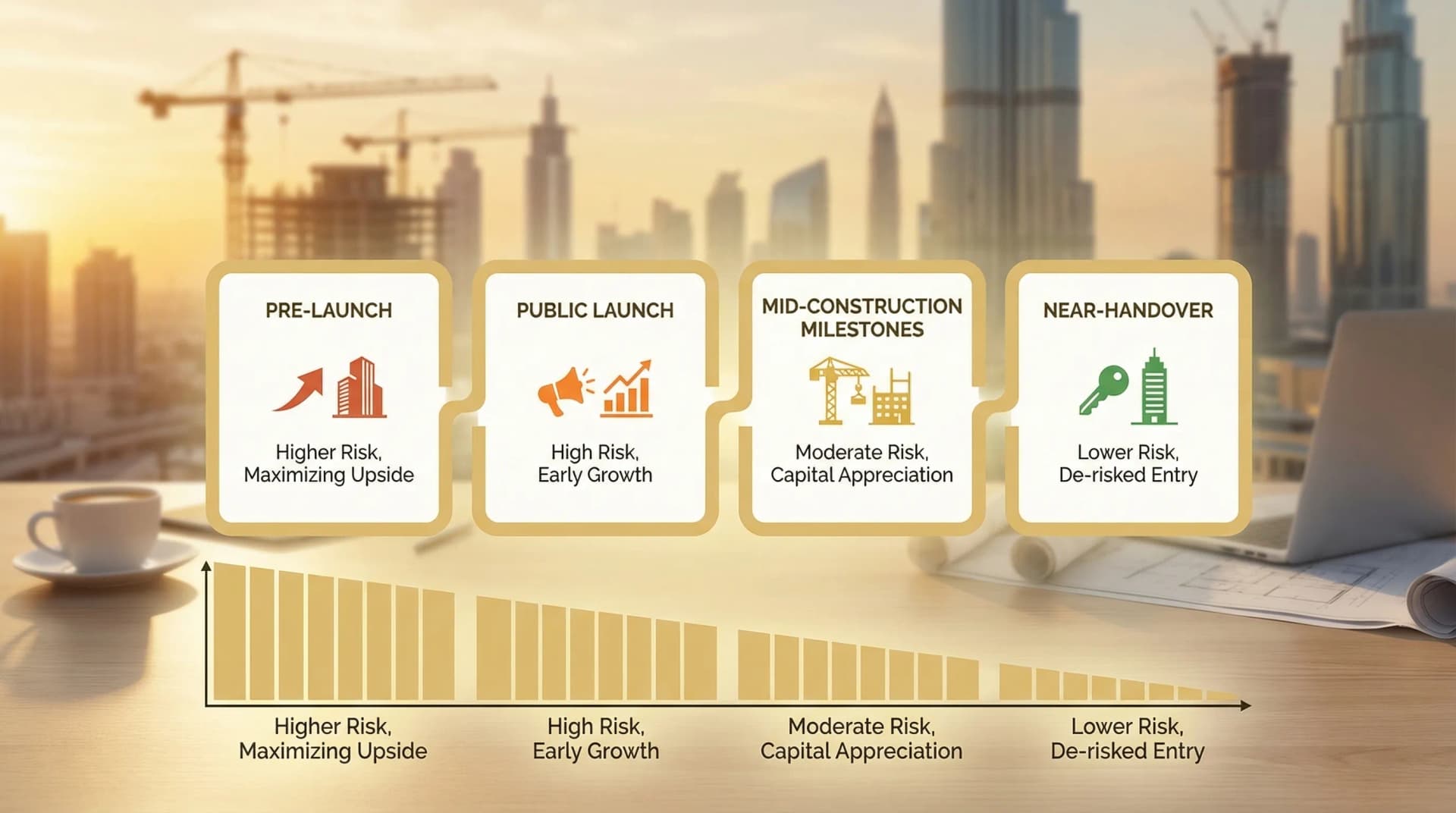
Pre-launch and VIP allocations (highest upside, highest execution risk)
This is where growth capital often performs best, because the risk you are taking (early commitment) is typically compensated by better entry pricing and better unit selection.
Pre-launch can make sense when:
- You have strong conviction in the location and developer, and you value choice (best views, best stack, best layout) as much as headline price.
- Your holding horizon is long enough to ignore short-term noise.
- You can tolerate policy, macro, and construction risks without needing to liquidate.
Pre-launch becomes far less attractive when markets are overheated and developers can push prices aggressively from day one. In that environment, growth capital may be better deployed into earlier-phase projects that still have genuine price discovery, or into near-handover units where the risk is lower.
Azimira’s edge here is primarily access and filtration: curated off-plan projects plus exclusive pre-launch access so you can deploy growth capital where the risk-reward actually looks asymmetric, not merely early.
Public launch (better information, still meaningful upside)
At public launch you have more visibility: published payment plans, clearer specification, and usually a stronger sense of buyer demand. You may pay a premium to pre-launch, but you can still capture meaningful upside if the project sits in a growth corridor.
This stage can be ideal for investors who want growth exposure but prefer more data:
- Comparable pricing is easier to verify.
- The Sales & Purchase Agreement (SPA) and escrow details are typically clearer.
- You can compare multiple projects launching in the same quarter.
If you want a deeper grounding in protections and documentation, Azimira’s guide to the legal framework of off-plan investing in the UAE is a useful companion.
Mid-construction milestone entry (risk starts to compress)
Buying after visible construction progress often reduces “execution uncertainty”, but you may still get favourable pricing relative to near-handover or ready stock.
Growth capital can be deployed here when your priority is risk-adjusted growth:
- You still want appreciation into completion and handover.
- You want clearer evidence of delivery competence.
- You are willing to give up some upside to reduce tail risk.
This is also a stage where disciplined investors revisit their assumptions. If your thesis was “new infrastructure will unlock demand by handover”, you should now verify timeline alignment.
Near-handover (lowest construction risk, different growth profile)
Near-handover can be attractive if your growth capital strategy includes converting appreciation into income quickly (renting immediately post-handover) or refinancing once title is issued.
The trade-off is simple: less construction risk, but often less upside remaining.
If you are deciding between off-plan timing and ready property, Azimira’s modelling piece on off-plan vs ready property IRR helps frame the decision in return terms rather than narratives.
Third: use a cycle-based trigger, not a headline-based trigger
Investors often deploy growth capital because of a single headline (a mega-project, a resort opening, a rail announcement). Headlines matter, but pricing and liquidity conditions decide whether the opportunity is still there.
A more robust approach is to deploy when multiple signals align:
1) Liquidity and rates are not working against you
Even cash buyers are affected by the rate environment because it influences marginal buyers, mortgage approvals, and overall transaction velocity.
You do not need to predict interest rates perfectly, but you should know whether the environment is tightening or easing.
- The UAE’s monetary conditions are closely linked to the US because the dirham is pegged to the dollar (which flows through to policy and funding costs).
- For a credible starting point on policy direction, follow commentary and releases from the Central Bank of the UAE and global macro sources such as the IMF.
A common growth-capital mistake is deploying into a high-beta segment (early-stage, premium off-plan) at the same time as liquidity is being withdrawn.
2) Supply is controlled in your micro-market
“UAE property” is not one market. The question is whether your community is adding supply faster than demand can absorb it.
Off-plan growth strategies work best when:
- The pipeline is credible and phased.
- New inventory adds amenities and demand drivers rather than just competing stock.
- Your unit has defensible differentiation (view corridors, walkability, proximity to anchor attractions).
RAK is frequently analysed as an emerging market with strong growth drivers, but the practical investor task is to pick the right micro-location and unit selection, not just the right emirate. Azimira’s quarterly sentiment and market insights can help you gauge how capital is shifting across emirates and segments.
3) Price discovery is still happening
Growth capital wants a mispricing or a structural reason why today’s price is not the long-term clearing price.
In off-plan, price discovery tends to fade as:
- The project sells through its best inventory.
- Construction de-risks delivery.
- The surrounding community becomes “obvious” to a broader buyer base.
If pricing has already moved in multiple sharp steps and incentives have disappeared, you may be late for that specific project, even if the broader market still has upside.
A decision matrix: when growth capital should (and should not) go into off-plan
Use the matrix below as a high-level filter before you spend time on unit selection.
| Situation | Deploy growth capital into UAE off-plan? | Why |
|---|---|---|
| You can hold 3 to 7+ years and want equity growth | Often yes | Time allows the growth thesis to play out and absorbs volatility |
| You need liquidity within 12 to 24 months | Usually no | Off-plan exit liquidity is not guaranteed, and fees can compress returns |
| You have strong FX exposure and no plan for staged payments | Caution | Payment schedules can amplify currency risk over time |
| You already own multiple properties in one micro-market | Maybe, but diversify | Concentration risk rises, especially in emerging sub-markets |
| You can access pre-launch, high-quality developer stock | Often yes | Unit selection and entry price improve the risk-reward |
| You are choosing projects mainly on “guaranteed returns” marketing | No | This is a classic pathway into poor risk-adjusted outcomes |
For scam and misrepresentation risk, Azimira’s investor protection piece on UAE property scam red flags is worth reading before you transfer any deposit.
Structuring growth capital deployment with payment plans (so you do not overcommit)
Off-plan payment plans can be a feature or a trap. They are capital-efficient, but they are still obligations.
A disciplined way to deploy growth capital is to treat the plan like a funding schedule rather than a “discount”.
Build a staged funding plan around milestones
In most UAE off-plan structures, you will pay a deposit, then instalments tied to construction milestones, and sometimes post-handover tranches.
Three practical considerations matter:
- Reserve buffer: plan for delays and overlapping commitments so you do not need to sell other assets at the wrong time.
- FX management (for international investors): staged payments mean repeated conversions over time. If the currency can move against you, consider whether hedging tools are appropriate for your situation. Azimira has a dedicated primer on FX hedging strategies for staged payments.
- Opportunity cost: capital tied to instalments cannot be deployed elsewhere. Your goal is not just high ROI on paper, but a strong return per unit of capital actually deployed.
If you are comparing payment structures, Azimira’s analysis on post-handover payment plan models helps translate terms into cash-flow reality.
Risk controls that make growth capital “investable” in off-plan
Growth capital does not mean reckless capital. The best growth investors in UAE off-plan tend to be strict on process.
Developer and escrow diligence
Your downside protection starts with regulatory compliance and where the money is held.
If you want a step-by-step process, see Azimira’s guide to escrow account due diligence for off-plan.
Delay risk and timeline realism
Delays do not just postpone handover, they can:
- push back rental income,
- change your financing costs,
- overlap with other investment commitments.
For a structured way to think about this, Azimira’s risk matrix on construction delays vs ROI is a practical planning tool.
Exit planning before you buy
Growth capital strategies should define an exit or conversion plan upfront, even if the intention is long-term holding:
- Hold to handover and rent.
- Refinance post-title (where feasible) to recycle capital.
- Sell on completion if the market has overshot.
- Use an assignment sale only if the project’s rules and market liquidity support it.
Exit costs and rules vary by emirate and developer, so it is not enough to assume a frictionless sale.
Why Ras Al Khaimah (and other high-growth nodes) often fit growth capital
Emerging high-growth markets can suit growth capital because they may offer more room for price discovery than fully mature markets. That said, the “growth” is never automatic. The investable edge comes from combining:
- entry timing (pre-launch or early-phase when mispricing exists),
- unit selection (differentiation that survives new supply),
- developer quality and delivery evidence,
- realistic cash-flow planning.
Azimira’s core investment positioning is built around those mechanics: premium off-plan opportunities, expert market insight, and tailored investment strategies with dedicated client support. If you want a starting point for the RAK investment thesis specifically, see Azimira’s RAK investment overview.
A practical “deploy / wait” checklist you can use this week
If you want a fast, decision-grade filter, aim to answer these with evidence, not optimism:
- Do I have enough liquidity to meet every instalment even if my income drops for 6 to 12 months?
- Is my return target driven mainly by market growth, or by buying well (entry price and unit selection)?
- What is the most likely reason this investment disappoints, and do I have a mitigation?
- If the market is flat at handover, can the unit still perform as a rental (or does the strategy break)?
- What is my exit route and expected friction (fees, timing, buyer depth)?
If you cannot answer these cleanly, the correct move is often to wait or reduce commitment size, not to force deployment.
How Azimira supports growth-capital deployment into UAE off-plan
If you are ready to deploy growth capital, the value of a specialist partner is less about viewing listings and more about avoiding structural mistakes.
Azimira can help by:
- providing curated off-plan projects aligned to your objective (growth, balanced, or owner-occupier),
- securing exclusive pre-launch access where the best risk-reward often exists,
- sharing market analysis and reports to support timing and location decisions,
- building a tailored investment strategy around your liquidity, horizon, and currency profile,
- supporting ongoing monitoring through investment performance tracking.
For a confidential conversation about timing, stage selection, and which UAE off-plan opportunities fit your growth-capital profile, explore Azimira and request a consult with the team.
Related articles
What Counts as Good Real Estate Investments in 2026
Learn what makes good real estate investments in 2026, from net yield and demand signals to legal checks, exit plans and UAE opportunities.

Investors Needed for Real Estate? Start With This Plan
Investors needed for real estate? Use this practical plan to define strategy, numbers, due diligence and partners before raising capital.

Investment Marketing Tactics Developers Use at Launch
Understand investment marketing tactics developers use at launch, from scarcity to incentives, and learn how to assess UAE off-plan deals.