
What Makes a Real Estate Investment Property Perform Well
Learn what makes a real estate investment property perform well: cash flow, appreciation, costs, risk and due diligence metrics to check before you buy.
When investors say a property “performs well”, they usually mean one thing: it reliably turns committed capital into attractive, repeatable returns. In practice, that performance comes from a blend of income, capital growth, and risk control, not just a headline rental yield.
This guide breaks down what actually makes a real estate investment property perform well, the metrics to look at before you buy, and the common traps that make seemingly “great” deals underperform.
What “perform well” really means in property investing
A strong-performing investment property is one that delivers good total return for the risk you took, while staying easy enough to own that it does not drain time, cash flow, or attention.
Most performance can be grouped into four outcomes:
- Stable cash flow: rent is achievable, collected, and resilient through market cycles.
- Sustainable growth: the property participates in long-term price appreciation and rent increases.
- Capital efficiency: your deposit and ongoing cash injections generate strong returns (especially relevant if using financing).
- Exit optionality: you can sell, refinance, or reposition without being trapped by low demand or high transaction friction.
A useful way to frame this is: return is created by the asset, but kept through execution (buying well, managing costs, and planning exits).
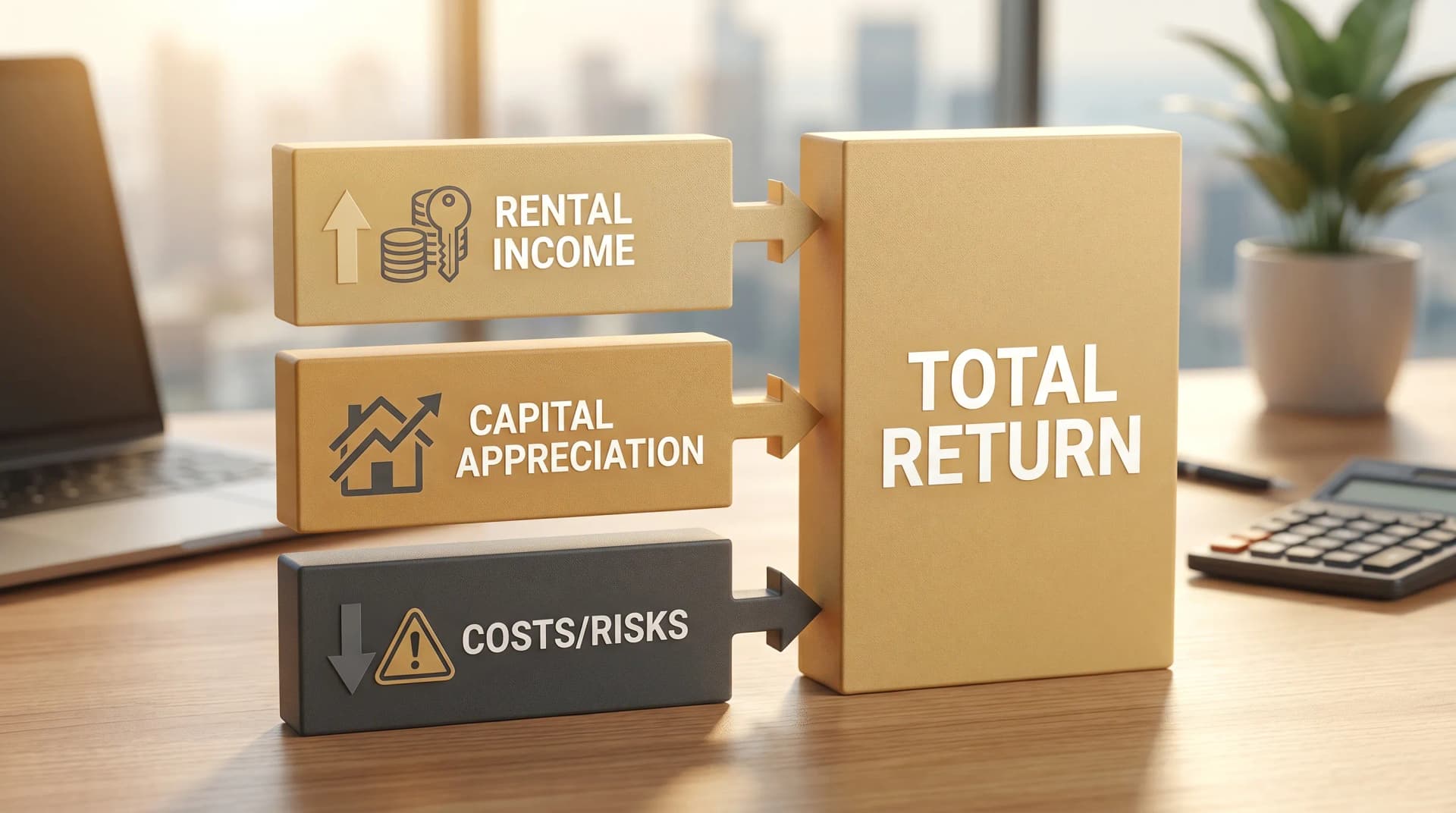
The 3 engines of investment performance: income, growth, capital structure
1) Income quality (not just “yield”)
Headline yield is easy to market and easy to misread. What matters is income quality, meaning:
- Occupancy resilience (how quickly it rents, even when demand softens)
- Tenant depth (how many people can realistically afford and want the unit)
- Rent sustainability (whether today’s rent is supported by fundamentals or temporary spikes)
A property can show a high “gross yield” while still underperforming if it suffers frequent vacancy, high maintenance, weak tenant quality, or rising service charges.
A simple check: ask “If I had to reduce rent by 5 to 10% to secure a tenant quickly, does the deal still work?” If a small rent drop collapses your cash flow, the investment may be fragile.
2) Growth drivers (capital appreciation and rent growth)
Appreciation is not magic. Over time, prices follow a mix of:
- Demand growth (population, jobs, tourism, migration, household formation)
- Scarcity and supply discipline (what is being built, where, and how fast)
- Quality premiums (better buildings and better-positioned units maintain pricing power)
Short-term price moves can be sentiment-driven, but long-term outperformance tends to show up in locations where demand has multiple independent drivers, not just one story.
3) Capital structure (how you finance the asset)
Two investors can buy the same property and get very different results based on financing.
Key considerations:
- Interest rate and terms: affects cash flow stability and refinance options.
- Payment plan timing (for off-plan): staged payments can improve capital efficiency if the project is high quality and well-located.
- Liquidity buffer: the best investors plan for repairs, vacancies, and policy changes.
Financing can boost returns, but it can also magnify mistakes. If your numbers only work in perfect conditions, leverage becomes a risk, not a tool.
Location that performs: focus on the micro-market, not the city name
“Location” is often repeated, but the real performance gap is usually created at the micro-market level (the specific community, building cluster, or even the side of a development).
Demand drivers you can verify
Look for drivers that create real tenant and buyer demand:
- Employment anchors: business districts, industrial hubs, free zones, hospitals, universities.
- Connectivity: road access, commuting convenience, airports, public transport improvements.
- Lifestyle pull: waterfronts, beaches, retail, dining, family amenities.
- Regulatory clarity: clear ownership rules and enforceable rental frameworks reduce risk.
If you are investing in a market like the UAE where off-plan is common, investor confidence is strongly linked to transparent rules around developer conduct, escrow, and registration. (For a high-level overview of the UAE’s investment environment and macro indicators, the IMF country information pages are a useful starting point.)
Supply pipeline (the silent performance killer)
Oversupply does not always crash prices, but it often caps rent growth, increases competition, and raises incentives needed to lease or sell.
Before committing, try to understand:
- What is under construction within a short drive radius
- Whether future supply is similar to your unit (same size, same positioning)
- Whether the area is shifting upscale or becoming commoditised
If five nearly identical towers deliver at once, your property competes on price. If the supply is controlled and differentiated, it competes on value.
Quick “micro-market” checklist
| Micro-market factor | What strong looks like | What weak looks like |
|---|---|---|
| Tenant demand depth | Multiple tenant types fit the unit | Only one niche tenant profile fits |
| New supply risk | Limited pipeline or clearly differentiated stock | Large volume of similar units delivering |
| Pricing power | Rents rise with inflation or wage growth | Rents flat unless incentives are offered |
| Liquidity | Comparable sales happen regularly | Few transactions and wide bid-ask spreads |
| Liveability | Amenities and maintenance feel “kept” | Visible decline, poor management, noise/congestion |
Property and unit fundamentals: what creates “pricing power”
Even in a great area, two properties can perform very differently. Outperformance often comes from owning the unit buyers and tenants fight over.
Design and functionality beats square footage
Tenants pay for usability. Common drivers of rentability include:
- Efficient layouts (fewer wasted corridors, workable storage)
- Natural light and ventilation
- Practical parking and building access
- Noise control (road positioning, building orientation)
A slightly smaller unit with superior layout can outperform a larger but awkward one.
Build quality and durability protect net returns
High-end finishes help marketing, but durability protects profit.
What matters to performance is whether the property avoids:
- Frequent defects and call-outs
- Premature replacement of fixtures
- Water ingress and HVAC issues
This is where due diligence on the developer and contractor ecosystem matters, especially for off-plan.
Operating costs shape performance more than most investors expect
Two properties with the same rent can deliver different net yields because of:
- Service charges / community fees
- Utilities during vacancy periods
- Maintenance intensity (especially in coastal or high-humidity climates)
- Insurance and compliance requirements
Net performance is usually won or lost in the operating line items.
The numbers that separate good deals from great ones
If you want to judge performance, evaluate the property like a business.
Start with net yield (not gross yield)
Gross yield is simple:
- Gross yield = Annual rent / Purchase price
But investors experience net yield:
- Net yield = (Annual rent minus annual operating costs) / Total cash invested
Where operating costs typically include service charges, maintenance allowance, letting fees, management, insurance, and a vacancy assumption.
If you want a clearer benchmark, consider tracking:
- Vacancy rate assumption (even 2 to 6% changes outcomes materially)
- Maintenance reserve (plan for wear, not just emergencies)
- Operating expense ratio (costs as a percentage of rent)
Use sensitivity analysis to avoid “false precision”
A high-performing investment should still look reasonable if:
- Rent is 5% lower than expected
- Vacancy is one month longer each year
- Service charges rise
- Interest rates are higher at refinance
If the deal becomes unattractive with small changes, performance is not robust.
Management and strategy fit: the best property is the one you can run well
A property performs well when it matches your capacity and goals.
Examples:
- Long-let stability tends to reward simple, low-maintenance units in communities with strong resident demand.
- Short-stay performance can be strong, but it often comes with higher volatility, higher furnishing and turnover costs, and heavier operational load.
- Value-add strategies (renovation, repositioning) can lift returns, but only if you can execute reliably and cost-effectively.
If you are investing remotely, management quality becomes a core performance driver. Many underperforming “assets” are actually execution problems (slow leasing, weak tenant screening, reactive maintenance).
For additional background on property as an asset class and how institutional investors evaluate real estate risk and income, the Royal Institution of Chartered Surveyors (RICS) is a credible reference point.
Liquidity and exits: performance includes what happens when you sell
A property can “perform” on paper but disappoint when you exit. Strong exit optionality usually comes from:
- A large buyer pool (end users and investors)
- Clear comparable sales evidence (transparent pricing)
- Reasonable transaction friction (fees, processes, timing)
Plan exits before you buy. Ask:
- Who is the natural buyer in 3 to 7 years?
- What would make this unit more desirable (or less) over that period?
- Can you refinance if selling is unattractive in that window?
In international markets, it is also worth understanding how ownership is registered and how disputes are handled. (In the UAE context, official portals like the UAE Digital Government provide useful starting points for general regulatory orientation.)
A practical pre-purchase performance checklist
Use this as a quick screen before deep due diligence:
- Market fit: Is tenant demand broad and measurable, or mostly speculative?
- Supply risk: What similar inventory is delivering nearby?
- Unit advantage: Does the unit have a lasting reason to be chosen (layout, view, floor, access, parking)?
- Net maths: Have you modelled vacancy, management, service charges, and maintenance reserves?
- Downside case: Does it still work if rent is lower or leasing takes longer?
- Execution plan: Who manages leasing, compliance, and maintenance, and what does it cost?
- Exit plan: What is your likely buyer and your realistic holding horizon?
How Azimira supports investors aiming for high-performing properties
Azimira focuses on connecting buyers and investors with premium off-plan opportunities in the UAE, with an emphasis on high-growth markets such as Ras Al Khaimah. If your goal is to build a property portfolio that performs well over a multi-year horizon, the edge usually comes from:
- Project selection (avoiding weak locations and undifferentiated supply)
- Timing and access (especially when pre-launch pricing and unit choice matter)
- A strategy that matches your objectives (income, growth, residency planning, or a blend)
You can explore Azimira’s approach to UAE property investing at the investment page, and if you want to pressure-test deal performance, their guide to quick ROI calculation is a helpful companion to the frameworks above.

Frequently Asked Questions
What is the most important factor in a real estate investment property performing well? The most important factor is usually pricing power, which comes from a strong micro-location plus a unit that stays desirable. That combination supports occupancy, rent growth, and resale value.
Is high rental yield always a sign of a good investment property? No. High yield can signal higher risk, weak demand, heavy costs, or oversupply. Always model net yield (after costs and vacancy) and run downside scenarios.
How do I compare two investment properties quickly? Compare them on the same inputs: realistic rent, vacancy assumption, annual operating costs, and an estimated exit value. If one property only wins because of optimistic rent or missing costs, it is not truly outperforming.
Do off-plan properties perform better than ready properties? They can, especially when bought early in high-demand projects with disciplined supply. But performance depends on developer quality, contract protections, delivery risk, and the local market cycle. Treat off-plan as a different risk profile, not a guaranteed shortcut.
What’s the biggest reason investment properties underperform after purchase? Underperformance is often caused by execution gaps, such as overpaying, underestimating operating costs, weak property management, or choosing a unit with poor long-term desirability.
Ready to find a high-performing investment property in the UAE?
If you want help identifying properties with stronger fundamentals, better unit selection, and a strategy aligned to your return goals, Azimira can help you evaluate opportunities and avoid the common performance traps.
Explore Azimira or start with the investment page to see how their team supports investors seeking premium off-plan opportunities in the UAE.
Related articles
What Counts as Good Real Estate Investments in 2026
Learn what makes good real estate investments in 2026, from net yield and demand signals to legal checks, exit plans and UAE opportunities.

Investors Needed for Real Estate? Start With This Plan
Investors needed for real estate? Use this practical plan to define strategy, numbers, due diligence and partners before raising capital.

Investment Marketing Tactics Developers Use at Launch
Understand investment marketing tactics developers use at launch, from scarcity to incentives, and learn how to assess UAE off-plan deals.