
Real Estate Portfolio Management for Smarter UAE Growth
Real estate portfolio management for UAE investors: set goals, track KPIs, diversify across off-plan and ready assets, and rebalance for smarter growth.
Most UAE property investors are excellent at buying, but far fewer are excellent at managing what they’ve bought. That gap matters because the UAE is a fast-moving, multi-emirate market where your returns are shaped by timing (off-plan vs ready), operating costs (service charges, maintenance, management) and decision discipline (when to hold, refinance, or sell).
Done well, real estate portfolio management turns a set of standalone properties into a coordinated plan for smarter growth across the UAE, including high-potential markets like Ras Al Khaimah.
What “real estate portfolio management” really means in the UAE
Real estate portfolio management is the ongoing process of:
- Defining clear outcomes (growth, income, residency, lifestyle use)
- Tracking performance with consistent metrics
- Managing risk (cash flow, legal, tenant, construction timeline, currency)
- Rebalancing when the market or your circumstances change
In the UAE, portfolio management has a few unique wrinkles:
- Off-plan is a major asset class, not just a buying method. Staged payments can dramatically change your cash flow and risk profile.
- Operating costs can be significant (service charges, cooling, maintenance, insurance), and they vary by community and property type.
- Residency strategy can be linked to the portfolio, especially for investors targeting property-linked visas.
- Many investors are international owners, which makes governance, reporting, banking and remote management part of performance.
If you want a refresher on return metrics before building your system, Azimira’s guide on the 2-minute ROI calculation is a useful baseline.
Step 1: Set portfolio goals that you can actually manage
“Maximise ROI” is not a management goal, it’s a wish. In practice, you need targets that translate into decisions.
A strong starting point is to pick a primary goal and one secondary goal, then define what success looks like.
| Portfolio goal | What you optimise for | Practical KPI examples | Common trade-off |
|---|---|---|---|
| Capital growth | Buying early, riding catalysts | Projected IRR range, appreciation trend, supply pipeline | Higher volatility, longer hold periods |
| Income | Stability and net yield | Net yield after costs, occupancy, arrears rate | Slower growth in some sub-markets |
| Balanced (growth + income) | Mix of stages and tenant profiles | Blended yield + appreciation, cash reserve coverage | Requires more deliberate asset allocation |
| Residency-led | Qualifying assets + continuity | Visa compliance, valuation documentation, asset liquidity | Less flexibility if you must hold qualifying equity |
| Lifestyle + letting | Usage flexibility without killing returns | Hybrid occupancy, seasonal pricing, management intensity | More operational complexity |
Your goals determine your portfolio “rules”, for example:
- How much of your capital can be in off-plan at once
- Whether you prioritise long-term tenants or short-term stays
- When you refinance vs when you sell
For investors building around off-plan, Azimira’s practical guide to off-plan investing in the UAE complements this portfolio approach.
Step 2: Build a simple portfolio dashboard (your decision engine)
You do not need institutional software to manage a UAE portfolio well. You need consistency.
A good “dashboard” answers three questions at any time:
- What do I own and what is it worth today?
- What does it generate after all costs?
- What could break, and what do I do if it does?
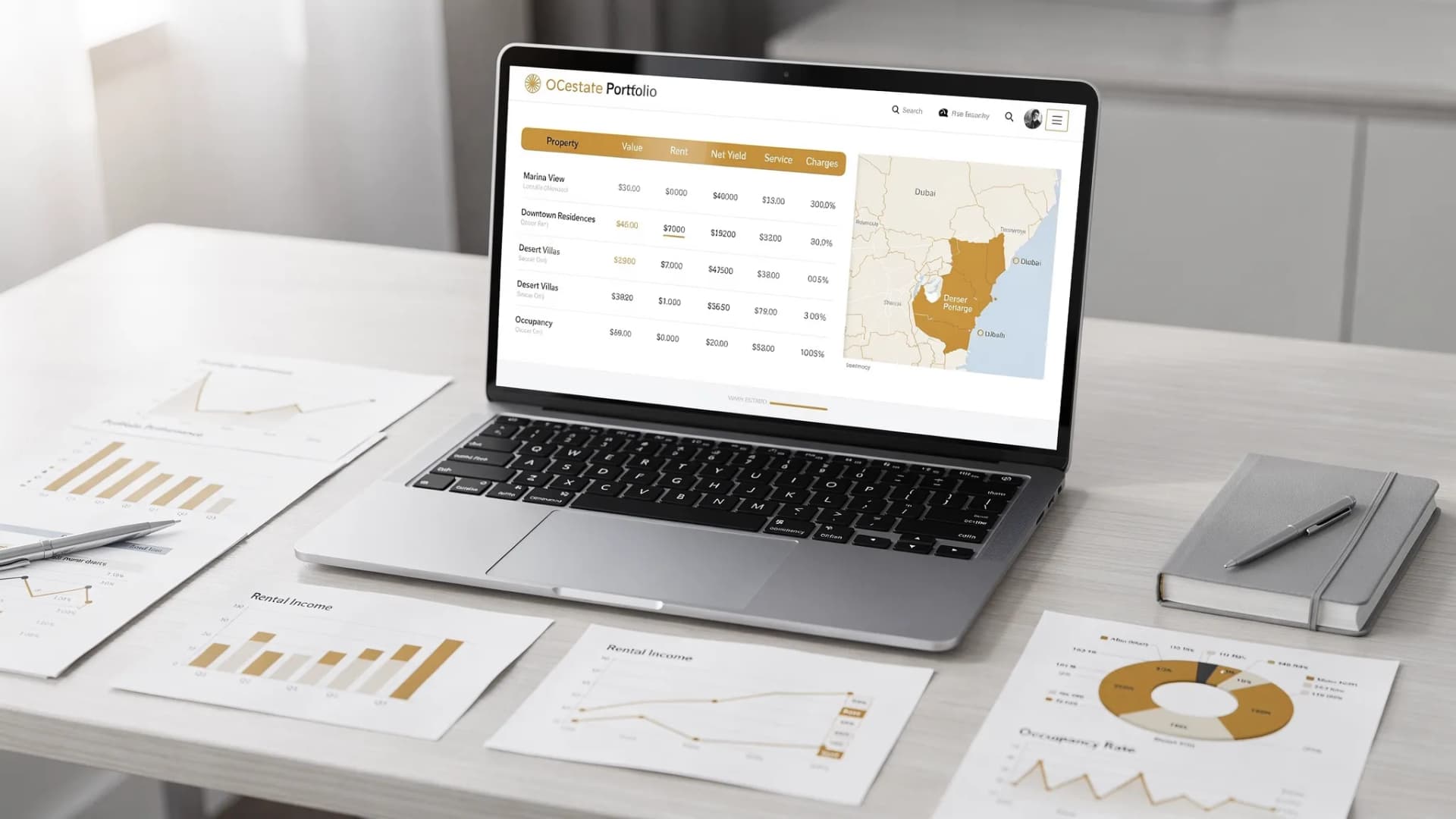
The UAE portfolio metrics worth tracking (and how often)
| Metric | Why it matters | Review frequency | Notes for UAE investors |
|---|---|---|---|
| Current market value (estimate) | Drives equity decisions and risk | Quarterly | Track by comparable sales where possible, not just listing prices |
| Net rental yield (after costs) | Prevents “headline yield” mistakes | Quarterly | Include service charges, management, maintenance reserve, insurance |
| Occupancy and vacancy days | Reveals tenant-market strength | Monthly | Separate short-stay vs long-let performance |
| Service charges and utilities | Often the silent return killer | Quarterly | Benchmark against similar buildings/communities |
| Maintenance reserve (cash buffer) | Protects you from forced selling | Quarterly | Plan for annual + unexpected items |
| Lease expiry and rent review dates | Prevents income shocks | Monthly | Keep renewal windows and notice requirements visible |
| Development milestone risk (off-plan) | Time delays can change IRR | Monthly/Quarterly | Align construction milestones with your liquidity plan |
| Concentration (location, developer, tenant type) | One shock should not hit everything | Quarterly | Avoid over-exposure to one micro-market |
If you want to get extremely practical about costs, Azimira’s breakdown of the real cost of owning RAK property is a good template for what to include in your net figures.
Step 3: Diversify intelligently (not randomly)
Diversification in UAE real estate is not only “buy in different places”. The most effective levers are often structural.
1) Diversify by development stage: off-plan vs ready
- Off-plan can be powerful for growth-focused investors because pricing is often strongest at early phases, and payment plans can improve capital efficiency.
- Ready assets tend to stabilise cash flow faster (assuming they are rentable immediately and costs are understood).
The management point is this: your portfolio should not have all its risk in the same “time bucket”. If multiple units depend on future handovers, your income plan can become fragile.
Azimira has modelled this trade-off in detail in off-plan vs ready property IRR modelling.
2) Diversify by income strategy: long-let vs short-stay
Short-stay can outperform in high-tourism periods, but it is operationally heavier and more sensitive to seasonality and reviews. Long-lets often deliver better “boring reliability”.
If you are weighing this choice across your holdings, see Azimira’s holiday rental vs annual lease profitability analysis.
3) Diversify by micro-market role (growth engine vs cash-flow stabiliser)
A simple way to think about portfolio construction is assigning roles:
- Growth engine: typically early-phase, high-catalyst locations (often off-plan)
- Stabiliser: a unit designed to stay occupied and cover costs consistently
- Optionality asset: something with strong resale demand, or flexible use (depending on your profile)
This logic is similar to what Azimira describes in the 3-property strategy, but you can apply the framework across the wider UAE as well.
Step 4: Put risk management on autopilot (as much as possible)
Good portfolio management is mostly avoiding preventable mistakes.
Here are the controls that consistently protect UAE investors:
- Cash buffer discipline: ring-fence reserves for service charges, vacancy and repairs.
- Written governance: who can approve repairs, spending thresholds, and how decisions are documented (critical for overseas owners).
- Tenant and contract hygiene: strong agreements reduce disputes and vacancy drag.
- Insurance alignment: cover should match usage (owner-occupied vs long-let vs holiday let).
- Off-plan delay planning: treat delays as a scenario, not a surprise.
If your portfolio includes off-plan units, Azimira’s article on a risk matrix for construction delays is particularly useful because it forces you to quantify the impact rather than guess.
For investors managing rentals in Ras Al Khaimah specifically, the practical legal framework matters as much as the numbers. Azimira’s guide to essential clauses in a RAK rental agreement is a strong checklist to reduce preventable disputes.
Step 5: Rebalance with triggers, not emotions
Rebalancing is where portfolio management becomes “real”. It is also where many investors overtrade or freeze.
A pragmatic approach is to define triggers that prompt a review (not an automatic sale). Examples include:
- A property’s net yield falls below your minimum after service charge increases and maintenance
- An area’s supply pipeline changes enough to weaken rent growth or resale liquidity
- You are overly concentrated in one strategy (for example, too many handovers in the same year)
- Your personal situation changes (residency goals, liquidity needs, family use)
A quarterly portfolio review checklist (15 minutes per property)
- Confirm current rent, occupancy and renewal timeline
- Update service charges, insurance renewal dates and expected maintenance
- Refresh a conservative value estimate based on recent comparables
- Compare actual net yield vs your target band
- Decide one action per asset: hold, optimise income, refinance review, or exit planning
When exit planning is relevant, you will often do better with an estimated timeline rather than a vague intention. Azimira’s guide on how long to hold RAK property for maximum returns is a helpful model to adapt.
Step 6: Operating from abroad, turn “remote” into a strength
Many UAE portfolios are owned by international investors. Remote ownership is viable, but only if you reduce avoidable friction.
The common operational upgrades are:
- Banking and payments: ensure you can pay fees, service charges and suppliers smoothly.
- Automation: schedule recurring obligations, reduce “missed payment” risk.
- Professional management: especially if you run short-stay units or have multiple properties.
Azimira has a detailed, practical guide to automating service charge payments from overseas, which pairs well with a portfolio dashboard.
Where Azimira fits in your portfolio management plan
Portfolio management is easiest when your acquisition process is disciplined and your information is reliable.
Azimira supports investors and buyers in the UAE with:
- Curated off-plan projects in high-growth markets
- Exclusive pre-launch access (useful when early-phase pricing matters)
- Expert market insight and reports to support timing and allocation decisions
- Tailored investment strategies aligned to your objectives (growth, income, or mixed)
- Dedicated client support, including for international buyers
If you are still deciding where to concentrate your next allocation, you can start with Azimira’s overview of property investment in Ras Al Khaimah.
Frequently Asked Questions
What is real estate portfolio management in simple terms? It’s the ongoing system for tracking what you own, measuring performance after costs, managing risk, and making hold, optimise, or sell decisions based on defined targets.
Which metrics matter most for managing UAE property investments? Net yield (after service charges and maintenance), occupancy/vacancy, cash reserves, concentration risk (location and strategy), and for off-plan units, milestone and delivery risk.
How do I manage an off-plan-heavy UAE portfolio without taking excessive risk? Avoid stacking too many handovers in the same period, maintain liquidity buffers, track developer milestones, and balance with at least one income-stabilising asset if your strategy requires cash flow.
Should I diversify across UAE emirates or focus on one market? It depends on your objective and risk tolerance. Focus can improve execution and local knowledge, while diversification can reduce concentration risk. Many investors combine a core market they know well with selective exposure to high-growth pockets.
Is professional property management worth it for overseas owners? Often yes, especially if you own multiple units or operate short-stay rentals. The goal is not convenience, it’s protecting occupancy, controlling costs, and reducing legal and operational mistakes.
Build a portfolio plan before you buy the next property
If you want your next UAE purchase to strengthen your overall performance (not just add another asset), start with a clear portfolio target and a dashboard that tracks net returns and risk.
To discuss curated UAE opportunities and how they could fit into a smarter allocation, explore Azimira’s investment approach or contact the team via Azimira.com.
Related articles
What Counts as Good Real Estate Investments in 2026
Learn what makes good real estate investments in 2026, from net yield and demand signals to legal checks, exit plans and UAE opportunities.

Investors Needed for Real Estate? Start With This Plan
Investors needed for real estate? Use this practical plan to define strategy, numbers, due diligence and partners before raising capital.

Investment Marketing Tactics Developers Use at Launch
Understand investment marketing tactics developers use at launch, from scarcity to incentives, and learn how to assess UAE off-plan deals.