
How Investors Match Property Deals to Financial Goals
How investors match property deals to financial goals: a practical framework, key metrics, and deal filters for UAE and RAK opportunities.
A property “deal” is not just a unit in a brochure. It is a bundle of cash flows, risks, timelines, fees, financing constraints and an exit path. That is why two investors can look at the same off-plan launch and reach opposite conclusions, both rational, because they are optimising for different outcomes.
This guide shows how investors match property deals to financial goals in a repeatable, numbers-first way, so you can filter opportunities quickly and avoid buying a good property that is the wrong investment.
Step 1: Define the financial goal (and rank it)
Most real estate decisions go wrong at the start: the goal is vague (“I want a good investment”) and the deal does the decision-making.
Write your goal as a ranked outcome with a time horizon.
- Income: “I want dependable net rental income within 6 to 12 months.”
- Growth: “I want capital appreciation over 3 to 7 years, I can tolerate limited income early.”
- Capital preservation: “I prioritise downside protection and resilience over maximum return.”
- Liquidity: “I may need to exit quickly if my circumstances change.”
- Residency: “I want the property to support UAE residency planning (where applicable).”
- Lifestyle plus return: “I will use it part-time, returns are secondary but must be sensible.”
The rank order matters because it drives trade-offs. For example, high growth potential often comes with construction and delivery risk (especially off-plan), while early income often comes with a higher entry price.
A goal-to-deal translation table
Use this as a first-pass filter before you dive into layouts and views.
| Primary financial goal | What you should optimise | Typical deal characteristics that fit | Common mismatch to avoid |
|---|---|---|---|
| Near-term income | Net yield stability, occupancy depth, operating costs | Ready or near-handover units, proven long-let demand, conservative cost assumptions | Buying early-stage off-plan and expecting immediate income |
| Capital growth | Location catalysts, supply discipline, developer quality, timeline | Early-phase off-plan in high-growth micro-markets, strong developer track record, strong future demand drivers | Overpaying for “headline yields” that ignore long-term appreciation drivers |
| Balanced (income + growth) | Total return, flexibility, refinance potential | A mix of near-handover plus selective off-plan, or a unit with broad tenant appeal | Choosing a niche unit that limits tenant pool and resale liquidity |
| Capital preservation | Build quality, end-user demand, cost predictability | Established communities, resilient unit types, strong management, realistic service charges | Over-leveraging or buying where fees erode net returns |
| Liquidity | Resale depth, broad buyer demand, clean documentation | Units with wide appeal, transparent pricing, clear exit costs and timelines | Buying a complex product (restrictions, unusual terms) without an exit plan |
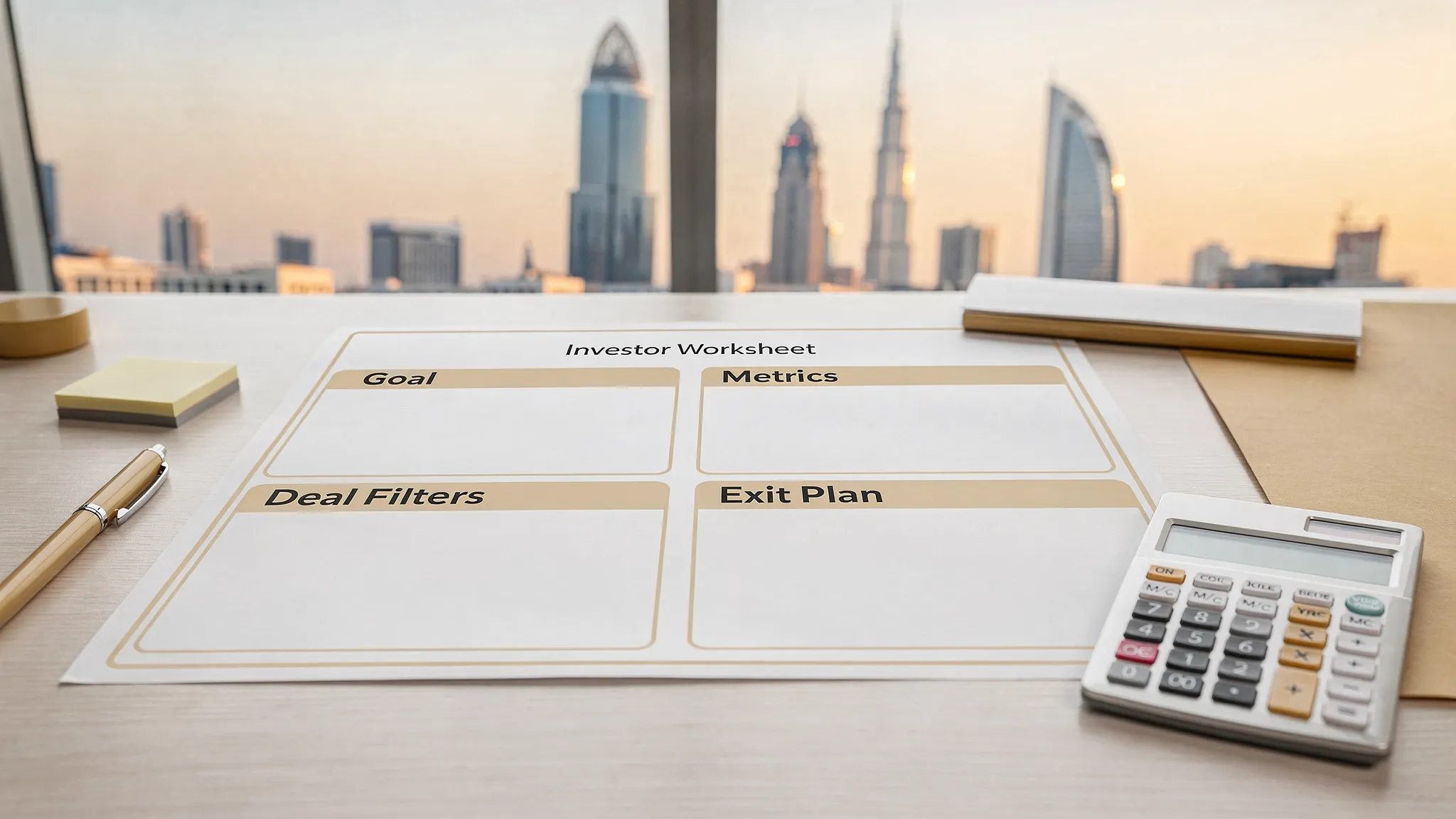
Step 2: Turn the goal into measurable targets
You do not need an institutional model to be disciplined. You need a few clear targets and a “deal breaker” list.
The minimum set of metrics investors use
- Hold period: 2 years, 5 years, 10 years (choose one baseline).
- Net yield target (not gross): net yield accounts for vacancy, service charges, maintenance and management.
- Capital growth assumption: use a conservative, base and optimistic scenario.
- Cash flow timing: when money goes out (deposit and instalments) versus when money comes in (rent or resale).
- Liquidity and exit costs: transfer fees, agency fees, developer assignment or early settlement charges (where applicable).
If you want a fast refresher on the core maths, Azimira’s guide to quick ROI thinking is useful: The 2-Minute ROI Calculation Every Property Investor Should Know.
Step 3: Choose a deal structure that matches the goal
This is where investors separate “property selection” from “investment selection”. The same location can offer very different deal structures.
Off-plan vs ready, matched to goals
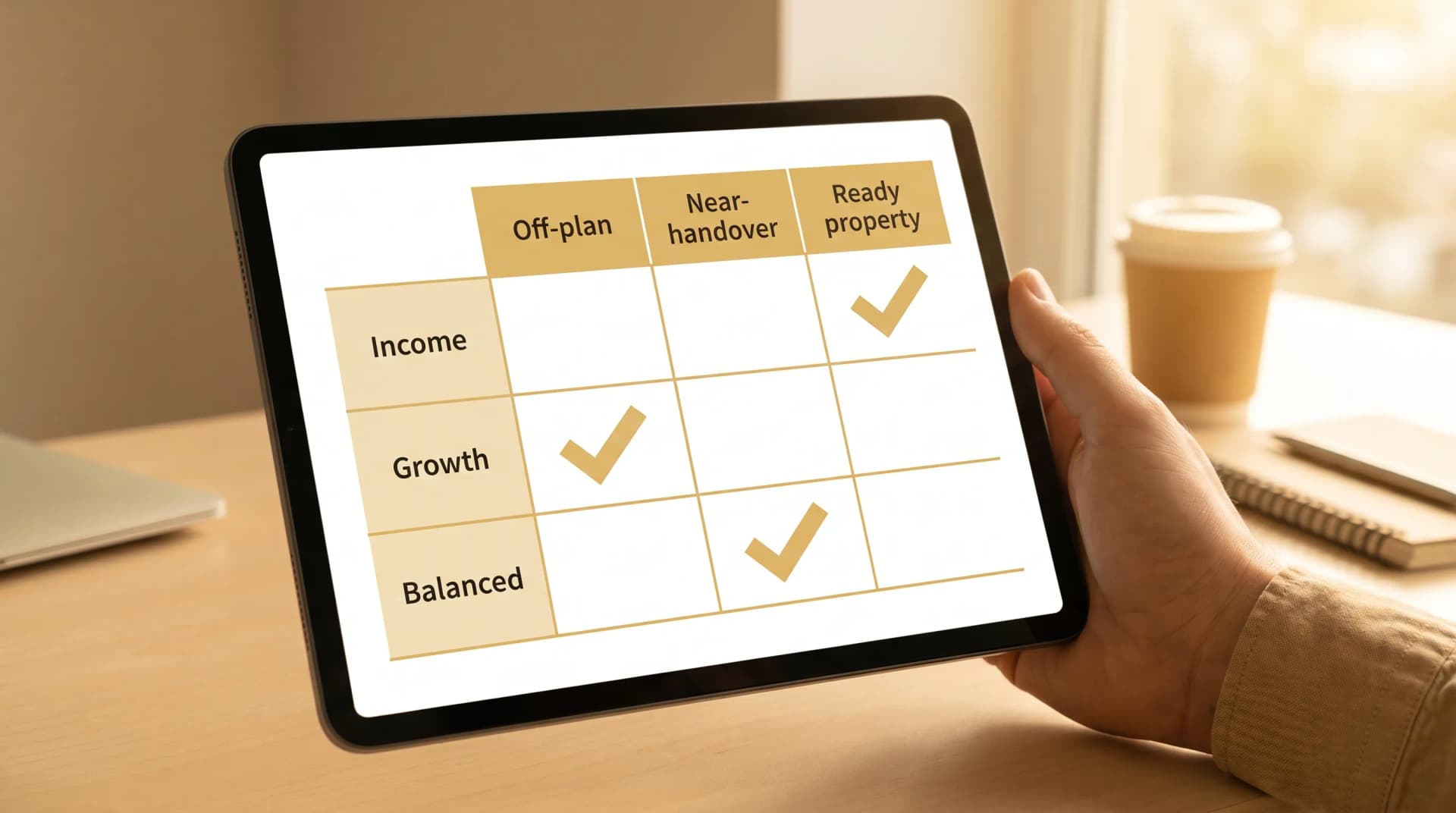
Off-plan can be powerful for growth-focused investors because pricing and payment structure can improve the risk-adjusted outcome if the project, developer and micro-market are right. Ready property can suit income-first investors because it typically allows earlier leasing and clearer operating-cost visibility.
If you are weighing the trade-off, you may also want a deeper view of how staged cash flows change return profiles: Off-Plan vs Ready Property: 5-Year IRR Modelling for RAK Investments.
A practical “deal type” comparison
| Deal type | Best for | Why it matches | What to stress test |
|---|---|---|---|
| Early-stage off-plan | Growth | Potential to capture upside as the area and project mature | Delivery timeline, escrow and contract terms, liquidity before handover |
| Near-handover (off-plan) | Balanced | Shorter wait to income, still some upside | Snagging and handover friction, leasing timeline, initial service charge clarity |
| Ready, tenanted or lettable | Income, preservation | Immediate or near-term cash flow | Tenant quality, vacancy assumptions, maintenance backlog, true net yield |
| Managed / serviced concepts | Higher-touch income seekers | Operations can be systematised if management quality is strong | Fee load, owner control, contract restrictions, seasonality risk |
Step 4: Match financing and payment timing to your real cash flow
Two investors can buy the same unit at the same price and get different outcomes based on capital structure.
Key questions:
- Can you fund instalments without stress? Off-plan staged payments can help, but they also create timing obligations.
- Is leverage part of the plan? Mortgages can amplify returns and risks, and they can change liquidity.
- Do you have foreign exchange exposure? If your base currency is not AED, staged payments can introduce FX risk over months or years.
For UAE investors comparing funding routes, these two references are helpful:
- Developer Financing vs Bank Mortgage: Which Is Better in RAK?
- FX Hedging Strategies for Off-Plan Property Staged Payments
Step 5: Underwrite the “real world” operating model (this is where returns are won)
Many deals look great on headline rental numbers, then disappoint because of avoidable operational leakage.
Income-focused investors should pay special attention to:
- Service charges and building cost structure (these often make or break net yield).
- Maintenance and lifecycle reserves, especially in coastal or high-usage properties.
- Vacancy and seasonality, particularly if you are considering short stays.
- Property management quality, which affects tenant stability, maintenance costs and vacancy.
Azimira has several deep operational guides that help investors translate brochure economics into reality:
- Rental Property in the UAE: Yields, Costs, and Common Traps
- RAK Property Maintenance Costs: Complete Annual Budget Guide for Owners
Step 6: Build the exit into the purchase decision
A deal is only fully “matched” to your financial goals once the exit is realistic.
Examples of goal-aligned exits:
- Income goal: long hold, refinance later (if appropriate), focus on occupancy resilience.
- Growth goal: planned resale window aligned to market catalysts, or assignment sale rules understood upfront for off-plan (where permitted).
- Liquidity goal: choose unit types and communities with broad demand, avoid restrictive terms.
You should also model exit friction. Here is a useful reference on costs that investors often under-budget: Exit Costs Explained: Transfer Fees, Agency Fees, and Early-Settlement Charges in UAE Property.
A worked example: matching one deal to three different investors
Assume three buyers are reviewing the same off-plan opportunity in a high-growth UAE micro-market. The unit and price are identical, but the “right” decision differs.
Investor A: “Income in 12 months”
This investor should likely pass or choose a different deal type, because early-stage off-plan usually delays rental income. Even if the projected total return is attractive, it mismatches their timing goal.
Investor B: “Capital growth over 5 years, I can wait”
This deal can fit if the investor can comfortably meet instalments, accepts delivery risk, and has validated developer quality, escrow protections and local supply dynamics. Their underwriting should focus on timeline buffers and a conservative resale scenario.
Investor C: “Balanced, I want upside but also cash flow”
This investor may choose a near-handover unit instead of early-stage off-plan, or combine one growth property with one income property. The matching decision is portfolio-level, not deal-level.
The point is not that off-plan is “better” or “worse”, it is that the same deal produces different outcomes depending on investors and their financial goals.
A quick deal-matching checklist (use before you book a viewing)
- Goal clarity: Is your top objective income, growth, preservation, liquidity, residency, or lifestyle?
- Time alignment: Does the deal’s timeline match when you need cash flow?
- Net return reality: Have you estimated net yield after fees, vacancy and maintenance?
- Risk fit: Can you tolerate delays, market volatility, or management complexity?
- Financing fit: Do instalments, mortgage terms and FX exposure match your cash flow?
- Exit plan: Do you know how you will exit, when, and what it will cost?
Frequently Asked Questions
What is the first step to matching property deals to financial goals? Start by writing a ranked goal with a time horizon (for example, “net income within 12 months” or “capital growth over 5 years”). Then translate it into measurable targets like net yield, hold period and acceptable risk.
Should income-focused investors avoid off-plan property? Not always, but they should be realistic about timing. Off-plan can be better suited to growth goals unless the project is near handover or the investor has other income assets to bridge the gap.
Why do experienced investors focus on net yield instead of gross yield? Gross yield ignores the costs that determine real performance, such as service charges, management, maintenance and vacancy. Net yield is closer to what you actually keep.
How do I avoid buying a property that looks good but is a poor investment for me? Use a simple filter: goal fit, cash flow timing, net-return assumptions, risk tolerance, and a defined exit plan. If any of those do not fit, keep looking even if the property is attractive.
Can one property meet multiple goals, like growth and residency planning? Sometimes. The key is to model trade-offs explicitly. A deal can be excellent for residency planning but weak for near-term income, or vice versa, so you need to decide which objective leads.
Match your next deal to your goal with a specialist shortlist
If you already know your priority, growth, income, or a balanced plan, the next step is to compare a small number of opportunities that genuinely fit, rather than browsing hundreds of listings.
Azimira helps investors and buyers access curated off-plan projects, market insight and deal support, with a focus on high-growth UAE markets including Ras Al Khaimah. Explore the investment approach at Azimira or contact the team via the website to discuss a goal-led shortlist that matches your timeline and risk profile.
This article is general information, not financial, legal or tax advice. Always take qualified professional advice for your circumstances.
Related articles
What Counts as Good Real Estate Investments in 2026
Learn what makes good real estate investments in 2026, from net yield and demand signals to legal checks, exit plans and UAE opportunities.

Investors Needed for Real Estate? Start With This Plan
Investors needed for real estate? Use this practical plan to define strategy, numbers, due diligence and partners before raising capital.

Investment Marketing Tactics Developers Use at Launch
Understand investment marketing tactics developers use at launch, from scarcity to incentives, and learn how to assess UAE off-plan deals.