
Investment Capital Growth: Why Timing Beats Cheap Entry
Investment capital growth comes from timing catalysts, not bargain hunting. Use this framework to choose UAE off-plan deals with real upside.
Most investors chase “cheap” because it feels safe. A low price looks like protection. But in real estate, investment capital growth is usually won or lost earlier, by choosing the right moment in the market cycle, in the right micro-location, with the right project dynamics.
In other words, a small discount at entry rarely compensates for missing a growth window.
This article explains why timing often beats cheap entry, what “timing” actually means in property (especially off-plan), and a practical framework you can use to prioritise capital appreciation without relying on hype.
Capital growth is not a discount, it’s a rerating
When investors say they want capital growth, they are really betting on a future repricing event. That repricing can happen because:
- The area becomes more desirable (new infrastructure, tourism anchors, employer inflows).
- The market discovers the location (more transactions, deeper buyer pool, improved financing access).
- The project de-risks over time (construction progress, handover, operational proof).
- Comparable stock reprices upward (neighbourhood benchmarks reset).
A bargain entry price helps, but it is only one lever. If you buy a “cheap” unit in a place that doesn’t rerate, you may just own a low-liquidity asset that stays cheap.
The maths: why a “cheap” deal can be the expensive choice
A discount is usually measured in single digits. Timing windows can drive double-digit changes.
Here’s a simplified way to see it.
If you negotiate 5% off a property price, you improve your starting point by 5%. Helpful.
But if you miss a growth phase where prices move 20% to 40% (common around major catalysts or during early masterplan absorption in high-demand pockets), your 5% discount becomes almost irrelevant.
To keep it grounded, here is a hypothetical comparison with round numbers.
| Factor | “Cheap entry” focus | “Timing” focus |
|---|---|---|
| Purchase price | AED 950,000 (5% discount) | AED 1,000,000 (no discount) |
| Market move over holding period | +5% | +25% |
| Estimated value at exit | AED 997,500 | AED 1,250,000 |
| Value difference | AED 252,500 |
This is not a promise of returns, it’s a reminder of scale. Capital growth is dominated by market repricing, not negotiation skill.
What “timing” means in property (and why it’s not the same as seasonality)
Timing is often misunderstood as “buy in summer, sell in winter” style thinking.
In reality, timing in property is usually about structural phases that change risk and pricing power. For investors targeting capital appreciation, these phases matter more than seasonal patterns.
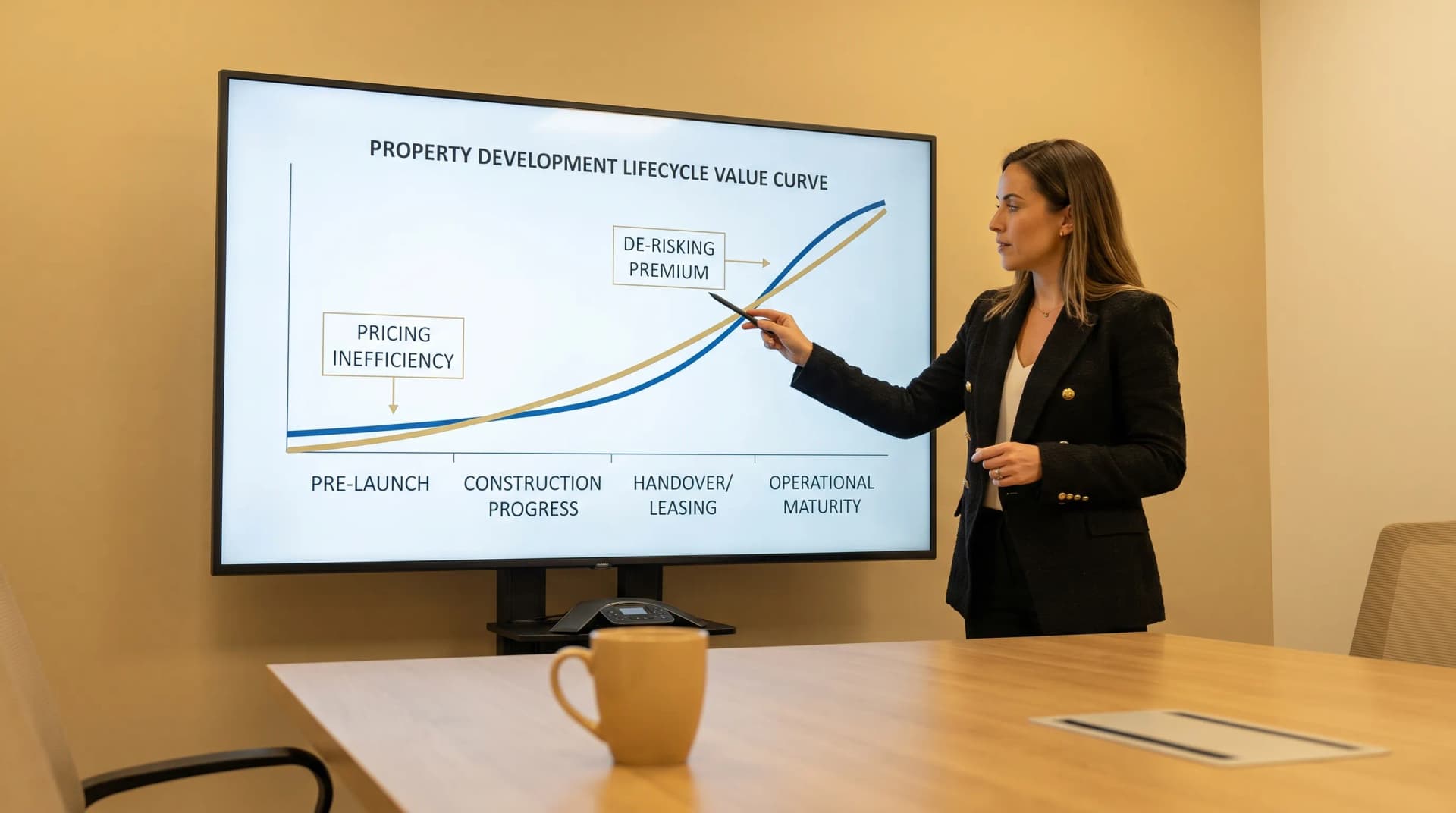
Phase 1: Pre-launch and early launch (the mispricing window)
This is where the best “risk-adjusted” upside can exist, because the market has not fully priced in:
- the project’s final positioning,
- the strength of buyer demand,
- the speed of absorption,
- and sometimes even the area’s next catalysts.
However, this phase demands the most due diligence: developer quality, escrow protections, contract terms, and supply pipeline.
Phase 2: Construction progress (de-risking and comparables reset)
As construction advances, uncertainty falls. In many markets, reduced uncertainty translates into higher prices.
In off-plan, this is when the market begins benchmarking the project against:
- nearby ready stock,
- newer launches,
- and actual progress photos rather than brochures.
Phase 3: Handover and leasing (cashflow proof)
Handover changes the buyer pool. End-users, mortgage buyers (where applicable), and yield-focused investors tend to engage more once a building is real, inspected, and rentable.
This can support pricing, but it can also reveal weak demand if the project is poorly positioned.
Phase 4: Operational maturity (the “neighbourhood brand” phase)
Once amenities are open, communities mature, and the location develops a lifestyle identity, a premium can form.
This is also where resale liquidity can improve significantly, because the asset becomes easier to understand and finance.
Why timing drives investment capital growth in the UAE (and why it’s especially relevant in emerging luxury markets)
In the UAE, off-plan is not a niche, it is a core transaction channel. That creates a market structure where:
- price discovery happens in phases,
- catalysts can reprice micro-locations quickly,
- and access (pre-launch, best stacks, better payment plans) can be a measurable advantage.
For growth-focused investors, timing is often about positioning before the market broadly agrees on a location’s premium.
In Ras Al Khaimah, for example, investors frequently watch major tourism and infrastructure announcements because these can change:
- end-user demand,
- short-stay and long-let rental depth,
- and the “comparison set” (what buyers consider a substitute).
Two widely discussed examples are the Wynn Al Marjan Island integrated resort development (a major tourism anchor) and national connectivity upgrades such as Etihad Rail’s expansion plans. You can read more directly from primary sources like Wynn Resorts’ development updates and Etihad Rail.
The key point is not any single project, it’s the mechanism: when credible catalysts increase future demand faster than future supply, pricing often rerates.
The “cheap entry” traps that kill capital growth
Buying cheap can be smart. Buying cheap for the wrong reason is usually costly.
Here are the most common traps that reduce investment capital growth potential.
Cheap because the micro-location is not investable (yet)
A unit can be “cheap” simply because the area has thin transaction volume, weak rental demand, poor access, or no clear path to a premium buyer pool.
If you cannot articulate the rerating story in one sentence, “cheap” is not a thesis.
Cheap because the supply pipeline is mismatched
If a micro-market has a heavy pipeline of similar units, pricing power can remain capped for years.
A discount at entry does not protect you from:
- developer competition,
- incentives becoming standard,
- and buyers choosing newer stock.
Cheap because the unit is a resale problem
Some discounts exist because future buyers will discount the same issues:
- compromised views,
- poor layout efficiency,
- bad stack (noise, heat exposure, service areas),
- or weak amenity access.
In premium segments, “unit quality” is not cosmetic, it affects liquidity.
Cheap because costs are structurally higher
Investors often focus on price and ignore ownership friction:
- service charges,
- maintenance intensity,
- furnishing refresh cycles,
- management costs (especially for short-stay strategies).
Net outcomes matter. A cheap purchase with high running costs can underperform a higher entry price asset with stronger demand and lower friction.
A practical timing framework: 7 questions to ask before you optimise price
If your goal is investment capital growth, use these questions to determine whether you are looking at a genuine timing opportunity or just a discount.
1) What is the rerating trigger, and is it time-bound?
Strong triggers are specific and time-bound, for example:
- planned infrastructure completion,
- new tourism anchors and hospitality openings,
- phased masterplan delivery that upgrades liveability.
Vague triggers (“it will grow because it’s the next Dubai”) are not a plan.
2) Is demand broadening, or concentrated?
Capital growth is easier when demand expands to include:
- end-users,
- international second-home buyers,
- income investors,
- and later, mortgage-supported buyers.
A market with only one buyer type can be fragile.
3) Is supply disciplined at the micro level?
A city can be booming while your specific waterfront strip or community is oversupplied.
Ask what is launching in the next 24 to 36 months that competes directly with your unit type.
4) Are you early in the project’s price discovery curve?
In off-plan, the same project can be priced very differently across stages:
- early release,
- mid-construction,
- near-handover,
- post-handover.
Timing advantage often means buying before the market has “proof” and prices in certainty, while still controlling risk via due diligence.
5) Does the payment plan match the timing thesis?
A growth thesis is also a cashflow thesis.
If the market reprices during construction but your payment plan is heavily front-loaded, your risk increases. If payments are staged sensibly, you can maintain optionality and liquidity.
(For deeper reading on managing off-plan risk, Azimira has a useful primer in Beyond the Hype: A Practical Guide to Off-Plan Investing in the UAE.)
6) What is the exit buyer at your target price?
Capital growth is realised when someone else pays the higher price.
Define the likely exit buyer:
- end-user relocating,
- investor buying yield,
- international second-home buyer,
- or another off-plan buyer via assignment (where permitted).
If you cannot identify the exit buyer, your timing thesis is incomplete.
7) Can you verify the story with data, not just marketing?
You don’t need perfect information, but you do need verifiable signals:
- transaction depth in the area,
- rental demand indicators,
- credible developer track record,
- realistic comparable pricing.
If you want a timing lens specific to Ras Al Khaimah, it can also help to compare it with seasonal negotiation dynamics, but treat that as a secondary layer. See: When to Buy RAK Property: Seasonal Pricing Patterns Revealed.
Timing playbook: how sophisticated investors “buy the window”
Once you’ve identified a credible timing setup, execution matters. Here are the most common ways investors turn timing into actual outcomes.
Secure access before the best inventory is gone
In off-plan, the best capital growth candidates are often:
- best views with view protection,
- best stacks (quiet, efficient layouts),
- and best floor ranges for the target tenant or buyer.
These tend to sell first, even if “average” units remain available at discounts later.
This is where pre-launch access and curated sourcing can be more valuable than chasing an extra 1% to 2% off the price.
Underwrite the developer like a credit analyst
A timing thesis fails if delivery fails.
Focus on:
- delivery history,
- escrow compliance,
- after-sales quality,
- and realistic construction timelines.
If you want a structured approach, Azimira’s guidance on partner expectations is a useful checklist: What to Expect from a Property Partner in the UAE.
Model downside first, then negotiate
Price negotiation is still useful, but it should come after you confirm:
- you can hold through delays,
- you can carry costs,
- and the asset remains liquid under a weaker scenario.
If you need help framing returns properly, start with a disciplined ROI method like the one covered in The 2-Minute ROI Calculation Every Property Investor Should Know.
A simple decision table: discount vs timing signal
If you’re choosing between two opportunities, this table can help you decide which variable is doing the heavy lifting.
| Signal | Suggests “cheap entry” matters more | Suggests “timing” matters more |
|---|---|---|
| Market phase | Mature, stable, little repricing potential | Early cycle, catalysts pending, repricing likely |
| Demand | Steady, predictable | Accelerating and broadening buyer pool |
| Supply | Low and stable | Constrained in the micro-market relative to demand |
| Your edge | Negotiation and deal sourcing | Access, research, and selecting the right micro-location |
| Risk | Lower project risk, more market risk | Higher project risk, but de-risking premium over time |
Neither column is “better” universally. The right answer depends on your objective and risk tolerance.
How Azimira supports capital growth-focused timing (without guessing)
Azimira specialises in premium off-plan opportunities in the UAE, with a particular focus on high-growth markets such as Ras Al Khaimah. If your priority is investment capital growth, timing advantages typically come from:
- Curated off-plan projects that fit a growth thesis (not just what is available).
- Expert market insight to separate real catalysts from noise.
- Exclusive pre-launch access where inventory selection can matter more than discounts.
- Tailored investment strategies aligned to horizon, risk rules, and exit plan.
- Dedicated client support through reservation, contracting, and the practical steps to ownership.
You can explore Azimira’s investment positioning here: Azimira Real Estate Investments.
Frequently Asked Questions
Isn’t buying cheap always safer for capital growth? Not necessarily. A low price can reflect low demand, weak liquidity, or a heavy supply pipeline. Capital growth usually requires a rerating catalyst, not just a discount.
What is the best timing for investment capital growth in off-plan property? Often the strongest window is early launch to mid-construction, when pricing inefficiencies still exist but the project can de-risk over time. The right timing depends on developer quality, payment plan, and micro-market supply.
How do I tell if a location has real growth potential or just marketing hype? Look for verifiable, time-bound drivers (infrastructure delivery, tourism anchors, transaction depth, rental demand) and compare supply coming to market. If the thesis cannot be validated with data, treat it cautiously.
Should I prioritise timing or rental yield? For growth-first investors, timing and rerating matter most. For income-first investors, net yield stability and operating costs can dominate. Many portfolios blend both by holding a growth asset alongside an income stabiliser.
Next step: build a timing-first shortlist
If you’re evaluating UAE opportunities and want investment capital growth rather than just a “cheap” unit, focus on building a shortlist where the rerating story is clear, time-bound, and supported by supply-demand logic.
Azimira can help you compare projects, understand the timing window, and access curated off-plan opportunities in high-growth UAE micro-markets. Start here: Contact Azimira or visit the investment page to discuss your strategy.
Related articles
What Counts as Good Real Estate Investments in 2026
Learn what makes good real estate investments in 2026, from net yield and demand signals to legal checks, exit plans and UAE opportunities.

Investors Needed for Real Estate? Start With This Plan
Investors needed for real estate? Use this practical plan to define strategy, numbers, due diligence and partners before raising capital.

Investment Marketing Tactics Developers Use at Launch
Understand investment marketing tactics developers use at launch, from scarcity to incentives, and learn how to assess UAE off-plan deals.