
UAE Real Estate Market: Dubai vs RAK vs Abu Dhabi Compared
UAE real estate market compared: Dubai vs RAK vs Abu Dhabi. Understand liquidity, risk, returns and which emirate fits your strategy in 2026.
Choosing where to invest in the UAE is no longer just “Dubai or nothing”. In 2026, serious buyers are increasingly comparing Dubai vs Ras Al Khaimah (RAK) vs Abu Dhabi because each emirate offers a distinct mix of liquidity, pricing, tenant demand, regulation and upside!
This guide breaks down the UAE real estate market across the three most compared locations, with a practical framework to match the right emirate to your strategy.
The “big three” at a glance
At a high level:
-
Dubai is the most liquid and internationally recognised market, with the deepest resale pool and the widest choice of lifestyle and investment products.
-
Abu Dhabi leans institutional and end-user, with a strong premium segment and a different rhythm to supply and demand.
-
RAK is an emerging, high-growth market where investors often focus on earlier-cycle pricing, newer masterplans and value-led entry (especially in off-plan).
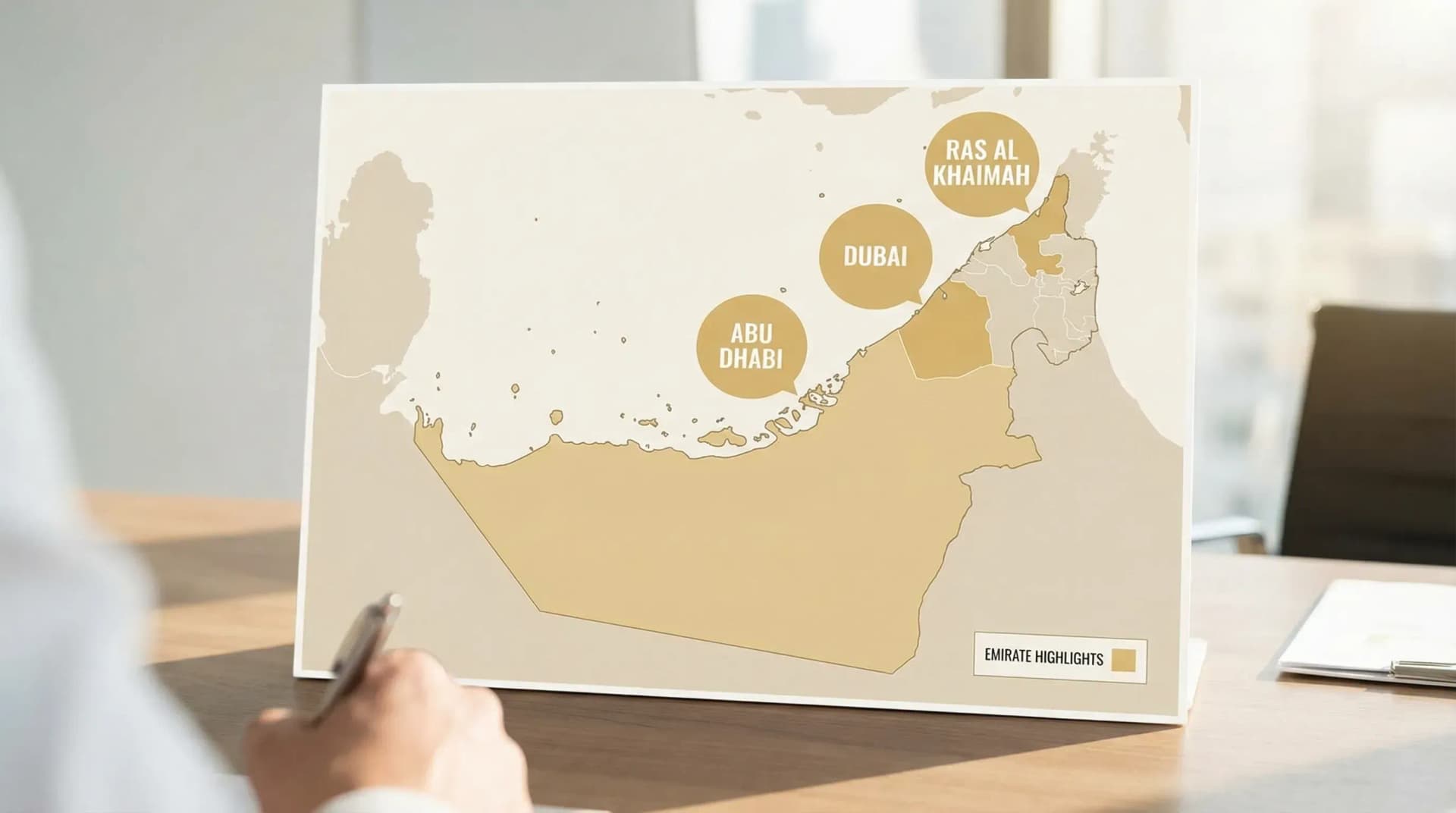
Comparison table: Dubai vs RAK vs Abu Dhabi for property buyers
The table below focuses on factors most investors care about: regulation, transaction friction, liquidity, demand depth and typical strategy fit.
| Factor | Dubai | Ras Al Khaimah (RAK) | Abu Dhabi |
|---|---|---|---|
| Market maturity | Most mature, globally marketed | Earlier-cycle, developing quickly | Mature, more measured cycle |
| Typical buyer mix | Global investors + end-users | Value and growth-focused investors + lifestyle buyers | End-users + long-term investors |
| Resale liquidity | Highest (relative to UAE) | Improving, but thinner than Dubai | Solid in prime zones, generally below Dubai |
| Off-plan culture | Very active, frequent launches | Very active, often earlier-entry dynamics | Active, tends to be more selective |
| Short-term rental ecosystem | Large, regulated via holiday home licensing | Growing, tourism-led in key areas | More selective, rules vary by zone |
| Transfer/registration fee (headline) | Dubai Land Department fee commonly referenced at 4% | RAK transfer/registration fees are often lower than Dubai (project and land department specifics matter) | Abu Dhabi is commonly referenced as lower than Dubai (zone-specific rules apply) |
| Best suited for | Liquidity, diversification, global tenant depth | Earlier-cycle upside, value entry, tourism-led plays | Long-hold stability, premium end-user demand |
Important: exact fees and processes can vary by deal type (off-plan vs ready), developer, and the relevant land department. Always confirm the current schedule before committing.
Dubai: liquidity, breadth of demand, and a fast-moving cycle
Dubai’s core advantage is depth. Depth of tenants, depth of buyers, depth of financing options, and depth of submarkets. That matters if your plan includes refinancing, selling within a defined window, or scaling a portfolio.
What Dubai does best
1) Exit options and resale velocity
Dubai remains the easiest place in the UAE to sell quickly (relative to other emirates) because there is a larger pool of active buyers across many price bands.
2) Tenant diversity
Demand is supported by a wide range of residents and corporate relocations, plus a strong short-stay segment where buildings and locations allow it.
3) Product variety
From branded residences to family villas to business-bay style rental stock, Dubai lets you build diversified exposure without leaving the emirate.
Trade-offs to plan for
Dubai’s speed and visibility also create predictable investor challenges:
-
Higher competition for “obvious” deals in prime areas.
-
Marketing noise in off-plan launches, making developer and escrow diligence essential.
-
Price dispersion between communities, where two superficially similar projects can perform very differently.
If Dubai is your target, the edge usually comes from selection (micro-location, view line, unit type, handover timing) rather than simply “being in Dubai”.
Ras Al Khaimah (RAK): earlier-cycle pricing and a tourism-led story
RAK has become a serious part of the UAE real estate conversation because it combines lower entry points (relative to Dubai’s prime stock) with a market cycle that many investors view as earlier in its development arc.
Azimira’s existing research and investor content focuses heavily on RAK, so rather than repeat the same thesis, here’s the comparison lens that matters when you put RAK next to Dubai and Abu Dhabi.
Where RAK can outperform
1) Asymmetric upside (if you pick the right pocket)
Emerging markets can deliver strong results when catalysts, infrastructure delivery, and product-market fit align. In RAK, investors often focus on locations where tourism, masterplanning and new inventory quality can shift demand.
2) Payment-plan flexibility in off-plan
RAK’s off-plan landscape can be attractive for capital-efficient investors who want staged exposure rather than tying up full equity on day one. The exact benefit depends on the developer, construction timeline and your exit/hold plan.
3) Yield-led strategies
RAK is commonly evaluated through the lens of net yield potential and total return (yield plus appreciation). This is especially relevant for investors who want cash flow without relying entirely on price growth.
Risks and realities
RAK is not “Dubai 2.0”, and treating it that way is a common mistake.
-
Liquidity is improving but still thinner. Your holding period should be planned accordingly.
-
Submarket selection is critical because demand can be concentrated in a smaller set of communities.
-
Supply timing matters. When multiple projects hand over around the same time, rent and resale pricing can become more competitive.
If you are buying in RAK primarily for growth, your analysis should be driven by (a) the specific community pipeline, (b) the quality and positioning of the asset, and (c) your ability to hold through completion and stabilisation.
Abu Dhabi: premium positioning, end-user demand, and long-hold logic
Abu Dhabi is often mischaracterised as “slower Dubai”. In reality, it is a different market with different demand drivers, including government-linked employment, long-term residents, and a premium cultural and lifestyle pull in certain districts.
Where Abu Dhabi shines
1) End-user depth in prime areas
Markets with strong end-user participation can be resilient because buyers are not purely return-chasing. That can support price stability in established neighbourhoods.
2) Premium and lifestyle-led segments
Abu Dhabi has a distinct luxury and cultural positioning, and some investors prefer it for long-duration holds rather than quick flips.
3) A different diversification profile
If you already hold Dubai exposure, Abu Dhabi can diversify your UAE portfolio behaviour because the market often moves to a different rhythm.
What to watch
-
Freehold and investment zones vary. Your options depend on where you buy and your residency status.
-
Rental dynamics can be more location-specific than investors expect.
-
Off-plan isn’t automatically “cheaper value”. In premium districts, you may be paying for positioning rather than discount-to-market.
The decision framework: pick the emirate that matches your strategy
Instead of asking “which emirate is best?”, ask “which emirate is best for my plan?”. Use this four-part filter.
1) Your primary objective: income, growth, or lifestyle
| Objective | Dubai | RAK | Abu Dhabi |
|---|---|---|---|
| Maximise liquidity and optionality | Strong fit | Medium fit | Medium fit |
| Earlier-cycle growth exposure | Medium fit (select pockets) | Strong fit | Medium fit |
| Long-hold stability in premium zones | Strong fit (prime only) | Medium fit | Strong fit |
| Holiday-home style strategy | Strong fit (where permitted) | Strong fit (tourism-led pockets) | Selective fit |
| Owner-occupier lifestyle | Strong fit | Strong fit (value-led) | Strong fit |
2) Time horizon: how long can you realistically hold?
-
0 to 3 years: Dubai generally offers better exit flexibility, but only if you buy well and account for fees.
-
3 to 7 years: all three emirates can work, and selection starts to matter more than emirate choice.
-
7+ years: you can lean into thesis-driven plays (RAK growth pockets) or stability-led premium holds (Abu Dhabi prime, Dubai prime), depending on your risk appetite.
3) Risk you can tolerate: price volatility vs execution risk
Real estate risk is not one-dimensional.
-
Dubai often carries pricing volatility risk across cycles.
-
RAK often carries more execution risk (project delivery, area maturation, absorption).
-
Abu Dhabi often carries opportunity-cost risk if your strategy requires faster capital recycling.
4) Operational plan: who will manage it and how?
Your returns can be won or lost in operations:
-
Short-stay strategies require licensing, guest operations, and strict cost control.
-
Long-lets require tenant screening, maintenance systems, renewals and dispute processes.
If you will manage from abroad, prioritise assets and buildings with strong management infrastructure and clear rules.
Regulation and transaction realities you should not ignore
The UAE is regulated at both federal and emirate levels, and the day-to-day investor experience is shaped by the relevant land department and rental frameworks.
A few practical points that matter across Dubai, RAK and Abu Dhabi:
Off-plan protections are real, but diligence still matters
Escrow mechanisms and developer registration frameworks exist, but investors should still verify:
-
the developer’s licensing and delivery record
-
escrow account and payment instructions (never pay to personal accounts)
-
contract terms on delays, variations, handover specs and snagging
(If you want a practical lens on investor red flags, Azimira has already published scam-avoidance guidance tailored to UAE property buyers.)
Freehold zones are not identical across emirates
“Foreign ownership allowed” is not a blanket statement. It is typically tied to designated areas or specific project types. Make sure you confirm:
-
whether the asset is freehold, leasehold, or another right
-
how title registration works for off-plan (and what document you receive at each stage)
Fees can change the real return more than investors expect
Investors often focus on headline yields and forget transaction friction.
Model your deal with:
-
transfer/registration fees and admin charges
-
agent fees (where applicable)
-
mortgage registration fees (if financing)
-
service charges and sinking funds
-
furnishing, fit-out and initial marketing
A “good deal” on paper can become average after costs, and a great asset can still be a bad investment if you overpay on entry.
Structuring: buying personally vs via a company
As portfolios get larger, the question shifts from “where to buy?” to “how to hold it?”. Depending on your nationality, tax residency, estate planning goals and banking needs, you may consider a company or SPV to hold UAE property.
This is not one-size-fits-all, and you should take regulated tax and legal advice. But it is worth planning early, because restructuring later can create additional cost and paperwork.
If you are exploring UAE entity setup for property holdings, foundations, or long-term compliance, a corporate services specialist such as UAE company formation and structuring support can help you understand options and operational requirements before you commit to a purchase.
Practical “if this, then that” guidance
Here are the most common decision patterns seen among international buyers:
You prioritise resale flexibility and market depth
Dubai is usually the starting point. Focus on assets that remain liquid in multiple market conditions: proven communities, transport connectivity, and unit types with broad tenant appeal.
You want earlier-cycle upside and can hold through completion
RAK can fit well, especially for off-plan buyers who understand delivery timelines, absorption, and the need to hold through market maturation.
You want a long-hold, premium lifestyle market
Abu Dhabi is often compelling when the goal is stable ownership in prime districts and a less speculative investment posture.
How Azimira fits into a Dubai vs RAK vs Abu Dhabi decision
Azimira specialises in connecting investors and buyers with curated off-plan opportunities in the UAE, with a particular focus on high-growth markets such as Ras Al Khaimah. If you are comparing emirates, the most valuable support is not generic market commentary, it is execution:
-
Shortlisting projects that match your strategy (income, growth, lifestyle, or a blend)
-
Access to pre-launch or limited inventory where available
-
Risk-based due diligence, including developer and contract checkpoints
-
Ongoing client support through reservation, SPA, registration and handover
If you already know which emirate you prefer, Azimira can help translate that choice into a portfolio of assets that actually fit your timeframe, risk profile and exit plan.
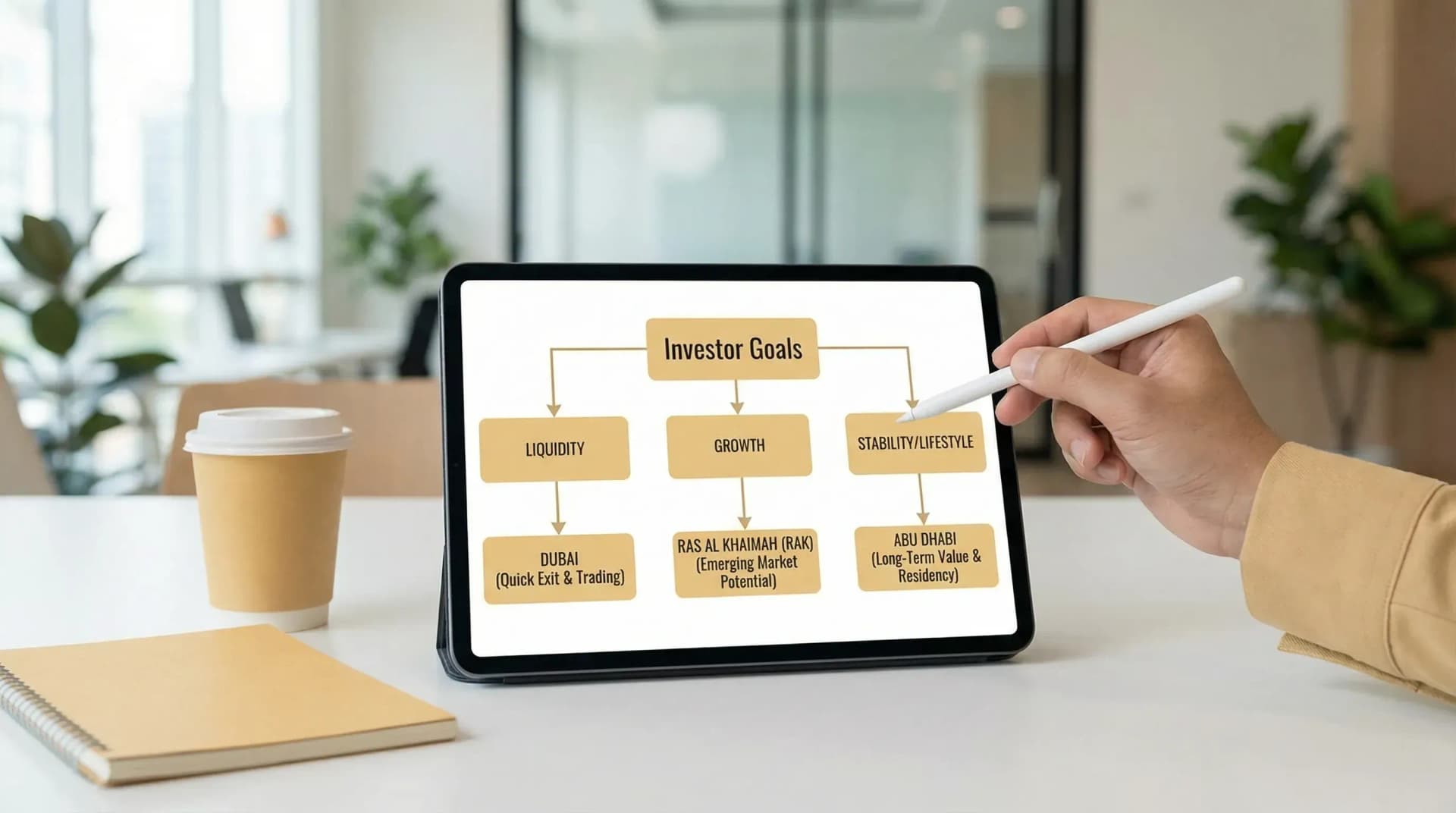
Bottom line
The UAE real estate market is best understood as three different plays under one country umbrella.
Dubai tends to win on liquidity and breadth, Abu Dhabi on premium long-hold logic and end-user stability, and RAK on earlier-cycle positioning where careful selection can produce strong risk-adjusted outcomes.
If you make the decision based on your objective, time horizon and operational plan (not hype), “Dubai vs RAK vs Abu Dhabi” becomes a portfolio design question, not a debate.
Related articles
What Counts as Good Real Estate Investments in 2026
Learn what makes good real estate investments in 2026, from net yield and demand signals to legal checks, exit plans and UAE opportunities.

Investors Needed for Real Estate? Start With This Plan
Investors needed for real estate? Use this practical plan to define strategy, numbers, due diligence and partners before raising capital.

Investment Marketing Tactics Developers Use at Launch
Understand investment marketing tactics developers use at launch, from scarcity to incentives, and learn how to assess UAE off-plan deals.