
About Real Estate Investment in the UAE: Terms You Must Know
Essential terms for real estate investment in the UAE, explained simply: freehold, off-plan, Oqood, escrow, service charges, ROI, and more.
If you are researching real estate investment in the UAE, you will quickly notice that most costly mistakes do not start with a “bad property”. They start with misunderstood terminology: a buyer thinks they are getting a title deed when they are actually getting an off-plan registration, assumes “handover” means the unit is ready to rent, or compares two projects using gross yield instead of net yield.
This guide explains the UAE property terms you must know, grouped by the moments you will encounter them (ownership, off-plan, fees, financing, rentals, and exits). Use it as a practical glossary you can refer back to while reviewing brochures, SPAs, and payment plans.
1) Ownership and legal framework terms (the foundation)
Freehold
Freehold means you own the property outright (and in many cases, the land share linked to it), subject to the rules of the relevant emirate and the building’s jointly owned property regulations.
Why it matters for investors:
- Freehold is typically the clearest form of long-term ownership for international buyers.
- It can affect resale liquidity and eligibility for certain residency pathways, depending on the emirate and property type.
Leasehold
Leasehold means you own the right to use a property for a fixed period (often decades), but not the underlying land in the same way as freehold.
Why it matters:
- Your investment horizon should match the lease term.
- Resale value and buyer pool can differ from freehold.
Usufruct
Usufruct is a right to use and benefit from a property for a defined period, without owning it in the full freehold sense.
Why it matters:
- It is more of a “right of use” structure and can impact financing and exit options.
Title deed
A title deed is the official ownership document issued by the relevant land authority once the property is registered as completed (for ready property) or upon completion/handover (for many off-plan purchases).
Why it matters:
- Banks, future buyers, and residency processes may require a title deed (or the off-plan equivalent, depending on the use case).
Land department / property authority
Each emirate has its own property registration authority and processes. In Dubai, for example, the Dubai Land Department (DLD) plays a central role in registration and regulation.
Why it matters:
- Fees, timelines, and documentation differ by emirate.
NOC (No Objection Certificate)
An NOC is a document confirming the developer (or relevant authority) has no objection to a transaction, commonly needed for resale transfers in master-planned communities.
Why it matters:
- Without an NOC, a transfer can be delayed or blocked.
- NOCs can come with administrative fees and processing timelines, which should be built into your completion schedule.
2) Off-plan investment terms (what you see in most UAE launch deals)
Off-plan investing is a major part of the UAE market, especially in high-growth areas. But it has its own vocabulary.
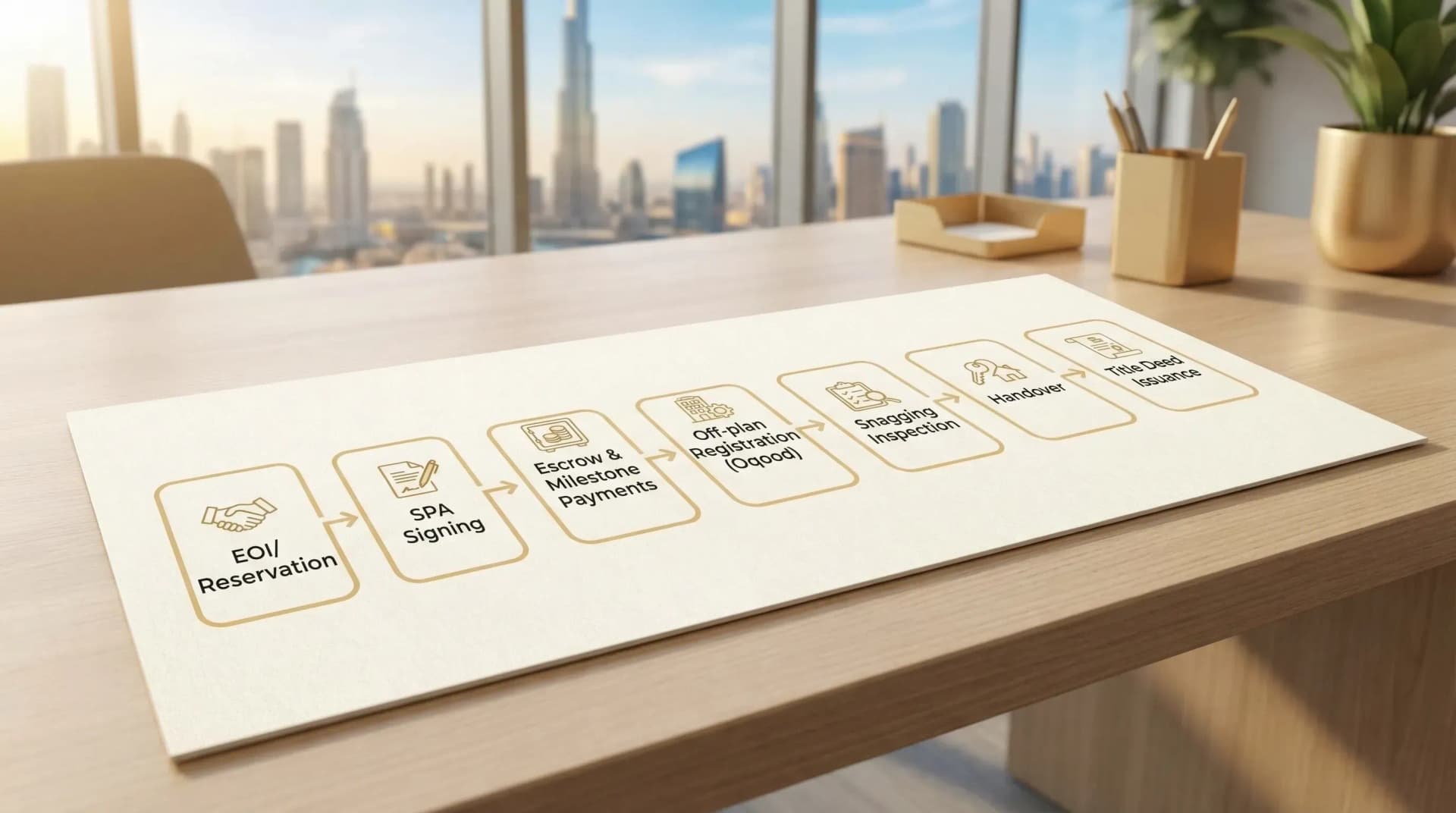
Off-plan
Off-plan means you buy a unit that is not yet completed, typically directly from the developer, with payments made in stages linked to construction milestones.
Why it matters:
- Off-plan can magnify capital growth if you enter early, but it introduces timeline and delivery risk.
Ready property (secondary / resale)
A ready property is completed and can often be occupied or rented immediately after transfer.
Why it matters:
- You can underwrite the asset based on real rental comparables, actual service charges, and physical condition.
EOI (Expression of Interest)
An EOI is an early signal of intent to reserve a unit, sometimes used for pre-launch allocation.
Why it matters:
- It can improve your chances of getting preferred unit types or views in high-demand launches.
- Always confirm whether an EOI is refundable and on what terms.
Reservation form / booking form and reservation fee
This is the initial paperwork and payment used to temporarily hold a unit while the Sale and Purchase Agreement is prepared.
Why it matters:
- It defines the unit details, price, and key deadlines.
- The reservation fee rules (refundability, timelines, deductions) should be clear before you pay.
SPA (Sale and Purchase Agreement)
The SPA is the core legal contract between buyer and developer. It sets out payment schedules, specifications, completion timelines, remedies for delays, and transfer conditions.
Why it matters:
- The SPA is where “headline promises” become enforceable (or not). Treat it as the real product.
Escrow account
In regulated off-plan transactions, buyers typically pay into an escrow account tied to the project, rather than directly to a private account.
Why it matters:
- Escrow structures are designed to protect buyers by controlling how funds are released.
- You should verify the project’s escrow arrangements and payment instructions match official documentation.
Oqood (Dubai off-plan registration)
Oqood is Dubai’s system for registering off-plan sales. It is an interim registration (not the final title deed).
Why it matters:
- It is a formal record of your off-plan ownership claim in Dubai.
- Investors sometimes confuse Oqood with a title deed, they are not the same document.
3) Cost and fee terms (what changes your real return)
Many investors compare only price per square foot, then get surprised by ongoing costs. These terms help you model the “all-in” picture.
Registration / transfer fee
A transfer fee (or registration fee) is paid to the relevant land authority to register the property transfer or ownership.
Why it matters:
- This is often the single largest transaction cost.
- It varies by emirate and sometimes by property type.
Example of emirate variation: Azimira’s guide to the Ras Al Khaimah Land Department explains that RAK property registration totals 2.25% (2% registration plus 0.25% admin) for standard registrations, which is a meaningful difference compared with higher-fee jurisdictions.
Agency fee / brokerage commission
A brokerage commission is paid to the agent or brokerage in many secondary market transactions.
Why it matters:
- It affects your break-even holding period.
- In off-plan, commissions are typically paid by developers to brokers, but you should still confirm whether any buyer-side fee applies.
Service charges
Service charges are annual fees paid by owners to maintain and operate common areas (lobbies, lifts, pools, landscaping, security, master community infrastructure).
Why it matters:
- They reduce net yield.
- They differ dramatically between buildings, especially luxury waterfront or serviced assets.
Sinking fund / reserve fund
A reserve fund is money set aside for major building repairs and long-term maintenance.
Why it matters:
- Underfunded reserves can lead to special levies or future service charge spikes.
VAT (Value Added Tax)
In the UAE, VAT exists (currently 5%), but its application depends on whether a property is residential or commercial and whether it is a first supply or resale.
Why it matters:
- VAT can impact purchase price, cash flow, and your ability to recover input VAT in some scenarios.
- For complex cases (mixed-use, corporate ownership, serviced accommodation), tax advice is essential.
4) Financing terms (especially important for non-residents)
LTV (Loan-to-Value)
LTV is the percentage of the property value the bank will finance.
Why it matters:
- Your required deposit is driven by LTV.
- Non-resident LTV can differ from resident LTV.
Mortgage pre-approval
Pre-approval is the bank’s conditional approval of your borrowing capacity, before you commit to a purchase.
Why it matters:
- It strengthens negotiation and prevents wasted reservation fees if finance is later rejected.
Fixed rate vs variable rate
A fixed rate stays constant for a period. A variable rate changes based on the bank’s benchmark and market conditions.
Why it matters:
- Variable rates can improve early cash flow, but increase risk if rates rise.
- Fixed periods provide predictability for yield-focused investors.
Valuation report
A valuation report is a bank-approved assessment of the property’s market value.
Why it matters:
- If the valuation comes in below your agreed purchase price, you may need a larger deposit.
- Valuations are also commonly used for refinancing and some residency processes.
5) Investment performance terms (how professionals actually compare deals)
Rental yield (gross vs net)
Gross yield typically means annual rent divided by purchase price.
Net yield accounts for recurring costs (service charges, maintenance, insurance, management, vacancy).
Why it matters:
- Gross yields are easy to market.
- Net yields are what you can bank.
ROI (Return on Investment)
ROI is a simple return metric that can include rental income and capital appreciation relative to your invested cash.
Why it matters:
- ROI is useful for quick comparisons, but it does not fully capture timing.
IRR (Internal Rate of Return)
IRR measures the annualised return of an investment, accounting for the timing of cash flows (deposits, staged payments, rents, sale proceeds).
Why it matters:
- IRR is especially useful for off-plan, where capital is deployed over time.
Capital appreciation
Capital appreciation is the change in the property’s value over your holding period.
Why it matters:
- In high-growth areas, appreciation can dominate total returns.
- It is also the biggest variable, so it should be stress-tested (base case, conservative case).
6) Rental and tenancy terms (if income is part of your strategy)
Tenancy contract
A tenancy contract is the legal agreement between landlord and tenant.
Why it matters:
- Contract structure, notice periods, deposit clauses, and maintenance responsibilities directly affect risk and vacancy.
Ejari (Dubai) and local tenancy registration equivalents
Ejari is Dubai’s tenancy registration system. Other emirates have their own processes and authorities.
Why it matters:
- Proper registration supports enforceability and dispute resolution.
- It is often required for utilities or government processes.
Short-term rental (STR) licence / holiday home permit
If you plan to operate a holiday let, you may need a holiday home permit or STR licensing, depending on emirate rules.
Why it matters:
- Returns can be attractive, but compliance, furnishing, and management intensity are higher.
7) Exit and risk terms (how you protect and realise gains)
Assignment sale (off-plan resale)
An assignment sale is selling your off-plan unit contract before final handover, subject to developer and authority rules.
Why it matters:
- It can be a powerful exit tool, but restrictions and fees vary by project.
- The SPA usually determines whether assignment is allowed, when, and at what cost.
Early settlement / mortgage release
If the property is mortgaged, selling typically requires a mortgage release process.
Why it matters:
- Timelines can affect buyer confidence and transaction speed.
- There may be early settlement charges and admin fees.
AML / KYC and source of funds
UAE transactions are subject to anti-money laundering (AML) checks and Know Your Customer (KYC) requirements.
Why it matters:
- Buyers should be ready to document source of funds (bank statements, sale proceeds, business income) to prevent delays.
Quick-reference glossary (most-used terms in one table)
| Term | Plain-English meaning | Investor takeaway |
|---|---|---|
| Freehold | Full ownership (within emirate rules) | Typically strongest long-term control and resale appeal |
| Off-plan | Buying before completion | Higher upside potential, but timeline and delivery risk |
| SPA | Core developer-buyer contract | Everything important should be here, review carefully |
| Escrow | Controlled project bank account | Key buyer protection in regulated off-plan sales |
| Oqood | Dubai off-plan registration | Evidence of off-plan registration, not the final title deed |
| Service charges | Annual building/community costs | Crucial for net yield and long-term ownership cost |
| LTV | Bank finance as % of value | Determines deposit and leverage risk |
| Gross yield | Rent divided by price | Easy to inflate, not your true return |
| Net yield | Yield after recurring costs | The better metric for income-focused investors |
| Assignment | Off-plan resale before handover | Can accelerate profits, but is rule-heavy |
Frequently Asked Questions
Is off-plan real estate investment in the UAE safe? It can be, but “safe” depends on the developer, escrow structure, contract terms, and the emirate’s regulatory environment. Treat due diligence and SPA review as non-negotiable.
What is the difference between Oqood and a title deed? Oqood is an off-plan registration record used in Dubai for under-construction properties. A title deed is the final ownership document typically issued once a property is completed and fully registered.
What costs do investors most often forget when calculating ROI? Service charges, vacancy, maintenance, insurance, management fees, and transaction costs like registration/transfer fees. These are why net yield often differs materially from gross yield.
Do I need a UAE bank account to buy property? Not always, but it can make payments, service charges, and ongoing ownership significantly easier, especially for international investors managing a property remotely.
Does buying property in the UAE automatically give residency? Not automatically. Residency depends on meeting specific programme rules and submitting an application. For official information, review the UAE government’s Golden Visa guidance.
Speak to a specialist before you sign anything
If you are evaluating UAE opportunities, terminology is not just jargon, it is risk management. A single misunderstood clause (assignment rules, handover definition, service charge obligations, escrow payment instructions) can change your outcome.
Azimira specialises in connecting investors and buyers with premium off-plan opportunities in the UAE, with a particular focus on high-growth markets like Ras Al Khaimah. If you want support translating contracts and payment plans into a clear investment strategy, explore Azimira’s approach to UAE property investment or contact the team via Azimira.
Disclaimer: This article is for general information only and does not constitute legal, tax, or financial advice.
Related articles
What Counts as Good Real Estate Investments in 2026
Learn what makes good real estate investments in 2026, from net yield and demand signals to legal checks, exit plans and UAE opportunities.

Investors Needed for Real Estate? Start With This Plan
Investors needed for real estate? Use this practical plan to define strategy, numbers, due diligence and partners before raising capital.

Investment Marketing Tactics Developers Use at Launch
Understand investment marketing tactics developers use at launch, from scarcity to incentives, and learn how to assess UAE off-plan deals.