
Investor’s Plan for UAE Property: A Simple 90-Day Roadmap
Investor’s plan for UAE property: a simple 90-day roadmap for budgeting, due diligence, financing, and signing the right deal with confidence.
Most investors don’t lose money in the UAE because they chose the “wrong” emirate. They lose money because they arrived without a plan, then made fast decisions under pressure (deadlines, “VIP” allocations, or a payment date that suddenly becomes urgent).
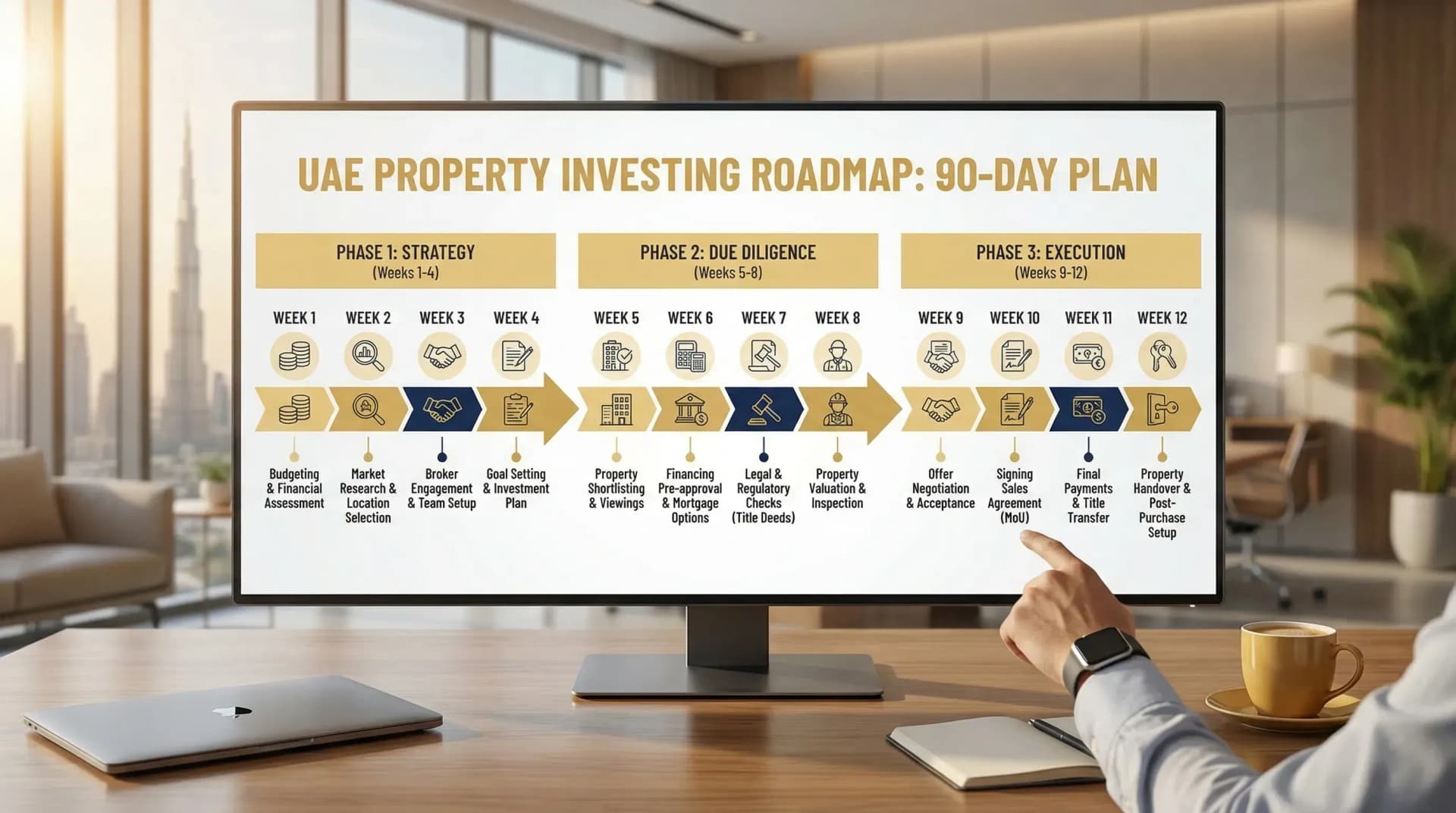
This investor’s plan for UAE property is designed to get you from idea to signed deal (or a fully verified shortlist) in 90 days, with clear deliverables each week. It works whether you’re targeting Dubai, Abu Dhabi, or a high-growth market like Ras Al Khaimah (RAK), and it’s especially useful if you want to secure off-plan allocations where timing matters.
Before you start: define what “done” means in 90 days
A 90-day roadmap should end with something concrete. Choose one:
- Ready property track: you aim to complete a purchase and register ownership (where feasible within your jurisdiction, banking setup, and transaction complexity).
- Off-plan track: you aim to secure an allocation, sign the SPA (Sale and Purchase Agreement), confirm escrow/payment mechanics, and complete the relevant off-plan registration steps.
You can absolutely select an off-plan unit in 90 days without completing construction, but you should still treat the first 90 days as the “risk window” where most irreversible mistakes are made.
Phase 1 (Days 1–14): build your investor profile and decision rules
Step 1: choose your objective (growth, income, residency, or a blend)
Your strategy dictates everything: area selection, unit type, financing, and exit planning.
| Primary objective | What you optimise for | Common best-fit approach in the UAE | Typical mistake to avoid |
|---|---|---|---|
| Capital growth | Future price uplift | Early-phase off-plan, supply-disciplined communities | Overpaying for “marketing views” without resale logic |
| Rental income | Stable net yield | Completed or near-completion units, tenant-ready layouts | Modelling gross yield only (ignoring service charges, voids, management) |
| Golden Visa / residency planning | Eligibility and timeline certainty | Properties that clearly meet visa criteria and documentation | Assuming “any off-plan” qualifies without checking rules and proof requirements |
| Balanced portfolio | Risk-adjusted total return | Mix of one growth asset + one cash-flow asset | Putting all capital into one project phase or one developer |
If your plan includes residency, read the official overview on the UAE government portal and confirm the current thresholds and rules before you commit funds.
Step 2: set non-negotiables (so you don’t improvise under pressure)
Write these down and treat them like an investment policy:
- Maximum all-in budget (including transaction and set-up costs).
- Minimum acceptable developer credibility (track record, escrow compliance, delivery evidence).
- Maximum concentration (for example, one emirate only vs diversified).
- Holding period and exit options (resale, refinance, rental, assignment where permitted).
- Acceptable currency risk approach for staged payments (especially off-plan).
Step 3: decide your risk stance on off-plan (it’s not “high risk” by default)
Off-plan can be a rational strategy in the UAE because payment plans and early pricing can be favourable, but it requires stricter due diligence (developer, escrow, SPA terms, delivery risk).
If you want a deep, investor-focused view of off-plan mechanics and protections, Azimira has a practical guide you can use as supporting reading: Beyond the Hype: A Practical Guide to Off-Plan Investing in the UAE.
Phase 2 (Days 15–45): pick your market, then build a verified shortlist
Step 4: choose an emirate based on “fit”, not headlines
UAE markets can behave very differently depending on supply pipeline, buyer mix, rental demand drivers, and maturity. Your plan should include a reasoned choice.
A simple way to decide is to match emirates to what you need most:
- If you prioritise global liquidity and maximum transaction volume, Dubai may fit (but competition and pricing can be tighter).
- If you prioritise institutional stability and a different demand profile, Abu Dhabi may fit certain strategies.
- If you prioritise value entry and asymmetric growth potential, emerging luxury and infrastructure-led markets like Ras Al Khaimah can be compelling, especially for early-phase off-plan.
Azimira’s own Q1 2026 survey-based market piece highlights the continued strength of off-plan appetite and RAK’s growing profile among high-net-worth investors: UAE Property Investor Sentiment Barometer: Q1 2026.
Step 5: build a shortlist the way a professional underwriter would
At this stage, don’t aim for one “perfect unit”. Aim for 3–5 investable options that meet your rules.
For each option, capture:
- Location logic (what demand driver makes this place rent or resell well in 3–7 years).
- Developer and contractor track record (delivery history matters more than renders).
- Unit liquidity features (layout, size bracket, parking, view realism, floor considerations).
- Total cost of ownership categories (fees, service charges, insurance, management, utilities).
If you’re looking at RAK specifically, start by confirming whether the community sits inside a freehold area suitable for foreign buyers, then narrow to sub-markets that match your strategy. This supporting resource is useful for that filtering step: Complete Map of RAK Freehold Areas for Foreign Investors.
Step 6: pressure-test yields and ROI (fast, then properly)
In week-to-week decision-making, you need two speeds:
- A quick screen to kill weak deals early.
- A full model before signing anything.
If you want a simple framework for rapid screening, Azimira’s quick method is a good starting point: The 2-Minute ROI Calculation Every Property Investor Should Know.
Then, before you reserve, build a proper model that includes:
- Financing costs (if applicable).
- Service charges and sinking funds.
- Management and letting fees.
- Vacancy/void assumption.
- Furnishing and rent-readiness costs (if you plan to let).
- Currency transfer costs (often overlooked, sometimes material).
Phase 3 (Days 46–90): execute like a buyer, not a browser
Execution is where investors either create an edge (by being prepared) or pay a premium (by being rushed).
Step 7 (Days 46–55): get financing and banking “ready to transact”
If you’re using a mortgage, treat pre-approval as a gating item, not an afterthought. Even cash buyers benefit from having banking rails in place (especially for source-of-funds checks and transfer timing).
Useful supporting reading if you’re financing: Getting Mortgage Pre-Approval in UAE: Complete Step-by-Step Guide.
If you’re a non-resident, also plan for operational friction:
- Account opening timelines.
- KYC and source-of-funds documentation.
- Large transfer compliance.
Step 8 (Days 56–70): run legal and developer due diligence before you pay meaningful money
There’s a difference between “a popular project” and “a safe contract”. Your investor’s plan should include a formal diligence pass before reservation becomes non-trivial.
Key diligence themes:
- Developer legitimacy and registrations: confirm the developer and the project are properly registered under the relevant emirate framework.
- Escrow mechanics for off-plan: ensure payments flow to the correct escrow structure as required.
- SPA review: delivery timelines, specification schedule, variation clauses, termination and refund terms, assignment/resale restrictions, dispute venue.
- Fee clarity: understand registration, admin, NOC, and any developer charges.
If you’re investing in Ras Al Khaimah, it’s worth understanding the land department processes, digital portals, and fee structure early, so your timeline doesn’t break on paperwork. Start here: RAK Land Department: Complete Guide to Services, Fees, and Navigation.
Step 9 (Days 71–90): reserve, sign, register, and lock your post-signing plan
This is the final stretch. The goal is not just to sign, but to sign cleanly.
What “clean execution” looks like for a ready property
- Deposit and sales agreement completed with clear conditions.
- Title and seller authority verified.
- Transfer appointment booked and funds prepared.
- Registration completed with the relevant authority.
- Utilities and handover logistics planned (especially if you will rent immediately).
What “clean execution” looks like for off-plan
- Allocation confirmed with a unit schedule that matches what you were shown.
- SPA signed after review.
- Payment plan and milestones understood (and matched to your cash-flow plan).
- Off-plan registration steps completed as required in that emirate.
- A build-monitoring and documentation system set up (you will need an audit trail).
If you want a dedicated deep-dive on off-plan timelines (including what typically happens after SPA), this guide is helpful: The Process of Buying an Off-Plan Property in RAK: Complete Timeline and Expectations.
Your 90-day weekly roadmap (simple, but specific)
Use this as your operating cadence. Each week ends with a deliverable so you can measure progress.
| Week | Focus | Deliverable you should have by Friday |
|---|---|---|
| 1 | Strategy | Written objectives, budget ceiling, hold period, exit options |
| 2 | Market fit | Chosen emirate shortlist (1–2), target communities (3–6) |
| 3 | Deal pipeline | Longlist of 10–15 units/projects meeting your criteria |
| 4 | Shortlist | 3–5 options with initial ROI screens and risk notes |
| 5 | Transaction readiness | Banking rails plan, document pack checklist, FX plan outline |
| 6 | Financing | Mortgage pre-approval path (or cash readiness proof plan) |
| 7 | Due diligence | Developer verification, escrow confirmation approach, SPA questions |
| 8 | Negotiation | Offer strategy, reservation terms, incentive targets |
| 9 | Legal review | SPA reviewed, fee schedule confirmed, signing conditions set |
| 10–12 | Execution | Reservation, SPA signing, registration steps initiated/completed |
| 13 | Post-signing | Letting plan or portfolio tracking plan (KPIs, management decision) |
The document pack most investors should prepare early (to avoid “deal drag”)
You’ll want a single folder (digital and printable) ready for banks, developers, agents, and legal advisers. Requirements vary by emirate, developer, lender, and your residency status, but commonly requested items include:
- Passport copy and proof of address.
- Source-of-funds evidence (bank statements, sale proceeds, business income documents).
- If financing, income documentation (employment letters, accounts, tax returns depending on profile).
- Marriage certificate and family documents if you’re planning residency sponsorship (where relevant).
- Power of Attorney plan if you may sign remotely.
For remote execution, it’s worth understanding timelines and attestation steps before you need them: How to Notarise a Power of Attorney for UAE Property Purchase.
Common failure points (and how this plan prevents them)
Failure point 1: choosing the unit before choosing the strategy
Investors fall in love with a view, then try to force the numbers to work. Your plan fixes this by locking objectives and non-negotiables first.
Failure point 2: underestimating “all-in” costs and timing friction
Transaction and ownership costs vary and can meaningfully change net returns. Build a cost model early, and validate fees with the relevant authority guidance or a trusted specialist in your emirate.
If you want a cost-category breakdown framework for RAK, Azimira’s cost guide is a practical reference: The Real Cost of Owning RAK Property: A 7-Point Breakdown.
Failure point 3: signing without a post-signing operating plan
If your plan is to rent, you need a decision on management, licensing (if short-term), tenant screening, and a maintenance budget. If your plan is capital growth, you need progress monitoring and exit triggers.
How Azimira fits into a 90-day investor’s plan
Azimira is positioned for investors who want curated off-plan and premium opportunities in the UAE, with a strong focus on high-growth markets like Ras Al Khaimah. If your roadmap includes off-plan, pre-launch timing, or you simply want an expert to sanity-check your shortlist and diligence trail, Azimira can support with:
- Access to curated off-plan projects and luxury inventory.
- Market insight, analysis, and reports to help validate your assumptions.
- Dedicated client support through selection, diligence, and transaction steps.
- Tailored investment strategies aligned to your risk profile and horizon.
To discuss your targets and build a shortlist aligned with this 90-day plan, start here: Azimira Real Estate investment page.
Important: This roadmap is educational and does not constitute legal, tax, or financial advice. Always confirm current regulations and obtain qualified professional advice for your personal circumstances.
Related articles
What Counts as Good Real Estate Investments in 2026
Learn what makes good real estate investments in 2026, from net yield and demand signals to legal checks, exit plans and UAE opportunities.

Investors Needed for Real Estate? Start With This Plan
Investors needed for real estate? Use this practical plan to define strategy, numbers, due diligence and partners before raising capital.

Investment Marketing Tactics Developers Use at Launch
Understand investment marketing tactics developers use at launch, from scarcity to incentives, and learn how to assess UAE off-plan deals.