
Growth Partners in UAE Real Estate: How Deals Get Done
Growth partners in UAE real estate explained: who they are, how deals get done, and how to vet advisors, developers, banks, and managers.
In the UAE, property deals rarely “just happen”. The strongest outcomes are usually engineered by an ecosystem of growth partners: the people and institutions that create access, reduce risk, accelerate timelines, and improve the economics of an investment.
If you are buying in high-momentum markets (including emerging luxury destinations like Ras Al Khaimah), understanding who does what, when they get involved, and how they get paid can be the difference between a smooth, bankable transaction and an expensive learning experience.
What “growth partners” means in UAE real estate
In this context, growth partners are not only “introducers” or “agents”. They are stakeholders who materially improve one (or more) of the following:
- Deal access (pre-launch allocations, better unit selection, developer inventory that never reaches public portals)
- Deal quality (due diligence, contract terms, escrow checks, realistic underwriting)
- Deal execution (financing coordination, valuation readiness, registration, compliance)
- Portfolio outcomes (rental strategy, management quality, maintenance planning, exit timing)
In mature markets, these roles are often separated and strictly siloed. In the UAE, they can overlap, especially in off-plan transactions, so clarity on responsibilities matters.
The UAE deal flow: how property transactions actually get done
Most successful purchases follow a predictable sequence of “handoffs” between partners. Here is a practical view of the journey.
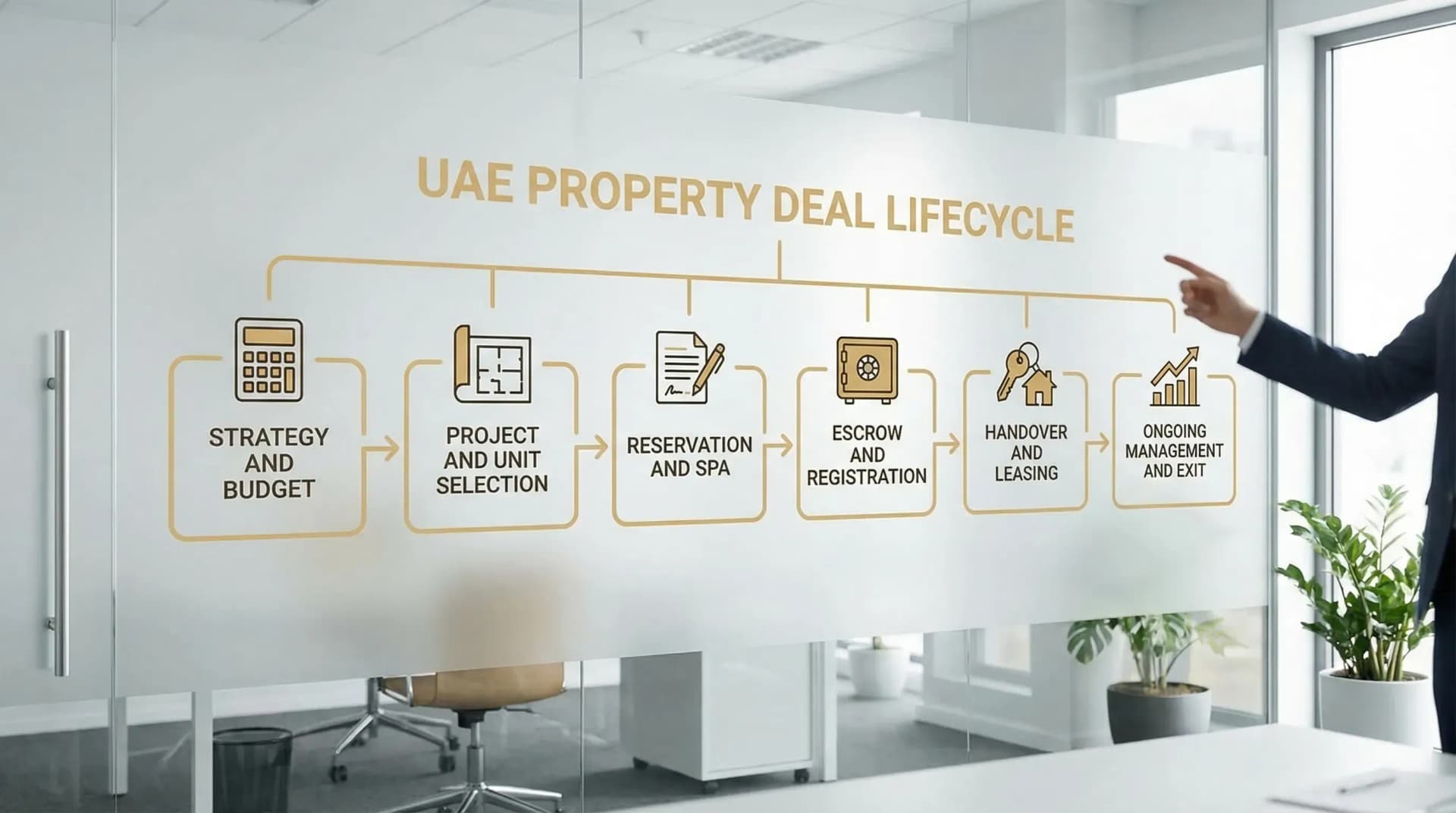
1) Strategy and underwriting (before you look at units)
This stage decides whether the deal works on paper. The biggest error investors make is starting with a property and only later asking whether it matches their objectives.
A robust underwriting conversation typically covers:
- Target outcome: capital growth, yield, residency planning, lifestyle use, or a blend
- Holding horizon: 2–3 years vs 5–10 years changes what “good” looks like
- Cashflow shape: lump-sum vs staged payments (common in off-plan)
- Risk tolerance: construction risk, liquidity risk, currency exposure
Growth partners involved: specialist advisor, mortgage advisor (if relevant), FX specialist (for non-AED base currency), tax counsel in your home jurisdiction.
2) Project and unit selection (where returns are often won)
Two buyers can enter the same development and get very different outcomes based on unit selection (stack, view, layout, proximity to amenities, service-charge profile). In off-plan, the best inventory can be allocated early.
Growth partners involved: developer sales team, specialist buyer advisor with allocation access, independent market research.
3) Reservation, compliance checks, and SPA negotiation
This is where a “great deal” can be compromised by weak paperwork. In the UAE, off-plan purchases typically revolve around the Sale and Purchase Agreement (SPA), payment milestones, and conditions around assignment, handover specs, and remedies for delays.
Growth partners involved: legal counsel (contract review), developer relationship manager, compliance teams (KYC/AML), sometimes a mortgage pre-approval partner.
For investor safety frameworks, it helps to understand how regulated markets operate. Dubai’s off-plan system, for example, is overseen through the Dubai Land Department and RERA (for background, see the Dubai Land Department portal). Other emirates run their own processes and portals, with different documentation norms and timelines.
4) Escrow, progress payments, and registration
For off-plan, your money flow and registration steps matter as much as the brochure.
Key operational realities:
- Payments should align to the contracted schedule and the correct approved payment channels.
- Registration (for example, Oqood-style interim registration in relevant contexts) is not just admin. It is part of the legal architecture that supports off-plan buyer protections.
Growth partners involved: land department, developer escrow team, your advisor, your bank or remittance provider.
If you are investing in Ras Al Khaimah specifically, it is worth reviewing local process and fees before committing, because differences between emirates can affect timelines and total costs. Azimira’s guide to the RAK Land Department services and fee structure is a good starting point.
5) Handover, snagging, and readiness for income
A handover is not a photo moment, it is a quality-control and cashflow milestone.
Investors who convert quickly to income tend to have a plan for:
- Snagging and defect resolution
- Utilities activation
- Insurance
- Furnishing strategy (if applicable)
- Listing, tenant screening, and contract compliance
Growth partners involved: snagging professional, property manager, leasing agent, insurer.
6) Ongoing management and exit execution
Once the property is live, performance becomes operational, not theoretical. High-quality management can protect occupancy, maintenance costs, and the quality of future resale buyers.
At exit, your growth partners help you time the sale, minimise friction, and avoid costly surprises such as assignment restrictions, valuation gaps, or missing documents.
Growth partners involved: sales broker, property manager, legal counsel, valuation partner, mortgage settlement partner (if leveraged).
Who the key growth partners are (and what to ask each one)
The most common mistake is hiring partners based on charisma rather than evidence. Use this table to create a simple “partner scorecard”.
| Growth partner | What they do in practice | What to ask before committing | Common value they add |
|---|---|---|---|
| Specialist buyer advisor | Sources opportunities, compares micro-markets, helps structure the deal | How do you validate developer quality? How do you get paid? What is your process from reservation to handover? | Better unit selection, fewer errors, access to pre-launch allocations |
| Developer (and developer sales team) | Sets pricing, payment plans, handover specs, assignment rules | Is the project properly registered? How is escrow handled? What are the handover standards and penalties for changes? | Payment-plan leverage, incentives, early-phase price discovery |
| Land department / regulator | Registers ownership, transfers, mortgages, NOCs | What documents are required for my buyer profile (resident, non-resident, corporate)? What are the fees and timelines? | Legal certainty, enforceability |
| Mortgage advisor / bank | Pre-approval, underwriting, valuation coordination | What LTV applies to my residency status? What fees apply? What are your valuation timelines? | Higher execution certainty, better financing fit |
| Lawyer (UAE real estate experienced) | SPA review, risk clauses, POA, inheritance planning touchpoints | Which clauses are most negotiated in this emirate? What are my remedies for delay/spec changes? | Contract risk reduction, cleaner exit later |
| FX partner (for international buyers) | Converts and times transfers for staged payments | How do you handle documentation and proof-of-funds? Can you set rate alerts/forwards for milestones? | Reduced FX leakage, predictable cashflow |
| Valuer | Valuation for mortgage and sometimes residency-related processes | Are you approved by relevant authorities/banks? What is your turnaround time? | Avoids financing delays, reduces valuation shock |
| Property manager | Leasing, maintenance, compliance, reporting | What are your fees, response SLAs, and financial controls? How do you handle arrears and disputes? | Higher net yield, lower vacancy, asset protection |
If you want a practical lens on investor protection, pair this with Azimira’s guide on property scam red flags in the UAE and the checklist of essential documents before signing a RAK deal.
How growth partners create real value (beyond “finding a property”)
Access is a financial advantage, not a luxury
In off-plan markets, the best units are often allocated first. That matters because:
- View corridors and prime stacks can command resale and rental premiums.
- Certain layouts rent better and resell faster, even within the same building.
- Early-phase allocations can widen the margin of safety if pricing appreciates during construction.
This is where “growth partner” is a literal description. The partner is expanding your opportunity set.
Execution speed reduces risk
In the UAE, delays often come from predictable bottlenecks: incomplete KYC packs, misaligned funding timelines, missing attestations, or last-minute valuation issues.
A coordinated partner network reduces the probability that you:
- Lose a unit due to slow document turnaround
- Miss a payment milestone and incur penalties
- Delay registration and complicate financing or resale
If you are buying from abroad, operational readiness matters even more. Many investors benefit from planning remote mechanics in advance, such as a properly drafted POA. (See Azimira’s guide to buying UAE property with a Power of Attorney.)
Better deal structure beats headline discounts
A common misconception is that the “best deal” is the biggest sticker discount. In reality, structure often drives outcomes more than price.
Examples of structural value:
- A payment plan that matches your income or liquidity schedule
- Clauses that preserve your ability to exit (for example, assignment rules)
- A furnishing and rental strategy that maximises net yield, not gross rent
If you want to model returns properly, use a disciplined ROI framework rather than relying on marketing numbers. Azimira’s guide on projecting UAE real estate ROI is a useful reference point.
A realistic example: how a cross-border off-plan purchase is coordinated
Consider a typical international investor targeting a premium off-plan unit in the UAE.
What “good coordination” looks like:
- The advisor aligns the shortlist to the investor’s horizon and risk profile, then secures access to a unit that matches liquidity and exit objectives.
- Legal counsel reviews the SPA for clauses that matter in practice (variation, handover, assignment, default remedies).
- The investor’s funding plan accounts for staged payments, including FX planning if their base currency is not AED.
- Registration steps are planned early, so identity documents, notarisation, and compliance packs are ready before deadlines.
- A property manager is lined up pre-handover, so leasing and pricing are not improvised after the keys arrive.
What tends to go wrong when growth partners are missing:
- The buyer selects based on marketing, not micro-market performance drivers.
- The SPA is signed without understanding which terms are negotiable.
- Funding arrives late, or FX costs silently erode returns.
- Post-handover is delayed by snagging, utilities, or licensing surprises, pushing back first income.
This is why sophisticated investors treat partner selection as part of investment selection.
How to choose growth partners in the UAE (a practical vetting framework)
1) Demand process, not promises
Ask partners to walk you through their workflow from first call to handover. You are looking for specificity, not sales language.
2) Make incentives explicit
Misaligned incentives create poor advice. Clarify:
- Who pays the partner and when
- Whether the partner is tied to a limited set of developers
- Whether they provide options across emirates, or only one narrative
3) Look for evidence of “deal hygiene”
Strong partners are obsessive about documentation, timelines, and verification.
A simple test: if a partner is casual about escrow verification, registration steps, or legal review, they are not a growth partner, they are a risk.
4) Prefer partners who can stay with you past the purchase
The UAE rewards investors who can execute the full lifecycle: acquisition, handover, leasing, compliance, and exit.
If a partner disappears after the reservation form, you are left to coordinate the most complex stages alone.
Where Azimira fits as a growth partner
Azimira is positioned around the parts of the process where growth partners matter most for investors: curated off-plan opportunities, market insight, exclusive pre-launch access, and tailored investment strategy, with dedicated support through execution.
If you are evaluating UAE off-plan opportunities now, a high-signal next step is to compare your shortlist against a structured due diligence process (developer credibility, escrow mechanics, SPA terms, realistic ROI). Azimira’s practical guide, Beyond the Hype: a practical guide to off-plan investing in the UAE, is designed for exactly that.

The takeaway
“Growth partners in UAE real estate” is not a buzzword. It is the operating system behind how serious deals get sourced, verified, funded, registered, and turned into real performance.
If you treat partner selection with the same rigour as property selection, you improve your probability of a smooth closing, a faster path to income, and a cleaner exit later. And in fast-evolving markets, that operational edge is often the most durable advantage you can buy.
Related articles
What Counts as Good Real Estate Investments in 2026
Learn what makes good real estate investments in 2026, from net yield and demand signals to legal checks, exit plans and UAE opportunities.

Investors Needed for Real Estate? Start With This Plan
Investors needed for real estate? Use this practical plan to define strategy, numbers, due diligence and partners before raising capital.

Investment Marketing Tactics Developers Use at Launch
Understand investment marketing tactics developers use at launch, from scarcity to incentives, and learn how to assess UAE off-plan deals.