
UAE Market Guide: The Macro Signals Property Investors Watch
UAE market guide to the macro signals property investors watch: rates, supply, inflows, tourism, FX and regulation, plus how to act on each.
Macro signals rarely make a property look beautiful, but they often determine whether an investor’s underwriting holds up (or breaks) over a 3 to 7 year horizon. In the UAE, macro matters even more because demand is international, the dirham is pegged to the US dollar, and real estate cycles can be driven by global liquidity as much as local fundamentals.
This UAE market guide lays out the macro signals serious property investors watch, where to track them, and how to translate each signal into practical decisions on timing, leverage, and location, especially for off-plan opportunities.
Why macro signals matter in the UAE market (and why they are easy to misread)
Many investors analyse listings and developer brochures but miss the “big levers” that move the entire pricing environment: interest rates, credit availability, population inflows, and the supply pipeline. In a market with strong global participation, these levers can change quickly.
A useful way to think about macro is that it doesn’t replace due diligence on a specific project. It sets the range of plausible outcomes. If the macro environment is supportive, good assets tend to do well and weak assets can still sell. If macro tightens, only genuinely scarce, well-positioned assets keep liquidity.
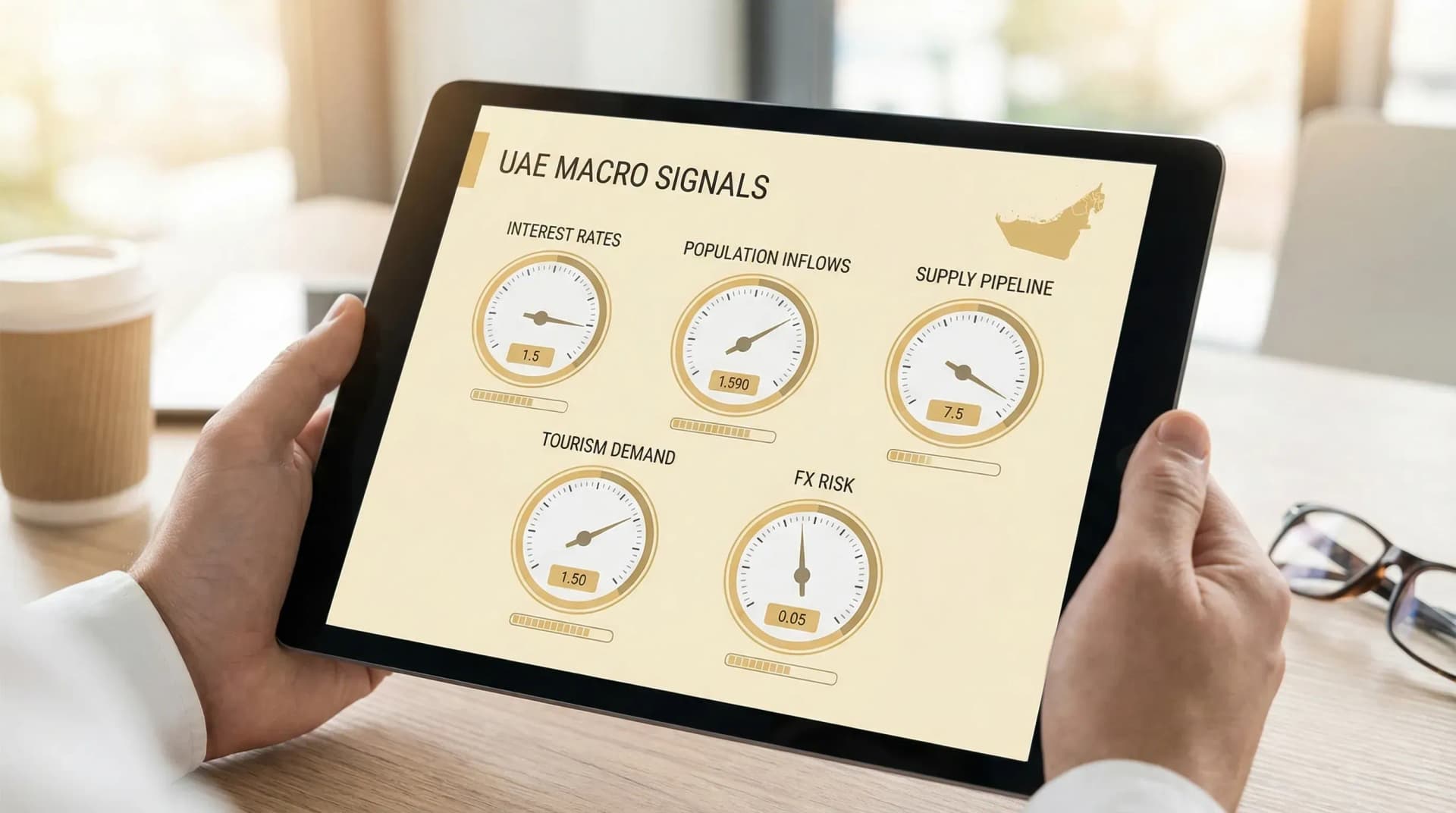
The macro dashboard: signals, sources, and what they mean for property
Use the table below as a starting “dashboard”. You do not need to monitor everything weekly, but you should know which direction each variable is moving and why.
| Macro signal | Where investors track it | Why it matters in UAE property | What to do with the signal |
|---|---|---|---|
| US Fed policy and global rates | US Federal Reserve communications, global bond yields | The AED is pegged to the USD, so monetary conditions often transmit into UAE borrowing costs | Stress-test mortgage affordability and exit cap rates, consider fixed vs variable exposure |
| Local interbank rates (EIBOR) and mortgage pricing | UAE banks’ rate sheets, Central Bank of the UAE updates | Affects leveraged buyers, end-user affordability, and investor cash-on-cash returns | Model payment shock scenarios, verify re-fix timelines and fees |
| Population growth and residency inflows | UAE government releases, visa programme updates, reputable research houses | Rental demand and absorption are ultimately driven by households and workers arriving | Align asset type with demand (studios vs family units), prioritise areas with job density and connectivity |
| Supply pipeline and delivery timing | Developer disclosures, land department updates, market research reports | Delivery waves can compress rents and resale liquidity in specific communities | Prefer supply-disciplined micro-markets, avoid “all-handover-same-quarter” clusters |
| Tourism and air connectivity | Tourism authority releases, airline route announcements, airport expansion updates | Drives short-term rental economics and premium waterfront demand | Match strategy to regulation and seasonality, underwrite conservative occupancy |
| Inflation and construction costs | UAE inflation releases, global commodities and freight indicators | Construction cost pressure can affect replacement cost and developer margins | Check contract specs, variation clauses, and realistic handover buffers |
| Oil price and fiscal stance | OPEC updates, macro research, UAE budget priorities | Oil influences regional liquidity and government spending confidence, even in diversified economies | Treat it as a “risk-on/risk-off” barometer, not a direct rent driver |
| Currency dynamics and the USD cycle | USD index (DXY), home-currency FX rates | The peg reduces AED volatility, but investors fund in GBP, EUR, SGD, HKD, etc. | Plan staged FX conversions for off-plan, consider hedging for large commitments |
| Regulatory posture and enforcement | Land departments, real estate regulators, official circulars | Enforcement shapes investor protection, escrow discipline, broker behaviour | Prefer regulated channels, document everything, verify registrations and escrow |
| Geopolitical risk and global mobility | Major news, travel advisories, shipping risk indicators | Can impact sentiment, travel, and cross-border capital flows | Demand a margin of safety on pricing, prioritise liquid segments and strong developers |
1) Interest rates: the UAE’s “hidden” demand lever
Because the AED is pegged to the USD, US rate cycles often ripple into UAE financing conditions. Even cash buyers are affected indirectly: when financing becomes more expensive, marginal demand drops, resale liquidity can slow, and developers may adjust incentives.
What sophisticated investors do differently:
- They underwrite two affordability cases for end buyers (today’s rates and a higher-rate scenario).
- They check whether an intended buyer pool is mostly cash, mostly leveraged, or mixed (this varies by segment and emirate).
- They avoid over-optimising on leverage in a market where rates can remain elevated longer than expected.
Practical underwriting tip: when comparing off-plan vs ready assets, incorporate the possibility that the financing environment at handover will be different from the one at reservation.
2) Credit availability and banking standards (not just the headline rate)
A common mistake is to track only the interest rate and ignore credit appetite. Banks can tighten loan-to-value limits, documentation requirements, or property eligibility criteria in ways that change demand.
This matters most for:
- Mid-market and end-user driven communities.
- Investors who plan to refinance at handover.
- Assignment sales strategies that depend on a broad pool of financed buyers.
If your strategy depends on financing, treat “financeability” as part of asset quality. A premium unit that is hard to finance can become illiquid at the wrong moment.
3) Population inflows and labour market composition
In the long run, property performance is anchored by people: workers, founders, retirees, and families choosing to live in the UAE. When the mix of arrivals shifts, the best-performing unit types and locations can change with it.
Examples of how the composition matters:
- More families and longer-term residents typically strengthens demand for larger units, schools, and community amenities.
- More remote workers and flexible residency can lift demand for lifestyle-first coastal communities.
- More corporate expansion can increase demand in areas with commuting convenience.
In 2026, many investors are also watching how residency pathways (including long-term options) shape tenant duration, which is a key driver of vacancy risk and net yield.
4) Supply pipeline: the macro factor you can map street by street
Supply is macro, but it becomes very local very fast. Two neighbouring communities can perform completely differently if one faces a heavy wave of near-identical handovers.
When you assess supply, look for:
- Concentration risk: too many studios or too many identical one-beds hitting the market together.
- Delivery realism: whether handover timelines across multiple projects cluster into the same period.
- Secondary market depth: the number of comparable resale listings during handover windows.
This is one of the places where a specialist advisor is worth paying for. You are not just buying the unit, you are buying into a delivery schedule and a competitive set.
5) Tourism and aviation: a demand engine with different risk rules
Tourism is an obvious driver for short-term rentals and branded lifestyle communities, but it is not a free lunch. It introduces operational complexity, regulatory requirements, seasonality, and sensitivity to travel sentiment.
Macro questions to ask:
- Is tourism growth broad-based (more routes, more hotel keys, more events), or concentrated in a single catalyst?
- Are you underwriting a property as a home, a long-let investment, or a hybrid STR asset?
- Does the community have enough year-round demand to stabilise occupancy outside peak seasons?
If you plan to operate STR, build a conservative model. Peak months can disguise weak shoulder-season economics.
6) Inflation and construction costs: replacement value and developer risk
Construction-cost inflation influences two important things:
- Replacement cost: if costs rise, existing stock can look relatively better priced.
- Execution risk: when costs rise faster than expected, weaker developers can face margin pressure.
For off-plan investors, macro cost pressure should push you towards stronger documentation:
- Clear specifications and finish schedules.
- Transparent change-order rules.
- Realistic contingency for delivery timing.
(You are not just betting on the market, you are betting on execution.)
7) Oil, liquidity, and the regional “risk-on” mood
The UAE economy is far more diversified than it was decades ago, but energy prices still influence regional liquidity and sentiment. For property investors, oil is best treated as a macro risk gauge rather than a direct rent driver.
When the regional mood is risk-on, you often see:
- Faster absorption of new launches.
- Stronger performance in premium segments.
- More competition for pre-launch allocations.
When sentiment turns cautious, liquidity concentrates in the best locations and the most credible developers.
8) FX and the dirham peg: stability for pricing, complexity for investors
The dirham peg reduces local currency volatility, which many international investors like. But your returns still depend on your home currency.
Off-plan adds an extra layer: staged payments create a sequence of FX decisions over months or years.
Practical approaches investors use:
- Convert in tranches aligned to payment milestones.
- Maintain a buffer for fees, registration, and fit-out.
- For large commitments, explore professional FX risk management (especially if a sharp move would force you to sell other assets).
9) Regulation and compliance: the macro variable investors underestimate
In cross-border real estate, regulation shows up as friction, or as protection. Stronger enforcement generally improves market quality, but it also raises expectations around documentation, source of funds, and transaction clarity.
As the UAE market continues to professionalise, investors should treat compliance as part of deal readiness, not an afterthought. That includes:
- Clear source-of-funds documentation.
- Consistent beneficial owner information for corporate purchases.
- Traceable payment flows aligned to contract terms.
If you manage multiple entities or frequent transactions, it can help to systematise compliance workflows. Tools such as AI compliance automation platforms exist to reduce manual load for teams handling regulatory and risk processes.
Turning macro signals into a decision framework (timing, leverage, and asset selection)
Macro analysis is only useful if it changes what you do. A simple framework is to link the dashboard to three decisions: when to buy, how to finance, and what to buy.
Timing: when macro favours early-phase off-plan
Early-phase off-plan can outperform when:
- Credit is available and end-buyer demand is broad.
- Supply is disciplined in the target micro-market.
- The community has credible catalysts with realistic timelines (infrastructure, hospitality, transport, employment nodes).
Off-plan becomes riskier when macro is tightening and multiple competing projects hand over together.
Leverage: aligning financing with the rate cycle
If rates are volatile, investors often prefer:
- Conservative loan sizes.
- A clear plan for refixing (rather than hoping rates drop).
- Assets that remain liquid even if financed buyer pools shrink.
Asset selection: which properties hold up when macro cools
When the market slows, liquidity concentrates. The features that tend to help are not mysterious:
- Prime location within the community (views, waterfront, walkability, access).
- Differentiation (layout, scarcity, brand positioning, quality of build).
- A developer and masterplan with credible delivery history.
A simple scenario map for UAE property investors
You do not need perfect forecasts. You need prepared actions.
| Macro scenario | Typical market behaviour | Investor focus |
|---|---|---|
| Rates easing + strong inflows | Faster absorption, improving resale liquidity | Secure high-quality off-plan early, prioritise scarce unit types |
| Rates steady/high + supply rising | More incentives, price dispersion, longer selling times | Negotiate harder, avoid oversupplied segments, favour value with quality |
| Risk-off shock (geopolitics or global recession) | Buyers pause, only prime assets trade smoothly | Hold liquidity, buy only if margin of safety is clear and fundamentals are defensive |
Where Azimira fits (and how to use this guide)
Macro tells you what to be careful about. Execution determines your outcome.
Azimira focuses on connecting investors and buyers with curated off-plan opportunities in the UAE, with particular attention to high-growth markets such as Ras Al Khaimah. If you use the macro signals above as your filter, the next step is to apply them at the project level: supply mapping, developer diligence, payment-plan realism, and exit pathways.
If you want help translating today’s UAE market conditions into a tailored investment strategy, Azimira can support with market insight, pre-launch access where available, and dedicated client guidance through the decision process.
Related articles
What Counts as Good Real Estate Investments in 2026
Learn what makes good real estate investments in 2026, from net yield and demand signals to legal checks, exit plans and UAE opportunities.

Investors Needed for Real Estate? Start With This Plan
Investors needed for real estate? Use this practical plan to define strategy, numbers, due diligence and partners before raising capital.

Investment Marketing Tactics Developers Use at Launch
Understand investment marketing tactics developers use at launch, from scarcity to incentives, and learn how to assess UAE off-plan deals.