
Capital Appreciation: What Really Moves UAE Property Prices
Understand what drives capital appreciation in UAE property: rates, demand, supply, infrastructure and developer quality, plus a clear scorecard for deals.
If you are investing for capital appreciation in the UAE, you are really making a bet on one thing: future demand for a specific home, in a specific place, under specific rules, arriving faster than future supply.
That sounds simple, but most investors get distracted by the wrong signals, glossy renders, “hot” launch headlines, or one-off anecdotes from friends. UAE property prices do move quickly at times, but they rarely move randomly.
This guide breaks down what actually moves UAE property prices (and what doesn’t), so you can underwrite appreciation with more discipline, whether you’re buying off-plan or ready property.
Capital appreciation in UAE real estate (what it is, and what it isn’t)
Capital appreciation is the change in an asset’s market value over time. In property terms, it is the difference between:
- What you paid (all-in, including fees)
- What a real buyer is willing to pay later (net of selling costs)
It is not the same as:
- Rental yield (income return)
- Developer “price uplift” marketing (often based on list prices, not executed resales)
- A single nearby transaction (which can be an outlier based on view, floor, payment terms, urgency, or furnishing)
In the UAE, appreciation is heavily shaped by (1) macro liquidity and global money flows, (2) visa-driven population and business growth, and (3) the timing mismatch between off-plan supply and delivered, liveable communities.
The biggest drivers of UAE property price growth
Think of appreciation as a stack of layers. If the top looks good (a beautiful unit), but the base is weak (oversupply, weak exit liquidity, poor connectivity), prices struggle to hold.
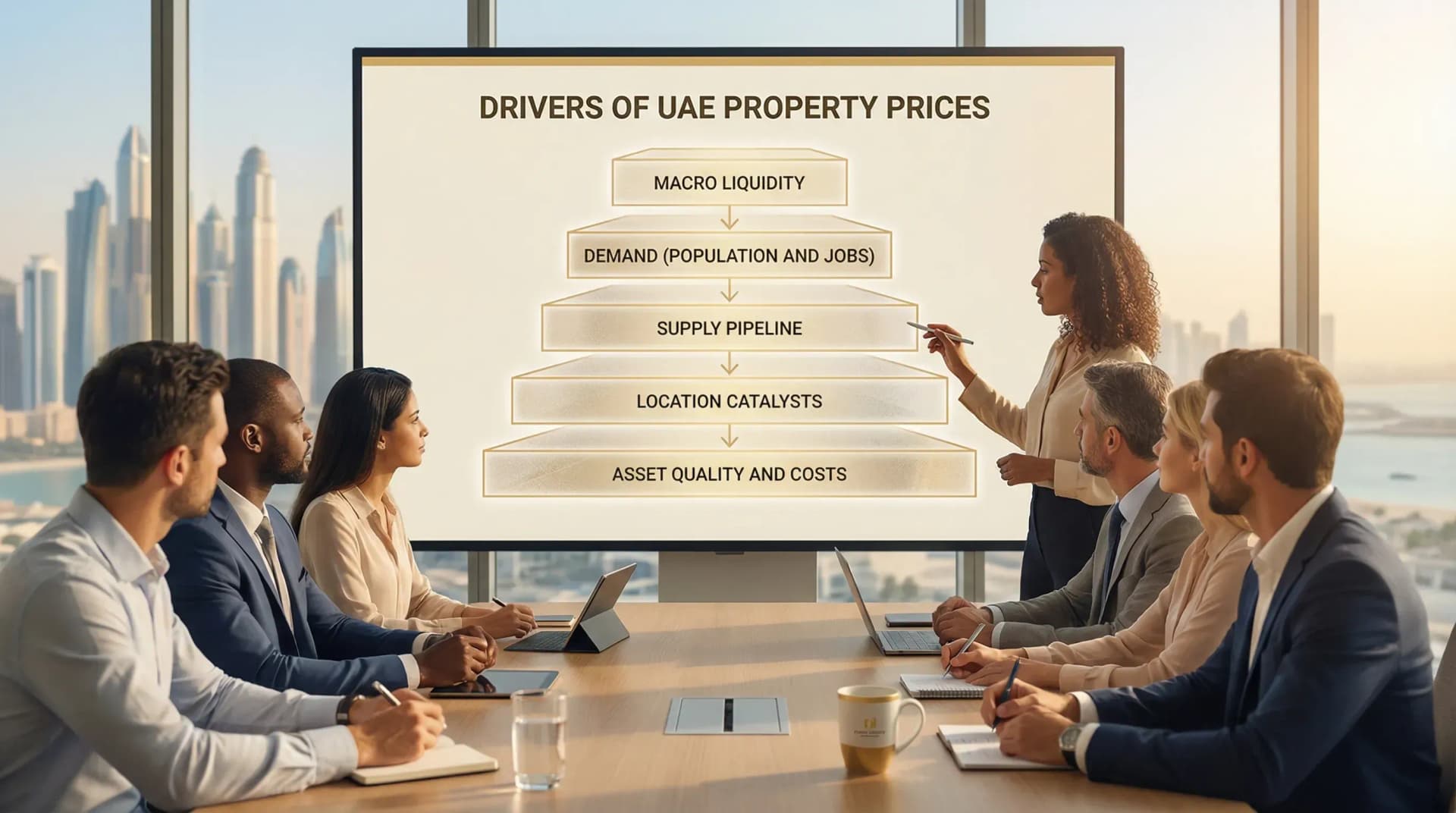
1) Liquidity conditions and interest rates (the “hidden” driver)
UAE property demand is unusually sensitive to global liquidity because:
- The UAE attracts international capital (buyers are often comparing the UAE with other global markets).
- The dirham is pegged to the US dollar, so local interest-rate conditions broadly track US monetary conditions over time.
When borrowing costs rise, affordability falls, and price growth typically cools in the most mortgage-dependent segments. When liquidity is abundant, you tend to see stronger competition for prime inventory, faster off-plan sell-outs, and more secondary-market depth.
What to watch:
- Mortgage-rate trends and bank lending appetite
- Cash buyer mix (higher cash share can reduce rate sensitivity)
- Transaction volumes (volumes often weaken before prices do)
Useful references for context include the Central Bank of the UAE and major bank research notes (interpret with caution, but track directionally).
2) Population growth, job creation, and residency pathways
Housing demand is downstream from people and paycheques.
In the UAE, demand is also downstream from policy-enabled mobility. Long-term residency pathways (including investor and long-stay visas) can increase the pool of buyers willing to hold property longer, upgrade homes, or place family roots.
What to watch:
- Net migration and employment growth (especially in higher-income sectors)
- New business formation and corporate relocations
- Residency rule changes and visa uptake (because “more permanent” residents behave differently to short-stay renters)
For baseline demographic and macro indicators, start with UAE Federal Competitiveness and Statistics Centre and cross-check with international sources like the World Bank.
3) Supply pipeline and delivery timing (off-plan is not just “more supply”)
The UAE is an off-plan-led market. That creates two distinct supply realities:
- Announced supply (units launched and sold off-plan)
- Delivered supply (units handed over, competing for end-users and tenants)
Prices usually respond most sharply when delivered supply hits the market in concentrated bursts, particularly if:
- Handover coincides with weaker demand
- Many owners list simultaneously
- Service charges or furnishing costs surprise first-time investors
On the flip side, appreciation can accelerate when delivery is constrained (delays, phased handovers, limited prime plots) while demand keeps rising.
What to watch:
- Construction progress realism, not brochure timelines
- How many similar units are due to hand over in the same 6 to 18-month window
- Whether the community is “live” at handover (retail, access roads, beaches/parks, schools, managed facilities)
For Dubai-specific project and regulatory context, the Dubai Land Department and RERA frameworks are a good starting point. Other emirates have their own regulators and processes.
4) Infrastructure and accessibility (prices follow reduced friction)
Infrastructure is not valuable because it is exciting. It is valuable because it reduces friction.
When an area becomes meaningfully easier to reach, easier to live in, or easier to rent out, more demand shows up at the same price point, and the market reprices.
Examples of “friction reducers” that can drive appreciation:
- Faster commuting options and new road capacity
- New airports or expanded routes that increase tourist and business inflows
- Masterplanned retail and lifestyle anchors that reduce the need to “drive elsewhere”
The key is timing. Markets can price in future infrastructure early, then stall if delivery slips. Strong investors treat infrastructure like a probability-weighted catalyst, not a guarantee.
5) Tourism and short-stay economics (where it matters, it matters a lot)
Tourism-linked demand can lift both:
- Rental income (especially short-stay)
- Buyer demand (second homes, lifestyle purchases)
In the UAE, this tends to concentrate in leisure-first micro-markets (waterfronts, resort zones, branded hospitality corridors). When tourist demand rises, investors can accept lower yields because they expect stronger capital growth, and lifestyle buyers can push up end-user pricing.
What to watch:
- Hotel pipeline and occupancy signals (a proxy for area demand)
- Holiday-home regulation and licensing clarity
- Seasonality and the true net (after management, utilities, furnishing churn)
6) Developer quality and product differentiation
Not all “new builds” appreciate the same way.
Over a multi-year hold, buyers pay for:
- Trust in handover quality and after-sales support
- Layout efficiency (saleability matters more than marble)
- Build durability in heat, humidity, and coastal conditions
- Brand, management standards, and community experience
In practice, stronger developers and better-managed communities often hold value more reliably during soft patches, because resale buyers feel safer.
If you are buying off-plan, this is not a soft factor. It is underwriting.
7) Ongoing ownership costs (service charges can cap appreciation)
A unit’s price is only one part of its affordability. In the UAE, service charges and lifecycle maintenance materially affect net returns.
Two properties with similar headline yields and similar “price growth” can produce very different investor outcomes if one carries high recurring costs or frequent special assessments.
What to watch:
- Service charge levels and what is truly included
- Amenities that look great in marketing but are expensive to maintain
- Building age and quality (future capex risk)
A practical scorecard: what to measure before you expect appreciation
Most investors can’t control macro cycles. But you can control what you buy, where you buy it, and how you validate the drivers.
Use the table below as a simple pre-purchase scorecard.
| Appreciation driver | What to check (practical indicator) | Why it moves prices |
|---|---|---|
| Liquidity and rates | Mortgage-rate direction, transaction volumes | Shifts affordability and buyer urgency |
| End-user depth | Who lives here (families, professionals, retirees) | End-users stabilise demand vs purely investor-led pockets |
| Supply risk | Competing handovers in the same segment | Delivered oversupply pressures resales and rents |
| Infrastructure | Confirmed projects, credible timelines | Reduced friction expands the buyer and tenant pool |
| Rental competitiveness | Achievable rent vs comparable units | Strong rents support valuations and investor demand |
| Developer and building quality | Track record, handover consistency, management | Quality reduces resale discounting and improves liquidity |
| Ownership costs | Service charges, maintenance expectations | High costs reduce net returns and cap buyer willingness |
| Exit liquidity | Days-on-market, discounting trend, buyer mix | Appreciation is only real when you can sell efficiently |
What doesn’t reliably move UAE property prices (or is easy to misread)
Some signals get over-weighted in investor conversations:
- “Highest floor always wins.” Views and height matter, but layout, sellability, and building reputation often matter more.
- Launch-day sell-outs. Off-plan sell-outs can reflect marketing allocation and incentives, not long-term resale depth.
- Guaranteed return messaging. Treat it as a risk flag, not a value driver (see Azimira’s guide to spotting UAE property scam red flags).
- Single-number appreciation forecasts. Real appreciation is scenario-based: base case, upside case, downside case.
How to underwrite capital appreciation on a specific UAE deal
If you want a repeatable process, separate your analysis into three questions.
Will demand be stronger in 3 to 7 years?
Look for demand that is structural, not purely cyclical:
- A growing employment base in reachable distance
- A maturing lifestyle proposition (schools, healthcare access, retail, beaches/parks)
- A reason for people to choose this location over alternatives (time saved, experience, community quality)
Will supply be controlled in your micro-market?
Micro-market matters more than emirate-wide headlines.
Ask:
- How many similar units (size, finish level, view line, building class) will compete with you at handover?
- Is land constrained (true waterfront, protected views), or can the market replicate your product endlessly?
Will the unit be easy to resell?
Liquidity is the difference between “paper appreciation” and bankable profit.
Check for:
- Layouts that match the largest buyer pool
- Reasonable ownership costs
- A developer and community name that secondary buyers recognise and trust
If you are buying off-plan, also validate the legal and payment mechanics. Azimira’s article, Beyond the Hype: A Practical Guide to Off-Plan Investing in the UAE, is a helpful starting point.
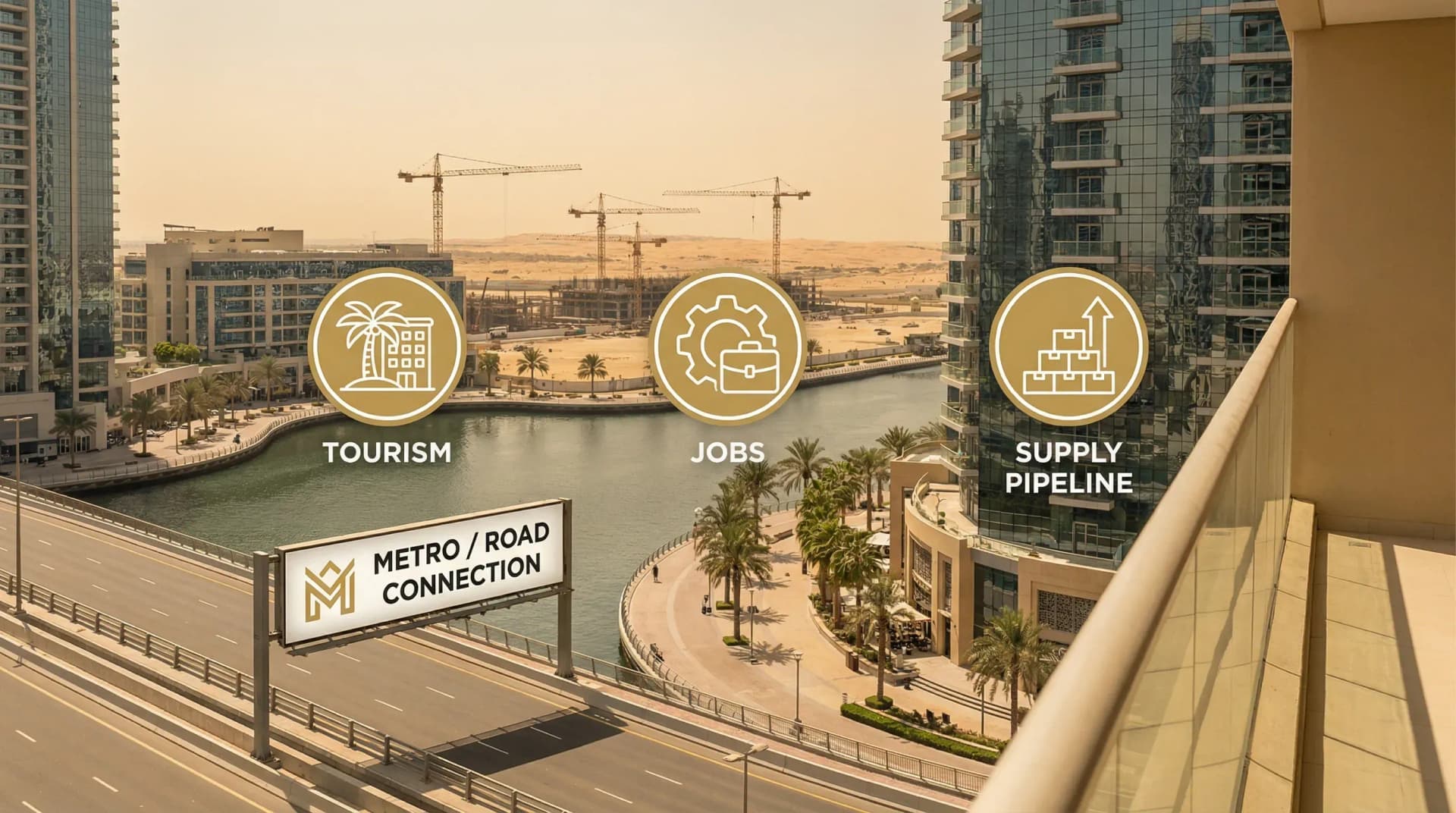
Bringing it together: why some UAE markets outperform in appreciation
Across the UAE, the markets that tend to produce stronger capital appreciation over a cycle usually share a common profile:
- They are early enough in their maturity curve that infrastructure and placemaking still have upside.
- They attract a mix of end-users and investors (not just one group).
- They have differentiated product (true waterfront, branded living, unique nature access), not easily replicated inventory.
- They benefit from credible government and private-sector capital commitments.
That is one reason investors often explore high-growth corridors alongside established hubs. If you are comparing opportunities, it helps to look at the UAE as a portfolio of micro-markets, each with its own supply clock and demand engine.
If you want capital appreciation, start with the right deal selection
Capital appreciation is not luck. It is the result of buying a property where demand is likely to broaden, supply is unlikely to swamp the market at your exit window, and the asset is easy to own and easy to resell.
Azimira specialises in connecting investors and buyers with curated off-plan opportunities in the UAE, with a particular focus on high-growth markets. If you want help stress-testing an appreciation thesis (location, supply risk, developer track record, exit liquidity), you can explore Azimira’s approach on the investment page or contact the team for a tailored shortlist based on your goals.
Related articles
What Counts as Good Real Estate Investments in 2026
Learn what makes good real estate investments in 2026, from net yield and demand signals to legal checks, exit plans and UAE opportunities.

Investors Needed for Real Estate? Start With This Plan
Investors needed for real estate? Use this practical plan to define strategy, numbers, due diligence and partners before raising capital.

Investment Marketing Tactics Developers Use at Launch
Understand investment marketing tactics developers use at launch, from scarcity to incentives, and learn how to assess UAE off-plan deals.