
Growth Investment: Why Emerging UAE Cities Beat Mature Markets
Growth investment in UAE property: why emerging cities like Ras Al Khaimah can outperform mature markets, and how to assess risk.
In real estate, “safe” often means “priced accordingly”. If you are pursuing a growth investment strategy in the UAE, the most compelling opportunities are increasingly found outside the most mature, globally traded neighbourhoods of Dubai and Abu Dhabi. Not because the mature markets are weak, but because their upside is more efficiently priced, and their next phase of growth tends to be steadier rather than explosive.
Emerging UAE cities and sub-markets (especially those moving from local demand to international demand) can offer something rarer: asymmetric returns, where a series of catalysts (infrastructure, tourism, new employment nodes, masterplanned communities) re-rate an entire area over a multi-year window.
Growth investment vs mature-market investing (what you are really choosing)
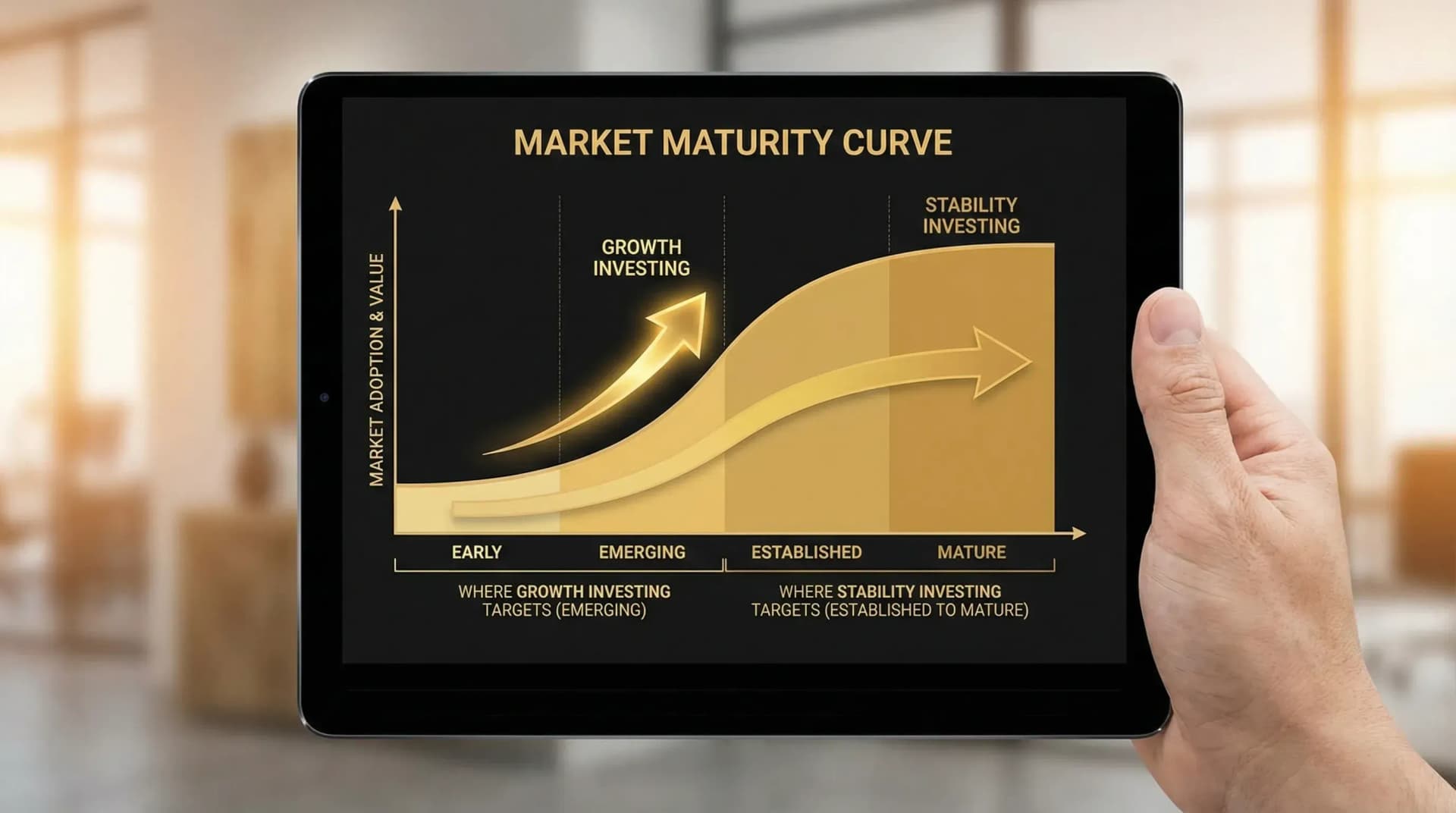
In property, “growth” is not a vibe, it is a function of where a market sits on its development curve.
- Mature markets typically deliver lower volatility, deeper resale liquidity, and more predictable rental demand. The trade-off is that future growth is usually incremental because much of the future is already reflected in today’s prices.
- Emerging markets can deliver faster appreciation when they transition from “planned” to “proven”. The trade-off is higher execution risk (delivery timelines, supply pipeline, and liquidity).
A useful mental model is to ask a simple question:
Is this location already valued like a global city district, or is it still valued like a regional market that is about to become global?
Why emerging UAE cities can outperform mature markets
The UAE is unusual because “emerging” does not mean “unsupported”. Many growth corridors are backed by government masterplanning, upgraded transport, and global-brand tourism initiatives. That combination can compress the timeline from early-stage to established.
Here are the mechanisms that most often cause emerging UAE cities to beat mature markets on growth.
1) The pricing gap is still open (and re-rating potential is real)
In mature markets, pricing is anchored by international comparables, high transaction volumes, and constant media coverage. In emerging cities, pricing is often anchored by historical local demand, even as the buyer pool begins to internationalise.
That gap can close quickly once:
- flagship districts reach critical mass (retail, schools, healthcare, hospitality)
- a location becomes “tourist mapped” (it appears in trip planning, not just resident planning)
- institutional-grade developers and operators expand into the market
This re-rating dynamic is one reason off-plan buyers in emerging cities often target early phases of masterplans, not because off-plan is magic, but because markets can price the future faster than buildings can be delivered.
2) Catalysts arrive in clusters, not in isolation
Mature markets still get catalysts, but they are usually upgrades. Emerging cities are more likely to experience stacked catalysts, several large demand drivers landing within a short period.
Examples of catalyst types that move demand meaningfully:
- new resort districts and global hospitality brands
- major transport connectivity upgrades (rail, highways, airport expansion)
- new free zones, industrial clusters, or business licensing initiatives
- masterplanned waterfront communities reaching occupancy and amenity completion
When catalysts cluster, they can change not just prices, but also:
- tenant mix (from local to international)
- length of stay (short-stay and mid-stay demand rises)
- buyer psychology (from “speculative” to “FOMO, but rational”)
For context on national connectivity projects, see Etihad Rail’s official updates.
3) Better “yield spread” can fund your holding period
Growth investors often under-estimate how important carry is. If a property produces a healthier rental yield (or has a viable short-stay strategy where permitted), it can offset service charges, furnishing, and vacancy risk while you wait for the growth thesis to play out.
In many mature districts, yields compress precisely because capital values are high and competition is intense. In emerging cities, you can sometimes secure a more favourable yield profile without relying on aggressive assumptions.
If you want a practical framework for yield comparisons across locations, Azimira’s rental-yield analysis content is a helpful starting point.
4) Product is newer, more differentiated, and often “exportable” to global buyers
Mature markets have plenty of prime stock, but they also have large volumes of ageing inventory. Emerging cities, especially those building destination districts, often launch with:
- newer building standards
- resort-style amenities and waterfront planning
- branded residences and hospitality-linked operations
That matters because global buyers frequently pay premiums for recognisable, easy-to-understand product. In other words, the property becomes simpler to “sell internationally”, which can improve liquidity as the market matures.
5) Mature markets are efficient, emerging markets are still discoverable
Dubai and Abu Dhabi are heavily analysed. In efficient markets, mispricing is quickly corrected.
In emerging UAE cities, the “information edge” still exists because:
- data is improving but not always centralised
- micro-locations can be mispriced (two communities 8 minutes apart can behave very differently)
- pre-launch allocations and early phase releases can meaningfully change entry price
This is where access and due diligence become part of the return, not an afterthought.
Emerging vs mature UAE markets: a practical comparison
Use this table to align the market type with your actual objective (not just your preference).
| Factor | Emerging UAE cities | Mature UAE markets |
|---|---|---|
| Entry pricing | Often lower, with more dispersion between projects | Higher, with pricing anchored by global comparables |
| Growth drivers | Catalyst-led re-rating, infrastructure, tourism, new districts | Incremental growth, global demand, established job hubs |
| Rental profile | Often stronger yield spread, but more variability by micro-location | More stable occupancy, yields can be compressed |
| Liquidity | Improving, but can be thinner in early stages | Typically deeper resale market |
| Risk | Higher execution risk (delivery, supply, absorption) | Lower execution risk, but upside can be capped |
| Best fit | Growth investment, early-to-mid cycle positioning | Capital preservation, stability, shorter resale timelines |
Ras Al Khaimah as the “emerging-market playbook” (without the hype)
Ras Al Khaimah (RAK) is a useful case study because it shows what “emerging” looks like when it is supported by a clear tourism and infrastructure narrative.
Key takeaway: growth investing here is not about guessing, it is about identifying whether the market is transitioning from planned demand to visible demand.
Signals investors typically track include:
- destination catalysts that increase international awareness
- new supply quality and pacing (how much is launching, how quickly it absorbs)
- connectivity improvements to Dubai and other emirates
On the destination side, the planned Wynn development on Al Marjan Island has been widely covered and is referenced by Wynn directly (see Wynn Resorts announcements). Whether you view it as a tourism demand driver, a branding catalyst, or both, it illustrates a broader point: global brands change perception faster than local marketing can.
On connectivity, national transport initiatives such as Etihad Rail (see the official Etihad Rail site) can materially reshape commuting logic and weekend tourism flows. For growth investors, connectivity is not just a convenience factor, it can be a valuation factor.
If you want a RAK-specific deep dive, Azimira’s overview of RAK investment fundamentals provides additional context.

How to identify an emerging UAE city that is likely to outperform
Not every “emerging” location becomes a winner. The ones that outperform usually show progress across three pillars: demand, delivery, and defensibility.
Demand: who will live here, work here, or visit here?
Look for multiple demand channels, not just one.
- Resident demand (schools, healthcare, affordability migration)
- Employment demand (free zones, industrial clusters, corporate hubs)
- Tourism demand (hotels, events, attractions, international accessibility)
A common mistake is to underwrite a market on tourism alone. Tourism can be powerful, but the strongest markets have a resident base that stabilises occupancy.
Delivery: can the masterplan be executed on time and at quality?
Emerging-market returns can disappear if timelines stretch or if the delivered product does not match the positioning.
Key checks include:
- developer track record (delivery history in the UAE)
- escrow and off-plan protections (always verify your project’s compliance)
- construction progress transparency and milestone logic
If you are investing off-plan, it is worth understanding the UAE’s regulatory landscape and emirate-level processes. A starting reference point is the Dubai Land Department for the broader ecosystem context (even if your target emirate is different).
Defensibility: what prevents the next launch from diluting your upside?
The most underrated risk in emerging markets is not “will it grow?”, it is “will new supply cap growth?”
Defensibility comes from:
- genuine waterfront scarcity, protected views, or geographic constraints
- premium nodes within larger masterplans (walkability to key amenities)
- product differentiation (layout efficiency, operator, brand, finish quality)
A risk-aware framework for growth investment in UAE property
Growth investing is not about being bullish, it is about being prepared.
This table summarises the main risks and the most practical mitigations.
| Risk | What it looks like in practice | Mitigation approach |
|---|---|---|
| Construction delays | Handover shifts, delayed rental start | Choose proven developers, align cash reserves to timelines, avoid overly front-loaded payment plans |
| Oversupply | Many similar units launch in a short window | Prioritise prime micro-locations, unique views, differentiated product, monitor pipeline releases |
| Liquidity constraints | Longer time-to-sell, wider bid-ask spread | Hold longer, avoid niche layouts, plan exit windows around completion and amenity delivery |
| Operational drag | Service charges, furnishing, management complexity | Underwrite net yields (not headline), plan management early, budget realistically |
| Regulatory misunderstandings | Licensing, ownership, registration errors | Use regulated professionals, verify documentation, secure legal review |
For investors who want a structured process for off-plan execution, Azimira’s guide on off-plan investing in the UAE complements this growth framework.
Portfolio strategy: how to combine emerging and mature markets (instead of choosing one)
Many experienced investors end up with a blended approach because it matches how property behaves.
A common structure is a core and growth allocation:
- Core (mature markets): prioritise liquidity, stability, and proven rental demand.
- Growth (emerging cities): target early-to-mid cycle projects where catalysts are visible and the pricing gap is still open.
This approach can be especially relevant if you are deploying significant capital and want exposure to upside without concentrating all risk in a single market phase.
Where Azimira fits if you are targeting growth-led UAE opportunities
Emerging-market outperformance is rarely captured by browsing listings. It is usually captured through:
- project selection (micro-location and developer quality)
- entry timing (pre-launch and early phase access)
- strategy alignment (payment plan structuring, holding horizon, rental plan)
Azimira specialises in connecting investors and buyers with curated off-plan opportunities in the UAE, with a particular focus on high-growth markets such as Ras Al Khaimah. If you are building a growth investment allocation and want support with market selection, due diligence, and access to premium launches, you can explore Azimira’s approach on the investment page or start a conversation via the main site at Azimira.
Disclaimer: This article is for information only and is not financial, legal, or tax advice. Always take professional advice for your circumstances and verify all project documentation before committing capital.
Related articles
What Counts as Good Real Estate Investments in 2026
Learn what makes good real estate investments in 2026, from net yield and demand signals to legal checks, exit plans and UAE opportunities.

Investors Needed for Real Estate? Start With This Plan
Investors needed for real estate? Use this practical plan to define strategy, numbers, due diligence and partners before raising capital.

Investment Marketing Tactics Developers Use at Launch
Understand investment marketing tactics developers use at launch, from scarcity to incentives, and learn how to assess UAE off-plan deals.