Property Capital Growth: What Drives Prices in RAK and Dubai
Property capital growth explained: what drives prices in RAK and Dubai, key catalysts, supply factors, and investor signals to watch in 2026.
Property prices do not rise by magic. Property capital growth happens when demand for a specific type of home, in a specific place, increases faster than the market can add suitable supply. That sounds simple, but in the UAE it is shaped by a distinctive mix of global capital flows, long-term planning, infrastructure delivery, and buyer psychology.
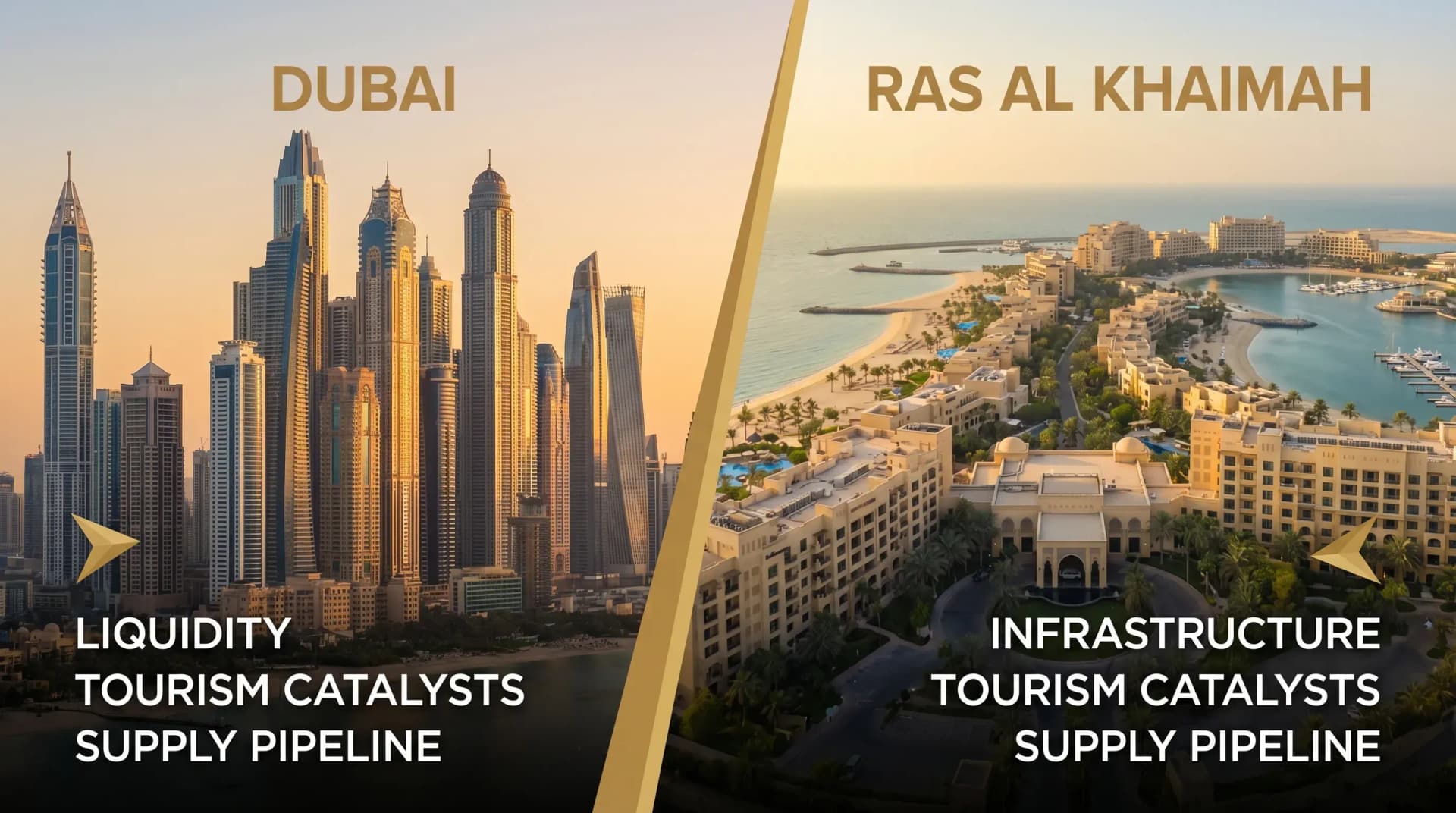
Ras Al Khaimah (RAK) and Dubai can both deliver capital appreciation, but they are powered by different “price engines”. Dubai is a global city market with deep liquidity and mature prime districts. RAK is an emerging premium destination market that is being re-rated as major tourism and infrastructure catalysts come online.
This guide breaks down what actually drives prices in RAK and Dubai, how to spot the difference between hype and fundamentals, and what investors should monitor in 2026.
What is property capital growth (and what it is not)
Capital growth is the increase in a property’s market value over time, excluding rental income.
- Capital growth is mostly about future willingness to pay (end users and investors) meeting scarce, desirable supply.
- Rental yield is about current cash flow.
In practice, the best UAE strategies often combine both, but if your goal is capital appreciation you need to analyse drivers that change perceptions of an area over a 3 to 7-year horizon.
The 7 fundamentals that move prices in RAK and Dubai
The same broad forces apply to both emirates, but their impact differs because Dubai is mature and segmented, while RAK is earlier-stage and more catalyst-led.
| Capital growth driver | What it is | How investors can measure it (practical signals) | Typical impact profile |
|---|---|---|---|
| End-user depth | Local and expat households buying to live, not just invest | Population inflows, job creation, school openings, commute improvements | Stabilises prices and reduces volatility |
| Tourism and branded demand | Visitor growth, hotel pipeline, branded residences, second homes | Hotel openings, tourism targets, major attractions, airline seat capacity | Can re-rate entire districts, especially waterfront |
| Supply discipline | How much comparable stock arrives, and how fast | Off-plan pipeline, handover schedules, inventory for sale and rent | Oversupply caps growth, scarcity accelerates it |
| Infrastructure delivery | Roads, public realm, airports, rail, utilities | Tender awards, construction milestones, opening dates | Pulls forward demand and raises “liveability” premiums |
| Regulation and transparency | Buyer protections, escrow, title systems, transaction process | Regulatory updates, enforcement activity, standardisation | Supports international capital and improves liquidity |
| Financing conditions | Mortgage rates, LTV rules, developer payment plans | Bank rate trends, eligibility for non-residents, payment-plan terms | Impacts affordability and buyer pools |
| Market narrative and liquidity | How easily you can resell, and to whom | Transaction volumes, broker depth, international marketing reach | Liquidity itself becomes a price premium |
If you want a shortcut, think of capital growth as a score. Areas that stack multiple drivers at once tend to outperform.
What drives property prices in Dubai
Dubai’s pricing is best understood as a collection of micro-markets. “Dubai property” does not move as one asset.
1) Global city premiums and wealth migration
Dubai benefits from strong international visibility, business formation, and lifestyle positioning. That translates into sustained demand for prime districts, especially where there is proven resale liquidity.
Dubai’s capital growth drivers are often strongest when:
- Global risk sentiment pushes buyers toward stable, internationally accessible hubs.
- New high-income residents arrive (corporate relocations, entrepreneurs, family offices).
- Prime supply is constrained relative to demand.
A practical investor view is that liquidity is a feature in Dubai. The ability to sell quickly, and to a broad buyer base, supports higher price floors.
2) District maturity, not just location
In Dubai, two properties can be 10 minutes apart and behave very differently.
Mature districts tend to command premiums because they already have:
- Completed infrastructure and public realm
- Established retail, schools, and community services
- Clear tenant profiles and proven absorption
This is why “almost ready” masterplans can still trade at a discount to fully matured ones, even when the brochure looks similar.
3) Supply segmentation and the prime scarcity effect
Dubai can build quickly, but prime, truly differentiated stock is still scarce.
Price growth tends to concentrate in segments where supply is limited by reality, for example:
- Waterfront or marina-front homes with protected views
- Ultra-prime branded residences with genuine global demand
- Low-density villa communities with high end-user appeal
In other words, Dubai’s upside often comes from uniqueness and micro-scarcity, not from general market shortage.
4) Short-term rental economics and lifestyle-led demand
Dubai’s tourism base and business travel also supports certain investor theses (especially where regulations and building rules allow efficient short-term letting). When nightly rates rise faster than operating costs, investors can pay more for assets, lifting sale prices.
For official market context, Dubai’s land and property regulation ecosystem is led by the Dubai Land Department and RERA frameworks, which are key to investor confidence.
What drives property prices in Ras Al Khaimah (RAK)
RAK is different. It is not trying to be “cheaper Dubai”. It is developing its own identity as a premium resort, lifestyle, and second-home market, while also deepening its resident base.
If Dubai is often priced like a global city, RAK can be priced like an emerging destination undergoing a re-rating.
1) Tourism catalysts that change the reference point
When a destination gains a globally recognised anchor project, the reference point for pricing shifts. Buyers start benchmarking the location against other international resort markets, not just neighbouring emirates.
In RAK, major tourism and hospitality investment is a core narrative, and the largest price impacts usually show up in:
- Waterfront zones closest to new attractions
- Branded and managed residences that align with incoming visitor profiles
- Communities with infrastructure that is visibly progressing, not just announced
Wynn Resorts has publicly confirmed its integrated resort development on Al Marjan Island, which you can follow via Wynn Resorts’ official updates.
2) The “affordability gap” to Dubai (and why it matters)
RAK’s relative value compared with Dubai can expand the buyer pool. When investors and second-home buyers feel priced out of Dubai’s prime segments, they look for the next market where:
- Entry prices are lower
- Upside is tied to visible catalysts
- Yields remain competitive
This does not mean prices only rise because they are “cheap”. The mechanism is that affordability plus catalysts can unlock new demand, which then meets limited comparable supply.
3) Supply discipline in premium waterfront communities
RAK’s strongest growth potential is typically linked to areas where:
- Freehold ownership is clear
- Masterplans control release phases
- Comparable waterfront inventory is limited
If supply remains phased and demand grows via tourism and new residents, pricing pressure can build rapidly.
4) Infrastructure and connectivity as a multiplier
Infrastructure in an emerging market does two things at once:
- It improves quality of life for residents (supporting end-user demand).
- It reduces “distance risk” for Dubai-linked professionals and frequent visitors.
Investors commonly track large national connectivity programmes such as Etihad Rail because faster inter-emirate travel can widen the practical commuter radius and increase the appeal of lifestyle-first markets.
For a RAK-specific perspective on how infrastructure links to investment outcomes, Azimira has also covered the topic in detail in its market research (see: RAK infrastructure spending and property impact).
5) Market re-rating and the “visibility effect”
As international awareness rises, RAK can experience a visibility-driven re-rating. This is not purely sentiment. Visibility tends to bring:
- More international broker attention
- More comparable sales evidence (supporting valuation confidence)
- Higher liquidity than the market previously had
This is one reason RAK investors often prioritise projects with strong developer credibility and clear differentiation, because those assets benefit most when the broader market gets discovered.
RAK vs Dubai: the key differences investors should underwrite
Both markets can grow, but they usually grow for different reasons. The biggest mistake is using Dubai assumptions to model RAK, or using emerging-market excitement to model Dubai.
| Topic | Dubai (typical behaviour) | RAK (typical behaviour) |
|---|---|---|
| Main price support | Deep end-user and investor demand, global hub premium | Catalyst-led re-rating, tourism growth, improving end-user depth |
| Liquidity | Generally higher, more frequent transactions | Improving, but varies sharply by project and location |
| Growth style | Segment-driven (prime pockets outperform) | Phase-driven (early entry into key masterplans can outperform) |
| Biggest risk | Overpaying for “me too” supply, assuming all districts behave the same | Buying the wrong project in the right story, or mistiming supply waves |
| Best performing assets (often) | Truly scarce stock in prime micro-markets | Differentiated waterfront, branded, or infrastructure-aligned communities |
If you want a deeper historical comparison, you may find Azimira’s analysis helpful: RAK vs Dubai capital growth back-test.
Where capital growth tends to concentrate: off-plan vs ready
Across the UAE, capital appreciation often clusters around information changes. When new certainty arrives, the market reprices.
That can happen at different stages:
- Pre-launch to early launch: developers price competitively to build momentum, and early buyers are compensated for uncertainty.
- Construction milestones: as delivery risk reduces, end-user and mortgage buyers participate more.
- Handover and operational proof: once the community is live, pricing can reflect real demand, real rents, and real comps.
Off-plan can be powerful for capital growth, but only when the fundamentals hold. If you want a practical due diligence framework, Azimira’s guide, Beyond the hype: off-plan investing in the UAE, is a strong companion piece.
A practical “price drivers” checklist for 2026 buyers
If you are trying to forecast property capital growth (rather than just hope for it), focus on leading indicators that change buyer behaviour.
- Supply reality: what is actually delivering in the next 12 to 24 months, not what is “announced”.
- Comparable evidence: are there real resales, or only developer asking prices.
- Infrastructure milestones: visible progress (roads, beachfront, retail, utilities) beats press releases.
- Demand composition: end users, second-home buyers, short-stay investors, each implies different resilience.
- Project-level differentiation: view protection, beach access, unit mix, service charges, management rules.
In RAK specifically, it also helps to track granular market movement rather than relying on general headlines. Azimira publishes regular updates such as the RAK Residential Index Tracker to help investors anchor decisions to data.

Common misconceptions that lead investors to overpay
“Prices rise because the UAE is growing”
The UAE can grow while specific sub-markets stagnate if supply is too heavy or if the product is undifferentiated. Always underwrite at the community and building level.
“RAK is the next Dubai, so it will copy Dubai’s path”
RAK can grow strongly without becoming Dubai. Its likely trajectory is more destination-led, resort-led, and waterfront-led. That changes what wins.
“Dubai is safe, so any Dubai deal is safe”
Dubai has higher liquidity, but that does not protect buyers from overpaying for poor layouts, weak micro-locations, or high recurring costs.
“Off-plan always outperforms”
Off-plan outperformance is conditional. Developer quality, escrow compliance, payment-plan structure, and market timing matter.
Frequently Asked Questions
What is the biggest driver of property capital growth in Dubai? Liquidity plus end-user depth. In practice, capital growth concentrates in differentiated prime micro-markets where supply is genuinely scarce.
What is the biggest driver of property capital growth in Ras Al Khaimah? Re-rating driven by tourism and infrastructure catalysts, especially in premium waterfront masterplans where supply is phased and demand is expanding.
Do interest rates matter for UAE property prices? Yes. Financing conditions affect affordability and buyer pool size, especially in markets and segments where mortgage buyers are a major share.
Is it better to buy off-plan for capital appreciation in RAK and Dubai? Off-plan can offer earlier entry pricing, but it adds delivery and market-cycle risk. The best results usually come from strong developers, clear differentiation, and realistic supply analysis.
How can I avoid buying into hype when a new mega-project is announced? Track what changes certainty: permits, construction progress, infrastructure delivery, comparable resales, and absorption. If nothing measurable is improving, price growth may be speculation.
Explore capital-growth opportunities with Azimira
If you are evaluating RAK and Dubai with capital growth in mind, the highest-value step is usually project selection and timing, not broad market debates.
Azimira specialises in curated off-plan opportunities and tailored investment strategies, with a particular focus on high-growth markets like Ras Al Khaimah. You can:
- Review Azimira’s approach to investing here: Real estate investment
- Speak with the team about your goals and risk profile via the Azimira website
If you come with your budget range, time horizon, and whether you prioritise growth, yield, or a blend, a specialist can help you map the most relevant communities and upcoming launches for your strategy.
Related articles
What Counts as Good Real Estate Investments in 2026
Learn what makes good real estate investments in 2026, from net yield and demand signals to legal checks, exit plans and UAE opportunities.

Investors Needed for Real Estate? Start With This Plan
Investors needed for real estate? Use this practical plan to define strategy, numbers, due diligence and partners before raising capital.

Investment Marketing Tactics Developers Use at Launch
Understand investment marketing tactics developers use at launch, from scarcity to incentives, and learn how to assess UAE off-plan deals.