
Real Estate Investment Strategies for High-ROI UAE Portfolios
Real estate investment strategies to build a high-ROI UAE property portfolio: allocation, off-plan tactics, rental models, risk controls and exit planning.
Most investors do not fail in the UAE because they picked a “bad” property. They fail because they built a portfolio without a plan, mixing time horizons, cash-flow profiles, and risks that do not belong together.
A high-ROI UAE portfolio is usually the outcome of three things done consistently well:
- Buying into the right demand engine (end users, tenants, tourism, corporate leasing)
- Structuring capital so you can hold through cycles (payment plans, leverage, reserves)
- Managing execution risk (developer quality, legal protections, operating costs, exit routes)
Below is a practical framework you can use in 2026 to design real estate investment strategies for high-ROI UAE portfolios, with particular attention to how experienced investors blend established markets (liquidity) with high-growth markets like Ras Al Khaimah (asymmetry).
1) Start with the only ROI definition that matters: net, risk-adjusted, and time-weighted
“High ROI” can mean very different things depending on whether you are buying ready property, off-plan, or building a multi-asset portfolio.
The ROI stack you should track
- Net rental yield: annual rent after realistic operating costs, divided by total cash invested.
- Cash-on-cash return: net annual cash flow divided by cash deployed (especially relevant if you use leverage or staged off-plan payments).
- Total return: net cash flow plus capital appreciation.
- IRR (Internal Rate of Return): the most useful metric when cash flows are uneven (typical in off-plan payment schedules).
If you only track headline gross yields, you will overestimate performance. A better habit is to build one “single source of truth” model per property and update it quarterly.
For ROI modelling basics and cost items investors often miss, see Azimira’s guide on projecting UAE real estate ROI.
2) Match strategy to your investor profile (not the other way around)
High-ROI portfolios are built by aligning each acquisition to a role inside the portfolio. That role depends on your constraints: liquidity needs, risk tolerance, residency goals, and how active you want to be as an owner.
| Investor goal | What “high ROI” usually looks like | Core strategy | Common mismatch to avoid |
|---|---|---|---|
| Capital growth | Appreciation, upgrade cycle, market repricing | Early-cycle locations, off-plan entry, branded or waterfront scarcity | Overpaying for “finished” assets when you need growth |
| Income now | Stable occupancy, predictable net yield | Ready or near-completion units, long-let focus, conservative leverage | Off-plan only, then being forced to sell before stabilised |
| Balanced | Growth plus income, smoother volatility | Mix of off-plan and ready, mix of emirates and tenant profiles | Owning 3 similar units in 1 micro-market |
| Lifestyle + investment | Utility plus wealth-building | Prime community choice, quality finishes, resale liquidity | Buying purely for views or brand, ignoring service charges |
| Residency-linked (e.g., Golden Visa) | Portfolio that also supports long-term plans | Align property value, ownership structure, timelines | Treating residency as an afterthought in deal selection |
If residency is part of the plan, always verify the latest eligibility and documentation rules via official sources (for example, u.ae on the Golden Visa) and seek professional advice where required.
3) Build a UAE allocation model: diversify by emirate, micro-market, and cycle stage
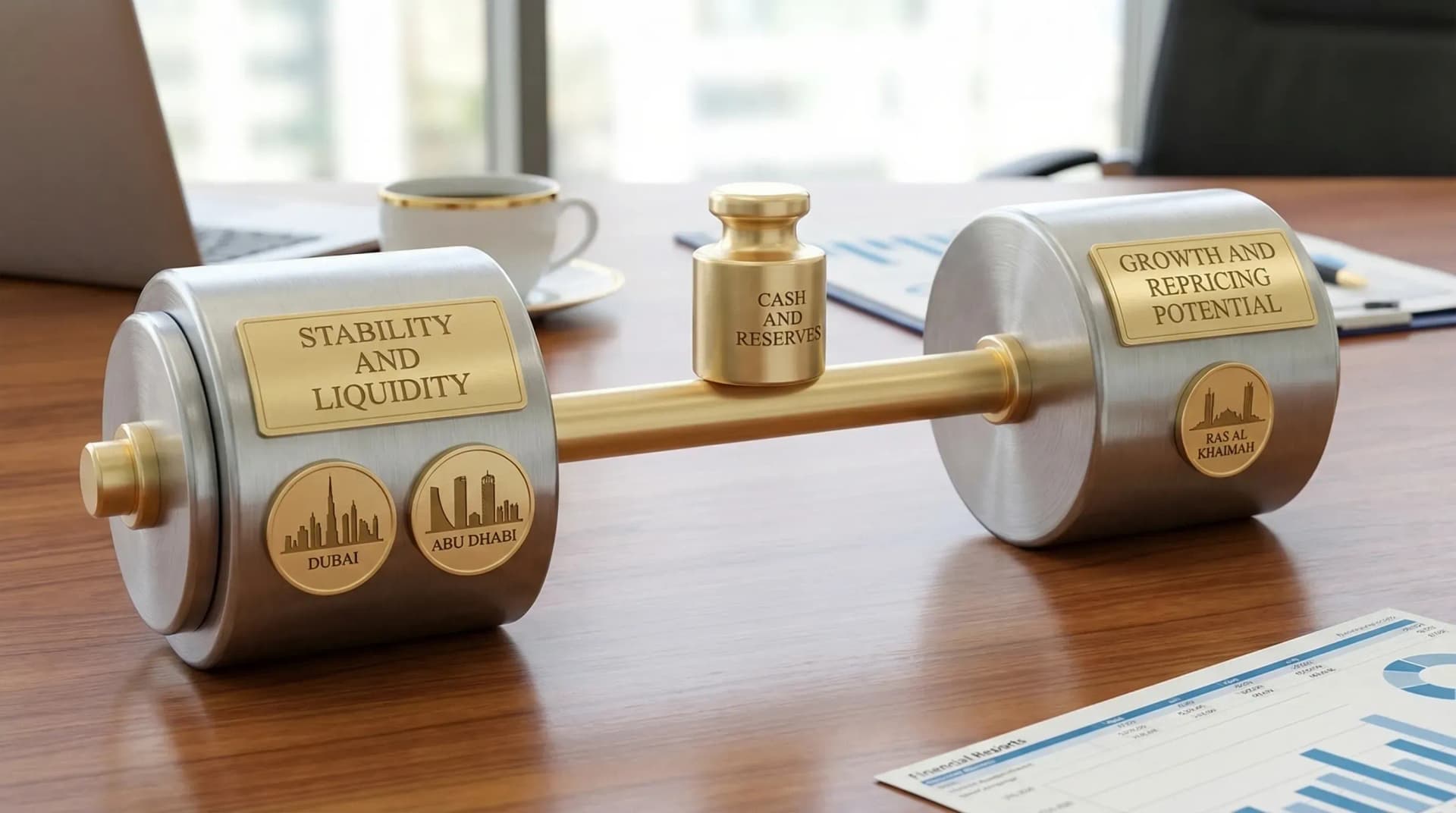
A common high-performance structure in the UAE is a barbell portfolio:
- One side prioritises liquidity and depth (easier resale, broader tenant pools).
- The other side targets asymmetric growth (earlier-cycle markets, infrastructure-led repricing).
How to think about the UAE’s “three-engine” approach
- Dubai often provides liquidity, global demand, and a deep resale market.
- Abu Dhabi can suit investors who prioritise institutional stability and long-term occupancy dynamics.
- Ras Al Khaimah (RAK) is increasingly used as the growth sleeve, where early-cycle pricing, tourism expansion, and new destinations can drive outsized appreciation (with the right project selection and risk controls).
Azimira’s own Q1 2026 investor sentiment research highlights how strongly investors continue to prioritise off-plan exposure and emerging high-growth segments, including RAK, especially in branded and sustainability-aligned product.
The key is not choosing “the best emirate”. It is choosing the best portfolio mix for your constraints, then executing repeatedly.
4) Use off-plan as a return enhancer, but underwrite the risks like a professional
Off-plan can be one of the most powerful levers for ROI in the UAE because it can combine:
- Earlier entry pricing versus completed stock
- Staged payment plans that improve capital efficiency
- Potential appreciation during construction
But off-plan returns are highly dependent on execution: developer performance, contract terms, escrow compliance, and realistic timeline buffers.
If you want a deeper (non-hype) orientation, Azimira has a detailed reference on off-plan investing in the UAE.
A practical off-plan underwriting checklist (portfolio-level)
Underwrite each off-plan purchase as if it were a small business, not just a unit.
| Underwriting area | What to verify | Why it affects ROI |
|---|---|---|
| Developer quality | Track record, delivery history, build quality signals, after-sales | Delivery risk and resale liquidity are return multipliers |
| Escrow and registration | Proper escrow structure and compliant payment process | Protects capital and reduces legal tail risk |
| Payment plan realism | Instalments vs your income and FX plan | Avoid forced sale due to cash-flow mismatch |
| Specification risk | What is guaranteed vs “artist impression” | Fit-out gaps reduce rentability and resale |
| Exit optionality | Assignment rules, resale restrictions, fees | Optionality increases IRR resilience |
A subtle but important point: off-plan should rarely be 100 percent of a portfolio unless you have significant liquidity and a long horizon. Most investors perform better with at least one stabilised, income-producing asset alongside the growth sleeve.
5) Choose the right rental model for the asset (long-let, short-stay, or hybrid)
Rental strategy is not a marketing choice, it is an operating model. Your costs, vacancy profile, regulation, and management intensity all change depending on the letting approach.
When long-let tends to win (risk-adjusted)
Long-let often suits portfolios prioritising predictable net yield, lower operational complexity, and steadier tenant behaviour (especially for family-oriented communities).
When short-stay can outperform
Short-term rentals can outperform when you have:
- A location with consistent tourism or event demand
- A property spec that competes in the premium segment (views, amenities, finishes)
- Professional operations (pricing, cleaning, guest experience, compliance)
If you are comparing models, use a single calculator and run conservative scenarios (base case, downside occupancy, and high-cost maintenance years). Azimira offers a useful starting point with its STR vs long-let ROI calculator guide.

6) Optimise your capital stack: payment plans, leverage, and reserves
The UAE rewards investors who treat financing as part of the strategy, not an afterthought.
Three capital approaches, and where they fit
All-cash can maximise flexibility and reduce forced-sale risk, but it can also concentrate risk if you over-allocate to a single market or timing window.
Bank mortgage can improve cash-on-cash returns, but only when the property can carry the debt under conservative assumptions (including rate increases, void periods, and maintenance shocks).
Developer payment plans (off-plan) can be a strategic weapon when they match your liquidity profile. The mistake is treating low upfront payments as “affordability”. You still owe the full price, and your portfolio needs a plan for each milestone.
The stress test high-ROI investors actually run
Before you buy, model these three scenarios:
- Downside rent: achievable rent is lower than expected.
- Higher costs: service charges, maintenance, or insurance rise.
- Timeline slippage: handover is delayed, pushing back rental income.
If the deal only works in the best case, it is not a high-ROI strategy, it is a high-risk bet.
7) Stop ROI leakage: the costs that quietly erase “great yields”
In most UAE portfolios, underperformance comes from avoidable leakage, not from catastrophic events.
Here is a practical cost map to include in your underwriting.
| Cost category | Examples | How to control it |
|---|---|---|
| One-off acquisition and admin | Registration, valuation, legal review, bank fees (if financing) | Budget upfront, confirm fee schedules, use a checklist |
| Recurring building costs | Service charges, common area fees | Compare projects, ask for historic schedules where available |
| Utilities and lifecycle | AC servicing, appliance replacement, water damage prevention | Preventative maintenance schedule, contingency reserve |
| Rental operations | Vacancy, letting fees, management fees, furnishing refresh | Choose the right rental model and manager, track KPIs |
| Compliance and insurance | Landlord insurance, liability, required permits (where relevant) | Insure to the right spec, keep documentation current |
This is also where “premium” units can outperform: higher-quality build and better tenant experience often reduces vacancy and maintenance friction, which improves net returns.
8) Build around scarcity premiums (the ROI accelerator in UAE luxury markets)
In 2026, two scarcity themes continue to matter across UAE prime segments:
- Waterfront and view-protected product (scarcity is physical)
- Branded and sustainability-aligned residences (scarcity is reputational plus regulatory plus demand-driven)
This does not mean every investor should chase branded property. It means you should understand what drives the resale and rental bid in your target tenant and buyer pool.
A practical rule: if you pay a premium, write down exactly how you expect to earn it back (higher rent, lower vacancy, stronger resale liquidity, or faster appreciation). If you cannot articulate the mechanism, you are speculating.
9) Portfolio operations: treat it like a fund, not a collection
Once you own multiple units, the “strategy” becomes operational discipline.
The KPI dashboard to review quarterly
- Occupancy (or void days) and renewal rates
- Achieved rent vs underwritten rent
- Net yield after all operating costs
- Maintenance spend versus budget, and upcoming capex
- Financing metrics if leveraged (rate reset dates, cash buffer)
- Market comparables for resale and rent, by micro-market
Azimira’s platform positioning includes investment performance tracking. Even if you track manually, the point is the same: measure what matters, and act early (for example, reprice rent to reduce vacancy, refinance only if break-even is clear, or rotate out of a weakening micro-market).
10) A simple “high-ROI” UAE portfolio blueprint (that scales)
If you want a clean starting point, this structure is common among disciplined investors:
- Anchor (growth): one off-plan or early-cycle asset chosen for location scarcity and strong end-user appeal.
- Engine (income): one ready or near-completion unit that can stabilise cash flow.
- Diversifier (risk control): a different emirate, tenant type, or product segment to reduce correlation.
The exact mix depends on your liquidity, timeline, and risk tolerance. What matters is that each property has a job, and the jobs complement each other.
Frequently Asked Questions
What are the best real estate investment strategies for a high-ROI UAE portfolio in 2026? The strongest strategies combine clear ROI measurement (net yield and IRR), diversified allocation across emirates and cycle stages, disciplined off-plan underwriting, and an operating plan that protects net returns.
Is off-plan always higher ROI than ready property in the UAE? Not always. Off-plan can improve IRR through early entry and staged payments, but ready property can outperform on risk-adjusted returns if it stabilises income faster and avoids delivery risk.
Should I focus my portfolio on one emirate or diversify across the UAE? Many investors diversify across the UAE to reduce concentration risk. A common approach is to balance liquidity-driven markets with a smaller growth sleeve in emerging markets, based on your risk tolerance.
How do I choose between short-term rental and long-let strategies? Choose based on location demand, property specification, your appetite for operational intensity, and compliance requirements. Always model net returns under conservative occupancy and cost assumptions.
What’s the biggest mistake investors make when targeting “high ROI” in the UAE? Underwriting gross returns and ignoring leakage. Service charges, voids, maintenance, furnishing cycles, and financing terms can materially change the realised net yield.
Build a high-ROI UAE portfolio with a strategy (and access) advantage
If you want your next UAE acquisition to play a precise role in a high-ROI portfolio, the fastest way to reduce mistakes is to combine market intelligence with vetted access.
Azimira specialises in connecting investors with curated off-plan opportunities in high-growth UAE markets, including Ras Al Khaimah, with expert guidance, exclusive pre-launch access, and tailored investment strategies.
Explore Azimira’s approach at azimira.com or start with the investment page and request a confidential portfolio strategy discussion.
Related articles
What Counts as Good Real Estate Investments in 2026
Learn what makes good real estate investments in 2026, from net yield and demand signals to legal checks, exit plans and UAE opportunities.

Investors Needed for Real Estate? Start With This Plan
Investors needed for real estate? Use this practical plan to define strategy, numbers, due diligence and partners before raising capital.

Investment Marketing Tactics Developers Use at Launch
Understand investment marketing tactics developers use at launch, from scarcity to incentives, and learn how to assess UAE off-plan deals.