
Real Estate Project Investment: How to Vet a Launch Early
Real estate project investment checklist: vet early launches with developer, escrow, pricing, demand and exit checks before reserving.
Early access is powerful in off-plan real estate, but it is only valuable when you know what you are getting early access to. A well-timed reservation in a high-quality launch can secure better inventory, stronger payment terms and a lower entry price. A rushed reservation in an overhyped project can lock capital into a weak location, unclear contract or unrealistic return story.
That is why real estate project investment should start before the public launch, not after the sales event has already created urgency. The objective is not to predict the future perfectly. It is to decide, with discipline, whether a project deserves your capital before emotion, scarcity language and glossy renders take over.
This guide explains how to vet a launch early, particularly in fast-moving UAE markets such as Ras Al Khaimah, where premium off-plan projects, tourism catalysts and limited early inventory can create genuine opportunity for selective investors.
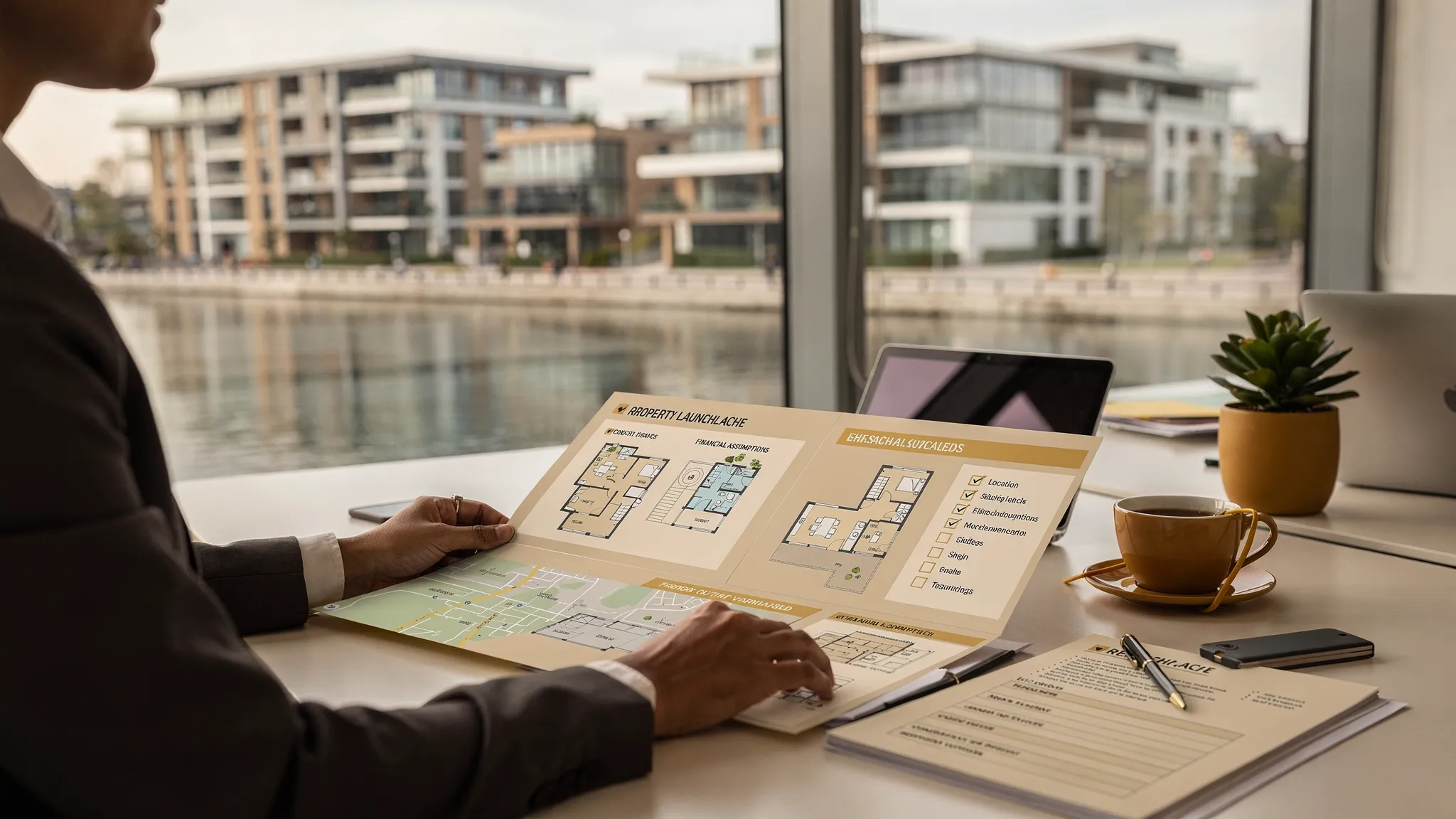
What “vetting a launch early” really means
Vetting a launch early does not mean relying on rumours, agent excitement or one attractive payment plan. It means building a clear view of the project before you place a reservation, sign an expression of interest or commit to the Sale and Purchase Agreement.
In most off-plan launches, investors move through several stages. Each stage has different information quality and different decision pressure.
| Launch stage | What investors usually see | What you should decide |
|---|---|---|
| Teaser phase | Location hints, developer name, unit mix, early price indications | Is the market and developer worth deeper review? |
| Pre-launch access | Floor plans, provisional pricing, payment plan, early allocation | Which unit types and price bands are investable? |
| Public launch | Full brochure, sales event, stronger competition for inventory | Are you acting on analysis or urgency? |
| Reservation | Booking form, initial payment, allocation confirmation | Do the terms match what was represented? |
| SPA stage | Contract, payment schedule, legal obligations | Are the risks acceptable before binding commitment? |
The earlier you start, the more leverage you have. You can compare alternatives calmly, request missing information, decide your walk-away price and avoid competing for whatever inventory remains.
Start with the market thesis, not the brochure
A project can look exceptional in isolation and still be a poor investment if the market thesis is weak. Before reviewing finishes, amenities or launch incentives, ask why this location should grow.
In the UAE, a credible market thesis usually combines several factors: population growth, tourism expansion, infrastructure delivery, employment creation, limited comparable supply and improving end-user demand. In Ras Al Khaimah, for example, investors often look at waterfront lifestyle demand, hospitality-led growth, master-planned communities and relative value compared with more mature emirates.
The key is to separate broad optimism from evidence. “This area is the next big thing” is not enough. You want to know what demand exists today, what will realistically increase it, and whether supply could dilute returns before your intended exit.
A simple early test is to write the investment thesis in one paragraph. If it depends on only one future event, one celebrity brand or one unverified infrastructure claim, it is fragile. If it rests on multiple reinforcing drivers, it deserves deeper underwriting.
For a broader framework on aligning property with investment objectives, see Azimira’s guide to real estate and investments in the UAE.
Verify the developer before you verify the deal
In off-plan investment, the developer is one of the biggest risk variables. A strong launch price means little if delivery quality, timeline discipline or after-sales service is poor.
Early-stage investors should assess the developer like a lender would. The question is not simply whether the developer is known. The question is whether they have the capability, capital discipline and track record to deliver this specific project at the promised quality level.
Look for evidence in four areas:
- Completed projects with similar scale, specification and buyer profile.
- Handover history, including delays, defect resolution and post-handover management.
- Financial and construction credibility, including contractor selection and project funding structure.
- Regulatory compliance, including project registration, escrow arrangements and required authority approvals.
Do not rely only on awards, renders or a prestigious sales gallery. Ask for completed project references, visit older developments where possible, speak to owners and compare promised finishes with delivered finishes.
If the project is in Ras Al Khaimah or another UAE emirate, your due diligence should include checking the relevant property authority process, escrow requirements and ownership framework. A reputable advisor should be able to explain what is registered, what is still pending and what must be verified before you sign.
Stress-test the location at street level
A strong emirate or district does not guarantee a strong unit. Real estate performance is often decided by micro-location, the exact road access, view corridor, surrounding plots, walkability, beach access, noise exposure, parking, future construction and proximity to daily needs.
When vetting a launch early, map the project as if you were a future tenant or buyer. How will someone reach it? What will they see when they arrive? What comparable buildings will compete with it? What will exist within a 5, 10 and 20-minute drive by the time the project completes?
If the demand thesis depends on families, schools, healthcare and daily retail matter. If it depends on tourism, beach access, hotel clustering, short-stay regulation and operator quality matter. If it depends on professionals, commute times, business districts and long-let convenience matter.
For international investors, this is where it helps to think beyond property marketing and study how people actually relocate. Families choosing a new country often prioritise practical settlement factors such as rentals, school access and suburb fit. Services offering rental and school support for relocating families illustrate the same principle investors should apply to any market: real demand is driven by lived convenience, not brochure language.
Analyse launch pricing like a secondary-market buyer
Launch pricing can be attractive, fair or inflated. The only way to know is to compare it against what a rational buyer might pay later.
Many investors make the mistake of comparing the launch price only with the developer’s next planned price increase. That is not enough. A staged price increase within the same sales campaign does not prove market value. It proves the developer’s pricing strategy.
Instead, compare the launch price with:
- Recent ready-property transactions in the nearest comparable communities.
- Similar off-plan launches at equivalent completion timelines.
- Price per square foot adjusted for view, floor, layout efficiency and payment plan.
- Expected service charges and ownership costs after handover.
- The resale price a buyer would need to pay for you to exit profitably.
Payment plans also affect pricing. A 60/40 or post-handover plan may justify a higher headline price if it improves cash-flow and reduces financing pressure. A low deposit can look attractive but still be poor value if the price per square foot is stretched or later instalments are clustered too aggressively.
Your early rule should be simple: do not buy because the unit is cheaper than tomorrow’s price list. Buy because today’s price still works under conservative resale, rental and cost assumptions.
Read the payment plan as a risk document
A payment plan is not just a convenience feature. It determines your liquidity risk, currency exposure, opportunity cost and ability to hold through delays.
For international buyers, staged payments can be helpful because they reduce upfront capital deployment. They can also create problems if payments arrive during unfavourable currency movements or if the investor has not reserved enough liquidity for fees, service charges, furnishing and post-handover set-up.
When reviewing a payment plan early, check whether instalments are linked to dates, construction milestones or a mix of both. Milestone-linked payments can feel safer, but you still need to understand exactly how milestones are certified. Date-linked plans can be easier to forecast, but they may create pressure if construction progress and payments become misaligned.
A good early launch model should include your total cash requirement, not just the booking amount. Include reservation, registration, agency fees if applicable, legal review, currency transfer costs, furnishing, snagging, insurance, service charges, management fees and a contingency reserve.
Azimira’s off-plan property investment timeline is useful if you want to see how payments, documentation and handover steps typically fit together.
Vet the unit, not just the project
In a popular launch, investors often focus on securing “a unit” rather than the right unit. That is risky. Two units in the same project can have very different liquidity, rental appeal and capital growth potential.
Unit-level due diligence should include layout efficiency, view protection, floor height, orientation, balcony usability, lift proximity, parking allocation, noise exposure and furnishing practicality. In resort-led or waterfront markets, view and orientation can materially affect both resale demand and short-stay performance.
The best unit is not always the most expensive. Sometimes a mid-floor unit with a clean layout and partial view can outperform a premium-view unit that has an excessive price uplift. Sometimes a smaller unit delivers stronger yield, while a larger unit offers better end-user liquidity. The right answer depends on your goal.
Use this simple filter before reserving:
| Investor goal | Unit features to prioritise | Features to treat carefully |
|---|---|---|
| Capital growth | Scarcity, protected views, strong floor plan, premium stack | Overpaying for cosmetic upgrades |
| Rental income | Efficient layout, practical furnishing, tenant convenience | Large unusable spaces that raise cost |
| Short-stay strategy | View, balcony, amenity access, guest-friendly location | High service charges and weak operator support |
| Owner-occupier use | Liveability, parking, storage, community facilities | Layouts designed only for investor brochures |
| Resale flexibility | Broad buyer appeal, sensible size, clean documentation | Highly niche units with limited buyer pool |
Review the legal and commercial terms before launch pressure peaks
The biggest mistake in early-stage real estate project investment is treating legal review as something that happens after the emotional decision has already been made.
Before paying a reservation or signing an expression of interest, understand what that document actually does. Is the amount refundable? Under what conditions? How long is the allocation held? What happens if the final SPA differs from the sales presentation? What if mortgage approval, funds transfer or KYC checks take longer than expected?
At SPA stage, investors should pay close attention to delivery timelines, grace periods, delay remedies, variation clauses, assignment rules, payment default consequences, service charge obligations, handover conditions and dispute resolution mechanisms.
This is not a place to rely on verbal reassurance. If a point matters to your investment case, it should be reflected clearly in the documents or reviewed by a qualified professional.
For a wider due-diligence checklist, see Azimira’s guide on off-plan property in the UAE.
Build three return scenarios before you reserve
Early launches often sell the upside case. Your job is to model the base case and downside case.
A good model does not need to be complicated, but it must be honest. Include all acquisition costs, staged payments, expected service charges, furnishing, management, vacancy, financing costs if applicable and realistic resale costs. Then test what happens if rental income is lower than expected, completion is delayed or resale values grow more slowly than the brochure implies.
| Scenario | What to assume | What it tells you |
|---|---|---|
| Upside case | Strong market growth, timely handover, high occupancy, successful premium positioning | Whether the opportunity is exciting enough to pursue |
| Base case | Moderate growth, normal costs, realistic rent, standard vacancy | Whether the deal works without perfect conditions |
| Downside case | Delay, softer rents, higher costs, weaker resale liquidity | Whether you can afford to hold and still protect capital |
If the deal only works in the upside case, it is speculation. If it works in the base case and survives the downside case, it may be investable.
Use an early launch scorecard
A scorecard prevents you from being swayed by one impressive feature. It also helps compare several projects with the same discipline.
Score each category from 1 to 5, then weight the categories according to your goal. A growth investor may place more weight on market thesis and scarcity. An income investor may place more weight on rental demand and operating costs.
| Category | Weight for most investors | Early vetting question |
|---|---|---|
| Market thesis | High | Are demand drivers broad, verifiable and likely to strengthen by handover? |
| Developer quality | High | Has the developer delivered comparable projects well? |
| Legal and escrow clarity | High | Are registration, escrow and contract terms clear before commitment? |
| Pricing discipline | High | Does the launch price work against external comparables, not just future price lists? |
| Unit quality | Medium to high | Does the specific unit have liquidity, liveability and rental appeal? |
| Payment structure | Medium | Can you meet all payments comfortably under currency and cash-flow stress? |
| Exit strategy | High | Who is the likely future buyer or tenant, and why will they choose this asset? |
| Operational costs | Medium | Do service charges, furnishing and management costs preserve net returns? |
A project does not need a perfect score. It does need a clear reason why the expected return justifies the risks you are accepting.
Red flags that should slow you down
Some early launches deserve urgency. Others create urgency because the fundamentals are weak. Slow down if you see any of the following signs:
- The sales story relies on guaranteed returns without clear assumptions, operator details or contractual support.
- The developer cannot provide evidence of registration, escrow arrangements or authority approvals at the relevant stage.
- Comparable pricing is avoided, replaced by vague claims about future appreciation.
- The payment plan looks easy upfront but creates heavy instalments before your liquidity is ready.
- The best inventory is unavailable, yet remaining units are marketed as equally scarce.
- The SPA review is discouraged or compressed into an unrealistic deadline.
- Service charges, furnishing costs or management obligations are not discussed until late in the process.
A red flag does not always mean “walk away”. It does mean “do not proceed until this is resolved”.
What to do in the first 72 hours of a launch
Fast-moving launches require preparation. The first 72 hours should not be spent learning the basics. They should be used to confirm whether the project matches a plan you already built.
- Confirm your investment mandate: Define your target return, hold period, liquidity limits, preferred unit type and maximum all-in exposure before reviewing allocations.
- Request the core document pack: Ask for floor plans, payment schedule, project details, reservation terms, registration information, escrow details where applicable and draft SPA timing.
- Rank units before negotiating: Create a shortlist of preferred stacks, floors and layouts so you do not accept a weaker unit under time pressure.
- Run your base and downside numbers: Model net yield, cash required, resale breakeven and delayed-handover tolerance before paying a reservation.
- Document every representation: Keep written records of pricing, incentives, handover expectations, service charge estimates and refund terms.
The investor who has already done the work can move quickly without being reckless. The investor who has not done the work often confuses speed with conviction.
How Azimira helps investors vet launches early
Azimira focuses on connecting investors and buyers with curated off-plan property opportunities in the UAE, with particular attention to high-growth markets such as Ras Al Khaimah. Early launch access is only valuable when paired with disciplined analysis, which is why investors should combine opportunity sourcing with developer checks, market context, unit comparison and realistic return modelling.
For clients evaluating a new launch, Azimira can support the process with expert market insight, curated project shortlists, pre-launch access where available, tailored investment strategies and ongoing client support. The goal is not to chase every launch. It is to identify the launches where timing, quality, pricing and investor objectives align.
If you are still shaping your wider acquisition criteria, Azimira’s investment property checklist for UAE buyers is a useful companion to this launch-specific framework.
Frequently Asked Questions
What is the biggest mistake investors make when vetting a property launch? The biggest mistake is analysing the brochure before analysing the fundamentals. Start with market demand, developer credibility, pricing comparables, legal protections and exit strategy. A beautiful project can still be a weak investment if those elements do not hold up.
How early should I start due diligence on an off-plan launch? Ideally, start during the teaser or pre-launch phase, before public allocation begins. This gives you time to verify the developer, compare pricing, rank unit types and set a walk-away price before sales pressure increases.
Is pre-launch access always better than buying after launch? Not always. Pre-launch access can offer better inventory and pricing, but only if the project is sound. If information is incomplete, pricing is inflated or legal terms are unclear, waiting may be safer than moving early.
What documents should I request before reserving a unit? Ask for the payment plan, floor plan, unit details, reservation terms, developer credentials, project registration information, escrow details where applicable and the expected SPA timeline. For any binding commitment, seek qualified legal review.
How do I know if a launch price is fair? Compare it with ready-property transactions, similar off-plan launches, price per square foot, payment-plan value, expected service charges and your likely resale breakeven. Do not rely only on the developer’s future price increase as proof of value.
Can international investors vet a UAE launch remotely? Yes, but remote investors need a structured process: independent comparables, verified documentation, video or third-party site checks, legal review, secure payment routing and a clear post-handover management plan.
Vet your next launch with confidence
The best real estate project investment decisions are made before the crowd arrives. By the time a launch is public, disciplined investors should already understand the market thesis, the developer, the price, the unit hierarchy, the legal terms and the exit plan.
If you want early access without relying on hype, Azimira can help you evaluate curated UAE off-plan opportunities with market-led due diligence and a strategy matched to your goals. Explore opportunities at Azimira or speak with the team about your next Ras Al Khaimah investment shortlist.
Related articles
What Counts as Good Real Estate Investments in 2026
Learn what makes good real estate investments in 2026, from net yield and demand signals to legal checks, exit plans and UAE opportunities.

Investors Needed for Real Estate? Start With This Plan
Investors needed for real estate? Use this practical plan to define strategy, numbers, due diligence and partners before raising capital.

Investment Marketing Tactics Developers Use at Launch
Understand investment marketing tactics developers use at launch, from scarcity to incentives, and learn how to assess UAE off-plan deals.