
Real Estate and Investments: How UAE Property Fits Your Plan
Real estate and investments guide: learn how UAE property can fit your plan, from goals and risk to strategy selection, due diligence, and portfolio sizing.
Most people approach real estate and investments backwards: they fall in love with a market headline, then try to justify the purchase.
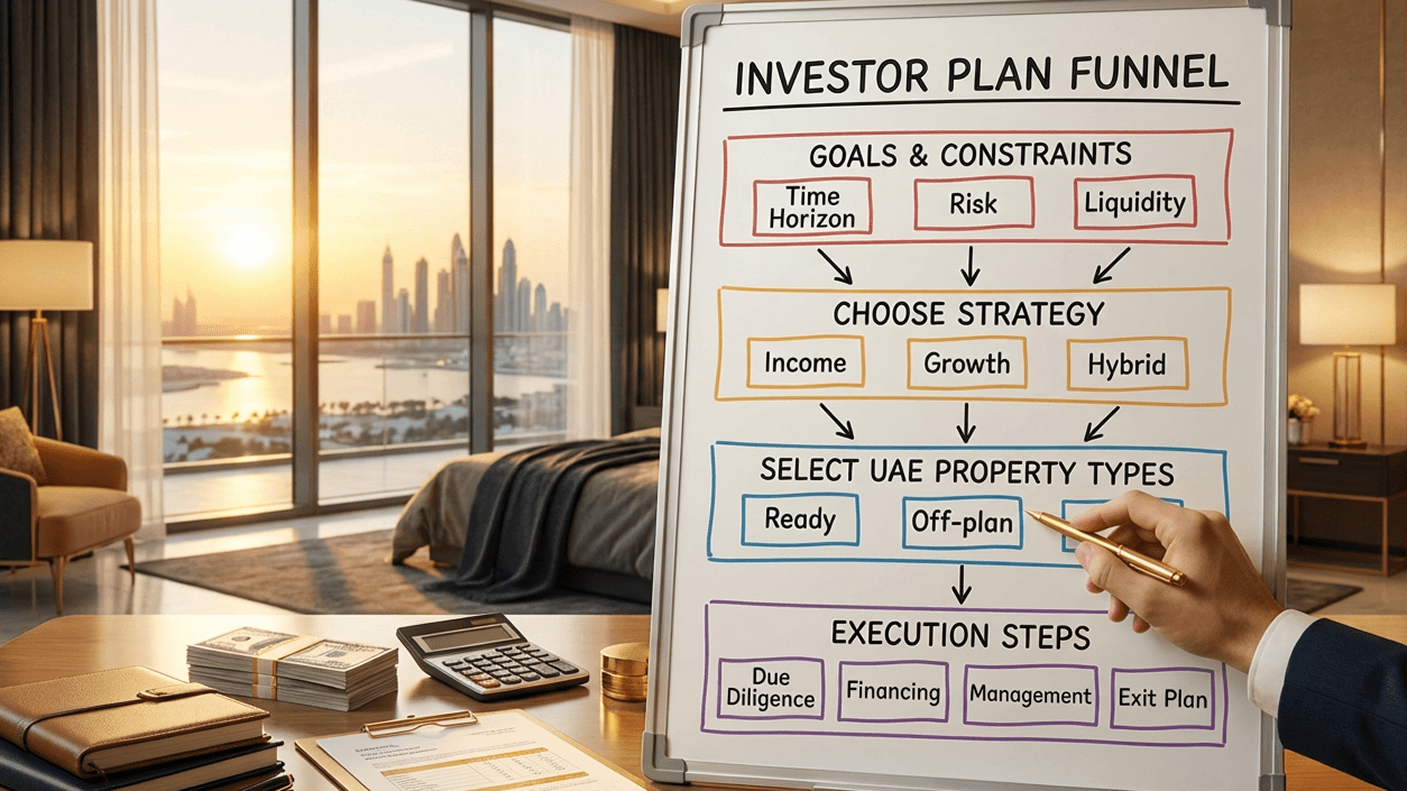
A better approach is the opposite. Start with your plan (time horizon, risk, income needs, and liquidity), then decide whether UAE property is the right tool. When you do that, the UAE can make a lot of sense, especially if you want a mix of capital growth potential, income, and international diversification.
Start with your investment plan (before you look at listings)
UAE property can play very different roles depending on what you need from it. Before you compare projects, get clear on four inputs that drive every good decision.
1) Your objective: growth, income, lifestyle, or a blend
Property is one of the few assets that can be:
-
A growth asset (buy early, benefit from development and market expansion)
-
An income asset (rent-driven cashflow)
-
A lifestyle asset (second home, relocation optionality)
The UAE, in particular, can also support a residency strategy for eligible investors (rules and thresholds change over time, so verify via official channels such as the ICP or consult a licensed adviser).
2) Your time horizon and liquidity tolerance
Real estate is inherently less liquid than listed investments. Even in active markets, selling typically involves marketing time, negotiation, transfer processes, and transaction costs.
As a rule of thumb:
-
0 to 2 years: property is usually a poor fit unless you are highly confident on exit liquidity and costs.
-
3 to 7 years: often the most practical window for capturing development completion, rental stabilisation, and area maturation.
-
8+ years: strongest match for compounding, multiple market cycles, and a “hold-quality” approach.
If liquidity matters to you, treat UAE property as a satellite allocation, not your entire plan.
3) Your risk profile (and what kind of risk you can actually tolerate)
“Risk” in property is not one thing. The UAE’s risk profile can look attractive on taxes and regulation, but you still need to price in:
-
Construction and delivery risk (for off-plan)
-
Market-cycle risk (pricing moves faster in some areas than others)
-
Tenant and vacancy risk
-
Currency exposure (if your home currency is not pegged to USD)
-
Concentration risk (one unit in one building is not diversification)
4) Your cashflow reality
Investors often over-focus on headline yields and under-focus on cashflow timing.
In the UAE, the cashflow shape differs by strategy:
-
Ready property: earlier rent, more immediate expenses, less “build-in” appreciation.
-
Off-plan: staged payments can reduce initial cash burden, but income typically starts at handover.
(If you want a deeper dive on return modelling, Azimira’s guide to projecting UAE ROI is a useful companion: How to Project Your Real Estate ROI.)
What UAE property can add to a diversified investment portfolio
When people talk about real estate and investments, they usually mean diversification. UAE property can contribute to that, but the “why” should be specific.
A distinct return driver: population, infrastructure, tourism, business formation
UAE property demand is influenced by structural drivers like:
-
Business and employment growth
-
Tourism and hospitality expansion
-
Infrastructure delivery (roads, airports, new districts)
These drivers do not always move in sync with UK, EU, or APAC housing cycles, which can be useful if your wealth is concentrated in one region.
A globally recognised tax environment (with an important caveat)
The UAE is widely known for having no personal income tax. For property investors, this can improve net outcomes compared to many high-tax jurisdictions.
Two caveats matter:
-
You still pay UAE transaction and ownership-related costs (registration, service charges, maintenance, insurance, and sometimes VAT depending on the asset type).
-
Your home country may tax worldwide income or capital gains depending on your tax residency.
If taxes are a key part of your plan, read Azimira’s overview: Complete Guide to UAE Property Tax, then validate your personal position with a cross-border tax professional.
Currency characteristics that can help (or hurt)
The UAE dirham is pegged to the US dollar. For some investors, that offers a form of currency stability versus floating currencies.
For others, it introduces risk. If your liabilities are in GBP, AUD, NZD, or SGD, you should treat FX as a first-class variable in your plan, not an afterthought.
If you expect staged off-plan payments, you can reduce unpleasant surprises by planning currency conversions in advance and using reputable providers.
An investable “access model” through off-plan
In many countries, buying pre-construction is risky or loosely regulated. The UAE has well-developed off-plan frameworks (including escrow mechanisms in relevant jurisdictions), but it still requires disciplined due diligence.
Off-plan can fit a plan when you want:
-
A staged payment structure
-
Early pricing in a growth corridor
-
The possibility of appreciation through construction and delivery
(For an off-plan reality check, see: Beyond the Hype: A Practical Guide to Off-Plan Investing in the UAE.)
Match your goal to the right UAE property strategy
The most expensive mistake is choosing a great property for the wrong objective.
Here is a practical mapping of common investor goals to UAE property approaches.
| Your primary goal | How UAE property can fit | Typical approach | What to measure (before you buy) |
|---|---|---|---|
| Near-term income | Turn capital into rent with manageable volatility | Ready properties in established communities, long-term leasing | Net yield after service charges, vacancy assumptions, tenant depth |
| Higher growth | Capture development and area maturation | Early-stage off-plan in high-growth corridors | Delivery track record, payment schedule, pipeline supply, resale liquidity |
| Balanced growth and income | Start with appreciation, move to income at handover | Off-plan with a clear post-handover rental plan | Stabilised rent assumptions, furnishing budget, management plan |
| Lifestyle plus optionality | Personal use with investment discipline | Prime locations, high liveability, flexible holding period | Total cost of ownership, resale depth, community maturity |
| Portfolio diversification | Add a non-home-market real asset exposure | One or two carefully sized allocations, sometimes across emirates | Concentration risk, FX exposure, exit plan, legal structure |
If your plan is specifically income-led, you may also want to consider operational models like serviced apartments, where the “yield story” depends heavily on management and occupancy. Azimira covers this model here: Serviced Apartments in RAK.
Make it investable: the due diligence layer that protects your plan
The UAE is not “low risk” by default. It becomes lower risk when you do the work.
Developer and project verification
For off-plan in particular, your outcome is tightly linked to execution quality. You want to validate:
-
Developer track record (delivered projects, delivery timeliness, quality)
-
Escrow and registration steps relevant to the emirate
-
Contract clarity (variation clauses, handover terms, penalties, snagging standards)
If you are worried about scams or too-good-to-be-true claims, use this checklist first: 4 Red Flags That Scream Property Scam in the UAE.
Cost realism (where returns are actually won or lost)
Two investors can buy the same unit and achieve very different outcomes based on costs.
Key cost categories to model include:
-
Registration and administrative fees
-
Service charges
-
Maintenance and sinking fund style reserves
-
Insurance
-
Utilities setup and ongoing usage assumptions
-
Letting and management fees
-
Furnishing (if targeting premium rentals or short-term strategies)
If you want to be systematic about ownership costs, Azimira’s budgeting guide helps: RAK Property Maintenance Costs.
Your management plan (especially if you live abroad)
Remote ownership is common in the UAE, but “set and forget” rarely works without a plan.
Decide upfront:
-
Long-term tenancy vs short-term licensing and operations
-
Who handles leasing, renewals, inspections, maintenance, and reporting
-
How you monitor performance against your expectations
(If remote buying is part of your plan, see: 5 Ways to Buy RAK Property Without Leaving Your Country.)
Your exit strategy (write it down before you commit)
An exit strategy is not just “sell in five years”. It is a defined set of triggers.
Examples:
-
Sell at handover if the market reprices significantly during construction
-
Hold for income once rents stabilise
-
Refinance (where available and sensible) to recycle capital
If you want a holding-period framework, Azimira has a dedicated guide: Exit Strategy Timeline.
Portfolio fit: sizing, leverage, and practical risk controls
Even if UAE property is attractive, your plan can fail if you size it poorly.
Avoid the concentration trap
Property feels diversified because it is “real”, but one unit is still a single asset with single-market risk.
Practical ways to reduce concentration risk:
-
Keep UAE property as a proportionate slice of your net worth
-
Prefer locations with multiple demand drivers (resident and tourism demand, employment access, infrastructure)
-
Build optionality (a unit that works for both long-term and short-term strategies tends to have broader resale demand)
Use leverage only if it strengthens your plan
Leverage can improve returns, but it can also turn a good deal into a forced sale if rates, vacancies, or your personal circumstances change.
Before you borrow, stress-test:
-
Interest rate increases
-
A vacancy period longer than expected
-
Currency movement against your home income
If you are comparing funding routes, Azimira’s RAK-focused overview is helpful: Developer Financing vs Bank Mortgage.
Maintain a reserve fund
A reserve fund is one of the simplest, most effective risk controls in property investing. It protects your plan from routine shocks like vacancy, repairs, or unexpected service charge changes.
Why Ras Al Khaimah is showing up in investor plans in 2026
Within the UAE, different emirates can serve different roles.
Ras Al Khaimah (RAK) is increasingly discussed as a “growth allocation” for investors who want exposure to:
-
A fast-developing tourism and lifestyle ecosystem
-
Major, high-profile projects that can accelerate destination demand
-
Entry pricing that can be more accessible than the most mature UAE submarkets
If you want a data-led view, Azimira publishes market outlooks and trackers, for example:
The key planning takeaway is simple: if you are investing in an “emerging growth” pocket, you should be more demanding on selection, timelines, and exit planning.

How Azimira supports investors building a UAE property allocation
If your conclusion is that UAE property fits your plan, execution matters.
Azimira focuses on connecting investors and buyers with curated off-plan opportunities in the UAE, with a particular focus on high-growth markets like Ras Al Khaimah. Depending on what you need, that can include:
-
Access to vetted projects and luxury inventory
-
Market insight and reports to support decision-making
-
Exclusive pre-launch opportunities (where available)
-
Tailored investment strategy support and dedicated client guidance
If you want a conversation that starts with your plan, not a sales pitch, you can explore Azimira’s approach at Azimira and then decide whether to request a consultation.
A simple way to decide if UAE property belongs in your plan
If you are weighing real estate and investments in 2026, UAE property can be a strong addition when it is:
-
Aligned to a clear objective (growth, income, lifestyle, or a defined blend)
-
Structured around your constraints (liquidity, cashflow timing, currency)
-
Protected by process (developer due diligence, cost modelling, management, and an exit plan)
If you want to move from interest to action, start by modelling one realistic scenario (not a best-case), shortlist two or three projects that fit that scenario, and validate the assumptions with a specialist who knows the micro-market.
Related articles
What Counts as Good Real Estate Investments in 2026
Learn what makes good real estate investments in 2026, from net yield and demand signals to legal checks, exit plans and UAE opportunities.

Investors Needed for Real Estate? Start With This Plan
Investors needed for real estate? Use this practical plan to define strategy, numbers, due diligence and partners before raising capital.

Investment Marketing Tactics Developers Use at Launch
Understand investment marketing tactics developers use at launch, from scarcity to incentives, and learn how to assess UAE off-plan deals.