
Off Plan Investment: How to Reduce Risk and Raise Returns
Off plan investment guide: reduce UAE off-plan risk with escrow checks, developer due diligence, smarter payment plans, and proven return levers.
Off plan property can be one of the most capital-efficient ways to build a UAE real estate position, but only if you treat it like an underwriting exercise, not a brochure decision. The same features that can lift returns (buying early, long construction runways, staged payments) also create specific risks (delivery delays, specification drift, liquidity constraints, counterparty exposure). This guide shows how to reduce risk and raise returns with a disciplined off plan investment process.
Start with a risk-adjusted plan (before you look at projects)
Most off plan mistakes happen before the first viewing, when investors skip the two questions that drive every good decision:
- What is the job of this property in my portfolio? (pure capital growth, growth plus income at handover, Golden Visa alignment, lifestyle plus yield)
- What risk can I tolerate and where? (construction risk, market risk, developer risk, currency risk, financing risk)
A simple way to avoid “deal drift” is to set three non-negotiables:
- Time horizon: how long you can hold if the market slows (and whether you can wait until handover).
- Cashflow comfort: the maximum monthly or quarterly cash outlay you can sustain if rents are delayed.
- Exit routes: the realistic options you would use (handover rental, resale post-handover, assignment sale if permitted).
If you have not mapped exit routes yet, Azimira’s RAK-specific view in Exit Strategy Timeline: How Long to Hold RAK Property for Maximum Returns is a useful anchor.
The off plan risk stack (and how to neutralise it)
Off plan investing is not “high risk” or “low risk”, it is a stack of identifiable risks you can price, mitigate, or refuse.
| Risk area | What it looks like in real life | How you reduce it | How you may raise returns safely |
|---|---|---|---|
| Developer (counterparty) | Overpromising timelines, poor after-sales support, weak delivery history | Verify track record, financial strength signals, project pipeline, complaint patterns, escrow discipline | Buy earlier only with high-conviction developers, target launches where demand is obvious but marketing is still limited |
| Legal and compliance | Informal payment requests, unclear SPA terms, weak buyer remedies | Escrow verification, SPA review, confirm registrations and approvals | Use legal clarity to move faster than other buyers when a strong pre-launch opens |
| Construction and timeline | Delays, phased amenity completion, quality variance | Milestone-linked payments, delay scenario planning, independent progress checks | Choose projects with strong logistics and realistic schedules, avoid “aggressive” timelines that force shortcuts |
| Market and pricing | Supply surges, shifting demand, view obstruction, comps moving | Micro-market research, supply pipeline analysis, conservative underwriting | Select scarcity features (protected views, waterfront adjacency, best lines), not just “top floor” |
| Financing and liquidity | Mortgage not available for a specific project, cash calls, thin resale market mid-build | Secure funding plan upfront, keep reserves, plan refinance timing | Use staged payments to deploy capital into multiple assets (diversification) |
| Currency and transfer | FX moves against you across multi-year payment schedules | Hedge staged payments, use timing tools and regulated providers | Turn FX discipline into a return lever by reducing leakage and volatility |
| Operating and handover | Weak net yields due to costs, vacancy, poor management, snagging issues | Budget total ownership cost, snagging plan, insurance, manager vetting | Raise net returns via professional management, better unit spec, and rent strategy |
For a deeper look at construction-delay risk specifically, pair this article with Azimira’s Risk Matrix: Balancing Construction Delays Against ROI in UAE Property Investments.

Due diligence that actually moves the needle (not “tick-box” checks)
A high-performing off plan investment process focuses on the handful of checks that prevent the most expensive failures.
1) Validate the money path: escrow and payment integrity
In the UAE, escrow accounts are a core investor protection mechanism in many jurisdictions and are widely used for off plan sales. Your goal is to make sure:
- Your payments go to the correct regulated account structure for the project.
- The schedule is tied to genuine progress, not just dates.
If you want a structured framework, Azimira has a dedicated guide: The Essential Guide to Due Diligence for Off-Plan Property Escrow Accounts in the UAE.
For background on Dubai’s escrow framework, see the Dubai Land Department (DLD) and RERA resources (useful reference points even when you are investing outside Dubai, because many best practices and market expectations converge across the UAE).
2) Underwrite the developer like a lender would
Marketing tells you what the developer wants you to believe. Underwriting tells you what the developer is likely to deliver.
Practical angles that matter:
- Delivery history: completed projects you can physically inspect (or have inspected), not just renders.
- Quality consistency: finishing, common areas, mechanical systems, and how buildings age.
- Customer service: defect resolution, warranty handling, and handover experience.
If you want a repeatable scoring approach, Azimira’s What Makes a Tier-1 Property Developer? The Definitive KPI Scorecard Template is a good way to standardise evaluation across multiple developers.
3) Read the SPA like a risk document (because it is)
Your Sale and Purchase Agreement is where return becomes real, or where “expected” outcomes silently evaporate.
Key SPA areas to scrutinise with legal support:
- Specifications and change rights: what can be substituted (materials, appliances, layouts) and what compensation applies.
- Completion definition: what legally counts as completion (and whether amenities are excluded).
- Delay remedies: triggers, notice periods, compensation, termination rights, and dispute routes.
- Assignment and resale: whether you can sell before handover, when, and at what fees.
For a broader view of the rules and protections, see The Legal Framework of Off-Plan Investing in the UAE: A Comprehensive Buyer’s Guide.
4) Model total return, not headline yield
Off plan returns get overstated when investors only model:
- purchase price
- projected rent
- “expected appreciation”
A more realistic model includes:
- registration and admin fees
- service charges and sinking funds
- furnishing and fit-out where relevant
- management fees
- vacancy and leasing costs
- insurance
Azimira’s The Real Cost of Owning RAK Property: A 7-Point Breakdown is particularly helpful for building a cost-aware underwriting template.
If you want a fast sanity check before deeper modelling, use the logic in The 2-Minute ROI Calculation Every Property Investor Should Know and then expand it into a full scenario model.
Structure the deal to cap downside (and protect upside)
Returns do not only come from picking the “right” project. They also come from structuring the purchase so that bad outcomes do less damage.
Use payment plans strategically, not emotionally
Staged payments are a feature of off plan investing, but they can either reduce risk or magnify it.
What to look for:
- Milestone alignment: payments triggered by verified progress, not arbitrary calendar dates.
- Avoid excessive front-loading: very heavy early payments increase counterparty and opportunity-cost risk.
- Post-handover terms: if a portion is payable after handover, model the cashflow carefully against realistic net rent.
To see how different structures change outcomes, Azimira’s Comparing Post-Handover Payment Plans: 3 Case Models for UAE Property Investors is a practical reference.
Plan currency risk if you fund from abroad
If you are paying staged instalments from GBP, SGD, HKD, AUD, EUR, or any non-AED currency, your “purchase price” is not fixed unless you make it fixed.
Common approaches include:
- Forward contracts for known future instalments
- Limit orders for opportunistic conversions
- Staged conversions with a rules-based approach, rather than guessing
Azimira’s FX Hedging Strategies for Off-Plan Property Staged Payments explains these tools in investor terms.
Keep liquidity reserves, even if the deal feels “safe”
Off plan investing punishes investors who are fully stretched. A conservative reserve buffer can cover:
- unexpected payment timing changes
- valuation gaps for financing
- handover costs, furnishing, and initial service charges
This is also how you avoid being forced into the worst possible sale timing.
Raise returns without adding reckless risk
Once the downside is controlled, you can work on the upside. The highest-quality return levers are the ones that do not rely on a booming market.
1) Buy earlier, but only when the “information edge” is real
Early-phase pricing can offer better upside, but only if you can validate:
- developer strength
- location fundamentals and future catalysts
- realistic supply pipeline
- end-user demand (not just investor hype)
“Early” is not a strategy on its own. “Early with verified demand and credible delivery” is.
Azimira often focuses on emerging growth markets such as Ras Al Khaimah, where timing and micro-location selection can matter significantly. If you want to compare how off plan can perform versus ready assets in a modelling context, see Off-Plan vs Ready Property: 5-Year IRR Modelling for RAK Investments.
2) Win on unit selection (this is where many investors underperform)
Two buyers can purchase in the same tower and experience different returns. Unit selection is a repeatable edge.
High-impact selection factors include:
- view protection (and future obstructions)
- distance to noise sources (roads, nightlife, construction zones)
- walkability to anchor amenities
- practical layouts that rent well (storage, balcony usability, parking)
If you are investing in coastal or resort-adjacent areas, factor in how “premium features” translate into rent and liquidity, not just resale stories.
3) Negotiate on value, not just on price
Lower price is one way to increase returns, but better terms can often beat a small discount.
Examples of value-based negotiation:
- payment-plan improvements that reduce early cash outlay
- upgraded furnishing packages or better specification clarity
- reduced assignment or administrative fees (where possible)
- securing a stronger unit line or better parking allocation
For tactic ideas, Azimira’s 5 Negotiation Tactics That Saved RAK Investors Thousands is directly relevant.
4) Build an exit strategy that matches the asset’s “liquidity curve”
Off plan liquidity is not constant. In many markets, the easiest windows tend to cluster around:
- early launch momentum (if assignment is permitted)
- late-stage construction (when uncertainty declines)
- handover and leasing stabilisation
If you intend to exit before handover, you must confirm assignment rules in the SPA and budget the fees. Azimira’s Exit Strategies: Maximising Returns Through Assignment Sales Before Handover in the UAE lays out the mechanics and constraints.
Post-signature discipline: where “safe” off plan investments stay safe
Signing is not the finish line, it is the start of risk management.
Track progress like an owner, not a spectator
Practical actions:
- keep a document vault (SPA, receipts, registration proofs, payment schedule)
- request periodic progress updates, ideally with evidence
- re-check handover assumptions (amenity completion, operational readiness)
If you are investing in RAK specifically, understanding registration processes and timelines matters. Azimira’s RAK Property Registration: Complete Guide to Fees, Process, and Timeline is a useful reference.
Treat snagging and handover as return protection
A rushed handover can quietly reduce returns through:
- early maintenance issues
- tenant complaints and higher turnover
- delayed letting
A structured snagging approach protects both rentability and resale value. See The Ultimate Snagging and Handover Checklist for Luxury UAE Properties.
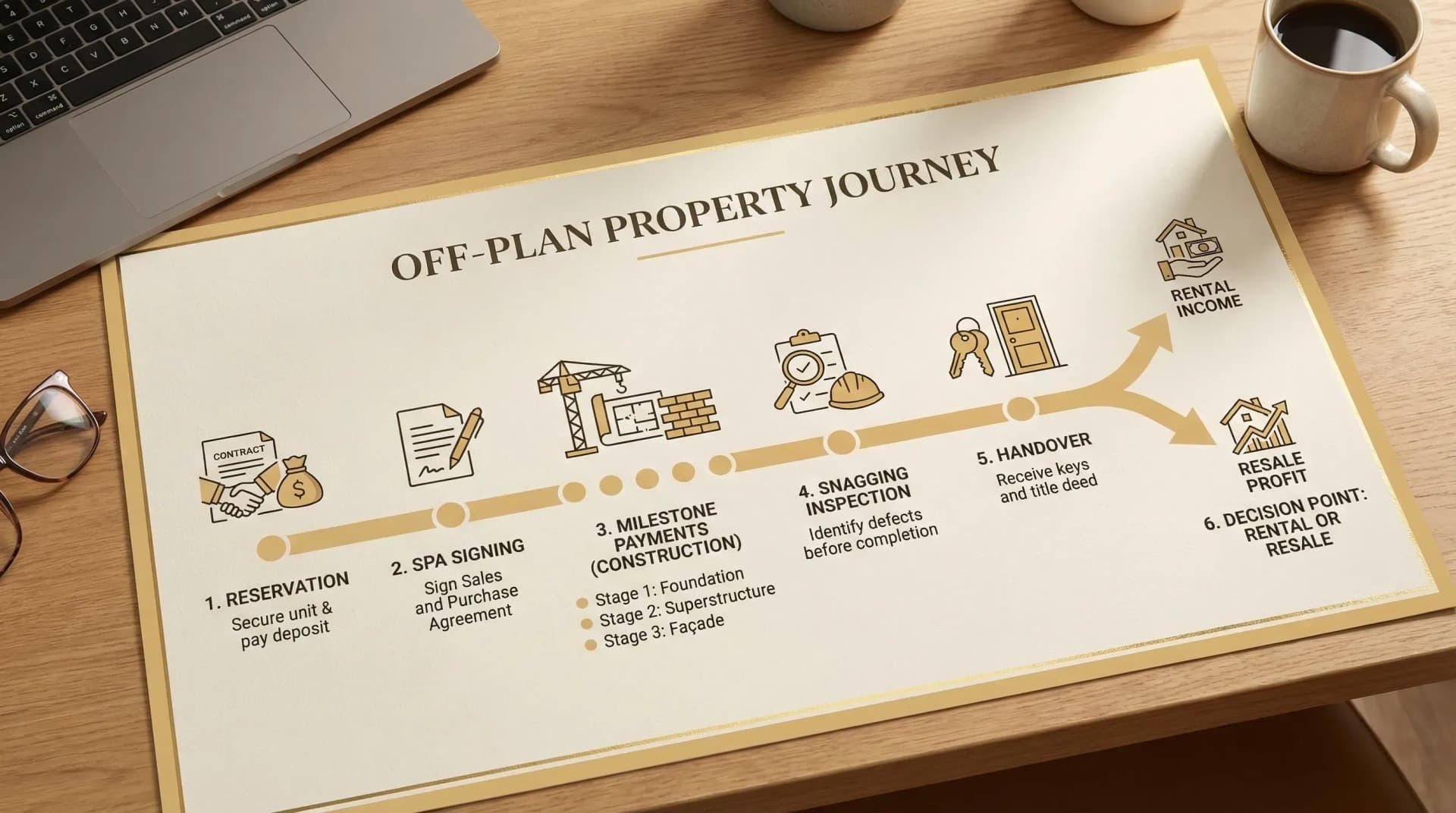
When a specialist advisor improves both risk and returns
Off plan investing is one of the few areas in real estate where access, verification, and execution quality can materially change outcomes.
Azimira’s positioning is aligned with the levers that matter most for investors:
- Curated off-plan projects rather than broad listings
- Expert market insight and reports to support underwriting
- Exclusive pre-launch access where early pricing and unit choice can improve return potential
- Tailored investment strategies based on your horizon, cashflow profile, and objectives
- Dedicated client support through the purchase and post-purchase journey
- Investment performance tracking to keep decisions data-led, not emotional
If you are comparing multiple opportunities across the UAE, or targeting high-growth markets such as Ras Al Khaimah, these services can reduce execution risk while improving your probability of capturing the upside that off plan investing can offer.
A practical “risk first, returns second” checklist you can reuse
Use this as a final filter before paying a reservation deposit:
- Can I explain, in one sentence, how this off plan investment makes money (and for whom) at handover?
- Have I verified where payments go, and what triggers each payment?
- Have I reviewed the SPA for delay remedies, spec change rights, and assignment rules?
- Does my model include total ownership costs and a conservative vacancy assumption?
- Do I have a funding plan that survives a delay scenario?
- Can I name two credible exit routes that fit my timeline?
If any answer is uncertain, slow down and validate. In off plan property, speed without verification is rarely an advantage, but disciplined speed can be.
Related articles
What Counts as Good Real Estate Investments in 2026
Learn what makes good real estate investments in 2026, from net yield and demand signals to legal checks, exit plans and UAE opportunities.

Investors Needed for Real Estate? Start With This Plan
Investors needed for real estate? Use this practical plan to define strategy, numbers, due diligence and partners before raising capital.

Investment Marketing Tactics Developers Use at Launch
Understand investment marketing tactics developers use at launch, from scarcity to incentives, and learn how to assess UAE off-plan deals.