
Dubai Real Estate Investment vs RAK: Which Wins on Value?
Dubai real estate investment vs Ras Al Khaimah: compare prices, yields, liquidity and risks to choose the best value strategy for 2026.
Most investors ask the Dubai question first: “Is a Dubai real estate investment still good value in 2026?” The better question is comparative: value compared to what?
Ras Al Khaimah (RAK) has moved from “interesting alternative” to a serious UAE contender, especially for off-plan buyers chasing a stronger price-to-upside relationship. Dubai remains the region’s most liquid, globally recognised property market, but liquidity and brand often come with a higher entry ticket.
This guide compares Dubai vs RAK through a value lens (not hype): entry pricing, rental economics, exit liquidity, risk profile, and who each market suits.
What “value” really means in UAE property (and why it differs by investor)
In real estate, “value” is rarely the cheapest square metre. For most buyers, value is the best combination of:
-
All-in cost (purchase price plus fees, furnishing, financing, holding costs)
-
Income strength (net yield after service charges, management and vacancy)
-
Upside (capital growth potential and catalysts)
-
Downside protection (liquidity, depth of tenant demand, regulatory safeguards)
-
Optionality (can you rent long-term, do short-term lets, resell quickly, or use the property yourself?)
Dubai and RAK can both be “good value” depending on which of these matters most to you.
Dubai vs RAK: value snapshot (2026)
| Value factor | Dubai | Ras Al Khaimah (RAK) |
|---|---|---|
| Market maturity | Highly mature, global buyer base | Emerging, growing international profile |
| Entry price | Typically higher, prime areas priced at a premium | Typically lower, especially in early-phase off-plan |
| Rental demand depth | Very deep across multiple tenant segments | Strong in key nodes (especially lifestyle and tourism-led areas), narrower overall |
| Liquidity (ease of resale) | Generally stronger, more transactional depth | Improving, but thinner resale market in many segments |
| Upside from new catalysts | More “priced in” in prime locations | More room for repricing as infrastructure and tourism mature |
| Off-plan incentives | Available, but competition and pricing can reduce “discount” | Often stronger early-buyer positioning, payment-plan flexibility |
| Best fit | Liquidity-first, stability-first, global-city exposure | Value-seekers, growth-oriented, early-cycle positioning |
Where Dubai wins on value
Dubai’s strongest “value” argument is not affordability. It is market depth.
1) Liquidity and exit options
Dubai is one of the most liquid real estate markets in the region, with large transaction volumes, broad international demand, and a mature brokerage ecosystem. If your strategy depends on the ability to sell quickly, refinance, or rotate capital, Dubai often offers a smoother exit.
Value takeaway: A more expensive asset can still be better value if it is easier to sell, easier to finance, and easier to keep occupied.
2) Diverse tenant and buyer demand (not one engine)
Dubai demand is spread across:
-
Long-term residential renters
-
Corporate lets
-
Short-term and holiday stays
-
End-users buying for lifestyle
-
Global investors buying for portfolio diversification
That diversity can reduce reliance on one driver (for example, a single resort corridor).
3) Wider choice of “risk grades”
Dubai lets you choose your risk level more precisely. You can buy:
-
Established communities with long operating histories
-
Branded residences with clear positioning
-
Off-plan projects, but also a deep ready market
That spectrum can be valuable if you want to dial risk up or down.
4) Financing ecosystem and buyer familiarity
In practice, Dubai tends to be easier for international buyers to research, underwrite, and finance because of the depth of market data, analyst coverage, and bank appetite.
If you are comparing off-plan vs ready strategies, keep your modelling disciplined. Azimira’s ROI guide is a useful reference for structuring “all-in” yield calculations (fees, vacancy, service charges, furnishing, currency effects): How to Project Your Real Estate ROI in the UAE.
Where RAK wins on value
RAK’s value proposition is simpler: you are often buying earlier in the cycle at a lower entry cost, with meaningful upside if catalysts deliver.
1) Lower entry price, better “option value”
When entry prices are lower, you gain flexibility:
-
You can diversify across multiple units instead of concentrating into one.
-
You can target higher-yielding segments without stretching your budget.
-
You have a larger buffer against market volatility because your breakeven is often lower.
This is one reason emerging markets can look compelling on a risk-adjusted basis, particularly in off-plan where payment schedules can spread capital deployment.
2) More asymmetric upside in select micro-markets
RAK’s upside tends to be micro-market specific (waterfront nodes, master-planned communities, tourism-led corridors). The gap between “good project” and “average project” can be wider than in Dubai, which is exactly why selection matters.
If you want a deeper RAK growth view, see Azimira’s forward-looking analysis: RAK Property Growth Forecast: What the Data Says for 2026.
3) Tourism and destination development as a demand driver
RAK’s investment narrative is closely tied to destination-building and tourism growth. Major resort and infrastructure projects can pull forward demand for:
-
Holiday rentals and serviced apartments
-
Lifestyle second homes
-
Branded and waterfront residences
The key is to underwrite conservatively. Tourism-led demand can be strong, but it is also more seasonal and more sensitive to supply additions.
4) Potentially lower transaction friction (fees)
Fees are part of value because they affect your true breakeven and minimum holding period.
Dubai’s property transfer fee is widely referenced as 4% of the property value via Dubai Land Department processes (plus admin fees). You can verify current fee guidance through official Dubai channels such as the Dubai Land Department.
RAK fee structures differ, and investors often see lower transfer-related costs. Azimira provides a detailed breakdown and examples here: RAK Property Registration: Fees, Process, and Timeline.
| Cost element (illustrative categories) | Dubai (typical structure) | RAK (typical structure) |
|---|---|---|
| Transfer/registration fee | Commonly referenced at 4% transfer fee (check current DLD guidance) | Often lower overall transfer-related fees (see Azimira’s RAK registration guide) |
| Service charges | Highly community-dependent, can be material in prime towers | Community-dependent, can also be material in waterfront projects |
| Furnishing (if needed) | Ranges widely, can be high in premium segments | Ranges widely, often attractive in serviced and lifestyle-led product |
Value takeaway: Even small fee differences compound when you model a 3 to 5-year hold.

The hidden value question: are you buying a market, or a specific micro-market?
Dubai is closer to a “market beta” investment. If you buy sensibly in a liquid area, you are often taking exposure to a broad ecosystem.
RAK is more “micro-market driven”. Your result depends heavily on:
-
Exact location and masterplan quality
-
Developer delivery track record
-
Supply pipeline near your project
-
Rental strategy fit (long-term vs short-term vs hybrid)
This makes due diligence non-negotiable. If you want a quick reality check on how scams and weak deals present in the UAE, keep this bookmarked: 4 Red Flags That Scream Property Scam in the UAE.
A practical framework: “value” by investor type
Different investors should expect different winners.
| Investor goal | What you should prioritise | Usually stronger fit |
|---|---|---|
| Liquidity-first | Resale depth, buyer pool, finance options | Dubai |
| Stability-first (lower volatility preference) | Mature communities, established leasing markets | Dubai (often) |
| Yield-first | Net yield after all costs, achievable occupancy | Often RAK in select segments, but deal-specific |
| Growth-first | Early-cycle repricing, catalysts, off-plan positioning | Often RAK in select nodes |
| Lifestyle plus returns | Liveability, weekend use, family utility | Both, depends on lifestyle preference |
| Portfolio diversification inside UAE | Non-correlated micro-markets, different demand engines | Split allocation (Dubai core + RAK growth sleeve) |
How to compare a Dubai real estate investment vs RAK without guessing
1) Compare net yield, not headline yield
Headline yields can be misleading if you ignore service charges, furnishing, management fees, and vacancy.
Use a consistent “net yield” approach across both markets. If you want a formula-driven refresher, Azimira’s ROI article walks through cost components and common modelling mistakes: UAE Tax-Efficient ROI Guide.
2) Underwrite your exit before you buy
Ask: “Who is my buyer in 3 to 7 years?”
-
In Dubai, the buyer pool is broad, but you still need a clear positioning (view, layout efficiency, building reputation, fees).
-
In RAK, the buyer pool can be more concentrated, so the project’s category matters (true waterfront, branded, serviced, or a community with proven end-user appeal).
If you want a structured approach to timing exits in RAK (and why holding periods matter when fees and maturity are considered), see: Exit Strategy Timeline: How Long to Hold RAK Property.
3) Treat off-plan selection like credit underwriting
Off-plan can amplify value in both Dubai and RAK, but only if the developer and project fundamentals are strong.
Key checks include escrow protections, documentation, and realistic delivery timelines. For a practical off-plan risk and reward overview, read: Beyond the Hype: A Practical Guide to Off-Plan Investing in the UAE.
4) Decide your “core vs growth” allocation
A common high-conviction approach is:
-
Core: Dubai for liquidity and stability
-
Growth sleeve: RAK for asymmetric upside and lower entry cost
This is not universal, but it matches how many global investors balance risk.
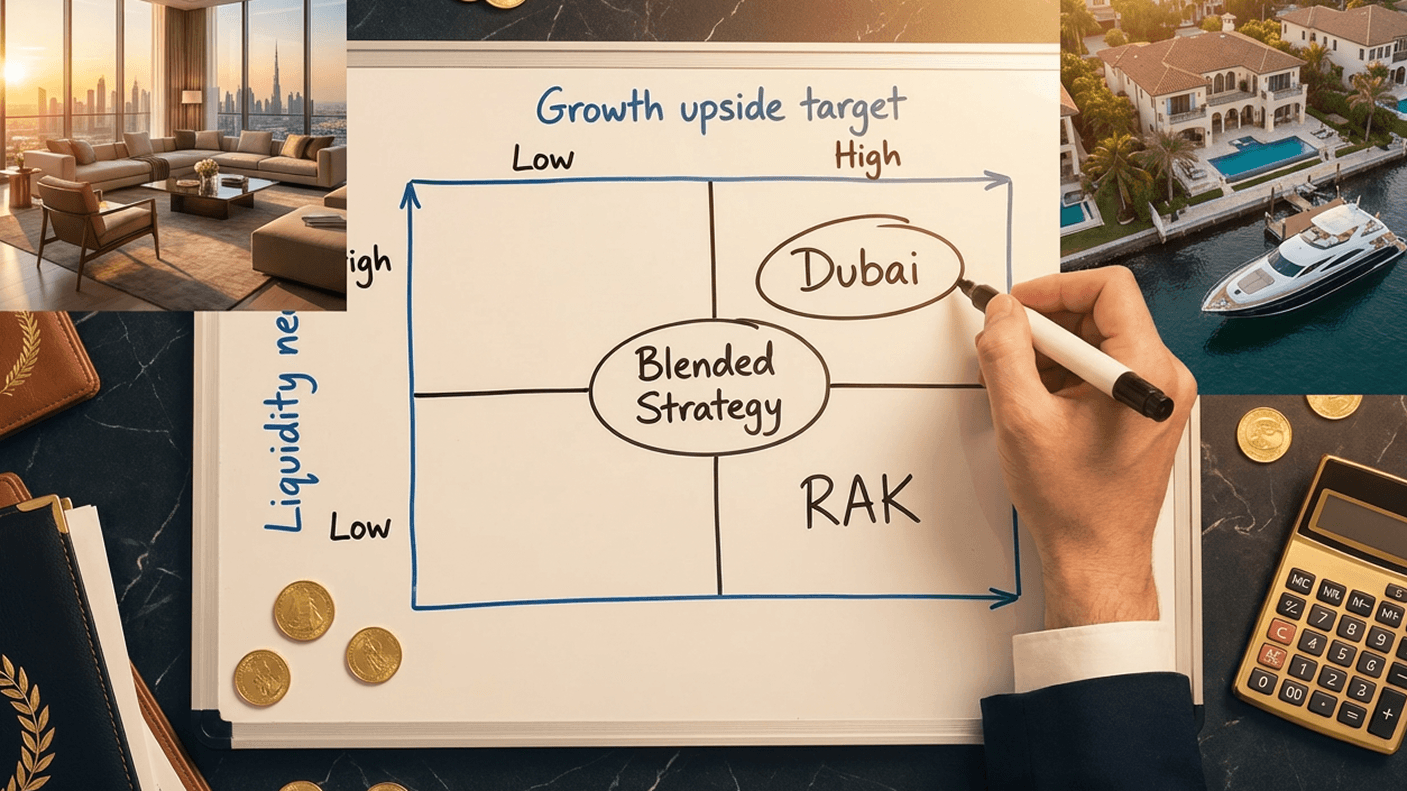
So, which wins on value?
If you define value as lowest price per square foot, RAK often looks stronger.
If you define value as the ability to enter and exit efficiently with less execution risk, Dubai often looks stronger.
In practice, the winner is determined by your constraints:
-
If you need liquidity, financing flexibility, and a deep tenant pool, Dubai is hard to beat.
-
If you are optimising for early-cycle upside and want more asset for your capital, RAK can win on value, especially in well-selected off-plan.
-
If you want the most resilient plan, a blended allocation can outperform a single-emirate bet, provided each purchase is underwritten properly.
Frequently Asked Questions
Is Dubai still a good place for property investment in 2026? Yes, Dubai remains one of the region’s most liquid markets with diverse demand drivers. Value depends on entry price, fees, and choosing a segment with durable rental and resale demand.
Is Ras Al Khaimah riskier than Dubai for property investors? Generally, yes, because it is a smaller, more emerging market with thinner resale depth. The risk can be managed through project selection, conservative underwriting, and a longer holding horizon.
Which market has better rental yields, Dubai or RAK? It depends on property type and location. In many cases, RAK can offer stronger yield potential relative to entry price, while Dubai often offers steadier occupancy and broader tenant depth.
Do transaction fees affect which market is better value? Yes. Transfer and registration fees, service charges, and management costs change your breakeven and minimum holding period. Always compare all-in costs, not just the purchase price.
Should I invest in Dubai or RAK if I want a UAE Golden Visa? Golden Visa rules and thresholds can change, so confirm current eligibility via official channels such as the UAE ICP. Investors often plan around the property value threshold and the type of property that qualifies.
Explore Dubai and RAK opportunities with Azimira
If you are weighing Dubai real estate investment vs RAK, the fastest way to get clarity is to map your target outcome (yield, growth, liquidity, lifestyle) to specific projects and payment plans.
Azimira specialises in curated off-plan opportunities in high-growth UAE markets (including Ras Al Khaimah), with expert market insight, exclusive pre-launch access, and tailored investment strategies.
Discuss your goals with the team at Azimira and request a shortlist aligned to your budget, timeline, and risk profile.
Related articles
What Counts as Good Real Estate Investments in 2026
Learn what makes good real estate investments in 2026, from net yield and demand signals to legal checks, exit plans and UAE opportunities.

Investors Needed for Real Estate? Start With This Plan
Investors needed for real estate? Use this practical plan to define strategy, numbers, due diligence and partners before raising capital.

Investment Marketing Tactics Developers Use at Launch
Understand investment marketing tactics developers use at launch, from scarcity to incentives, and learn how to assess UAE off-plan deals.