
UAE Investment Opportunities in 2026: Where Smart Money Is Going
UAE investment opportunities in 2026 explained: where smart money is going, top emirates and themes, plus a due diligence framework for property investors.
Capital is moving again in 2026, but it is doing so with far more discipline than in the “easy money” years. Across the UAE, sophisticated buyers and investors are prioritising clear demand drivers, credible delivery timelines, and exit liquidity rather than chasing headline yields.
For anyone researching UAE investment opportunities in 2026, the most useful question is not “Which emirate is hottest?” but “Which micro-markets have the strongest catalysts, the cleanest legal path, and a realistic plan for monetising returns?”
Why the UAE remains a magnet for global capital in 2026
The UAE continues to attract international investors for a blend of structural advantages:
- Investor-friendly tax profile (including no personal income tax and, generally, no personal capital gains tax, with investors still needing to consider their home-country tax rules).
- Currency stability via the AED peg to the USD, a meaningful factor for investors managing global portfolios.
- Pro-investment regulation and infrastructure build-out, including ongoing transport upgrades and large-scale tourism and mixed-use development.
- Residency pathways that can align with long-term investment planning (for example, the UAE Golden Visa route via property has been a major demand driver for some segments). For official reference, see the UAE Government portal’s overview of the Golden Visa.
From an underwriting perspective, these features do not guarantee profits, but they reduce friction (tax drag, currency uncertainty, administrative barriers) that can quietly erode returns in many other global markets.
What “smart money” is doing differently in 2026
In property markets, smart money usually looks boring on the surface. The difference is process.
1) Buying catalysts, not brochures
Investors are concentrating on areas where demand has a reason to arrive, such as:
- New tourism anchors and hospitality pipelines
- Transport connectivity improvements
- Matured community amenities (schools, marinas, retail)
- Constrained supply in premium waterfront and branded segments
2) Entering earlier, but only with stronger protections
Early-phase off-plan can be compelling when entry pricing, payment terms, and upside are asymmetric. In 2026, however, sophisticated investors are more likely to insist on:
- Verified developer track record
- Clear escrow and registration pathways
- Contract terms that match their risk tolerance
If you are weighing this route, Azimira’s guide to off-plan investing in the UAE is a useful baseline for risk management.
3) Matching asset type to the next buyer, not the current one
Liquidity is part of return. Investors are increasingly choosing unit types and communities that will be easiest to resell or refinance into, such as:
- Waterfront apartments with enduring view corridors
- Family-sized layouts in established communities
- Branded residences where the brand actually drives end-user demand
The 2026 opportunity themes that keep showing up
The headline opportunities in 2026 are less about a single emirate, and more about repeatable themes.
Early-phase off-plan in high-growth sub-markets (selectively)
Off-plan remains popular across the UAE because it can combine:
- Staged payment plans (capital efficiency)
- Potential appreciation between launch and handover
- Access to premium inventory before the broader market
The key word is selectively. The same mechanics that can boost returns can also amplify risk if a project is poorly structured.
If you are tracking launches, the most practical approach is to align entry timing with the development cycle. Azimira’s 2026 UAE property launch calendar is designed around that exact decision.
Branded residences and hospitality-linked living
Branded residences are not just a luxury trend. In many markets, they represent a distribution channel (hotel networks, global marketing) and a trust proxy (service standards, management, amenity ecosystems).
In 2026, investor interest tends to cluster where branding meets:
- Waterfront scarcity
- Strong tourism or business travel dynamics
- A buyer pool that values turnkey ownership and service
For a data-driven view of trade-offs (including ongoing costs), see Azimira’s analysis of branded residences vs standard properties in RAK.
Sustainability that improves real-world operating costs
Sustainability is shifting from marketing narrative to underwriting input. Investors are increasingly asking:
- Will this building cost less to run (cooling, insulation, efficient systems)?
- Will it remain compliant and desirable as standards tighten?
- Does sustainability translate into higher occupancy or resale demand?
This aligns with the UAE’s long-term policy direction, including the national Net Zero ambition (see the UAE’s Net Zero 2050 initiative).
Tourism-led rental demand, but with strategy (not assumptions)
Tourism strength can lift both rents and liquidity, but “tourism” alone is not a strategy. In 2026, smart money is separating:
- Prime short-stay assets (where ADR and occupancy justify higher operational complexity)
- High-quality long-lets (where cashflow stability and lower management intensity improve risk-adjusted return)
Azimira’s tools and research, such as the STR vs long-let ROI calculator, are built around modelling this properly, rather than relying on generic yield claims.
Infrastructure corridors and “time-to-connectivity” trades
Infrastructure-led investing is not new, but 2026 is placing more emphasis on timing. The trade is often:
- Buy before the connectivity becomes mainstream
- Hold through construction and sentiment change
- Exit when price convergence compresses the discount
If your thesis depends on connectivity, focus on specifics (station proximity, road access, last-mile commuting). For context, see Azimira’s analysis of the Etihad Rail impact on property investments.
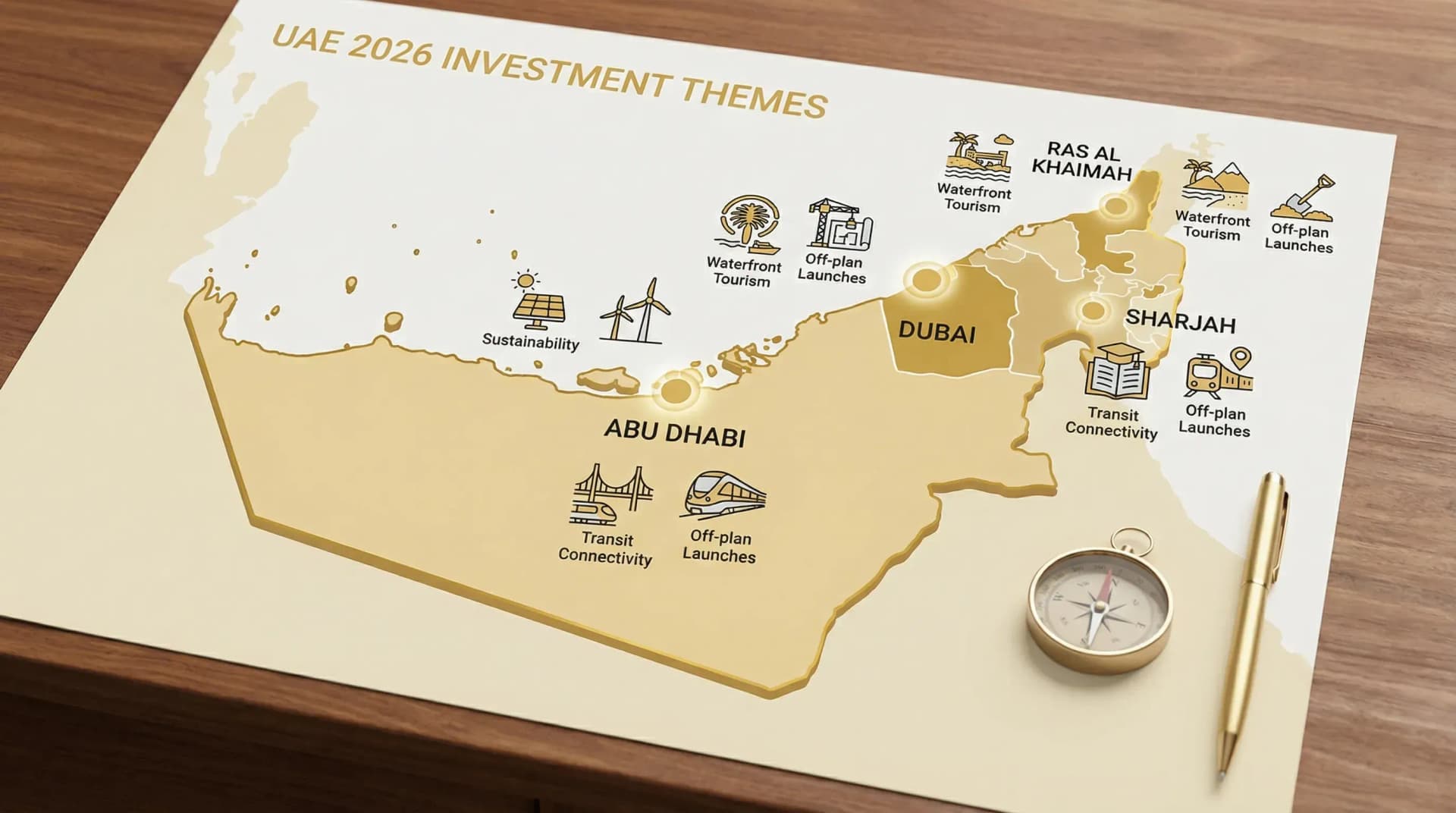
Where smart money is going by emirate (a practical view)
The UAE is not one market. Think of it as several distinct markets, each with different risk, liquidity, and demand drivers.
| Emirate | What investors are typically buying in 2026 | Why it appeals | The main risk to underwrite |
|---|---|---|---|
| Dubai | Prime and prime-adjacent assets, select off-plan launches, lifestyle communities | Depth of demand and global liquidity | Paying “perfect pricing” (thin margin for error) |
| Abu Dhabi | Stability-led residential, premium cultural and waterfront districts, longer holds | Institutional feel, strong end-user segments | Slower momentum trades (often a patience market) |
| Ras Al Khaimah | Early-phase waterfront, tourism-linked zones, emerging luxury | Growth runway and value positioning | Execution risk (choose developers and locations carefully) |
| Sharjah and Northern Emirates (select pockets) | End-user driven communities and affordability-led demand | Different demand base, often resilient occupancy | More limited resale liquidity in some segments |
This is exactly why many sophisticated investors build a blended UAE allocation rather than making a single-emirate bet.
Spotlight: Ras Al Khaimah’s “re-rating” story in 2026
Even within a UAE-wide opportunity set, Ras Al Khaimah keeps surfacing in investor conversations for one reason: it is still early enough for upside to be meaningful, while already large enough to attract global tourism and premium development.
Rather than repeating generic hype, a disciplined RAK thesis in 2026 usually rests on three pillars:
- Tourism expansion and destination positioning, particularly around major integrated resort and hospitality development.
- Infrastructure and masterplan execution, which can turn “future promise” into lived reality.
- Price-to-lifestyle value, which supports both owner-occupier demand and rental demand.
If you want a data-led baseline, Azimira publishes a dedicated RAK property growth forecast for 2026 and a broader market outlook.
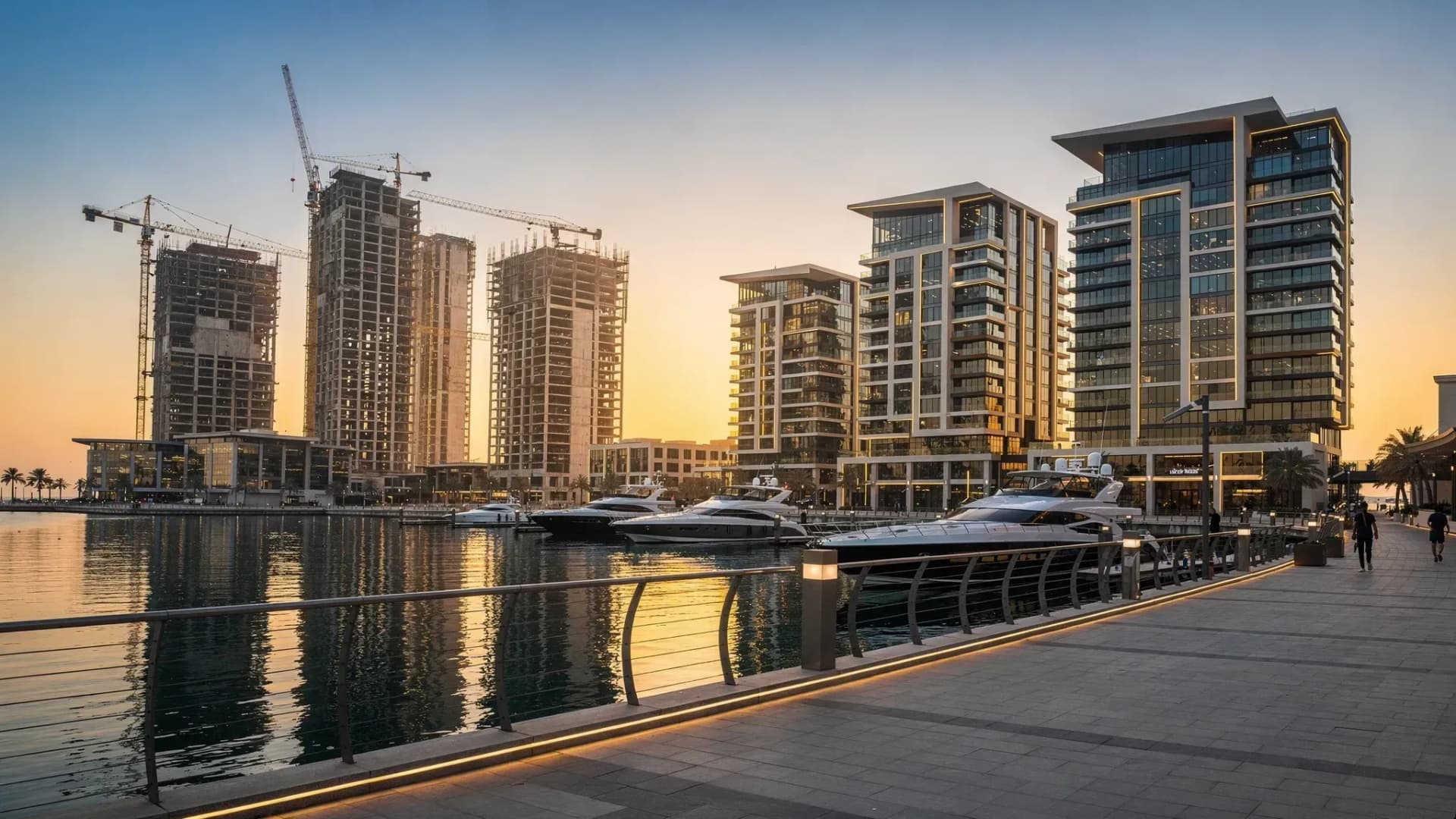
A 2026 due diligence framework you can apply to any opportunity
Most “bad deals” do not look bad on day one. They look bad in year two, when timelines slip, service charges surprise you, or your exit buyer pool is thinner than expected.
Use this framework to pressure-test opportunities across the UAE.
Demand: who is the real tenant or end buyer?
Ask what the area’s demand will look like without optimistic assumptions.
- Is the product built for tourists, residents, or a mixed audience?
- What is the likely lease duration and tenant profile?
- Are there nearby demand anchors (employment zones, resorts, schools, transport)?
Supply: what else is coming to market, and when?
Supply is not just “how many units”. It is timing, comparability, and absorption.
- Are future launches directly competing with your unit type?
- Will handovers cluster in a way that pressures rents?
- Is the project differentiated (views, waterfront access, brand, layout quality)?
Developer and legal protections: how is your downside capped?
For off-plan, protections and process matter.
- Confirm the legal framework and documentation pathway.
- Ensure payments are structured appropriately, and avoid informal payment requests.
Azimira’s investor safety content on recognising fraud patterns is worth reading before you wire any funds, for example: 4 red flags that scream property scam in the UAE.
Underwriting: model net returns, not marketing yields
A credible model includes more than rent.
- Registration and transaction fees
- Service charges and maintenance
- Insurance and property management (if applicable)
- Vacancy assumptions
- Financing costs (and rate reset risk)
If you want a clean starting point, see Azimira’s guide on projecting real estate ROI in the UAE.
Exit: define it before you buy
Your best exit depends on what you bought.
- Some units are best held through handover and stabilised rental.
- Others may support assignment-style exits (subject to developer rules and market conditions).
Azimira’s exit strategy timeline is a strong primer for aligning holding period with transaction friction.
So, where is smart money going in 2026?
If you need the practical summary: smart money in 2026 is going where fundamentals and structure align.
That typically means:
- Prime liquidity hubs (selectively, with price discipline)
- Emerging luxury markets with credible catalysts (with rigorous due diligence)
- Asset types that remain desirable across cycles (waterfront, well-managed communities, brand-backed product)
- Deals where payment structure and legal protections reduce downside
The “best” UAE investment opportunity in 2026 is the one that fits your objective (growth, income, residency planning, or a blend) and holds up under underwriting.
Frequently Asked Questions
What are the safest UAE investment opportunities in 2026? The safest opportunities are usually in established communities with proven rental demand, transparent legal processes, and strong resale liquidity. “Safe” still depends on pricing, costs, and your holding period.
Is off-plan property still a good idea in 2026? Off-plan can be attractive in 2026 when entry pricing, payment plans, and demand catalysts are compelling, but it requires stronger developer due diligence, clear escrow protections, and a realistic timeline.
Which emirate offers the best UAE investment opportunities in 2026? It depends on your strategy. Dubai often leads for liquidity, Abu Dhabi for stability, and Ras Al Khaimah for growth runway and value. Many investors diversify across emirates.
Do I need UAE residency to invest in UAE property? In many cases, no. Non-residents can buy property in designated areas, but residency can support banking, financing, and long-term planning. Always confirm eligibility and requirements for the specific emirate and project.
How do I compare UAE investment opportunities objectively? Use a consistent framework: demand drivers, supply pipeline, developer and legal protections, net return modelling (including costs), and a defined exit plan before you commit.
Explore curated UAE opportunities with specialist guidance
If you are researching UAE investment opportunities in 2026 and want a shortlist that matches your risk profile, timeline, and objectives, Azimira can help you filter noise from signal.
Explore Azimira’s approach to UAE property investing and Ras Al Khaimah specialism here: Azimira Real Estate Investment.
Related articles
What Counts as Good Real Estate Investments in 2026
Learn what makes good real estate investments in 2026, from net yield and demand signals to legal checks, exit plans and UAE opportunities.

Investors Needed for Real Estate? Start With This Plan
Investors needed for real estate? Use this practical plan to define strategy, numbers, due diligence and partners before raising capital.

Investment Marketing Tactics Developers Use at Launch
Understand investment marketing tactics developers use at launch, from scarcity to incentives, and learn how to assess UAE off-plan deals.