
UAE Property Investment Advantages: What Investors Actually Gain
UAE property investment advantages explained: tax efficiency, AED USD-peg stability, residency options, off-plan leverage, and the key risks to check.
Most articles about UAE property read like brochures. Investors, however, make decisions on what they can actually bank: after-tax returns, capital protection, cash-flow flexibility, legal clarity, and (in some cases) residency value.
Below is a practical breakdown of UAE property investment advantages, what they mean in real terms, and how to evaluate whether they fit your objectives.
The UAE property advantage, summarised
At a high level, the UAE tends to outperform many mature markets on capital efficiency (how much of your return you keep) and execution speed (how quickly you can deploy and manage capital), while still offering globally competitive lifestyle and infrastructure.
Here is a simple “what you gain” view.
| Advantage | What investors actually gain | Why it matters in your model |
|---|---|---|
| Tax efficiency (for many investor profiles) | More of your rental income and capital growth can remain untaxed locally | Can materially lift net yield, especially versus high-tax cities (always check home-country rules) |
| AED pegged to USD | Reduced FX volatility versus floating currencies (AED is pegged to USD) | Useful for wealth preservation, planning staged payments, and lowering currency shock risk |
| Off-plan access and staged payments | Ability to secure an asset with phased cash outlay, sometimes with developer payment plans | Improves capital deployment and can increase IRR if market rises during construction |
| Strong infrastructure and services | High-quality roads, airports, utilities, retail, healthcare, and tourism assets | Supports tenant demand, resale liquidity, and long-term value |
| Clearer investor protections vs “wild west” markets | Regulated brokers/developers, escrow rules for off-plan, defined registration | Lowers fraud and counterparty risk when due diligence is done properly |
| Residency optionality (where eligible) | Property can support long-term residency pathways such as the Golden Visa | Adds strategic value beyond pure financial return |
1) Tax efficiency: the advantage is not “no tax”, it is “more net return”
The UAE is widely known for no personal income tax and, in many cases, no personal capital gains tax. For property investors, the practical outcome is simple: your local tax drag can be low compared with jurisdictions that tax rental income, annual property ownership, and gains.
Two important nuances:
- Your home-country tax rules still matter. Many countries tax residents on worldwide income and gains, even if the UAE does not.
- Costs still exist, they are just structured differently (registration, service charges, agent fees, mortgage fees, management fees).
If you want the full context on how the UAE tax position interacts with typical property costs and VAT treatment, see Azimira’s guide on the UAE property tax-free advantage.
2) Lower friction can improve real-world ROI
Investors often underestimate how much “friction” eats returns: transfer taxes, annual levies, compliance costs, delays, and administrative complexity.
In the UAE, transaction and registration fees vary by emirate, and understanding the local schedule is part of underwriting.
For example, Ras Al Khaimah has a clearly documented registration cost structure. Azimira’s reference guide to the RAK Land Department fees and process details the 2.25% total registration-related charge (2% registration plus 0.25% admin).
This matters because lower friction:
- Reduces the “break-even holding period” (how long you must hold before sale makes sense).
- Increases flexibility to refinance, upgrade, or rebalance a portfolio.
3) The AED’s USD peg: an underrated capital preservation tool
For international investors, currency movement can make or break a good deal. The UAE dirham (AED) is pegged to the US dollar, which can reduce volatility compared with markets where the currency floats freely.
In practical terms, the peg can help with:
- Budget certainty for staged off-plan payments.
- Portfolio risk management, especially if you already hold USD-denominated assets.
- Wealth preservation planning for investors who prioritise stability.
Currency risk does not disappear (your home currency can still move versus USD/AED), but the peg can simplify the equation.
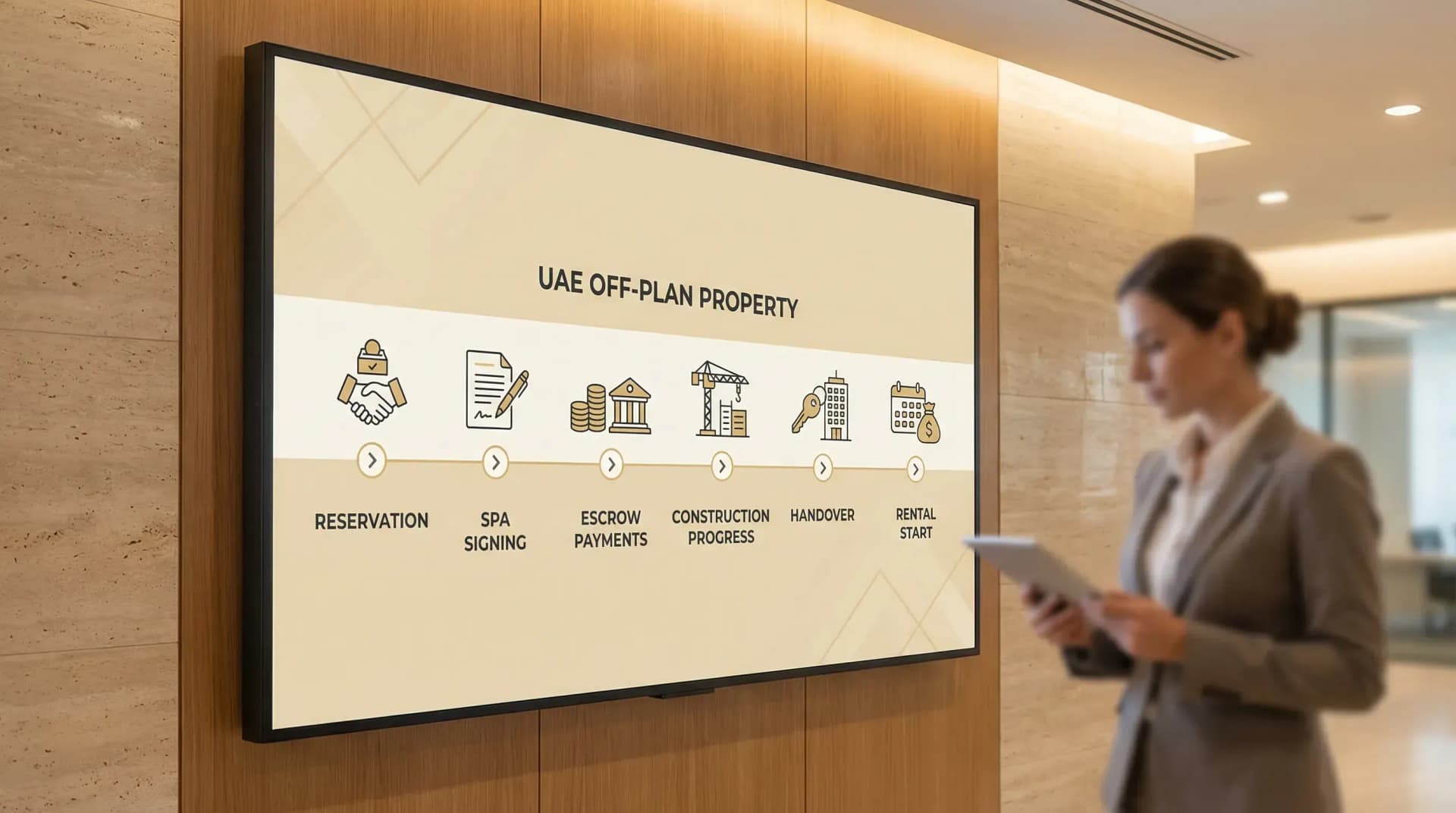
4) Off-plan investing: leverage without a traditional mortgage
One of the most distinctive UAE property investment advantages is how common and sophisticated the off-plan market is. In many countries, buying off-plan is niche or high-risk. In the UAE, it is a mainstream route, particularly in growth districts.
What investors often gain from off-plan:
- Earlier entry pricing (especially at pre-launch or early phases).
- Staged payment schedules that can align with your liquidity plan.
- Optionality: hold to handover for rental income, or exit earlier if assignment is permitted (subject to developer rules and market conditions).
Azimira has a practical, risk-aware resource on this topic: Beyond the Hype: A Practical Guide to Off-Plan Investing in the UAE.
5) Regulation and escrow: the advantage is protection, not perfection
The UAE’s regulated framework can meaningfully reduce certain risks, particularly when compared with less regulated markets. But the benefit only shows up if you use the system correctly.
In off-plan transactions, escrow mechanisms and registration processes are designed to protect buyers and increase transparency around developer obligations and progress payments. Still, investors should treat this as risk reduction, not a guarantee.
A good investor mindset is:
- Trust the framework.
- Verify the counterparty.
- Document everything.
If you want a deep dive into what to check, Azimira’s escrow account due diligence guide is a strong starting point.
6) Rental demand drivers: tourism, mobility, and “liveability”
A property’s performance is rarely just about the unit. It is about the ecosystem: transport, employment hubs, tourism, events, schools, healthcare, and the overall attractiveness of the location for tenants.
Across the UAE, investors typically benefit from:
- International connectivity (major airports and flight routes).
- A large expatriate tenant base in key employment centres.
- Tourism demand that can support short-stay strategies in appropriate communities (with the right licensing and management).
RAK in particular has been positioning itself as a high-growth tourism and lifestyle market, and Azimira’s research-led content often tracks those drivers (for example, the Q1 2026 investor sentiment report).
7) Residency optionality: when property is more than an investment
For some buyers, the UAE’s property advantage is strategic rather than purely financial. Long-term residency pathways (such as the Golden Visa, subject to eligibility rules) can add value through:
- Family planning and schooling options.
- Banking and operational convenience.
- Lifestyle flexibility and global mobility.
If residency is part of your thesis, it is worth separating two questions:
- Does the property meet the visa criteria?
- Does the property still stand up as an investment if the visa value changes?
Azimira maintains detailed Golden Visa resources, including what documents you need and the property-to-visa application steps.
Where the UAE advantage is strongest (match the emirate to your objective)
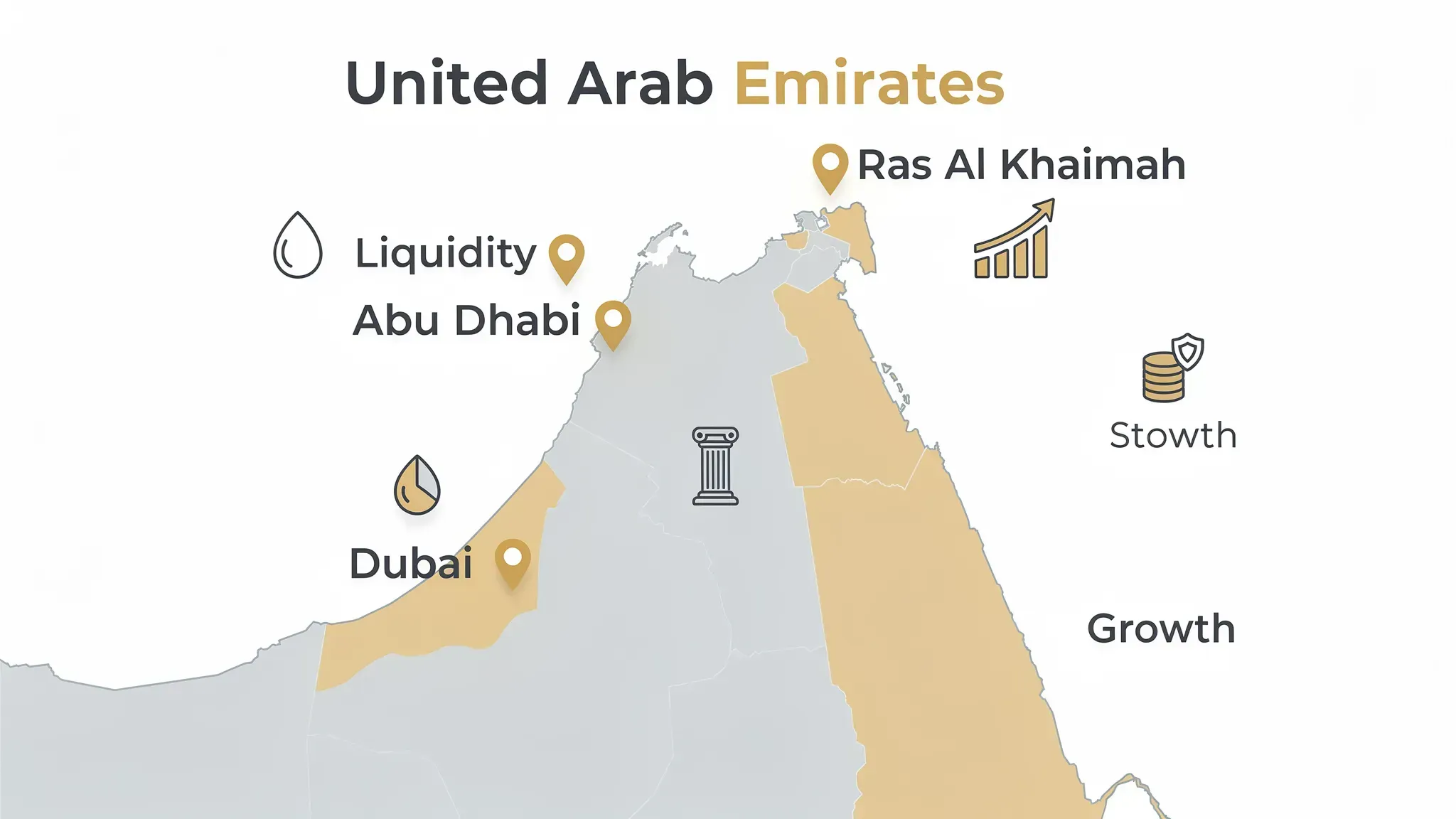
The UAE is not one market. Think of it as multiple markets with different risk-return profiles.
| Emirate / market type | Often suits investors who prioritise | Typical trade-offs |
|---|---|---|
| Dubai (global gateway) | Liquidity, mature infrastructure, broad tenant pools, premium branding | Higher entry pricing in prime areas, strong competition, underwriting must be precise |
| Abu Dhabi (institutional stability) | Long-term stability, government-linked demand drivers, measured development | Some submarkets can be less “fast-moving” for upside plays |
| Ras Al Khaimah (emerging growth) | Growth positioning, value entry points, off-plan upside, tourism-linked demand | As an emerging luxury market, it can have higher cycle sensitivity and varying liquidity by sub-area |
Azimira’s core focus is connecting investors with premium off-plan opportunities, especially in high-growth markets like Ras Al Khaimah, where early-phase access can be a meaningful edge.
A practical checklist: are the UAE property investment advantages real in your deal?
Before you commit, pressure-test the “advantage” claim with a deal-specific checklist:
- Net yield, not headline yield: Have you modelled service charges, vacancy, management, furnishing, and maintenance?
- Exit realism: What is your likely resale buyer profile (end-user, investor, offshore buyer) and how liquid is the micro-location?
- Developer and escrow verification (off-plan): Are payments routed correctly and are approvals in place?
- Payment plan fit: Does the schedule match your cashflow, including FX planning if you invest from abroad?
- Regulatory steps: Do you know the exact registration, NOC, and documentation requirements for the emirate?
- Home-country tax: Have you checked how rental income and capital gains are taxed where you are resident?
- Plan B: If your preferred rental strategy underperforms, what is the fallback tenant segment?
If your deal still looks strong after this, the UAE advantages are not marketing, they are structural.
Frequently Asked Questions
Are there really tax advantages for UAE property investors? Yes, the UAE is generally considered tax-friendly for many individual investors (for example, no personal income tax). However, your home-country rules may still tax rental income or gains.
Is off-plan property safer in the UAE than in other countries? The UAE has established off-plan regulations and escrow-related protections, but “safer” depends on developer quality, contract terms, and correct payment handling. Due diligence is still essential.
Does the AED peg remove currency risk? It reduces AED volatility versus USD, but you can still face FX risk between your home currency and USD/AED. Many investors manage this with staged conversions or hedging.
Which is better for investors, Dubai or Ras Al Khaimah? It depends on your objective. Dubai often offers liquidity and depth, while RAK can offer earlier-cycle growth opportunities and value entry points, with location and project selection being critical.
Can buying property help me get a UAE Golden Visa? Potentially, depending on the current eligibility thresholds and property status (ready vs off-plan) and documentation. Always confirm the latest requirements and get professional guidance.
Explore UAE opportunities with Azimira
If you want the UAE property investment advantages to show up in your numbers, project selection and structure matter as much as the headline location.
Azimira helps investors access curated off-plan projects, exclusive pre-launch opportunities, and tailored investment strategies, with particular depth in high-growth markets like Ras Al Khaimah. To discuss your goals and get matched to suitable opportunities, visit Azimira or start with the investment page at azimira.com/investment.
Related articles
What Counts as Good Real Estate Investments in 2026
Learn what makes good real estate investments in 2026, from net yield and demand signals to legal checks, exit plans and UAE opportunities.

Investors Needed for Real Estate? Start With This Plan
Investors needed for real estate? Use this practical plan to define strategy, numbers, due diligence and partners before raising capital.

Investment Marketing Tactics Developers Use at Launch
Understand investment marketing tactics developers use at launch, from scarcity to incentives, and learn how to assess UAE off-plan deals.